
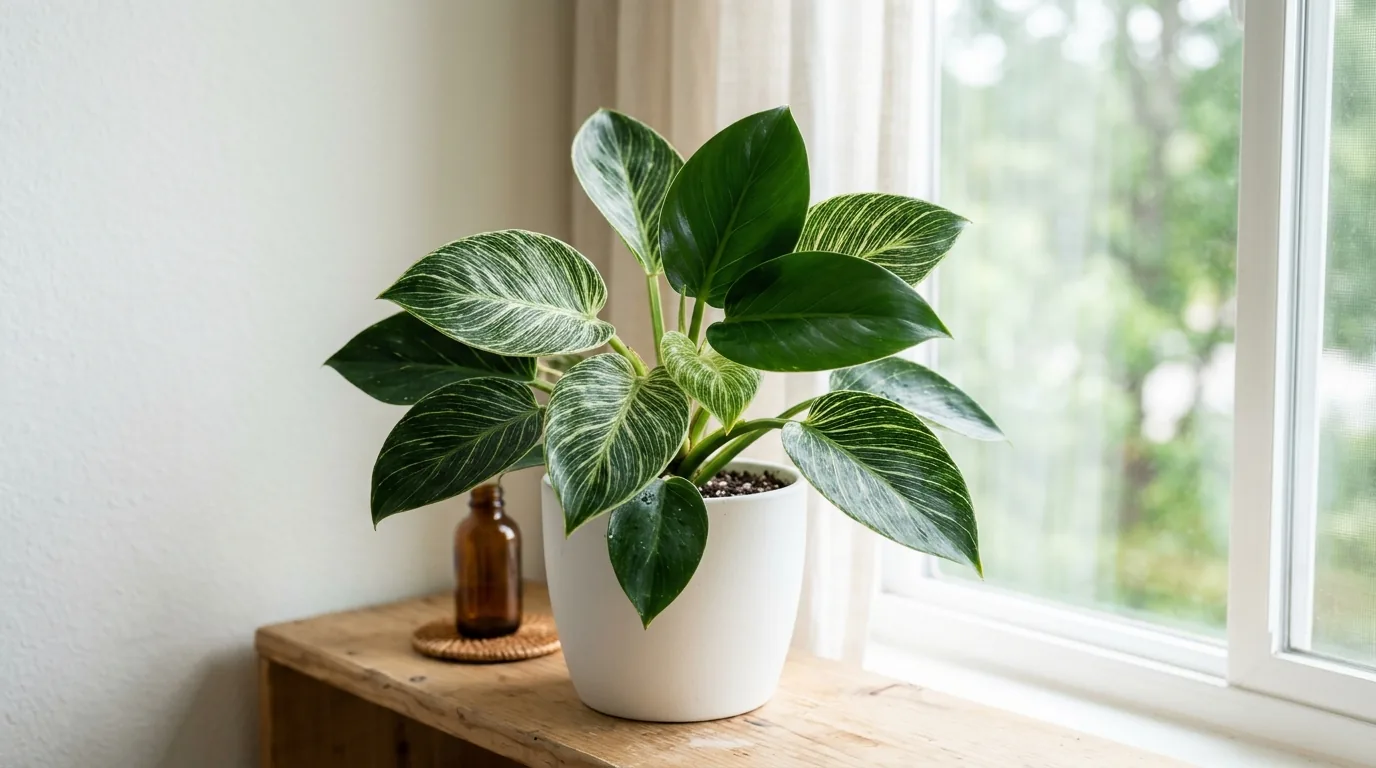
Philodendron Birkin reverting means new leaves come out solid green or dark maroon, without the white pinstripes. It happens because Birkin’s stripes come from a mutation in the growing tip that is not always stable. The Royal Horticultural Society explains that the mutations in variegated plants can revert to plain green shoots, and that those shoots are more vigorous and can eventually take over the plant. The fix is to cut reverted growth back to a part of the plant that still makes striped leaves, and to give the plant the bright, filtered light it needs.
| What you see | What it usually means | What to do |
|---|---|---|
| A whole stem now makes solid green or dark maroon leaves | Reversion: the striped mutation has been lost in that growing point | Cut back to just above the last well-striped leaf (RHS) |
| Stripes getting fewer and fainter on new leaves | Often too little light | Move to brighter, filtered light (NC State) and watch the next leaves |
| Young plant with few stripes | Pattern still developing | NC State says the pinstripes become more pronounced as the plant matures |
| Bleached, crispy or brown patches | Too much direct sun | Filter the light; NC State warns that too much sun scorches the leaves |
| Brown leaf tips | Low humidity | Raise humidity (NC State) |
Sources: Royal Horticultural Society; NC State Extension Plant Toolbox.
Why Philodendron Birkin Reverts
The Philodendron Birkin mutation is not a wild species. Birkin is most often described as a sport (a spontaneous mutation) of Philodendron ‘Rojo Congo’, though NC State Extension says its origin is unclear: it is believed to be either a rare mutation of ‘Rojo Congo’ or a hybrid of ‘Congo’ and ‘Imperial Green’. ‘Rojo Congo’ itself is a bred hybrid. Its US plant patent (PP14116) says it was selected in 1996 in Altha, Florida, from a cross between ‘Imperial Red’ and a selection of Philodendron tatei subsp. melanochlorum, and describes its newly unrolled leaves as brown-maroon-green. That is why a reverted Birkin often looks like a dark, solid-leaved Rojo Congo.
Why the stripes can disappear. A plant’s growing tip (the shoot apical meristem) is built from separate cell layers, called L1, L2 and L3 from the outside in. As Nabeshima and colleagues (2017, Frontiers in Plant Science) explain, when these layers have different genetic backgrounds the plant is called a periclinal chimera, and many variegated plants are built this way. The arrangement is only as stable as the layers it is made of: the same paper notes that the more vigorous cells can dominate and the chimeral structure disappears. In practice that is what reversion looks like: a growing point loses its mutated cells and starts making plain leaves.
What science can and cannot tell you here
No published study has mapped the exact cell layers of Philodendron Birkin, so nobody can say precisely which layer carries its stripes or predict when a given plant will revert. What is well established is the general pattern for variegated sports: they can revert, the reverted shoots tend to outgrow the variegated ones, and removing them is the standard fix (RHS).
Signs of Reversion (and What Is Normal)
Look at the newest leaves on each stem or growing point:
- Reversion: new leaves come out with no stripes at all, solid green or dark reddish-maroon, and the next leaves from that same point do the same. This is the “reverted philodendron Birkin” most people search for.
- Mixed leaves: a leaf with only a few stripes, or with stripes on one half, is common on chimeras. One odd leaf is not a reason to cut; a run of plain leaves from the same point is.
- Fading: stripes getting gradually thinner and fewer as new leaves come in. NC State says insufficient light can result in loss of variegation, so check the light first.
- Mostly white leaves: chimeras can also throw leaves with very little green. Those leaves have little green tissue to make food for the plant, so they tend to be weak. If a growing point produces only white leaves, cut it back the same way as a reverted one.
More light will not fix a reverted stem
Light helps a striped plant show its pattern, but it cannot put the mutation back into a growing point that has lost it. The RHS advice for reverted shoots is to prune them out completely or cut back into growth with variegated foliage.
How to Cut Back Reverted Growth
- Use clean, sharp pruners or a knife. Wear gloves: NC State notes the sap can irritate skin.
- Follow the reverted stem back to the last leaf that still has good striping.
- Cut just above that leaf’s node (where the leaf meets the stem), removing everything above it that has reverted. This follows the RHS advice to cut back into growth with variegated foliage.
- Wait for new growth. A bud on the striped section should start a new shoot. Judge the result by its first few leaves: if they are striped, the cut worked; if they are plain again, cut a little lower, into clearly striped growth.
- Remove reverted shoots early. The RHS warns that plain green shoots are more vigorous and can eventually take over the plant, so the sooner they go, the less of the plant you lose.
If the whole plant has reverted, there is no striped tissue left to cut back to. You can keep it as an attractive plain philodendron, or, if one side shoot still has stripes, root that piece separately and treat it as the new plant. A reverted cutting will grow on as a plain plant, which is a perfectly good houseplant in its own right.
Light, Water and Feeding
Good care will not stop a genetic reversion, but it keeps the plant growing well and the pattern at its best. NC State’s care notes for ‘Birkin’:
- Light: bright, filtered sunlight. Too much sun scorches the leaves, and too little can cost you variegation. An east window, or a spot set back from a bright south or west window with a sheer curtain, fits that description. A grow light helps in dark rooms; see our grow light guide.
- Soil and water: moist, well-drained soil. NC State warns that overwatering can cause root rot and yellowing leaves, and that leaf spots can occur if the leaves get wet during watering. Let the top of the mix dry a little between waterings and never let the pot sit in water. A chunky mix like our aroid soil mix drains well.
- Humidity: NC State links brown leaf tips to a lack of humidity.
- Feeding: a balanced houseplant fertilizer at the label rate during spring and summer is enough. Extra feeding will not bring back stripes on a reverted stem.
- Pests: NC State lists spider mites, mealybugs, aphids and scale insects. For mealybugs, see our guide to rubbing alcohol for mealybugs.
Keeping the Stripes Long Term
- Check new leaves every couple of weeks. Catching a reverted shoot when it has one or two leaves means a small cut instead of a big one.
- Keep the light bright and filtered all year. In winter, move the plant closer to the window or add a grow light.
- Propagate only from well-striped stems. A cutting can only carry the cell layers of the stem it came from, so a cutting from plain growth will grow plain.
- Accept some variation. Every Birkin leaf is a little different, and occasional leaves with more or less white are part of the plant’s character.
For the same reversion problem in other variegated plants, see our guides to variegated Monstera and Syngonium albo.
Is Philodendron Birkin Toxic to Pets?
Yes, mildly. NC State lists ‘Birkin’ as having low-severity poison characteristics: its toxic principle is calcium oxalate crystals, and if any part is eaten by people or pets it may cause pain and swelling of the mouth. The sap can also irritate skin. The ASPCA lists philodendron as toxic to dogs and cats for the same reason. Keep it out of reach, and see our cat-safe plants guide for alternatives.
Growing other philodendrons? See our guides to White Knight and Prince of Orange.
Frequently Asked Questions
Why is my Philodendron Birkin reverting?
Birkin’s stripes come from a mutation that is not always stable. The RHS explains that variegated mutations can revert to plain shoots, which are more vigorous and can take over the plant. Low light can also make stripes fade (NC State).
Can a reverted Philodendron Birkin turn back?
Not reliably. A growing point that has lost the mutation keeps making plain leaves. The RHS advice is to prune reverted shoots out or cut back into variegated growth, so new shoots come from striped tissue.
What do Philodendron Birkin reverted green leaves mean?
Solid green (or dark maroon) leaves with no stripes are the classic sign of reversion. Birkin is usually described as a sport of ‘Rojo Congo’, whose patent describes new leaves as brown-maroon-green, so a reverted Birkin often looks like a Rojo Congo.
Should I cut off reverted leaves?
Cut off the reverted shoot, not just single leaves. Cut back to just above the last well-striped leaf, because the RHS warns that reverted shoots can eventually take over the plant.
Is Philodendron Birkin a mutation of Rojo Congo?
It is usually described that way. NC State Extension says its origin is unclear: either a rare mutation of ‘Rojo Congo’ or a hybrid of ‘Congo’ and ‘Imperial Green’.
How much light does a Philodendron Birkin need?
Bright, filtered sunlight. NC State notes that too much sun scorches the leaves and insufficient light can result in loss of variegation.
Sources
- NC State Extension Plant Toolbox: Philodendron ‘Birkin’
- Royal Horticultural Society: Reversion
- US Plant Patent PP14116: Philodendron plant named ‘Rojo Congo’
- Nabeshima T. et al. (2017). Histogen layers contributing to adventitious bud formation are determined by their cell division activities. Frontiers in Plant Science 8.
- ASPCA: Split-leaf philodendron