
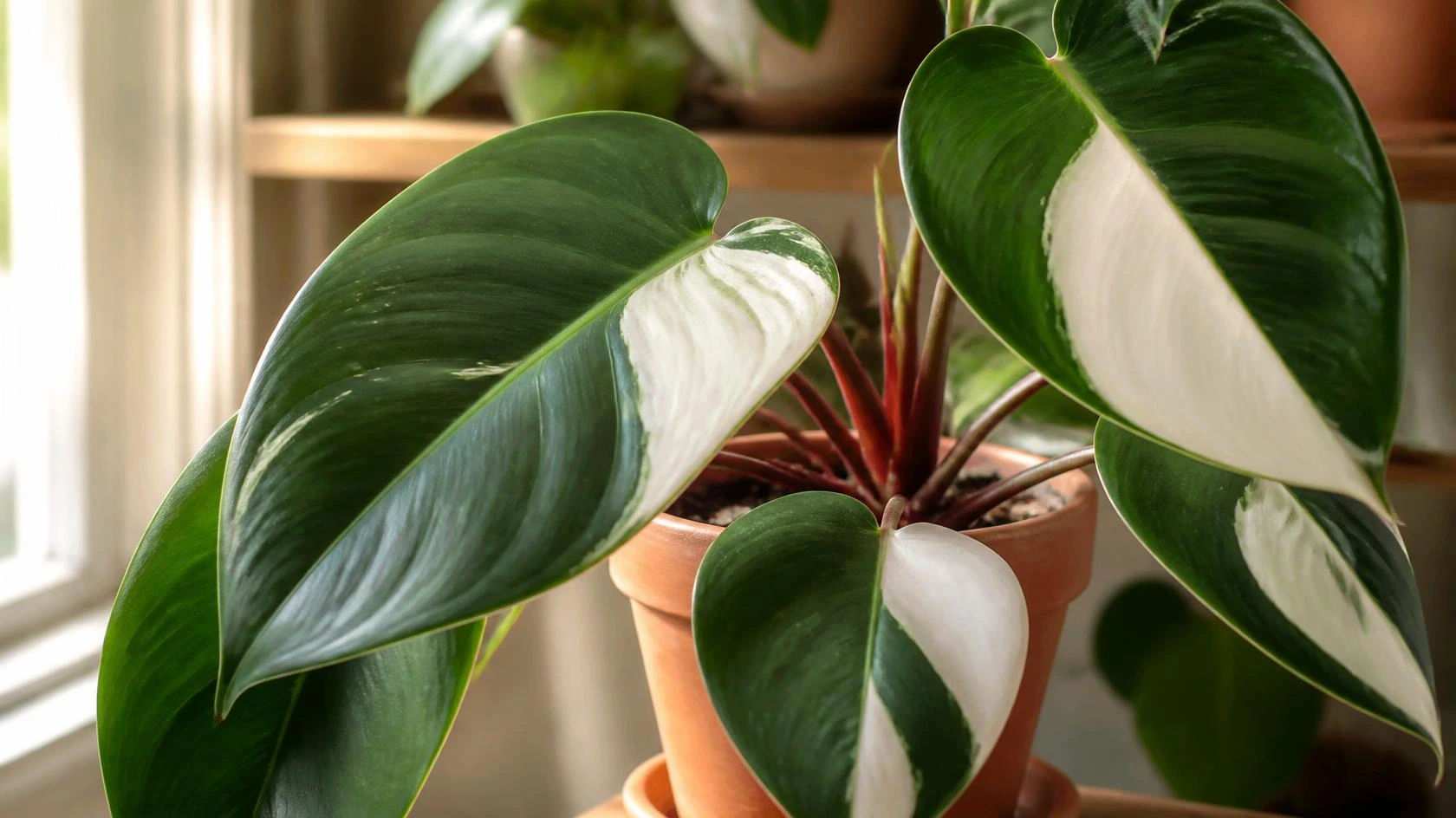
Philodendron ‘White Knight’ is a climbing philodendron with dark green leaves splashed with white, on dark red to burgundy stems. It is a variegated collector’s plant, so the two questions everyone asks are how to keep the white looking crisp and how to stop it from going all green. Philodendron White Knight care follows the same rules as other climbing philodendrons, with extra attention to light and to pruning out reverted growth. One honest note first: ‘White Knight’ is a trade cultivar, and none of the university extension services we use as sources publish a profile of it, so the care below is based on extension guidance for philodendrons in general and for its close relative Philodendron erubescens.
What Is Philodendron White Knight?
‘White Knight’ is a variegated, climbing philodendron sold for its white-splashed leaves and dark stems. It is usually grouped with Philodendron erubescens cultivars such as ‘Pink Princess’ and ‘White Princess’, though its exact parentage is not documented by the sources we rely on. NC State Extension describes P. erubescens as a climbing tropical perennial in the arum family, native to Colombia, that can climb 60 feet in its native rainforests.
The white patches have little or no chlorophyll, so they cannot make food; the green parts of each leaf support the whole plant. That is why light and reversion matter so much for any variegated philodendron.
White Knight vs White Wizard vs White Princess
These three white-variegated philodendrons are easy to mix up, and none of them has an official description from an extension service. NC State does list ‘White Princess’ as a P. erubescens cultivar with “green leaves splashed with white variegations”. Among growers and sellers, the usual rules of thumb are:
| Plant | Commonly described stem color | Variegation |
|---|---|---|
| ‘White Knight’ | Dark red to burgundy | White splashes and sectors on dark green |
| ‘White Wizard’ | Green | White splashes and sectors on green |
| ‘White Princess’ | Reddish to pinkish | White (sometimes with pink) on green |
Grower and seller descriptions, not an extension source. NC State documents ‘White Princess’ as a P. erubescens cultivar.
Because variegation is variable and young plants can look alike, the safest way to get a true ‘White Knight’ is to buy from a seller who labels and photographs the actual plant.
Light
The RHS says philodendrons thrive in bright, indirect light, and warns that direct summer sun can burn the leaves. NC State advises avoiding direct sunlight for P. erubescens. For a variegated plant, aim for the brighter end of indirect light: near an east window, or a little back from a south or west window behind a sheer curtain. In dim light, new leaves come out smaller and greener, and the plant is more likely to revert; in harsh sun, the white sections scorch first because they have no green pigment to protect them.
For reference, University of Florida production guidelines for commercial philodendrons (UF/IFAS EP150) note that most philodendrons tolerate interior light as low as 75 foot-candles, with 150 or more maintaining leaf color and size. A variegated cultivar needs considerably more than that minimum to keep its white; a grow light helps in dim rooms (see our grow light guide).
Soil and Potting
The RHS recommends a moisture-retentive but well-drained, peat-free potting compost for philodendrons, and NC State lists moist, well-drained soil rich in organic matter for P. erubescens. UF/IFAS EP150 notes that commercial growers use mixes of peat, pine bark and perlite or vermiculite. A good houseplant compost with some bark and perlite works well; our aroid soil mix guide covers the options. Always use a pot with drainage holes, and move up only one size when roots fill the pot.
Watering
The RHS says philodendrons prefer to be watered when the top few centimetres of compost have dried out, and warns that compost that stays saturated can rot the roots. NC State also notes that overwatering can cause root rot and recommends watering at the base of the plant without wetting the leaves. Water thoroughly, let the excess drain, empty the saucer, and wait until the top few centimetres are dry again. Expect to water less in winter.
Temperature and Humidity
The RHS says philodendrons dislike temperatures below 15 °C (59 °F). NC State gives 65 to 85 °F as the preferred range for P. erubescens and advises protecting it from cold drafts. NC State notes it prefers high humidity, while the RHS points out that many philodendrons do not need high humidity to thrive. In practice, normal room humidity is fine; in very dry heated air, a humidifier or grouping plants helps prevent crispy edges.
Fertilizer
Feed during spring and summer with a balanced or foliage houseplant fertilizer at the label rate, and stop in winter. UF/IFAS EP150 notes that commercial philodendrons are fed with a 3:1:2 or 3:1:3 N:P:K ratio, and advises not fertilizing indoor plants when soil salts are already high. Overfeeding shows up as brown tips and a white crust on the soil.
Moss Pole and Support
White Knight is a climber. The RHS notes that climbing philodendrons are often trained up a moss pole as houseplants, and a climbing plant given support generally produces larger leaves than one left to sprawl. Insert the pole when you repot, tie stems loosely to it, and guide aerial roots onto the moss. Keeping the pole slightly moist encourages the roots to grip.
Propagation
NC State recommends stem cuttings for P. erubescens. For a variegated plant, choose the cutting carefully:
- Pick a stem section with at least one node and a leaf showing good variegation; a cutting from a reverted, all-green stem will usually grow all green.
- Cut just below the node with clean shears, wearing gloves (the RHS warns the sap is a skin irritant).
- Root it in water or moist sphagnum moss in a warm, bright spot out of direct sun.
- Pot it into a well-drained mix once it has a few healthy roots.
Cuttings with more green leaf area tend to root more easily than heavily white ones, which have less ability to make food.
Why Is the White Turning Brown?
| Symptom | Likely cause | Fix |
|---|---|---|
| Tan or brown scorch on the white sections, on the side facing the window | Direct sun | Move back from the window or add a sheer curtain |
| Crispy brown edges across the leaf | Dry air, underwatering or fertilizer salts | Water more evenly; raise humidity; flush the pot |
| Yellowing leaves with wet compost, soft stem base | Overwatering, root rot | Let the top few centimetres dry; check roots |
| Spots on leaves, especially after wetting the foliage | Leaf spot diseases (NC State) | Water at the base; remove badly spotted leaves |
| A mostly white leaf that browns and dies | Too little green tissue to sustain itself | Remove it once it declines; good light supports better-balanced new leaves |
Sources: RHS; NC State Extension. Fixes are general practice.
White tissue is simply more fragile than green, so some browning on heavily white leaves is normal even with good care. Tissue that has turned brown will not recover; trim it neatly or remove the leaf.
How to Stop Reversion
Reversion is when a variegated plant starts producing plain green growth. The RHS explains on its reversion page that green shoots contain more chlorophyll than variegated ones, so they are more vigorous and can eventually take over the plant, and recommends pruning reverted shoots out completely or cutting back into growth with variegated foliage. For a White Knight:
- Watch each new leaf. One less-variegated leaf is not a crisis; a run of plain green leaves from the same stem is.
- Cut that stem back to just above the last leaf with good variegation, using clean shears.
- Keep the light bright and indirect, so the plant is not starved of energy.
- If new growth from that point is still green, cut back again to well-variegated growth.
For more on why variegated philodendrons revert, see our Philodendron Birkin reversion guide and our Pink Princess care guide.
Is White Knight Toxic to Pets?
Toxic to cats and dogs
The RHS says philodendrons are poisonous and the sap is a skin irritant, and advises keeping them out of reach of children and pets. The ASPCA lists philodendrons such as heartleaf philodendron as toxic to dogs, cats and horses because of insoluble calcium oxalates, with signs including oral irritation, pain and swelling of the mouth, tongue and lips, excessive drooling, vomiting and difficulty swallowing. NC State rates P. erubescens as low severity, with mouth and stomach irritation if eaten. If a pet chews it, call your vet or the ASPCA Animal Poison Control Center at (888) 426-4435.
Looking for something safe? See our cat-safe plants list.
Pests
NC State lists spider mites, mealybugs, aphids and scale for P. erubescens, and links banded greenhouse thrips as a common problem. Check the undersides of leaves and the leaf joints when you water. See our guides to spider mites, mealybugs and thrips. Test any spray on one leaf first; white tissue marks more easily than green.
Frequently Asked Questions
How much light does a Philodendron White Knight need?
Bright, indirect light. The RHS says philodendrons thrive in bright, indirect light and that direct summer sun can burn the leaves. Variegated plants like White Knight do best at the bright end of that range.
How do you stop a White Knight from reverting?
Give it bright indirect light and cut any stem that produces a run of plain green leaves back to the last well-variegated leaf. The RHS explains that green shoots are more vigorous and can take over if left.
Why are the white parts of my White Knight turning brown?
Usually direct sun scorching the white tissue, dry air, or uneven watering. White sections have no green pigment and are more fragile, so some browning on very white leaves is normal.
How often should I water a Philodendron White Knight?
When the top few centimetres of compost have dried out, as the RHS recommends for philodendrons. Never let the pot sit in water.
What is the difference between White Knight and White Wizard?
Growers usually tell them apart by stem color: White Knight is described with dark red to burgundy stems, White Wizard with green stems. No extension service publishes official descriptions of either cultivar.
Is Philodendron White Knight toxic to cats?
Yes. Philodendrons contain insoluble calcium oxalates, and the ASPCA lists philodendrons as toxic to cats, dogs and horses.