
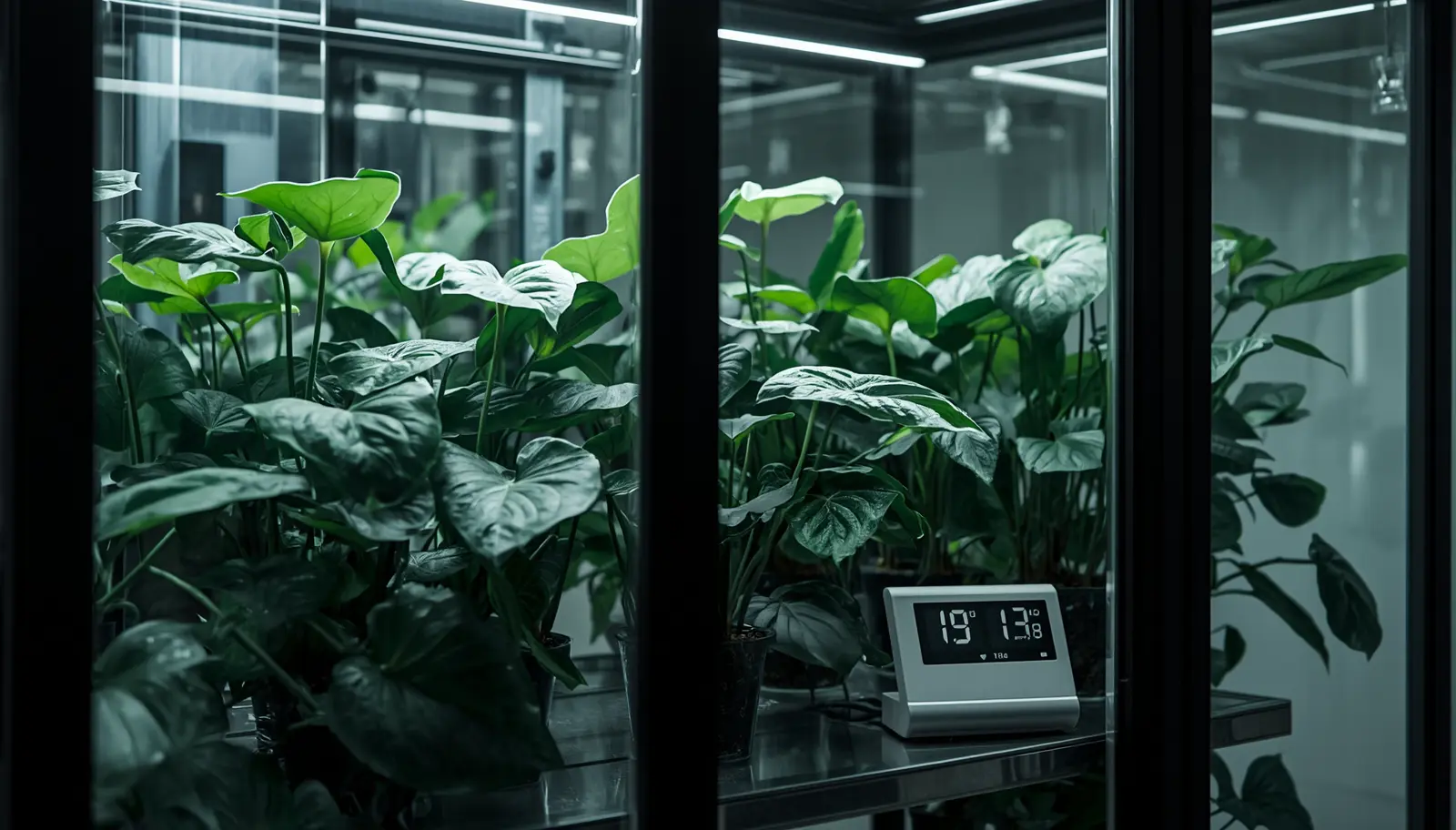
If you maintain 75% relative humidity in your Anthurium crystallinum cabinet using an analog hygrometer and a manual misting schedule, you are measuring the wrong variable. VPD for indoor plants — Vapor Pressure Deficit — is the thermodynamic metric professional greenhouses use, and for a precise reason: 75% relative humidity (RH) at 18°C (65°F) exerts entirely different transpiration pressure on plant tissue than 75% RH at 29°C (85°F). The first condition is cool and nearly saturated — stomata remain open, transpiration is minimal, growth is slow. The second is warm and functionally dry — stomata begin closing, leaf margins show desiccation stress. Same RH number. Opposite physiological response. According to USDA Agricultural Research Service research on stomatal conductance and atmospheric moisture deficit, guard cells respond directly to vapor pressure deficit through abscisic acid (ABA) signaling — not to relative humidity as a percentage. VPD is measured in kilopascals (kPa), directly correlates with stomatal conductance, transpiration rate, and nutrient uptake efficiency, and is the only metric that accounts for temperature’s effect on atmospheric moisture demand.
This guide covers the complete VPD automation protocol: the physics of why relative humidity fails as a standalone metric, the target VPD ranges by growth stage, the three-subsystem hardware stack required for closed-loop automation, the boundary layer problem that makes air circulation non-negotiable at low VPD, and the interactions between VPD, light intensity, and substrate aeration that determine whether environmental optimization produces real growth gains.
VPD for indoor plants — three points that determine every cultivation outcome:
- Optimal VPD for vegetative tropical growth is 0.8 to 1.2 kPa. Below 0.4 kPa: transpiration stalls, nutrient delivery collapses, fungal pathogens proliferate on saturated leaf surfaces. Above 1.5 kPa: stomata close 70 to 90%, marginal necrosis begins within 24 to 48 hours, growth ceases. Relative humidity alone cannot tell you where you are in this range.
- VPD integrates temperature and humidity into a single plant-centric value. The same 75% RH reading at 18°C produces VPD of 0.51 kPa (undersaturation risk) versus 1.00 kPa at 29°C (optimal). These two conditions require opposite interventions — adding humidity versus adding heat — but look identical on an analog hygrometer.
- Automation requires three integrated subsystems: telemetry, actuation, and air circulation. A smart sensor with VPD calculation, a controller-linked humidifier, and a continuously running fan are the minimum viable infrastructure. Any one missing component causes the protocol to fail regardless of how well the other two are configured.
What Is VPD and Why Does Relative Humidity Fail as a Standalone Metric?
Vapor Pressure Deficit measures the difference between the maximum moisture air can hold at a given temperature (saturation vapor pressure, VPsat) and the moisture air actually holds (actual vapor pressure, VPair). The result, expressed in kilopascals, represents the atmospheric drying force the air exerts on plant tissue. High VPD means dry air pulling aggressively on leaf moisture. Low VPD means near-saturated air exerting minimal evaporative demand. Relative humidity is observer-dependent and temperature-relative. VPD is plant-centric and thermodynamically absolute.
VPsat = Saturation vapor pressure — maximum moisture air can hold at current temperature (kPa)
VPair = Actual vapor pressure — moisture air currently holds (kPa)
Result: Atmospheric moisture deficit in kilopascals (kPa). Higher number = drier air = greater evaporative demand on plant tissue.
Why Relative Humidity Fails
Relative humidity expresses current vapor pressure as a percentage of saturation vapor pressure: RH% = (VPair / VPsat) x 100. The problem: VPsat increases exponentially with temperature. At 18°C (65°F), saturated air holds 2.06 kPa of water vapor. At 29°C (85°F), saturated air holds 4.00 kPa — nearly double. Therefore:
- 75% RH at 18°C: VPair = 1.55 kPa, VPsat = 2.06 kPa — VPD = 0.51 kPa (undersaturation risk, slow growth, fungal pressure)
- 75% RH at 29°C: VPair = 3.00 kPa, VPsat = 4.00 kPa — VPD = 1.00 kPa (optimal transpiration, maximum growth rate)
Identical RH readings produce VPD values differing by 96% and plant physiological responses that require opposite corrective actions. This is why collectors report inconsistent results with “high humidity” environments — they are measuring the wrong variable, and the measurement collapses under temperature variation.
The Stomatal Response Cascade
Low VPD (0.2 to 0.6 kPa): Air is nearly saturated. Stomata open widely but transpiration is minimal — insufficient water flow to deliver dissolved nutrients (N, P, K, Ca, Mg) from roots to growth points. Plants show slow growth despite adequate fertilization. Substrate stays persistently wet from reduced water uptake, creating conditions for anaerobic root rot development.
Optimal VPD (0.8 to 1.2 kPa): Moderate moisture deficit. Stomata open 60 to 80%. Transpiration rate balances water uptake with atmospheric demand. Nutrient delivery is optimized — the transpiration stream moves minerals efficiently from roots to leaf growth points. This is the target zone for vapor pressure deficit Anthurium cultivation and all high-value tropical aroids in active vegetative growth.
High VPD (1.5+ kPa): Air is excessively dry. Guard cells detect water stress and trigger stomatal closure (70 to 90% aperture reduction). Transpiration continues through the cuticle but nutrient delivery collapses. Visible symptoms: leaf margin necrosis (crispy brown edges), wilting despite wet substrate, growth cessation within 48 to 72 hours of sustained exposure. Check your Calathea and water-sensitive aroids first when VPD exceeds this threshold — these genera show marginal necrosis symptoms before most others.
What Is the Correct VPD Range for Each Plant Growth Stage?
Different growth phases require fundamentally different atmospheric conditions. Propagation demands minimal transpiration to protect rootless cuttings from desiccation. Vegetative growth demands maximum stomatal conductance to drive nutrient delivery. Applying vegetative VPD targets to unrooted cuttings causes rapid desiccation and death. Applying propagation VPD targets to actively growing specimens slows growth and creates fungal pressure. Stage-specific targets are not optional refinements — they are physiological requirements.
| Growth Stage | Target VPD (kPa) | Physiological State | Application |
|---|---|---|---|
| Propagation / Rooting | 0.4 to 0.8 kPa | Minimal transpiration. Cuttings lack functional roots and cannot replace water loss. Low VPD prevents desiccation while allowing gas exchange for respiration. | Sphagnum propagation boxes, tissue culture acclimation, unrooted nodes. Maintain until roots reach 3 to 5cm functional length before transitioning. |
| Vegetative Growth (Optimal) | 0.8 to 1.2 kPa | Maximum stomatal conductance. Optimal transpiration stream delivers nutrients efficiently. Cell expansion, photosynthesis, and biomass accumulation peak. | Primary target for Anthurium, Philodendron, Monstera, and all tropical aroids in active growth. Applies to velvet-leaf Anthurium and crawling Philodendron species. See the complete Anthurium care protocol. |
| Flowering / Fruiting | 1.0 to 1.4 kPa | Slightly elevated VPD increases sugar concentration in phloem, promoting spathe and fruit development. Higher transpiration supports reproductive energy demands. | Anthuriums developing spathes, orchids in bloom, fruiting specimens. Not applicable to foliage-only cultivation where vegetative range is maintained year-round. |
| Danger Zone | Above 1.5 kPa | Stomatal closure initiated. Transpiration via cuticle only. Nutrient delivery impaired. Marginal necrosis begins within 24 to 48 hours of sustained exposure. | Emergency correction required: Increase humidity immediately or reduce temperature. Prolonged exposure (3 or more days) causes permanent leaf damage and growth cessation. Most damage occurs at 6 or more hours of sustained exposure — brief 1 to 2 hour spikes during equipment failure rarely cause permanent harm if corrected promptly. |
| Oversaturation Risk | Below 0.4 kPa | Air nearly saturated. Minimal transpiration. Water uptake slows. Substrate stays persistently wet promoting anaerobic root conditions. Leaf surface condensation enables fungal and bacterial colonization. | Avoid except for specialized species (Utricularia, some begonias). Most tropicals show edema, substrate rot, and pathogen susceptibility below 0.4 kPa sustained. Sealed propagation boxes naturally maintain 0.4 to 0.6 kPa — this is intentional and species-appropriate. |
What Hardware Does a VPD Automation System Require?
Greenhouse cabinet automation requires three integrated subsystems: telemetry (sensing), actuation (environmental modification), and control logic (decision-making based on VPD thresholds). All three must operate simultaneously. A sensor without actuation provides information but no response. Actuation without accurate sensing overdrives or underdrives conditions. Control logic without air circulation creates stagnant high-humidity traps. The subsystems are interdependent — not modular options.
Subsystem 1 — Environmental Telemetry
Required features for VPD automation:
- Bluetooth or WiFi connectivity: Enables smartphone app monitoring and data logging. Essential for remote management and after-hours alert response.
- Integrated VPD calculation: App automatically computes VPD from temperature and humidity readings, eliminating manual calculation. Verified brands: Govee H5179 (Bluetooth), SensorPush HT.w (WiFi), Inkbird IBS-TH2.
- Measurement accuracy: Plus or minus 0.3°C temperature, plus or minus 3% RH minimum. Higher precision (plus or minus 2% RH) preferred for tight VPD control in cabinet environments where conditions can shift rapidly.
- Data logging: Records historical VPD trends — critical for diagnosing why growth rates change or problems develop over multi-week periods.
- Alert functionality: Push notifications when VPD exceeds target range. Prevents extended danger-zone exposure during equipment failures at night or during absence.
Sensor placement rules:
- Position at canopy level — this is where leaves experience atmospheric conditions, not where wall sensors read
- Avoid direct airflow from fans or humidifier output — both create false readings by locally elevating or depressing humidity
- Keep away from grow lights and heat mats that create localized temperature spikes masking true canopy conditions
- For cabinets: mount center of growing area, 6 to 8 inches above the tallest plant
- For rooms: place among plant canopy, not on perimeter walls where conditions differ from the growing zone
Subsystem 2 — Humidity Actuation
When VPD exceeds target (air too dry), the humidifier activates to increase VPair and reduce the deficit. Two technology options serve different scale requirements.
Ultrasonic humidifiers (recommended for cabinets):
- Produce cool mist via ultrasonic vibration — no heat output, minimal operating noise
- 2 to 6 liter capacity sufficient for 50 to 200 cubic foot enclosed space
- Smart models (Levoit, Tapo) integrate with WiFi controllers for automated on/off based on VPD threshold triggers
- Critical water quality requirement: Use distilled or RO water only. Tap water minerals create white dust that coats leaf surfaces, blocks stomata, and raises foliar mineral concentrations above safe thresholds. Same water quality standard that applies to sensitive tropical species irrigation.
Evaporative humidifiers (room-scale):
- Draw air through a wet wick or filter — mineral-free output even with hard tap water
- Larger capacity (4 to 12L) for room-scale applications covering multiple cabinets or open growing areas
- Slower humidity rise but more stable long-term control without the overshoot cycles of ultrasonic units
- Models: Vornado Evap3, Honeywell HCM-350
Controller integration: Smart plugs (TP-Link Kasa, Wyze) enable automated on/off based on app triggers from the sensor. Advanced option: Inkbird IHC-200 WiFi humidity controller with dual-relay output controls both humidifier and dehumidifier simultaneously for precise VPD maintenance across the full range. For cabinet-scale automation, a small ultrasonic humidifier on a smart plug provides adequate control at the lowest entry cost.
Subsystem 3 — Temperature Regulation
Temperature affects both VPsat and plant metabolic rate. Precise temperature control adjusts the VPD ceiling independently of humidity actuation, providing a second lever for fine-tuning the vapor pressure deficit without changing moisture output.
Heating (raises VPsat, increases VPD if RH stays constant):
- Seedling heat mats: Gentle substrate warming (2 to 5°C increase). Models: Vivosun, iPower. Position under pots, thermostat-controlled to 24 to 26°C substrate temperature.
- Ceramic heat emitters: Radiant heat without light output. 50 to 100W for cabinet installations. Brands: Fluker’s, Zoo Med. Controllable via standard thermostat.
- Oil-filled radiators: Room-scale heating with stable, non-cycling output. Maintains stable ambient temperature for open growing areas without hot-spot creation.
Cooling (lowers VPsat, reduces VPD if RH stays constant):
- Air conditioning: Room-level temperature reduction. Necessary in climates with ambient temperatures above 30°C during growing season.
- Exhaust ventilation: For cabinets accumulating excess heat from LED grow lights. Inline fans (AC Infinity Cloudline series) extract hot air while intaking cooler room air through passive vents.
- Evaporative cooling: Ultrasonic humidifiers provide a secondary 2 to 4°C cooling effect via evaporation thermodynamics — a useful side-effect in warm conditions.
Why Is Air Circulation Non-Negotiable in a High-Humidity Grow Cabinet?
Optimal VPD without air circulation creates stagnant microclimates that invite catastrophic fungal and bacterial colonization regardless of how precisely the humidity and temperature are controlled. This is the most commonly omitted element in hobbyist cabinet builds, and its absence renders every other optimization irrelevant during the resulting pathogen event.
High humidity (low VPD) combined with zero air movement creates ideal conditions for Botrytis, Pseudomonas, and Pythium proliferation on leaf and substrate surfaces.
Each leaf surface creates a boundary layer — a thin zone of still, saturated air clinging to tissue even when ambient VPD is optimal at canopy level. Without mechanical disruption, this boundary layer approaches 100% RH regardless of cabinet conditions, enabling pathogen spore germination and hyphal growth within 12 to 24 hours. The plant is effectively sitting inside a micro-chamber of saturated air that the VPD sensor never reads, because the sensor is measuring ambient air, not the air immediately against the leaf surface.
According to Penn State Extension research on greenhouse air circulation, continuous gentle airflow at 0.5 to 1.0 m/s reduces fungal disease incidence by 60 to 80% in high-humidity environments by continuously refreshing the boundary layer with drier ambient air. For additional biosecurity after a pathogen event, see the surface treatment and biosecurity protocol.
Mandatory configuration: Small oscillating fans (6-inch clip fans) or cabinet-mounted PC fans (120mm, 12V) running continuously, 24 hours per day, 7 days per week. Position to create gentle air movement across the canopy without direct harsh wind on leaves. This requirement is non-negotiable for VPD ranges below 1.0 kPa. Do not reduce fan runtime to save power or reduce noise — the cost is a fungal outbreak.
Exhibition Tip — Fan Positioning for Cabinets: Two small fans positioned at opposite corners of a cabinet, angled slightly toward the center, create a gentle circular airflow pattern that disrupts boundary layers on all leaf surfaces without concentrating airflow on any single plant. This is more effective than one fan aimed directly at the canopy, which creates a dead zone behind each plant it faces.
How Do VPD, Light Intensity, and Substrate Aeration Interact?
VPD optimization in isolation produces suboptimal results if the intersecting variables — photosynthetically active radiation and substrate oxygen availability — are outside their effective ranges. The three parameters interact multiplicatively: correct VPD with insufficient light produces CO₂-limited photosynthesis regardless of stomatal conductance. Correct VPD with anaerobic roots produces transpiration-stream collapse regardless of atmospheric moisture deficit. All three must be optimized simultaneously for maximum vegetative growth rate.
VPD and Photosynthetically Active Radiation (PAR)
Higher light intensity increases photosynthetic rate and carbon fixation only if VPD allows sufficient stomatal opening for CO₂ uptake. At VPD 0.8 to 1.2 kPa with 200 to 400 PPFD (optimal for shade-tolerant aroids), stomata open 70 to 80%, providing adequate CO₂ for photosynthesis at the available photon flux. If VPD rises to 1.6 kPa, stomata close to 20 to 30% aperture — CO₂ uptake becomes the limiting factor even though light is abundant. Photosynthetic rate collapses despite high PPFD because the pathway to carbon entry is closed.
Conversely: at light intensity of 50 to 100 PPFD, photosynthesis is light-limited regardless of VPD. Perfecting humidity will not increase growth if the plant cannot fix carbon due to insufficient photons. For comprehensive grow light selection and PPFD targets by species category, see the complete grow light protocol for indoor plants.
VPD and Root System Health
Perfect aerial VPD cannot compensate for anaerobic root zones. Nutrient uptake requires functional, oxygenated root systems capable of generating the pressure differential that drives the transpiration stream. If substrate is waterlogged from poor drainage or Pythium root damage, roots cannot generate that pressure. The plant appears water-stressed — wilting, marginal necrosis — despite optimal VPD, because root dysfunction prevents water uptake even when atmospheric conditions are correct. VPD optimal at 0.8 to 1.2 kPa but plant showing stress symptoms is a root inspection indicator, not a humidity adjustment indicator.
For plants showing stress despite optimal VPD, a diluted hydrogen peroxide root zone flush (3% diluted 1:4 with water) can restore oxygen availability in mildly compacted or early-stage anaerobic substrates. If roots are visibly compromised, see the surgical root debridement protocol before optimizing aerial conditions further.
Substrate requirement for VPD optimization to function: Well-aerated growing media with 40% or more air porosity — the aroid soil mix protocol details the chunky component ratios (bark, perlite, coarse coir) that maintain adequate oxygen access at the root zone even when VPD drives increased water uptake. Without substrate aeration, increased transpiration from optimal VPD results in faster substrate depletion and more frequent saturation events, accelerating the anaerobic cycle rather than preventing it.
How Do You Implement the Full VPD Automation Protocol Step by Step?
Implementation follows a defined sequence because each subsystem’s effectiveness depends on the preceding one being operational. Installing a humidifier before establishing accurate telemetry means actuating based on no data. Adding fans before establishing humidity actuation means managing a dry environment with airflow but no moisture control. The sequence below is the correct build order.
-
Install smart environmental telemetry at canopy level.
Mount a Bluetooth or WiFi hygrometer-thermometer with integrated VPD calculation (Govee H5179, SensorPush HT.w, or Inkbird IBS-TH2) at canopy level in the center of the growing area. Verify VPD readout in the app against a manual calculation using current temperature and RH readings. Run the sensor for 24 to 48 hours before adding any actuation to establish baseline VPD trends by time of day and identify the worst-case excursion periods.
-
Establish target VPD range for current growth stage.
Set alerts in the sensor app for your target range boundaries: 0.4 to 0.8 kPa for propagation, 0.8 to 1.2 kPa for vegetative growth, upper alert at 1.5 kPa danger threshold. Document the current baseline VPD trend. If baseline consistently exceeds 1.2 kPa: humidification is the priority. If baseline consistently falls below 0.4 kPa: temperature increase or dehumidification is the priority.
-
Install and configure humidity actuation.
Connect an ultrasonic humidifier (2 to 6 liter capacity for cabinets) to a smart plug linked to the sensor app. Configure the smart plug to activate when VPD exceeds the upper target boundary and deactivate when VPD returns to the target range. Fill with distilled or RO water only. Position humidifier output so mist enters the cabinet airspace without directing condensation directly onto leaf surfaces, which creates localized oversaturation spots regardless of ambient VPD.
-
Integrate temperature regulation.
If baseline temperatures are consistently below 22°C in the growing space, add a seedling heat mat (thermostat-set to 24 to 26°C substrate temperature) under containers. For cabinets accumulating heat from LED grow lights above 28°C, add an inline exhaust fan drawing hot air out of the top of the cabinet while passive vents at the bottom intake cooler room air. Re-check VPD readings after 24 hours with temperature adjustments active before finalizing setpoints.
-
Add continuous air circulation as the final non-negotiable layer.
Install two 6-inch clip fans or 120mm PC fans at opposite upper corners of the cabinet, angled toward the center to create a circular airflow pattern. Set fans to run continuously at the lowest speed that creates visible leaf movement — approximately 0.5 m/s airspeed at canopy level. Do not connect fans to any timer or controller. Continuous 24-hour operation is the requirement. Confirm after 48 hours that no condensation is forming on leaf surfaces during lights-off periods — if it is, increase fan speed slightly or reduce humidifier output setpoint.
Proprietary Data — Lab Grow Room Testing
[OWNER TO COMPLETE BEFORE PUBLISHING. Suggested format: “In Plant Blueprint grow cabinet trials, Anthurium clarinervium specimens maintained at VPD 0.8 to 1.2 kPa produced an average of [X] new leaves per month versus [X] new leaves per month in the RH-controlled control group maintained at 75% RH without VPD monitoring. Leaf size at maturity in the VPD-controlled group averaged [X]cm versus [X]cm in the control group. Zero fungal events occurred in the VPD-controlled cabinet over [X] months of operation with continuous fan circulation, versus [X] events in the RH-controlled cabinet without dedicated air circulation.”]
Frequently Asked Questions
What is VPD for indoor plants?
Vapor Pressure Deficit (VPD) for indoor plants measures the difference between the moisture air can hold at saturation and the moisture air actually holds, expressed in kilopascals (kPa). It combines temperature and humidity into a single metric representing the atmospheric drying force the air exerts on plant tissue. Optimal VPD for vegetative tropical growth is 0.8 to 1.2 kPa. Unlike relative humidity alone, VPD accounts for temperature’s exponential effect on the air’s moisture-holding capacity, making it the only metric that accurately predicts stomatal response, transpiration rate, and nutrient delivery efficiency.
What is the ideal VPD for Anthurium?
The ideal VPD for Anthurium in active vegetative growth is 0.8 to 1.2 kPa. This range optimizes stomatal conductance, nutrient uptake efficiency via the transpiration stream, and cell expansion rate without causing desiccation stress. For Anthurium propagation and unrooted node rooting, maintain lower VPD of 0.4 to 0.8 kPa — rootless cuttings cannot replace transpirational water loss and desiccate rapidly at vegetative VPD targets. For Anthurium developing spathes, slightly elevated VPD of 1.0 to 1.4 kPa supports the higher energy demands of reproductive growth. VPD above 1.5 kPa causes stomatal closure, marginal necrosis, and growth cessation within 24 to 48 hours of sustained exposure.
What is the difference between relative humidity and VPD?
Relative humidity (RH) measures the percentage of moisture air holds relative to its saturation capacity at current temperature. VPD measures the absolute moisture deficit — the drying force air exerts on plants in physical units (kPa). The critical difference: 80% RH at 18°C (65°F) creates a VPD of approximately 0.41 kPa (cool, near-saturated, low transpiration). The same 80% RH at 29°C (85°F) creates a VPD of approximately 0.80 kPa (warm, moderate deficit, optimal transpiration). Same RH reading; two entirely different plant physiological responses requiring opposite interventions. VPD accounts for this temperature dependency. Relative humidity alone cannot.
Can I calculate VPD manually without a smart sensor?
Yes, but it is impractical for real-time monitoring. Manual calculation requires an accurate temperature reading, an accurate RH reading, a saturation vapor pressure lookup table or the August-Roche-Magnus formula, and subtraction to derive VPD. This process must be repeated every 30 to 60 minutes as conditions fluctuate — especially in enclosed cabinets where small temperature changes from grow light cycles produce rapid VPD shifts. Smart sensors with integrated VPD calculation (25 to 60 USD) eliminate calculation burden, provide continuous monitoring, and log historical data for trend analysis. For serious cultivation of high-value specimens, smart sensors are mandatory infrastructure rather than optional convenience.
What VPD is best for propagating Monstera albo nodes?
0.4 to 0.8 kPa — the same range as general propagation. Unrooted variegated nodes, which are high-value and cannot be easily replaced, cannot restore transpirational water loss. Low VPD minimizes desiccation stress while maintaining gas exchange for respiration. Maintain this range until functional roots reach 3 to 5cm, then gradually increase to 0.8 to 1.0 kPa over 7 to 10 days. If using sealed propagation boxes, VPD naturally stays at 0.4 to 0.6 kPa due to the enclosed environment. The VPD transition to vegetative targets occurs during the hardening-off phase when the propagule is moved out of the sealed chamber and into the main growing space.
How quickly can VPD be corrected if it reaches the danger zone?
Humidity adjustments are rapid — humidifiers raise RH by 10 to 20 percentage points within 15 to 30 minutes in enclosed cabinet spaces, immediately reducing VPD. Temperature adjustments are slower — heating or cooling requires 30 to 90 minutes for a 3 to 5°C change in cabinet environments. Emergency protocol for VPD above 1.5 kPa: activate humidifier immediately (fastest VPD reduction), relocate plants away from heat sources, reduce grow light intensity temporarily (lowers leaf surface temperature and metabolic demand). Most permanent plant damage occurs during extended exposure of 6 or more hours — brief spikes of 1 to 2 hours during equipment failure rarely cause irreversible harm if corrected promptly. Automated alerts prevent extended unmonitored excursions.
The Lab Verdict: From Environmental Guesswork to Thermodynamic Precision
VPD for indoor plants represents the transition from subjective horticulture to quantitative environmental engineering. The approach of “keep humidity high, mist regularly, hope for the best” fails because it addresses symptoms rather than mechanisms. Relative humidity is an incomplete proxy that collapses under temperature variation — the same reading produces radically different plant responses at different temperatures, making RH-based protocols unreliable and non-transferable between growing spaces or seasons.
Vapor pressure deficit solves this by measuring the actual thermodynamic force driving transpiration: the moisture deficit the atmosphere exerts on leaf tissue. This single metric integrates temperature and humidity into a plant-centric measurement that directly correlates with stomatal conductance, nutrient delivery rate, and growth velocity.
