
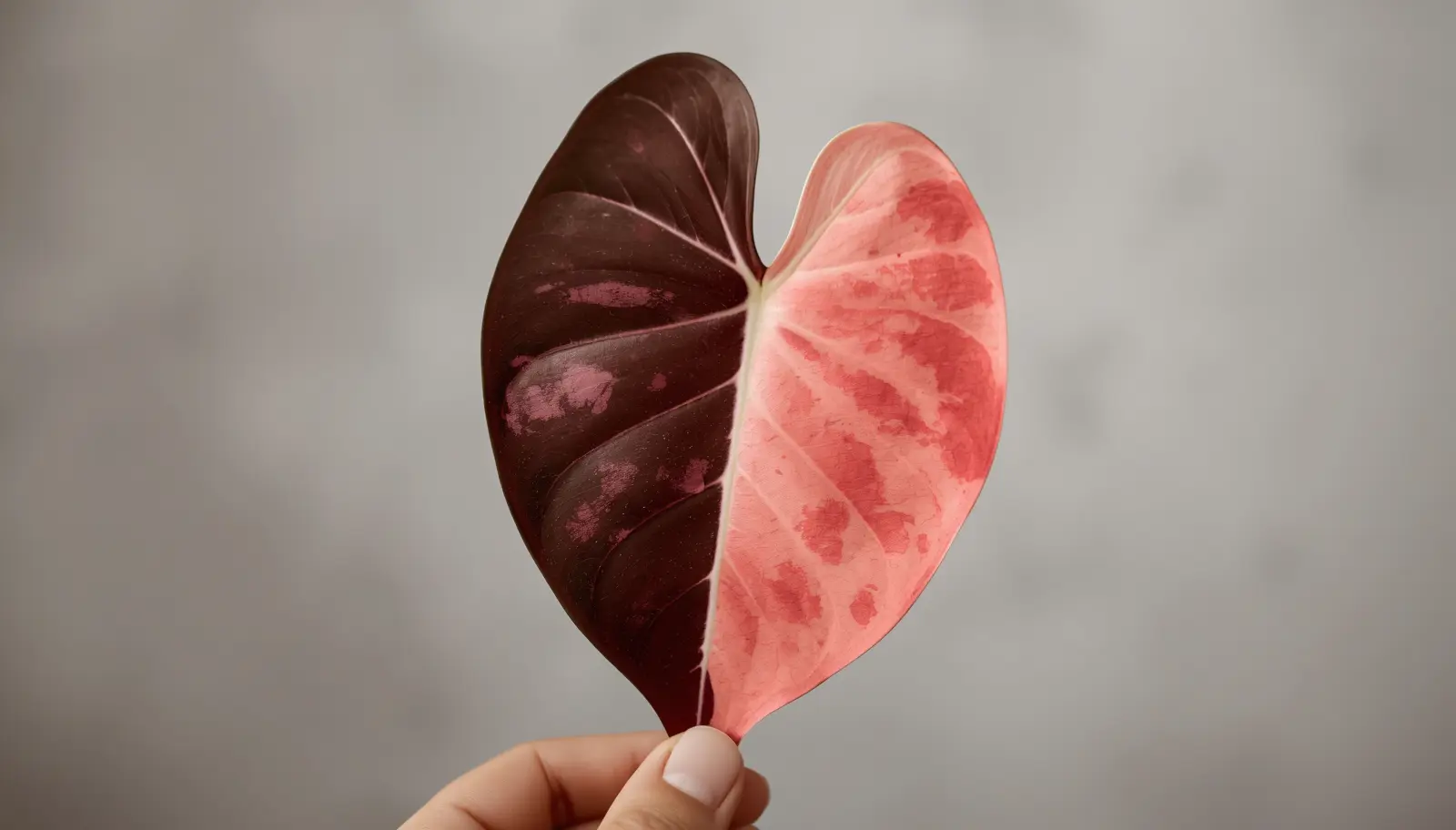
The Pink Princess philodendron (Philodendron erubescens ‘Pink Princess’) has dark purplish-green, heart-shaped leaves splashed with pink. It is a climbing philodendron, so it grows best with something to climb. Pink Princess philodendron care is mostly ordinary philodendron care: bright, indirect light, water when the top of the mix dries, warmth, and a well-drained mix. The variegation adds two extra jobs: keep the light good, and cut back stems that stop producing pink. This guide follows NC State Extension, the RHS and Clemson HGIC.
| Need | What the sources say |
|---|---|
| Light | Partial shade or dappled light, no direct sun (NC State); bright but indirect (RHS) |
| Water | Moist but not soggy; water at the base; overwatering causes root rot (NC State) |
| Soil | Moist, well-drained, rich in organic matter (NC State); loose, free-draining, pH about 5 to 6 (RHS) |
| Temperature | 65 to 85°F; protect from cold drafts (NC State) |
| Humidity | Prefers high humidity (NC State); philodendrons cope with normal home humidity (RHS) |
| Habit | Upright, vining; climbs a moss pole or trellis (NC State) |
| Size indoors | Species typically 3 ft tall, 16 in wide (NC State) |
| Pets | Toxic: calcium oxalate crystals (NC State) |
Sources: NC State Extension Plant Toolbox, Philodendron erubescens; RHS philodendron growing guide; Clemson HGIC Philodendron.
What Is a Pink Princess Philodendron?
NC State Extension lists ‘Pink Princess’ as a cultivar of Philodendron erubescens, the blushing philodendron, a climbing species native to Colombia. It describes ‘Pink Princess’ as having an upright, vining habit and heart-shaped, dark purplish-green leaves with pink variegation. Indoors, NC State says the species typically grows about 3 feet tall and 16 inches wide, and can climb a moss pole or trellis.
The pink sections are variegation, which, as the RHS explains, usually starts as a mutation or sport of a green plant and can be unstable. That is why every leaf is different and why some stems lose their pink over time.
Light
NC State lists partial shade and dappled sunlight for P. erubescens and says direct sunlight should be avoided. The RHS recommends bright but indirect light for philodendrons, out of summer sun, and notes that plants in low light become leggy and produce fewer, smaller leaves.
For a Pink Princess, bright, indirect light near an east window, or a few feet back from a south or west window, is a good target. Pink tissue has little chlorophyll and is easily scorched, so keep it out of direct midday sun. Good light helps the plant grow well, but it won’t create pink on a stem that has stopped producing it (see below). A grow light helps in dark rooms; see our grow light guide.
Watering and Soil
NC State says P. erubescens likes moist, well-drained soil rich in organic matter, warns that overwatering can cause root rot, and recommends watering at the base so the leaves stay dry, since the plant is susceptible to leaf spot diseases. The RHS advises waiting until the compost dries out before watering, using rainwater or filtered water in hard-water areas, and never leaving the pot standing in water.
Water when the top inch or two of the mix feels dry, let the excess drain, and empty the saucer. Expect to water less in winter.
For Pink Princess philodendron soil, the RHS suggests a loose, free-draining, slightly acidic mix (pH about 5 to 6), such as two parts orchid compost to one part peat-free ericaceous compost. Clemson HGIC notes that root rot usually comes from a mix that does not drain quickly. See our aroid soil mix guide for options.
Temperature and Humidity
NC State says P. erubescens prefers 65 to 85°F, warm temperatures and high humidity, and should be protected from cold drafts. The RHS gives a minimum of 15°C (59°F) for philodendrons and says to keep them away from radiators and cold draughts, adding that they are “perfectly happy” in the lower humidity of most homes. Clemson agrees that high humidity helps growth but is not essential.
In practice, normal room humidity works, and a humidifier helps in heated rooms in winter. See our guide to dry indoor air.
Moss Pole and Support
Because ‘Pink Princess’ is a vining plant (NC State), it grows upright with support. NC State says the species can climb a moss pole or trellis, and the RHS says climbing philodendrons benefit from a moss pole. Tie the stem loosely to the pole and guide aerial roots onto it. Many growers find leaves get larger once the plant is climbing, but expect that to take time on a slow-growing variegated plant.
Feeding and Repotting
The RHS suggests a general houseplant fertilizer from about April to September, and Clemson a diluted water-soluble or time-release houseplant fertilizer. Follow the label and stop feeding in winter. The RHS says philodendrons can stay in their pot for at least a couple of years, until the roots are densely packed, and should be repotted in spring into a pot only a few centimeters larger.
Turning Green or Too Pink
Turning green (reversion): if a stem produces several plain green leaves in a row, it has likely lost the variegation. The RHS says reverted shoots are more vigorous and can take over, and recommends pruning them out completely or cutting back into growth with variegated foliage. Follow the stem back to the last well-variegated leaf and cut just above its node. The stem itself is a useful guide: many growers check for pink streaks on the stem before choosing where to cut.
Too pink: leaves that are almost entirely pink have very little green tissue to make food, so they tend to be weak, often brown early, and don’t feed the plant. One all-pink leaf is not a problem. If a stem keeps producing mostly pink leaves, cutting it back to a section with a better balance of green and pink usually gives stronger growth.
For the same process on another variegated philodendron, see our Philodendron Birkin reversion guide.
Pink Princess Philodendron Propagation
NC State recommends stem cuttings for P. erubescens, and Clemson says philodendrons can also be air layered.
- Choose a section with good variegation, because a cutting carries the pattern of the stem it came from.
- Using clean, sharp tools, cut a piece about 10 cm (4 in) long with at least one node and a leaf (RHS). Wear gloves, because the sap can irritate skin (NC State, RHS).
- Root it in water for a couple of weeks, as the RHS describes, or in moist sphagnum moss; see our sphagnum moss propagation guide.
- Pot it into a free-draining mix once roots form, and judge the result by the first new leaves.
Spots, Stuck Leaves and Pests
| Symptom | Likely cause | Source |
|---|---|---|
| Yellow leaves, wet mix | Overwatering, root rot | NC State, RHS |
| Leaf spots | Leaf spot disease, worse when leaves stay wet | NC State |
| Crisp, bleached patches, especially on pink areas | Direct sun scorch | NC State, RHS |
| Leggy growth, small leaves | Low light | RHS |
| Webbing, stippling, cottony spots, bumps | Spider mites, mealybugs, aphids, scale, thrips | NC State |
Sources: NC State Extension; RHS.
Sticky spots: clear sticky droplets with no insects nearby are not necessarily pests, but sticky residue together with insects points to mealybugs, aphids or scale. Check with a hand lens before treating; for mealybugs, see our rubbing alcohol guide.
Stuck new leaves: a new leaf sometimes stays stuck in its papery sheath, especially in dry air. Pulling it tears the leaf. Mist the sheath to soften it and let the leaf work free on its own, and raise the humidity if it keeps happening.
Pink Princess vs Pink Congo
‘Pink Congo’ philodendrons were sold with solid pink leaves. Garden writer Jane Perrone reports that their pink color is chemically induced and temporary, and that the chemicals or process used have never been disclosed. A Pink Princess is a named cultivar with variegated, mostly dark leaves (NC State). If a plant is sold as solid pink and the seller can’t explain where its color comes from, don’t pay a premium for it.
Is the Pink Princess Philodendron Toxic to Cats?
Yes. NC State lists P. erubescens as toxic to cats, dogs and children: it contains calcium oxalate crystals that irritate the mouth and stomach if eaten, and the sap may irritate skin. The ASPCA lists philodendrons such as the split-leaf philodendron as toxic to dogs and cats for the same reason. Keep it out of reach and call your veterinarian or the ASPCA Animal Poison Control Center at (888) 426-4435 if a pet chews it. See our cat-safe plants list.
Growing other philodendrons? See our guides to White Knight.
Frequently Asked Questions
Why is my Pink Princess turning green?
Variegation can be unstable, and a stem can revert to plain green growth. The RHS recommends cutting reverted shoots back to growth with variegated foliage. Low light can also make a plant weaker and leggier.
How much light does a Pink Princess philodendron need?
Bright, indirect light. NC State says to avoid direct sunlight, and the RHS notes that low light gives leggy plants with fewer, smaller leaves.
How often should I water a Pink Princess philodendron?
When the top of the mix has dried. Water at the base and never leave it soggy, because overwatering causes root rot (NC State).
Does a Pink Princess need a moss pole?
It isn’t required, but NC State describes it as vining and says the species can climb a moss pole or trellis, which keeps it upright.
Is the Pink Princess philodendron toxic to cats?
Yes. It contains calcium oxalate crystals (NC State), like other philodendrons on the ASPCA’s toxic list.
What is the difference between Pink Princess and Pink Congo?
Pink Princess is a variegated cultivar of P. erubescens. ‘Pink Congo’ plants were sold with solid pink leaves whose color has been reported to be chemically induced and temporary.