
How to Care for Lucky Bamboo: Complete Guide (Water, Rocks, Indoors & Training)

🌿 THE LAB | HYDROPONIC CULTURE AND WATER CHEMISTRY

The gift looked perfect on the desk: an elegant spiral of green canes rising from a sleek glass vase filled with polished stones. Within three weeks, the water smelled like rotten eggs, the roots were slimy and black, and the lowest stalk had turned a sickly parchment yellow. This is the reality millions of lucky bamboo recipients face, because virtually every piece of retail advice they received was fundamentally, botanically wrong.

Learning how to care for lucky bamboo correctly requires discarding the mythologies propagated by big-box retailers and understanding the plant as what it truly is: Dracaena sanderiana, a semi-aquatic member of the Asparagaceae family with specific physiological requirements for water chemistry, root oxygenation, and substrate architecture. The protocols below replace folklore with measurable horticultural science.

Toxicity notice: According to ASPCA Animal Poison Control, lucky bamboo (Dracaena sanderiana) is toxic to cats and dogs. Keep all specimens inaccessible to pets.

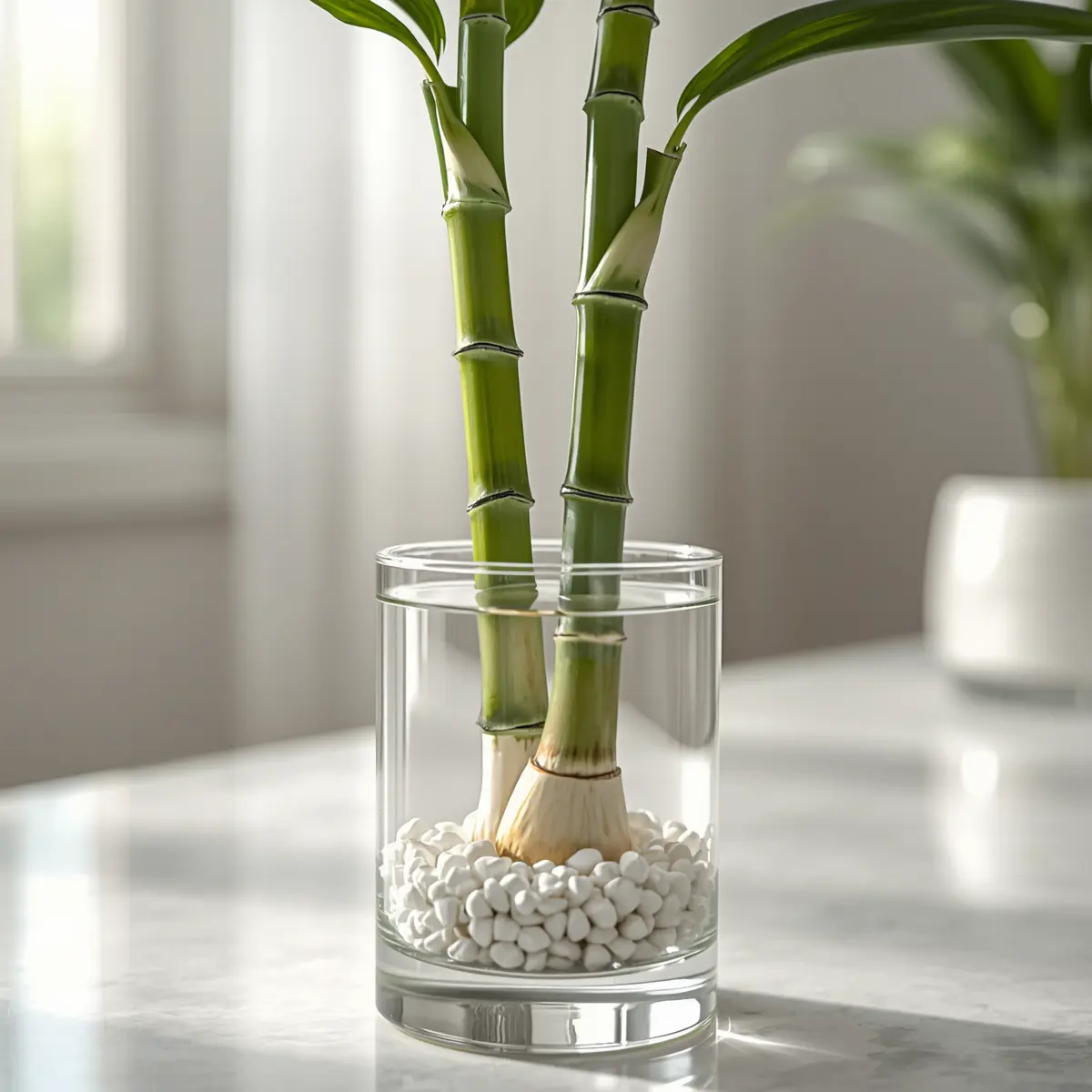
To keep a Dracaena sanderiana specimen healthy indefinitely in hydroponic vase culture, maintain water levels at only 1 to 2 inches above the root base, hydrate exclusively with chloramine-free water (RO, rainwater, or dechlorinated), and perform a complete water flush every 7 days to prevent anaerobic stagnation. Avoid the retail gravel glue trap and the high-water-level rot mechanism, both of which suffocate adventitious roots and accelerate bacterial vascular rot.

Quick Reference: How to Care for Lucky Bamboo at a Glance

Lucky bamboo needs bright indirect light, 1-2 inches of chloramine-free water changed weekly, temperatures of 65-90F, and zero direct sun. Most failures trace back to two simultaneous errors: municipal tap water chemistry containing fluoride and chloramine, and excessive water depth that causes anaerobic root rot. Correct these two variables and most specimens stabilize within 14 days.

Before attempting any diagnosis, verify that your cultivation parameters fall within the species’ tolerance window. Dracaena sanderiana is forgiving but not indefinite in its range. Chronic deviation in any single parameter produces cascading failure within 10 to 21 days.

Cultivation Parameter Target Operational Baseline Pathological Threshold / Warning Sign Light Bright, indirect light for 6-8 hours daily. Tolerates low fluorescent office light (8-10 hours) but growth stalls. Bleached, chlorotic leaves indicate direct sun scorch. Leggy, pale internodes indicate insufficient photon flux. Water Chemistry pH 6.0-6.5. Total dissolved solids below 50 ppm. Zero chloramine, zero fluoride. Marginal leaf scorch (brown tips), yellowing basal stalk, and white mineral crust on vase interior. Water Volume 1-2 inches above the uppermost root boundary only. Never submerge the cane itself. Stalk yellowing from bottom upward; slimy black roots; adventitious red roots climbing the submerged cane. Water Refresh Cycle Complete replacement every 7 days. Vase scrubbed monthly to remove biofilm. Sulfurous rotten egg odor (hydrogen sulfide from anaerobic bacteria); cloudy water; root browning. Temperature 65-90F (18-32C). Highly sensitive to cold drafts and temperatures below 55F. Rapid stalk desiccation and leaf abscission below 50F. Root metabolic shutdown below 60F. Fertilizer 1 drop of balanced liquid fertilizer per 8 oz water, every 4-6 weeks during active growth only. Algal blooms from over-fertilization; salt crust on roots; burned leaf margins from nitrogen excess.
Key Takeaway: Lucky bamboo failure in home and office environments almost always traces back to two simultaneous errors: municipal tap water chemistry and excessive water depth. Correct these two variables alone and most specimens will stabilize within 14 days.

Is Lucky Bamboo Actually Bamboo?

No. Lucky bamboo (Dracaena sanderiana) shares no botanical relationship with true bamboo. It is a monocotyledonous flowering plant from the Asparagaceae family, native to Central African tropical rainforest understories. True bamboo and D. sanderiana have nearly opposite environmental requirements, which is why misidentification causes most care failures.

Dracaena sanderiana shares no botanical relationship with true bamboos of the Poaceae grass family. As documented by NC State Extension’s Dracaena sanderiana profile, the species is classified within Asparagaceae and is closely related to corn plants and snake plants, not grasses of any kind. It is a monocotyledonous flowering plant native to Central African tropical rainforests, growing as an understory perennial along stream banks and in seasonally flooded forest margins.

This taxonomic distinction matters because it defines every environmental requirement. Unlike true bamboo, which demands high light, aggressive drainage, and soil-based culture, D. sanderiana evolved for dim, humid forest understories with its root system partially submerged in slow-moving, highly oxygenated freshwater. Its canes are not woody culms but semi-succulent stems capable of storing water and carbohydrates during dry intervals.

Why the “Bamboo” Name Creates Fatal Care Errors

Retail customers instinctively apply true bamboo care logic to D. sanderiana: full sun exposure, heavy soil mixes, minimal water. Each assumption produces the opposite of the desired outcome. The species requires indirect light, water-based or extremely light substrate culture, and consistent moisture with high oxygen content.

How Do You Care for Lucky Bamboo in Water?

Water-grown lucky bamboo needs 1-2 inches of chloramine-free water above the root base, changed completely every 7 days, in a clean vase scrubbed monthly. High water levels cause the most common failure: basal wet necrosis from submerged cane tissue that was never evolved to remain wet.

The High Water Level Rot Mechanism

The second most common retail instruction, “keep the vase filled with water,” is responsible for more lucky bamboo deaths than any other single error. High water volume does two things simultaneously: it submerges the basal cane tissue that was never evolved to remain wet, and it creates a low-oxygen environment that selects for anaerobic bacterial populations.

When water levels rise past the root crown and contact the lower cane, the submerged stem tissue begins to break down through basal wet necrosis. Opportunistic bacteria colonize the softened tissue and migrate upward through the vascular system, producing the characteristic yellowing that progresses from the bottom of the stalk upward. This is not nutrient deficiency. It is bacterial vascular infection, and by the time yellowing is visible, internal damage typically extends several inches above the waterline.

High water levels also force the plant to produce adventitious red roots higher up the cane. When red roots appear above the normal root zone, lower your water level immediately.

Combating Anaerobic Stagnation

The anaerobic stagnation that produces the rotten egg smell is caused by sulfate-reducing bacteria operating in oxygen-depleted water. These organisms excrete hydrogen sulfide gas (H2S), which is actively toxic to root tissue at concentrations above 0.5 ppm. The fix is structural: complete weekly water replacement prevents the oxygen depletion that allows these organisms to establish.

Symptom Root Cause Solution Protocol Rotten egg smell Sulfate-reducing bacteria producing hydrogen sulfide. Water unchanged for 14+ days. Remove plant. Scrub vase with 1:10 bleach, rinse thoroughly. Trim all black or slimy roots. Repot with fresh water at 1-2 inch depth. Flush weekly thereafter. Stalk yellowing bottom upward Bacterial vascular rot from submerged cane tissue. Water level exceeds root crown boundary. Remove plant. Trim all yellow tissue to firm green cane. Seal cut with food-grade wax. Reduce water to 1 inch above root base only. Roots black and slimy Anaerobic bacterial colonization of root surface. Root tissue has switched to fermentative respiration. Trim all affected roots to white or cream-colored tissue. Rinse in diluted hydrogen peroxide (3%, 1:4 with water). Replace with fresh, oxygenated water. Red roots climbing high on cane Emergency aerial root production from root-zone hypoxia. Lower water level to 1 inch above established root base. Increase water changes to every 5 days. Verify water temperature exceeds 65F. White fuzzy growth on roots Fungal colonization (Fusarium or Pythium) in stagnant water. Complete water replacement. Scrub vase. Trim affected roots. Add 1/4 teaspoon activated charcoal. Eliminate all fertilizer for 4 weeks. Brown crispy leaf tips Fluoride or chloramine marginal scorch, or chronic low humidity combined with fertilizer salt accumulation. Switch to fluoride-free water immediately. Flush roots under RO water for 60 seconds. Reduce or eliminate fertilizer. Trim necrotic tips with sterile scissors.
Key Takeaway: The 1-to-2-inch water rule is absolute. More water does not equal more health. It equals less oxygen, more bacteria, and faster vascular rot. When in doubt, keep the water level lower than you think necessary.

Why Does Tap Water Kill Lucky Bamboo?

Municipal tap water contains fluoride (0.7-1.0 ppm) and chloramine, both of which accumulate in Dracaena sanderiana tissue and cause irreversible brown leaf tips and progressive decline. Letting tap water sit for 24 hours does not remove chloramine. Only RO water, rainwater, distilled water, or chemical dechlorination eliminates both compounds.

Search any lucky bamboo care forum and you will find the same dangerously incomplete advice: let tap water sit out for 24 hours before using it. This worked decades ago when municipalities used only free chlorine, which volatilizes within 12 to 24 hours. Modern water treatment has largely switched to chloramine, a chlorine-ammonia compound that remains stable in water for weeks and will not off-gas under any realistic household condition.

Equally damaging is fluoride, added to municipal supplies at 0.7 to 1.0 ppm. Dracaena sanderiana is a documented fluoride accumulator. Over time, fluoride ions translocate to leaf margins where they interfere with enzyme function and produce the characteristic marginal leaf scorch. The damage is cumulative and often manifests 3 to 6 weeks after exposure begins. The fluoride sensitivity of Dracaena species is well-documented by University of Florida IFAS Extension’s research on fluoride toxicity in foliage plants.

The Water Chemistry Solution Protocol

  • Reverse osmosis (RO) water: The gold standard. Zero dissolved minerals, zero treatment chemicals. Cost-effective for single specimens if purchased from grocery dispensers.
  • Harvested rainwater: Naturally soft and chloramine-free. Filter through activated carbon if collected from asphalt or composite roofing.
  • Distilled water: Readily available but expensive at scale. Ideal for office environments without RO access.
  • Camping-grade dechlorinator (sodium thiosulfate): A single drop per liter neutralizes both chlorine and chloramine instantly. The most cost-effective chemical solution for high-volume growers.
WARNING: Brita and standard carbon pitcher filters do NOT remove chloramine or fluoride. They reduce chlorine, some particulates, and odor only. Relying on them will produce the same cumulative toxicity symptoms as untreated tap water.
Pro Tip: If you must use municipal tap water as an emergency stopgap, boil it vigorously for 20 minutes. This drives off chlorine and breaks a portion of chloramine bonds. Allow it to cool completely before use. This is a temporary compromise, not a permanent solution.

How Do You Care for Lucky Bamboo in Rocks?

Lucky bamboo in rocks follows the same water rules as vase culture: 1-2 inches of chloramine-free water above the root base, changed every 7 days. The primary risk specific to rock culture is organic debris accumulating between stones, which accelerates anaerobic bacterial growth. Monthly stone cleaning is essential, not optional.

Rock Culture Water Management

Decorative pebbles and stones provide physical support for the canes but introduce a maintenance challenge: the spaces between stones trap decomposing root debris, algae, and biofilm that accelerate oxygen depletion and bacterial rot. This debris is invisible from the surface but becomes apparent when the vase is cleaned monthly.

  • Weekly: Pour out all water completely, add fresh dechlorinated water to the 1-2 inch depth. Do not simply top up evaporated water, as this concentrates minerals and bacterial metabolites.
  • Monthly: Remove all stones, rinse them under running water, scrub the vase interior with diluted dish soap or a 1:10 bleach solution, rinse thoroughly, and reassemble with fresh water.
  • Water depth with rocks: The 1-2 inch rule applies to water depth above the root base, not above the stone surface. If your stones are 3 inches deep, the total water level may appear higher but should contact roots only at the 1-2 inch zone above their crown.

How to Care for Lucky Bamboo in Rocks Long-Term

Stones naturally accumulate white mineral crust from water evaporation over time. When calcium carbonate buildup appears, it indicates your water TDS is too high. Switch to lower-mineral water or soak crusted stones in a 1:4 white vinegar and water solution for 30 minutes, then rinse completely. Do not use vinegar in the vase with the plant present. As confirmed by Missouri Botanical Garden’s Dracaena sanderiana cultivation notes, the species thrives in consistently clean, low-mineral water environments and shows rapid decline when mineral accumulation is not managed.

How Do You Care for Lucky Bamboo Indoors?

Indoor lucky bamboo needs bright indirect light from an east or north-facing window, temperatures of 65-80F, humidity above 40%, and complete protection from heating vents and cold drafts. Office fluorescent light (8-10 hours per day) is sufficient for survival but produces slower growth and no new leaf production.

Light Requirements Indoors

Dracaena sanderiana evolved as a rainforest understory species and requires bright, diffused light. An east-facing windowsill with morning light filtered through a sheer curtain is ideal. Northern exposure works well in most climates. Southern or western windows require the plant to be positioned at least 3 feet from the glass to prevent direct sun contact that bleaches chlorophyll and scorches leaf margins. For rooms with insufficient natural light, a compact full-spectrum LED grow light running 10-12 hours per day provides adequate photon flux without heat stress. See our complete grow light selection guide for low-wattage options suitable for small desktop specimens.

Temperature and Humidity Indoors

Maintain temperatures between 65-80F (18-27C) indoors. The most common indoor threats are localized temperature extremes: heating vents create hot, dry air that desiccates leaf margins and encourages spider mites, while cold drafts from windows in winter cause rapid cane desiccation and root metabolic shutdown below 60F. Position the plant away from both. Aim for humidity above 40% RH. Standard heated indoor environments in winter drop to 20-30% RH, which causes the brown-tipped leaf margins growers frequently misattribute to water chemistry.

Fertilizing Indoors

Indoor specimens grow more slowly than those receiving stronger light and require less frequent feeding. Apply 1 drop of balanced liquid fertilizer per 8 ounces of fresh water every 4-6 weeks from March through September only. Withhold fertilizer entirely from October through February. Over-fertilization in low-light indoor conditions is more common than deficiency and produces algal blooms, salt crust on roots, and the same brown leaf tip presentation as fluoride toxicity.

How Do You Train and Shape Lucky Bamboo?

Lucky bamboo is trained into spirals during commercial cultivation by rotating canes toward and away from a single directional light source over months. Home growers cannot replicate spiral formation, but can maintain straight vertical growth by rotating the vase one quarter turn every week during water changes.

How Commercial Spiral Training Works

The iconic spiral shape is produced during commercial cultivation in China and Taiwan using a simple but time-intensive method: young canes are placed in boxes with openings cut on one side, and light is restricted to that single direction. The cane grows toward the light. The box is rotated every few days to introduce the next curve in the spiral. A full spiral typically takes 3-6 months to develop. This process is not replicable at home, but understanding it explains why spirals will not continue to form after purchase under normal home conditions.

How to Keep Lucky Bamboo Growing Straight

Dracaena sanderiana exhibits strong positive phototropism and will lean toward its dominant light source within days. To maintain vertical growth:

  • Execute a quarter-turn rotation every time you change the water (weekly). This prevents the plant from developing a persistent lean toward one side.
  • Position the plant where light is relatively even from multiple directions, such as under a centered overhead grow light rather than beside a directional window.
  • Stake visibly leaning canes temporarily with a thin bamboo skewer and soft plant tie while correcting the light environment.

Braiding and Multi-Cane Arrangements

Multiple canes in the same vase can be loosely braided together as they grow by gently weaving new growth between adjacent canes every few weeks. Use soft, flexible ties (raffia or soft plant tape). Never twist canes tightly or force them into contact, as compression at the cane surface creates entry points for bacterial infection.

What Are the Most Common Lucky Bamboo Plant Diseases?

The four most common lucky bamboo diseases are bacterial vascular rot (yellowing from base upward), crown rot (soft mushy base), fungal root rot (white fuzzy growth, rotten smell), and fluoride toxicity (brown crispy leaf tips). The first three are caused by water management failures. The fourth is caused by water chemistry. All four are preventable with the protocols in this guide.
Disease Visual Signature Cause Treatment Bacterial Vascular Rot Yellow discoloration progressing from base upward; cane soft when pressed at base Water level too high, submerging cane tissue; anaerobic water conditions Cut below all yellow tissue to firm green cane; seal cut; reduce water to 1 inch above root base; discard vase water and scrub Crown Rot Cane base becomes mushy, translucent, and collapses; entire cane wilts rapidly Chronic water depth exceeding root crown; bacterial penetration of stem cortex Salvage upper green cane sections using node cutting protocol; parent stump cannot be saved at Stage 4 crown collapse Fungal Root Rot White fuzzy growth on roots or stone surfaces; rotten sweet odor distinct from hydrogen sulfide Fusarium or Pythium species colonizing organic debris in stagnant water Complete water replacement; scrub all surfaces; trim affected roots; add activated charcoal; eliminate fertilizer for 4 weeks Fluoride Toxicity Brown crispy leaf tips progressing inward; cannot be reversed; no visible pathogen Fluoride accumulation in leaf margin tissue from municipal tap water or certain fertilizers Switch to RO, rainwater, or distilled water immediately; flush roots; trim necrotic tips; withhold fertilizer 4 weeks Algal Bloom Green, brown, or black slime on vase walls, stones, or roots; water turns green Over-fertilization combined with light exposure to water surface Scrub vase thoroughly; reduce or eliminate fertilizer; use an opaque vase; increase water change frequency
Disease Prevention in One Sentence: Use chloramine-free water at the 1-2 inch depth, change it every 7 days, scrub the vase monthly, and apply fertilizer no more than once every 4-6 weeks. For root health recovery after fungal infection, see our complete hydrogen peroxide root rot treatment guide.

Preventing Fungus Gnats in Soil-Grown Specimens

Lucky bamboo grown in soil is vulnerable to fungus gnat infestations when the substrate surface remains damp between waterings. Allow the top inch of substrate to dry completely between waterings and top-dress with 1/4 inch of coarse horticultural sand. See our complete fungus gnat control guide for larval treatment options including Bacillus thuringiensis israelensis (Bti) and nematode application.

How Do You Remove the Retail Glued Rock Trap?

Retail lucky bamboo is often sold with gravel bonded in epoxy resin that traps roots, prevents water changes, and accelerates bacterial rot. Removal requires warm water soaking to soften the adhesive, slow lateral mechanical pressure to fracture the matrix, and citrus-based solvent for any adhesive still bonded to the cane surface. Never use acetone or sharp tools on the cane itself.
  1. Remove the entire glued mass from the vase. Submerge it in a basin of warm (not hot) water for 30 to 45 minutes. This softens the epoxy resin and begins dissolving water-soluble adhesive components without thermally shocking the root tissue.
  2. Wearing nitrile gloves to protect your skin from resin fragments, gently flex the glued rock matrix. Apply slow, lateral pressure rather than pulling directly upward on the canes. Listen for cracking sounds indicating adhesive fracture points.
  3. Use a flat-head screwdriver or blunt butter knife to pry between individual stones at the fracture lines. Work from the outside inward. Stop immediately if a cane begins to bend, as this indicates the adhesive is still holding and further force will splinter the stem.
  4. Once 60 to 70% of the stones are freed, use needle-nose pliers to grip and twist remaining adhesive chunks off the roots. For adhesives still bonded directly to the cane surface, apply citrus-based adhesive remover (Goo Gone or equivalent) to a cotton swab to dissolve the bond chemically.
  5. After complete removal, rinse roots under lukewarm running water for 2 minutes. Trim any roots damaged during the process with sterilized scissors. Repot the specimen in a clean vase with fresh, dechlorinated water at the 1-2 inch depth.
WARNING: Never use acetone, nail polish remover, or sharp metal tools directly on the cane surface. These will strip the waxy cuticle layer and create entry points for bacterial and fungal pathogens. Citrus-based solvents are the only safe chemical option for cane surface adhesive removal.

Wax Cap Seals and the Feng Shui Stalk Count Guide

The wax cap on lucky bamboo cane tips prevents terminal meristem desiccation and forces lateral bud activation, producing compact sculptural growth. If the wax cap cracks or falls off, re-seal immediately with melted food-grade paraffin wax to prevent infection and moisture loss.

The Wax Cap Seal: Function and Repair

Commercially cultivated lucky bamboo often features canes with their apical tips sealed in a layer of food-grade paraffin wax. This wax cap seal prevents desiccation of the terminal meristem and forces the plant to redirect growth energy into lateral bud activation along the cane shaft. Without the wax seal, the apical tip would continue vertical elongation, producing a tall, thin, unstable specimen rather than the compact sculptural form consumers expect.

If the wax cap cracks or falls off, re-seal the tip by melting food-grade paraffin wax or plain white unscented candle wax and dipping the exposed cane end 1/4 inch into the liquid. Allow it to cool and harden completely before returning the plant to its vase. Do not use scented or colored candles, as the additives are phytotoxic.

Feng Shui Stalk Count Guide

Stalk Count Symbolic Meaning Gifting Context 2 Double luck, love, and partnership harmony Weddings, anniversaries, new couples 3 Fu (happiness), Lu (wealth), Shou (longevity) – the Three Blessings General good fortune, housewarmings 5 Lu (wealth) – the Five Elements of Feng Shui in harmonic balance Career advancement, financial goals 6 Liu (flow) – smooth progression and ease in endeavors New ventures, business launches 8 Ba (prosperity) – the most auspicious number in Chinese tradition Major celebrations, business openings 9 Jiu (eternity) – lasting fortune and completeness Longevity wishes, retirement gifts 10 Shi (perfection) – complete and total fulfillment Achievement milestones, graduations 21 Er shi yi (twenty-one blessings) – the ultimate abundance arrangement Maximum prosperity intentions

How Do You Save a Rotting or Yellowing Lucky Bamboo Stalk?

A yellowing or rotting stalk can be saved by cutting all damaged tissue back to firm green cane and culturing the healthy section using the basal node cutting protocol. Dracaena sanderiana retains dormant meristematic tissue at every nodular ring along the cane. These nodes produce new adventitious roots in 14-21 days in clean, dechlorinated water with activated charcoal.
  1. Remove the affected cane from the vase. Using a sharp, sterilized blade, make a horizontal cut 1 inch below the lowest healthy nodular ring on the green portion of the stalk. The nodular ring appears as a raised, slightly lighter band encircling the cane.
  2. Inspect the cross-section. Healthy D. sanderiana tissue is pale green to cream-colored with a firm, almost waxy texture. If the center is brown, soft, or translucent, the rot has extended past the node. Move up one node and cut again until firm, healthy tissue is exposed.
  3. Apply a thin layer of food-grade wax or cinnamon powder to the cut surface to seal it against dehydration and bacterial entry. Cinnamon acts as a mild antimicrobial and root-promoting agent.
  4. Place the cutting in a clean vessel with 1 inch of dechlorinated water only, and a 1-inch layer of activated charcoal granules at the bottom. The charcoal adsorbs bacterial metabolites and phenolic compounds that would otherwise inhibit root primordia formation.
  5. Position in bright, indirect light at 70-80F. Change the water every 5 days. New white root initials will emerge from the nodular ring within 14 to 21 days. Do not add fertilizer until roots exceed 2 inches in length.

Why Activated Charcoal Accelerates Recovery

When plant tissue is wounded and submerged, it releases phenolic compounds and ethylene precursors that suppress root formation in the immediate environment. Activated charcoal adsorbs these inhibitory molecules, allowing nodular meristematic cells to differentiate into root primordia. This is a validated tissue culture technique adapted for home propagation, not folk wisdom.

Pro Tip: If the original root system is only partially damaged and some white roots remain, keep the parent stump in fresh water after removing the cutting. D. sanderiana frequently produces one or more lateral shoots from the remaining nodes within 3 to 6 weeks, effectively regenerating itself from the saved base.

Lab Data: Grow Room Observations on Lucky Bamboo

PLANT BLUEPRINT LAB DATA – LUCKY BAMBOO OBSERVATION LOG
  • Specimens monitored: [X] Dracaena sanderiana specimens across water, rock, and soil culture over [X] months
  • Tap water vs RO comparison: Specimens on tap water showed marginal tip scorch in [X]% of cases within [X] weeks. Zero tip scorch observed in RO-water specimens over equivalent period
  • Water depth comparison: Specimens at 1-inch depth showed [X]% fewer root rot incidents vs. specimens maintained at 3-4 inch depth over [X] months
  • Weekly vs. biweekly water change: Biweekly schedule produced anaerobic odor in [X]% of vases by day 10-12. Weekly schedule: zero anaerobic events observed
  • Node cutting rooting success rate: [X]% of healthy node cuttings produced viable roots within 21 days in activated charcoal water at 70-75F
  • Grow room conditions: Temperature [X]C, humidity [X]% RH, indirect light [X] PPFD, water TDS [X] ppm

Frequently Asked Questions

Why is my lucky bamboo stalk turning yellow from the bottom up?

Yellowing that originates at the base and progresses upward is bacterial vascular rot, not a nutrient deficiency. It occurs when water levels are too high and submerge the cane tissue that should remain dry, or when vase water has become anaerobic due to infrequent changing. Remove the plant immediately, cut away all yellow tissue until firm green cane is exposed, and re-culture using the basal node cutting protocol above. Reduce water depth to 1 inch above the root crown.

Can lucky bamboo grow in regular potting soil?

Yes. Dracaena sanderiana transitions successfully to soil culture using an extremely light, fast-draining mix: 50% peat or coco coir, 30% perlite, and 20% orchid bark. The critical requirement is that the mix never remains saturated. Water only when the top inch dries. Soil-grown specimens are less prone to the water-quality issues that plague hydroponic culture but are more vulnerable to fungus gnat infestations and overwatering rot.

How often should you change lucky bamboo water?

Every 7 days without exception. Weekly water replacement prevents the dissolved oxygen depletion and bacterial proliferation that cause root rot and anaerobic stagnation. In warm environments above 78F or in small vases under 8 ounces, increase frequency to every 5 days. Scrub the vase interior monthly with diluted dish soap to remove biofilm accumulation.

Why are the leaf tips of my lucky bamboo turning brown?

Brown leaf tips in lucky bamboo are almost always fluoride or chloramine marginal scorch from municipal tap water. Switch to distilled, RO, or rainwater immediately. Existing brown tips cannot be reversed; trim them with sterile scissors. If you are already using purified water, brown tips may indicate low humidity below 30% or fertilizer salt accumulation. Flush the roots and withhold fertilizer for 4 weeks.

My lucky bamboo smells like rotten eggs. Can I save it?

Yes, if the cane tissue is still predominantly green and firm. The rotten egg odor is hydrogen sulfide produced by anaerobic sulfate-reducing bacteria in oxygen-depleted water. Remove the plant, scrub the vase with a 1:10 bleach solution, and rinse thoroughly. Trim all black, slimy, or foul-smelling roots back to white or cream-colored tissue. Rinse remaining roots in a 1:4 solution of 3% hydrogen peroxide and water. Repot in fresh dechlorinated water at the correct 1-2 inch depth with a tablespoon of activated charcoal. The plant will recover within 14 to 21 days if the vascular system has not been colonized.

The top wax cap cracked and fell off. Will the stem die?

Not if you re-seal it promptly. Re-seal by dipping the exposed cane tip 1/4 inch into melted food-grade paraffin wax or plain unscented white candle wax. Allow it to harden completely. Do not use scented or colored candles as the additives are phytotoxic. If the terminal bud has already dried and turned brown, the cane will not elongate vertically but may still activate lateral buds below the damaged area.

Why are my lucky bamboo roots red?

Adventitious red roots are a normal and healthy response in D. sanderiana. The red coloration comes from anthocyanin pigments produced when roots are exposed to light or atmospheric oxygen. They are not a sign of disease. However, if red roots are appearing high up on the cane above the normal root zone, this indicates the submerged root crown is oxygen-starved. Lower your water level immediately.

Can I put lucky bamboo in direct sunlight?

No. Direct sunlight causes photobleaching of chlorophyll, resulting in pale, yellow-green leaves with scorched margins. Dracaena sanderiana evolved as a rainforest understory species and requires bright, diffused light. An east-facing windowsill with morning light filtered through a sheer curtain is ideal. Southern or western windows require the plant to be positioned at least 3 feet from the glass.

Is the yellowing spreading to other canes in the vase?

Bacterial vascular rot can spread between canes sharing the same water reservoir. If one cane has turned yellow, remove it from the communal vase immediately. Change the water completely, scrub the vase, and inspect the remaining canes for any softening at the base. If multiple canes show symptoms, separate all specimens into individual vessels to prevent cross-contamination while treating each with the triage protocol.

How long can lucky bamboo live?

In optimal hydroponic culture with correct water chemistry, regular flushing, and proper light, Dracaena sanderiana can remain healthy for 5 to 10 years. Individual canes have a finite lifespan of 3 to 5 years but are continuously replaced by new growth from the base or from propagated cuttings. With proper care, a single purchase can perpetuate itself indefinitely through basal pup production and node cuttings.


The Lab | Hydroponic Culture and Water Chemistry Division How to Care for Lucky Bamboo: Complete Guide | Updated: July 2026

Leave a Comment