
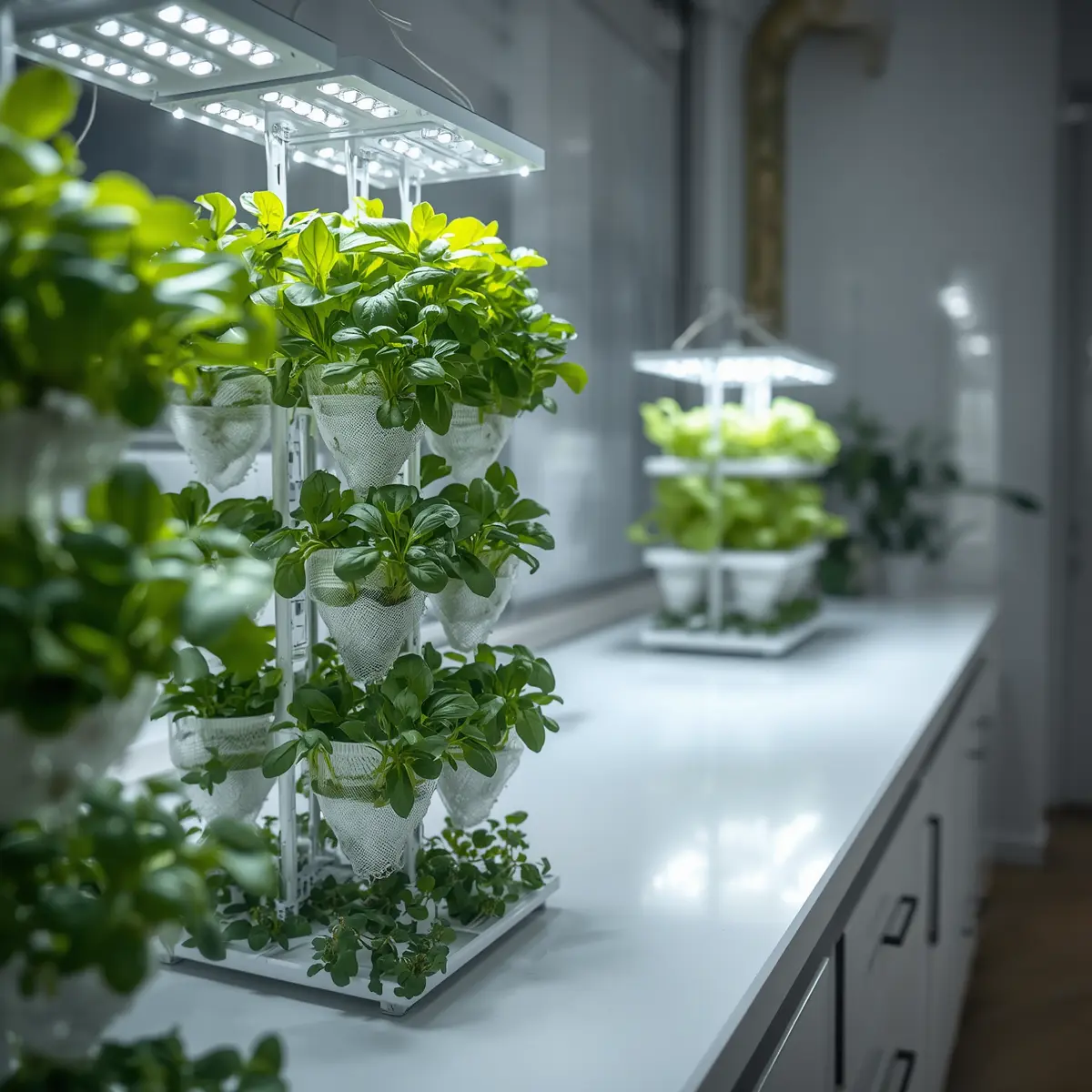
Hydroponic systems grow plants without soil, feeding the roots a water-based nutrient solution. Oklahoma State University Extension describes it as a method in which nutrients are supplied through a liquid solution, with roots either suspended in water or supported by a substrate such as perlite, rock wool, expanded clay or coconut coir. For a home grower the two easiest systems are the Kratky method (no pump, no electricity) and deep water culture (an air pump bubbles the solution). Whatever the system, success comes down to a complete hydroponic fertilizer, the right pH and EC, and a container that keeps light out.
| Crop | EC (mS/cm) | pH |
|---|---|---|
| Lettuce | 1.2 to 1.8 | 6.0 to 7.0 |
| Basil | 1.0 to 1.6 | 5.5 to 6.0 |
| Sage | 1.0 to 1.6 | 5.5 to 6.5 |
| Parsley | 1.8 to 2.2 | 6.0 to 6.5 |
| Spinach | 1.8 to 2.3 | 6.0 to 7.0 |
| Strawberry | 1.8 to 2.2 | 6.0 |
| Peppers | 0.8 to 1.8 | 5.5 to 6.0 |
| Tomato | 2.0 to 4.0 | 6.0 to 6.5 |
Source: Oklahoma State University Extension HLA-6722, Electrical Conductivity and pH Guide for Hydroponics (Dunn and Singh, 2017), Table 2.
What Is Hydroponics?
The word comes from the Greek hydro (water) and ponos (labor), Oklahoma State explains. Instead of soil, the plant gets all its nutrients from a solution of fertilizer salts dissolved in water. That removes the soil’s buffering: Oklahoma State notes that soil helps hold pH and nutrient levels in a suitable range, and in soilless culture you have to manage them yourself. That is why measuring pH and EC (electrical conductivity, a measure of how much fertilizer salt is in the water) matters so much.
Hydroponics can produce fast, clean growth when it is run well, which is why it is popular for leafy greens and herbs, but there is no single “percent faster than soil” figure that applies to every crop and setup. The results depend on light, temperature, the crop and how well the solution is managed.
The 6 Main Types of Hydroponic Systems
| System | How it works | Best for | Difficulty |
|---|---|---|---|
| Kratky (non-circulating) | Plants sit over a still container of solution; no pump or electricity | Lettuce, herbs | Lowest |
| Deep water culture (DWC) | Roots hang in solution oxygenated by an air pump and air stone | Leafy greens, herbs | Low |
| Nutrient film technique (NFT) | A thin stream of solution flows along channels past the roots | Lettuce, herbs, vertical setups | Medium |
| Ebb and flow | A tray floods on a timer, then drains | Mixed crops | Medium |
| Drip | Solution drips onto each plant’s substrate | Larger plants such as tomatoes | Medium |
| Aeroponics | Roots hang in air and are misted | Experienced growers | High |
The Kratky method was developed by Bernard Kratky at the University of Hawaii. In his paper on three non-circulating hydroponic methods for growing lettuce, all the nutrient solution is added before planting, and no electricity, pumps or wicks are needed. A seedling in a net pot sits with the bottom of the pot in a darkened container of solution; as the plant uses water the level drops, leaving a moist air space where the upper roots get oxygen. Systems with pumps (DWC, NFT, ebb and flow, drip, aeroponics) give more control but depend on the pump: if it stops, roots can dry out or run short of oxygen.
For more on the passive method, see our Kratky method guide.
How to Make a Simple Hydroponic System at Home
University of Illinois Extension describes a DIY setup built from a plastic container with a lid, rock wool growing medium, plastic net pots, a hydroponic nutrient solution, an aquarium air pump with tubing and an air stone, supplemental lighting, and pH test strips with an EC meter. It recommends lettuce and herbs, which can be harvested a little at a time for months.
- Container: an opaque plastic tub with a lid. Cut holes in the lid to hold the net pots snugly.
- Seedlings: start seeds in rock wool cubes or another inert medium, and move them into net pots once they have roots.
- Solution: fill the tub with water and add hydroponic fertilizer at the label rate. Check that the EC is in the range for your crop and adjust the pH (see the table above).
- Oxygen: for deep water culture, run the air pump and air stone continuously. For Kratky, skip the pump and let the level fall as the plants drink.
- Light: Illinois suggests 14 to 16 hours of supplemental light a day; position the light following its manufacturer’s distance guidance. See our grow light guide.
- Maintenance: Illinois recommends changing the nutrient solution and cleaning the container every two weeks, and Oklahoma State likewise advises replacing the solution completely every two weeks.
A Beginner Hydroponic Herb Garden
Lettuce and herbs are the classic first crops: they are small, quick and can be picked repeatedly. Oklahoma State gives EC and pH targets for basil, sage and parsley, among others, and Kratky’s research focused on lettuce. A small DWC tub or a few Kratky jars on a sunny counter or under a grow light is enough for a kitchen herb supply.
Larger fruiting crops such as tomatoes and peppers can be grown hydroponically but need more space, stronger light, support and higher nutrient levels (Oklahoma State lists tomato at an EC of 2.0 to 4.0). Root crops such as carrots and potatoes are impractical in typical home systems. For soil-grown herbs, see our guides to growing basil indoors and mint.
Nutrients, pH and EC
- Fertilizer: use a complete fertilizer made for hydroponics, which supplies all the nutrients in water-soluble form; there is no soil to make up for anything missing.
- pH: Oklahoma State says nutrient solutions for soilless culture should be about pH 5 to 6 (usually 5.5), so the root environment stays around 6 to 6.5, where nutrients are most available. Individual crops have their own ranges (table above).
- EC: too high causes osmotic stress, ion toxicity and nutrient imbalance; too low leads to deficiencies and slower growth (Oklahoma State). Measure EC first, then adjust pH.
- Checking: Oklahoma State recommends checking pH and EC daily, at the same time of day; Illinois suggests at least weekly for a small home system.
- Water temperature: Oklahoma State gives 72 to 75 °F as optimal.
- Source water: very hard (high-alkalinity) water pushes pH up, so check pH more often if your tap water is hard; Oklahoma State notes reverse osmosis is one way to remove alkalinity.
Even with top-ups, nutrient ratios drift over time because plants take up some ions faster than others, which is why a complete change about every two weeks is advised (Oklahoma State).
Troubleshooting
| Symptom | Common cause | What to do |
|---|---|---|
| Yellowing or poor growth despite feeding | pH out of range, so nutrients are less available; or EC too low | Check EC, then pH; adjust or replace the solution |
| Leaf edges burning | EC too high (too much fertilizer) | Dilute with water and recheck |
| Brown, slimy, smelly roots | Low oxygen or warm solution favoring root rot | Check the air pump, cool the solution toward 72 to 75 °F, clean the container and replace the solution |
| Green algae in the reservoir | Light reaching the solution | Use opaque containers and cover openings |
| Sudden wilting in a pumped system | Pump failure or blocked lines | Check the pump and lines |
Root problems in water are covered in our Pythium root rot guide.
Hydroponic Plants and Pets
The ASPCA lists basil as non-toxic to dogs and cats, but it lists garden mint as toxic to dogs, cats and horses (essential oils; vomiting and diarrhea if a lot is eaten). Whatever you grow, keep the nutrient solution, concentrated fertilizers and pH adjusters out of reach, since pets may drink from an open reservoir. See our cat-safe plants guide.
Common Beginner Mistakes
- Not measuring pH and EC. Without a buffer from soil, these drift; Oklahoma State recommends daily checks.
- Using a regular soil fertilizer. Use a fertilizer formulated for hydroponics so the solution has a complete, fully soluble nutrient supply.
- Clear containers. Light in the solution grows algae; Kratky’s systems use darkened containers.
- Never changing the solution. Replace it about every two weeks (Oklahoma State, Illinois).
- Warm water. Keep it around 72 to 75 °F where you can.
- Refilling a Kratky container to the top. The air space that forms as the level drops is what supplies the upper roots with oxygen.
Frequently Asked Questions
What is the easiest hydroponic system for beginners?
The Kratky method, which needs no pump or electricity because all the solution is added at the start (Kratky, University of Hawaii), or a small deep water culture tub with an aquarium air pump.
What are the main hydroponic system components?
A container or reservoir, net pots and an inert growing medium, hydroponic nutrient solution, a way to supply oxygen (an air space or an air pump and stone), light, and pH and EC testers (University of Illinois Extension).
What pH should hydroponic water be?
About 5 to 6, usually 5.5, for the nutrient solution, according to Oklahoma State Extension; individual crops have their own ranges, for example basil 5.5 to 6.0 and lettuce 6.0 to 7.0.
How often should I change hydroponic nutrient solution?
About every two weeks, topping up water in between (Oklahoma State and Illinois Extension).
Do hydroponic plants grow faster than soil plants?
They can, when light, temperature and the nutrient solution are well managed, but there is no single growth figure that applies to every crop and system.
Can I use regular fertilizer in hydroponics?
It is better not to. Use a fertilizer formulated for hydroponics so the solution contains all the nutrients in soluble form.
Sources
- Oklahoma State University Extension HLA-6722: Electrical Conductivity and pH Guide for Hydroponics (Dunn and Singh, 2017)
- Kratky B.A. (2009). Three non-circulating hydroponic methods for growing lettuce. University of Hawaii CTAHR / Acta Horticulturae 843.
- University of Illinois Extension: Homegrown DIY hydroponics for all gardeners (2020)
- ASPCA: Basil and Mint