
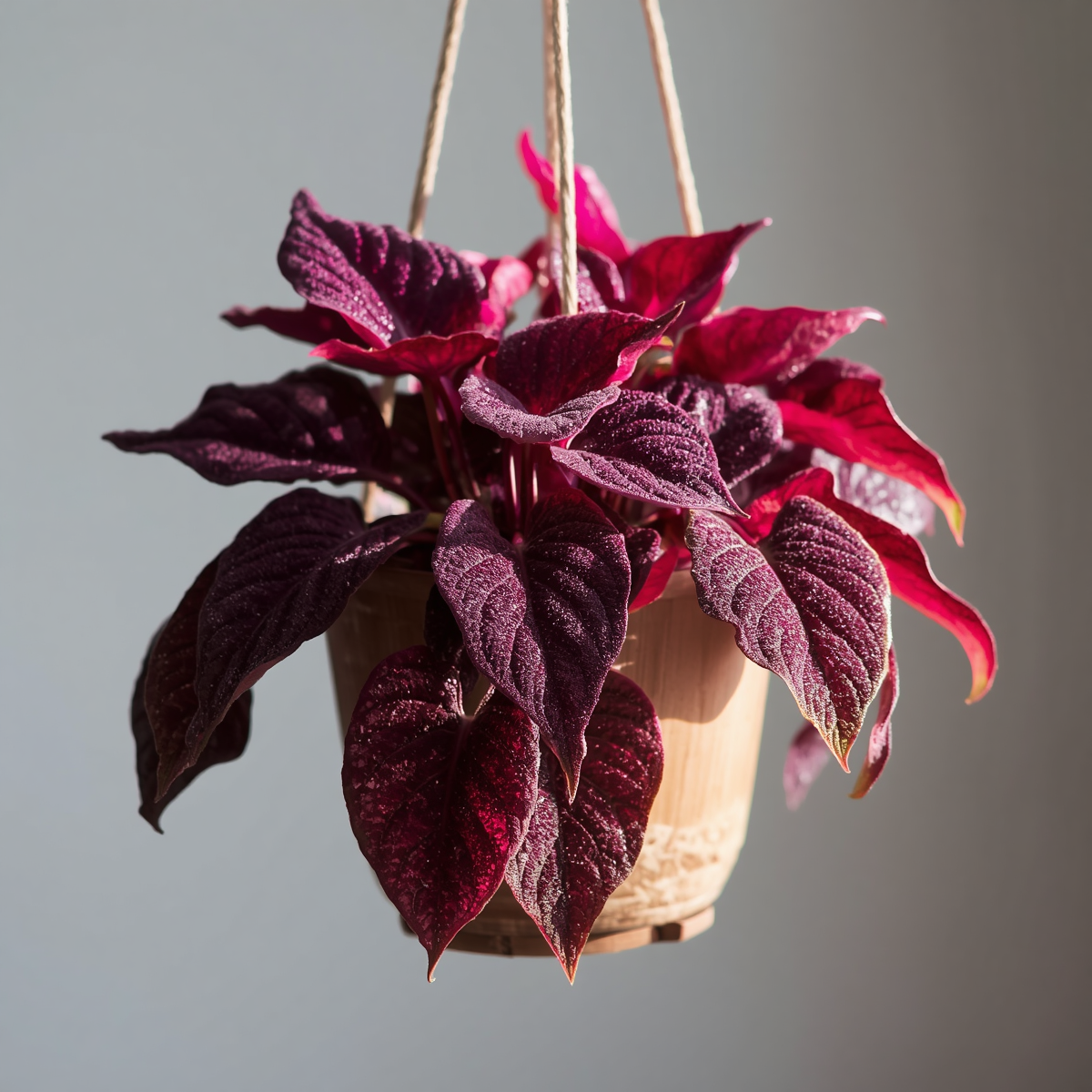
Looking for the passionflower vine (Passiflora) or passion fruit? This guide is about the velvet houseplant Gynura aurantiaca. The purple passion plant, also called velvet plant or purple velvet plant, has green leaves covered in fine purple hairs that make the whole plant glow violet in good light. Purple passion plant care is easy once you know its two needs: plenty of bright, indirect light to keep the purple, and evenly moist but never soggy soil.
Purple Passion Plant Care at a Glance
| Factor | What it wants |
|---|---|
| Light | Bright, indirect or filtered light; protect from afternoon sun |
| Water | Evenly moist; water less from fall to late winter; never waterlogged |
| Temperature | 65 to 80 °F indoors; avoid chilling below about 55 °F |
| Soil | Moist but well-drained; peat-free, loam-based potting compost |
| Pruning | Pinch growing tips to prevent legginess |
| Flowers | Small orange-yellow clusters with an unpleasant smell; often removed |
| Pets | Non-toxic to dogs and cats (ASPCA) |
Sources: NC State Extension; Missouri Botanical Garden; UF/IFAS EP346; RHS; ASPCA.
What Is a Purple Passion Plant?
Gynura aurantiaca is an evergreen perennial in the daisy family (Asteraceae). Missouri Botanical Garden describes it as native to Java and a woody-based evergreen perennial noted for its velvety, purple-haired foliage. The RHS describes the ‘Purple Passion’ cultivar as a sprawling plant to about 1 m tall that can reach 3 m if supported. NC State Extension notes its weak stems and sprawling habit, which is why it is often grown in a hanging basket.
Light: Keeping It Purple
Light controls the color. NC State says bright, indirect light with protection from afternoon sun gives the best foliage color, and that without enough light the leaves may look green instead of purple. MOBOT agrees that bright light with filtered sun is needed for best color, and lists greenish foliage as a sign of light that is too low. An east window, or a spot near a brighter window behind a sheer curtain, works well. In a dim room, add a grow light; see our grow light guide.
For commercial growers, UF/IFAS notes that acclimatized plants tolerate interior light as low as 150 foot-candles, with 150 to 250 as the optimal interior range. More light than that, as long as it is not harsh direct sun, keeps the color richer.
Watering
NC State says to keep the soil moist, watering less often in winter, because overwatering may cause rot. MOBOT says to keep soil evenly moist with a slight reduction in watering from fall to late winter. UF/IFAS notes the roots are fibrous and delicate and that root rot can develop if the root zone stays saturated.
- Water when the surface just begins to feel dry, soaking the soil and letting the excess drain.
- Pour water onto the soil, not over the hairy leaves; the dense hairs hold water against the leaf.
- Use a pot with drainage holes and empty the saucer.
- Water less from fall to late winter.
Temperature and Humidity
UF/IFAS gives 65 to 80 °F as the interior temperature range and notes that temperatures below 55 °F can cause chilling injury. Keep it away from cold drafts and heating vents. Average room humidity is usually fine. If your air is very dry, a humidifier or pebble tray raises humidity without wetting the velvety leaves.
Soil and Fertilizer
The RHS recommends a peat-free, loam-based potting compost and a moist but well-drained soil. UF/IFAS describes commercial rooting mixes of peat, bark and perlite. Any good houseplant mix that drains well works. Feed with a balanced houseplant fertilizer at the label rate during spring and summer, and cut back in winter. Too much fertilizer encourages soft, leggy growth and salt buildup.
Pinching and Flowers
Pinching. MOBOT advises pinching the growing tips to prevent legginess, and NC State notes that pinching back stems encourages a fuller plant. Pinch regularly through the growing season and use the tips as cuttings.
Flowers. NC State describes small orange-yellow flower clusters in fall and sometimes winter, which may not appear in low light, and notes they have an unpleasant smell and can be messy, so they are often removed. UF/IFAS also describes the fragrance as offensive. Pinching off the buds is purely a matter of taste; the flowers do no harm.
How to Propagate Purple Passion Plant
Stem cuttings are the recommended method (NC State), and MOBOT says the plant is easily propagated from cuttings. UF/IFAS reports that cuttings root year-round with warmth and humidity, forming roots in one to two weeks at a media temperature of at least 75 °F; rooting hormone is optional.
- Cut a 3 to 4 inch stem tip just below a leaf node, using clean scissors.
- Remove the lowest leaves.
- Root it in water or moist, well-draining mix in a warm, bright spot out of direct sun.
- Pot it up once roots are an inch or two long.
Older plants often get sparse and leggy despite pinching, so rooting fresh cuttings every year or two keeps a young, colorful plant going.
Is Purple Passion Plant Safe for Pets?
Yes: non-toxic to cats and dogs
The ASPCA lists purple velvet plant (velvet plant, royal velvet plant, purple passion vine) as non-toxic to dogs and cats, and NC State also tags it non-toxic for both. As with any plant, a pet that eats a lot of it may get a mild stomach upset.
More pet-safe options are in our cat-safe plants list.
Common Problems
| Symptom | Likely cause | Fix |
|---|---|---|
| Leaves turning green, losing purple | Too little light (MOBOT, NC State) | Move to brighter, indirect light |
| Long, sparse stems | Low light or no pinching | More light; pinch tips; root cuttings |
| Wilting with wet soil, soft stems | Overwatering, root rot | Let the surface dry; check drainage and roots |
| Spots on leaves | Water sitting on the hairy leaves, or sun scorch | Water the soil only; avoid harsh sun |
| Fine speckling or clusters of small insects | Spider mites or aphids (RHS) | See our spider mite guide and aphid guide |
Sources: Missouri Botanical Garden; NC State Extension; RHS. Fixes are general practice.
For more houseplants grown for their colorful leaves, see our guides to caladiums and polka dot plant. It is also on our list of plants safe for dogs.
Frequently Asked Questions
How do you care for a purple passion plant?
Give it bright, indirect light with protection from afternoon sun, keep the soil evenly moist with less water in winter, keep it at 65 to 80 °F, and pinch the growing tips to keep it full.
Why is my purple passion plant losing its purple color?
Too little light. Missouri Botanical Garden and NC State both note that greenish leaves indicate light that is too low. Move it to a brighter spot with bright, indirect light.
Should I mist my purple passion plant?
It isn’t necessary, and wetting the hairy leaves can leave them damp for a long time. Water the soil, and use a humidifier or pebble tray if the air is very dry.
Is the purple passion plant toxic to cats and dogs?
No. The ASPCA lists purple velvet plant as non-toxic to dogs and cats.
Why does my purple passion plant smell bad?
Its small orange-yellow flowers have an unpleasant smell, according to NC State and UF/IFAS. Many growers pinch off the buds.
How do you propagate a purple passion plant?
Take a 3 to 4 inch stem tip cutting below a node, remove the lower leaves, and root it in water or moist mix somewhere warm and bright. UF/IFAS reports roots in one to two weeks with warmth.