
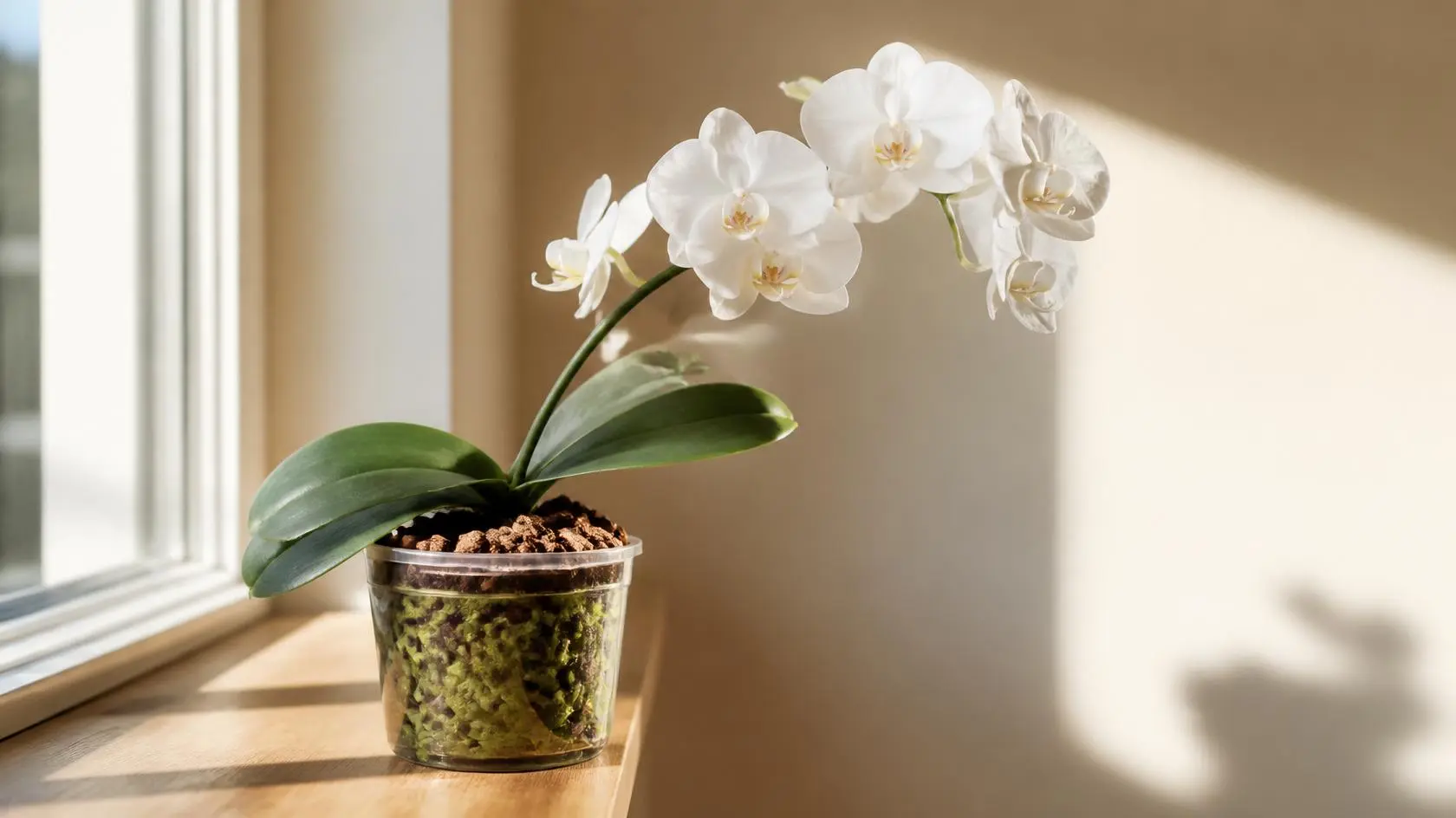
Orchid care for beginners almost always means the moth orchid, Phalaenopsis, the most popular orchid sold as a houseplant. NC State Extension sums up what it wants: low light, warm temperatures and high humidity, an east windowsill, a bark-based mix in a pot that drains, watering about once a week, and light, regular feeding. With that care, NC State says moth orchids flower once a year, and the flowers can last four months or more.
Orchid Care for Beginners at a Glance
| Need | What NC State Extension says (moth orchids) |
|---|---|
| Light | Low light; best on an east windowsill, or well-shaded west and south windowsills |
| Temperature and humidity | Warm temperatures and high humidity; hardy only in USDA zones 10 to 12 |
| Potting mix | Bark-based medium with excellent drainage; clear plastic pots are often used |
| Watering | Mornings, with tepid water; mature plants about once a week, more often in summer heat; let the mix dry some between waterings |
| Fertilizer | Balanced fertilizer, half strength twice monthly or quarter strength weekly |
| Repotting | About every two years, after flowering or as new leaves appear |
| Reblooming | Flowers once a year; large white spring bloomers need about a week of 55°F nights in autumn |
| Pets | Non-toxic to dogs, cats and horses (ASPCA) |
Sources: NC State Extension Plant Toolbox: Phalaenopsis; ASPCA: Phalaenopsis Orchid.
What Light Does a Phalaenopsis Orchid Need Indoors?
Less than most flowering plants. NC State says moth orchids prefer low light, and the best spot in the house is an east windowsill, though they can grow well on well-shaded west and south windowsills. Gentle morning sun is fine; hot afternoon sun through glass can scorch the leaves.
- Too much light: yellowish leaves or bleached, scorched patches.
- Too little light: healthy-looking but very dark leaves and no flower spikes; move it closer to the window or add a grow light (see our grow light guide).
NC State also notes that moth orchid roots can photosynthesize and turn green, which is why they are often sold in clear plastic pots.
How Often Should You Water an Orchid, and Do Ice Cubes Work?
About once a week. NC State recommends watering in the morning with tepid water, letting water run freely through the pot in a sink, letting the pot drain completely so the plant doesn’t stand in water, and watering mature plants once a week or more often in summer heat. The potting mix should dry somewhat between waterings.
- Check before watering: roots that look silvery and a light pot mean it is time; green roots and a heavy pot mean wait.
- Drain completely: never leave the pot in a saucer or decorative sleeve full of water.
- Water less in a cool winter room, when the mix dries more slowly.
Ice cubes: the research says they’re fine
In a trial by researchers at Ohio State University and the University of Georgia (South et al., 2017), moth orchids in bark were watered weekly either with three ice cubes or the same volume of room-temperature water for 4 to 6 months. Flower longevity, display life, leaf and root dry weights and photosynthetic efficiency were the same, with no sign of root damage. Ice is a convenient way to give a small, measured amount of water; tepid water poured through the pot works just as well and also flushes salts.
What Is the Best Growing Medium for Orchids in Pots?
A bark-based orchid mix. NC State explains that moth orchids like warm, humid, damp but not soggy conditions, so they are planted in a bark-based medium that provides excellent drainage. Many supermarket orchids come in pure sphagnum moss; NC State notes that pure sphagnum can be difficult to rewet and that it is better to repot such plants into a bark-based orchid mix.
Never use regular potting soil: it stays too wet and dense for orchid roots. Commercial orchid bark mixes, sometimes with a little perlite or charcoal, are the simplest choice. If you use sphagnum for any reason, wear gloves; see our sphagnum moss guide for why.
How Do You Care for an Orchid After It Stops Flowering?
- Cut the stalk just above a node. NC State says to cut the flower stalk just above the first node below the faded flowers; often, but not always, that node produces a branch with more flowers.
- Remove a dead stalk. If the stalk turns brown and dry, cut it off near the base.
- Keep up normal care. Steady light, watering and light feeding build the leaves that produce the next spike.
- Give a cool nudge if needed. NC State notes that the large-flowered white species and hybrids that bloom in spring need a cool nighttime chill, around 55°F for a week, in autumn to start flower spikes. Modern dwarf hybrids bred from summer-flowering species don’t need it.
If your orchid still won’t rebloom, our orchid not blooming guide walks through each cause. For a related problem with another plant, see our Christmas cactus not blooming guide.
How Do You Repot an Orchid Without Killing It?
NC State says orchids need repotting about every two years, after blooms have faded or as new leaves begin to appear. Repot sooner if the bark has broken down into a soggy, fine mix or the plant arrived in packed sphagnum.
- Wait until flowering is over.
- Remove the old mix completely and trim dead roots (brown, hollow, mushy) with clean scissors. Healthy roots are firm and silvery or green.
- Choose a pot only a little larger than the roots, with drainage holes.
- Set the plant at the same height as before and fill around the roots with fresh, pre-moistened bark mix without packing it hard.
- Water lightly and keep the plant out of direct sun for a week or two while it settles.
What Is the Best Fertilizer for Orchids and How Often Should You Apply It?
NC State recommends a balanced fertilizer applied regularly, either at half strength twice a month or at quarter strength weekly. Water first if the mix is very dry, and flush the pot with plain water every few weeks so salts don’t build up in the bark. Our fertilizer guide explains label numbers.
What Are the Most Common Orchid Care Mistakes?
| Mistake | What happens | Fix |
|---|---|---|
| Pot standing in water or in a sleeve with no drainage | Roots rot | Drain completely after every watering (NC State) |
| Regular potting soil or packed old moss | Mix stays wet; roots suffocate | Repot into bark-based orchid mix (NC State) |
| Hot afternoon sun | Scorched, yellow leaves | East window or well-shaded spot (NC State) |
| Moving the plant or sudden changes while in bud | Bud blast: buds drop before opening | Keep temperature, humidity, watering and location steady (NC State) |
| Overfeeding | Root tip burn, salt crust | Feed weakly; flush with plain water |
| Expecting the dyed blue color to return | It reblooms white | NC State: dyed orchids rebloom in their natural color |
Which Orchid Species Is Right for You?
Start with a moth orchid. NC State describes it as the most popular and widely available orchid sold as a houseplant, with more than 34,000 registered hybrids, and it suits the low light and warm rooms of most homes. Other common orchids are less forgiving indoors: many Dendrobium, Cymbidium and Oncidium types want brighter light, and several need cool nights or a seasonal dry rest to flower. Check the care needs for the specific plant before buying. If you buy a “blue” moth orchid, NC State notes it is usually a white orchid dyed blue, and it will rebloom white.
Can You Grow Orchids Without Soil or in Water?
Orchids never grow in soil; bark is the standard. Some hobbyists grow moth orchids in semi-hydroponics (clay pebbles with a small water reservoir) or in water culture, where roots are soaked and then allowed to dry on a schedule. These methods can work, but the roots must adapt and the plant needs a dilute, complete nutrient solution; they are not where a beginner should start. If you want to try, our Lechuza PON semi-hydro guide covers the basics.
Are Orchids Safe for Cats and Dogs?
Yes. The ASPCA lists the Phalaenopsis orchid as non-toxic to dogs, cats and horses. Like any plant, eating more than a bite or two may cause mild stomach upset. Keep the bark mix and any fertilizer out of reach too. For more pet-friendly options, see our cat safe plants list.
For other flowering houseplants, see our guides to jasmine indoors. It is also on our list of plants safe for dogs. It can also be grown as a kokedama; see our guide to kokedama moss balls. For another plant that grows on trees rather than in soil, see our guide to air plant care.
Frequently Asked Questions
How often should I water my orchid?
About once a week for a mature moth orchid, more often in summer heat, letting the mix dry somewhat between waterings and draining the pot completely (NC State Extension).
Can I use ice cubes to water my orchid?
Yes. In an Ohio State and University of Georgia trial, moth orchids watered weekly with three ice cubes kept their flowers as long as plants given room-temperature water, with no root damage or growth difference.
Why are my orchid’s roots turning brown?
Soft, brown, hollow roots are usually rotted from a mix that stays wet, old broken-down bark, or a pot left standing in water. Trim dead roots, repot into fresh bark mix, and let the pot drain completely after watering.
How do I get my orchid to bloom again?
Cut the spent stalk just above the first node below the faded flowers, keep up good light and feeding, and for large white spring-flowering types give about a week of 55°F nights in autumn, as NC State recommends.
How do I grow orchids from cuttings?
Moth orchids don’t grow from leaf or stem cuttings like many houseplants. The home method is a keiki, a baby plant that sometimes forms on a flower stalk; once it has several roots, it can be cut off and potted in bark.
Are orchids safe for cats and dogs?
The ASPCA lists the Phalaenopsis orchid as non-toxic to dogs, cats and horses, though eating a lot of any plant can upset a pet’s stomach.