
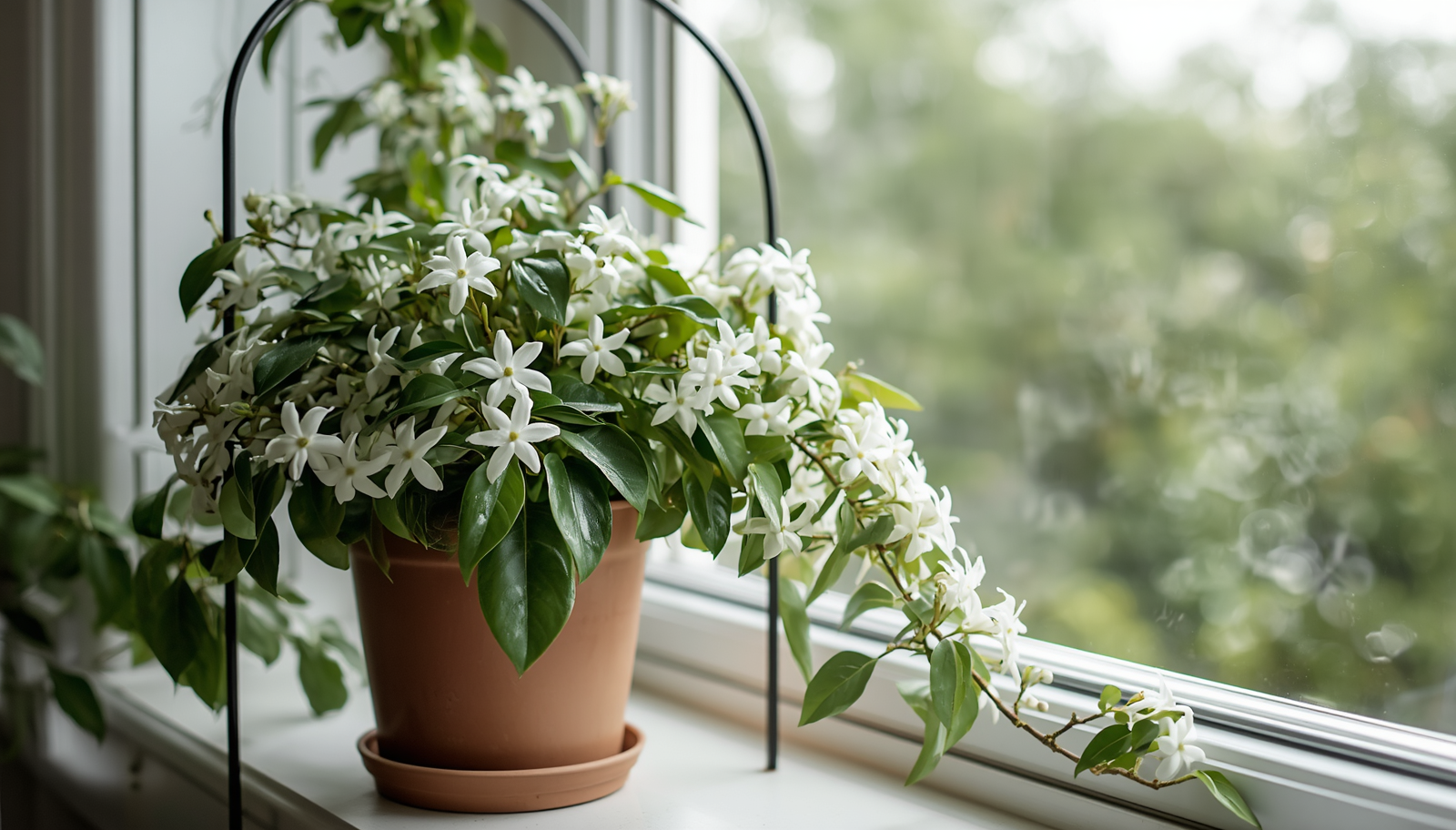
Few plants can scent a whole room like jasmine, but indoor jasmine has a reputation for growing leaves and no flowers. Learning how to grow jasmine indoors starts with picking the right species, then giving it bright light with some direct sun, steady moisture, extra humidity, and a cooler spell before it flowers. Sources disagree on a few details, such as how cool and what to feed, and this guide shows where. It follows the RHS, the New York Botanical Garden, Chicago Botanic Garden and NC State.
Which Jasmine Plant Is Best for Indoors?
Jasmine (Jasminum) is a genus of more than 200 species of evergreen or deciduous shrubs and vines in the olive family (NC State). Container plants usually stay at 4 to 5 feet and are easy to prune to size. Three species are common indoors:
| Species | Notes |
|---|---|
| Pink or Chinese jasmine (J. polyanthum) | The usual houseplant jasmine: white flowers from pink buds in late winter and spring; tender, keep above 13°C (55°F) per the RHS |
| Arabian jasmine (J. sambac) | Prefers warmer nights, above 60°F (NYBG) |
| Common jasmine (J. officinale) | Hardy outdoors once established (RHS); ‘Grandiflorum’ blooms best with nights of 55°F or lower (NYBG) |
Sources: RHS jasmine growing guide; New York Botanical Garden; NC State Extension.
If you’re learning how to grow pink jasmine indoors, that is J. polyanthum, and most of this guide is written with it in mind. Beware of plants sold as “jasmine” that are not true Jasminum, such as star jasmine (Trachelospermum), Carolina jessamine (Gelsemium) and night-blooming jasmine (Cestrum): their care and pet safety differ.
Light
Flowering needs light. Chicago Botanic Garden says jasmine needs bright light with at least four hours of direct sun a day. The New York Botanical Garden recommends bright light with some direct sun each day, in an eastern or western exposure. The RHS says to keep tender jasmines in a warm, bright spot indoors, with a conservatory ideal, and that they can go outside to a sheltered spot in summer. NC State lists full sun or at least bright light.
A plant that grows plenty of leaves but no flowers is very often short of light. Move it to your sunniest window or add a grow light; see our grow light guide.
Watering and Humidity
The NYBG says to keep the soil moist because jasmine wilts easily, and to water less during its winter slowdown. The RHS says indoor jasmines need regular watering while in growth but only very light watering in winter. Chicago Botanic Garden says to water J. polyanthum in cool autumn and winter only when the soil has dried out. Always use a pot with drainage holes, and never leave it standing in water.
For humidity, the NYBG suggests a tray of moistened pebbles, daily misting or a humidifier, which matters most in dry, heated rooms in winter.
Temperature and the Cool Spell
Jasmines that flower in late winter and spring are helped by cooler conditions beforehand, but the sources give different numbers:
| Source | What it says |
|---|---|
| Chicago Botanic Garden | Jasmine needs at least a 15-degree difference between day and night temperatures; J. polyanthum can tolerate 40 to 50°F from September until it sets buds |
| New York Botanical Garden | J. officinale ‘Grandiflorum’ blooms best with nights of 55°F or lower and days below 70°F; J. sambac prefers nights above 60°F |
| RHS | Tender jasmines such as J. polyanthum should be kept consistently warm, above 13°C (55°F); bring them in before nights drop to 13 to 15°C |
Sources: Chicago Botanic Garden; NYBG; RHS.
In practice: give J. polyanthum cooler nights in autumn, in a bright, unheated room or a cool windowsill, while avoiding frost and freezing drafts. The RHS keeps it above 55°F; Chicago says it tolerates down to 40°F before buds set. Keep J. sambac warm year-round.
Feeding for Flowers
Chicago Botanic Garden recommends feeding every two weeks in spring and summer with a high-phosphorus fertilizer to encourage flowers. The RHS suggests a high-potassium liquid feed, such as tomato fertilizer, for container jasmines to boost flowering. Both agree on feeding during active growth and avoiding a high-nitrogen feed that pushes leaves at the expense of flowers. Ease off in winter.
How to Grow Jasmine Indoors in Pots
- Pot and soil: NC State recommends moist, well-drained soil with plenty of organic matter. Use a good potting mix in a pot with drainage holes.
- Support: J. polyanthum is a climber. The RHS suggests a trellis in a conservatory, porch or heated greenhouse; indoors, a hoop or small trellis in the pot works.
- Repotting: Chicago Botanic Garden says pruning and repotting should take place in spring.
- Summer outside: the RHS says tender jasmines can go outside to a sheltered spot in summer and must come back in before nights drop to 13 to 15°C.
Why Your Jasmine Won’t Bloom
- Not enough light. Most indoor jasmines that won’t flower need more direct sun (Chicago Botanic Garden, NYBG).
- No cooler spell. A plant kept warm all autumn may not set buds (Chicago Botanic Garden; NYBG for J. officinale).
- Pruned at the wrong time. NC State says flowers are borne on old growth, so prune after flowering to protect next season’s buds.
- Too much nitrogen. Lush leaves, few flowers; switch to a bloom (high-P or high-K) feed in the growing season.
- Too young or recently disturbed. Give a newly repotted or very small plant a season to settle.
Other houseplants that need a seasonal cue to flower include Christmas cactus and moth orchids; see also our guide to getting a hoya to bloom.
Pruning and Propagation
NC State says that because flowers are borne on old growth, jasmines should be pruned after flowering. The RHS’s general advice is to cut flowered stems back to a strong side shoot lower down and thin out crowded or damaged growth, and the NYBG notes jasmines can be rampant growers that need frequent pruning. For a late-winter-flowering J. polyanthum, that means pruning in spring once the flowers fade, which matches Chicago Botanic Garden’s advice to prune and repot in spring.
For propagation, the RHS says tender jasmines root best from internodal softwood or semi-ripe cuttings taken in spring or summer.
Pests and Problems
The RHS says indoor jasmines can attract mealybugs and red spider mites and advises checking plants regularly. NC State lists aphids, spider mites, scale, leaf spot and root rot, and notes that plants brought indoors are more vulnerable. Dry, heated air favors spider mites, so humidity helps here too. See our spider mite guide and mealybug guide.
Is Jasmine Safe for Pets?
True jasmine is. The ASPCA lists Jasminum species as non-toxic to dogs, cats and horses. Plants that only share the common name, such as Carolina jessamine (Gelsemium) and night-blooming jasmine (Cestrum), are different plants, so check the botanical name on the label. See our cat-safe plants list.
For overwintering tips, see our guides to bringing plants indoors for winter and winter houseplant care.
Frequently Asked Questions
Which jasmine plant is best for indoors?
Pink or Chinese jasmine (Jasminum polyanthum) is the most common, flowering in late winter and spring. Arabian jasmine (J. sambac) suits warm rooms year-round (NYBG).
Can jasmine grow indoors year-round?
Yes, in a bright, sunny spot. The RHS says tender jasmines need to stay above about 13°C (55°F) and can spend summer outside in a sheltered spot.
How much sun does indoor jasmine need?
Chicago Botanic Garden says at least four hours of direct sun a day; the NYBG recommends some direct sun daily from an east or west window.
Why is my jasmine not blooming?
Usually too little light or no cooler spell in autumn. Pruning before flowering (NC State says flowers form on old growth) and too much nitrogen can also stop flowers.
When should I prune indoor jasmine?
Right after flowering (NC State), which for late-winter-flowering J. polyanthum means spring, when Chicago Botanic Garden also recommends pruning and repotting.
Is jasmine toxic to cats?
True jasmine (Jasminum) is non-toxic to dogs, cats and horses according to the ASPCA. Check the label, since some plants called “jasmine” belong to other genera.