
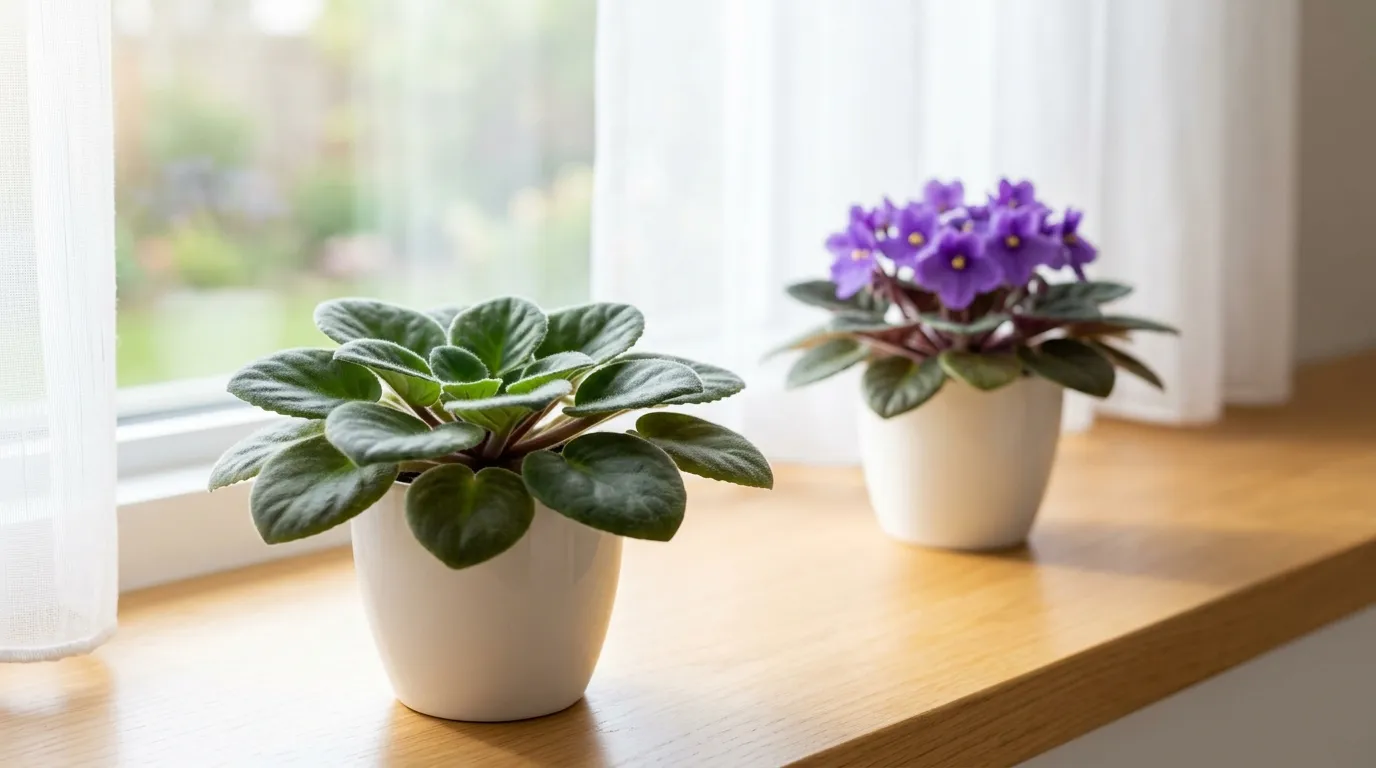
An African violet can flower almost all year, so a plant that sits there making leaves but no buds is telling you something is off. In most cases an African violet not blooming is short on light, or on darkness, or has too much fertilizer or too big a pot. The good news is that each of these is easy to fix, and a healthy plant usually starts budding again within weeks. This guide follows Penn State, Iowa State, UF/IFAS and NC State Extension.
Why Is My African Violet Not Blooming?
| Cause | Clues | Fix |
|---|---|---|
| Too little light | Thin, dark blue-green leaves on long stalks, stretching toward the window (Iowa State) | Move to an east window or add grow lights for 12 to 16 hours a day |
| No dark period | Lights left on most of the day, or a lamp on at night | Give 8 hours of darkness every night (Penn State, UF/IFAS) |
| Too much or wrong fertilizer | Lush leaves, tight center, rusty new leaves (UF/IFAS) | Feed lightly with a balanced, urea-free fertilizer; flush salts |
| Pot too big | Pot wider than about a third of the plant’s spread (Penn State) | Use a smaller pot |
| Temperature | Room below 60°F or above 85°F (Iowa State, UF/IFAS) | Keep at about 65 to 80°F |
| Root damage | Wilting in wet soil, or soil drying out completely (Penn State) | Keep the soil evenly moist, never soggy |
Sources: Penn State Extension (2025); Iowa State University Extension; UF/IFAS EDIS MG028.
If your African violet is growing but not blooming, start at the top of this table. Iowa State says poor flowering usually comes down to low light, low temperatures or improper fertilization.
Cause 1: Not Enough Light (or Darkness)
Light is the most common reason an African violet stopped blooming. Penn State Extension explains that too little light makes plants stretch and produce few or no flowers, while too much sun burns the leaves. It recommends bright, indirect light, ideally an east-facing window with a sheer curtain. UF/IFAS describes the right level as about 1,000 foot-candles without direct sun, for example within 3 feet of a southeast- or west-facing window.
How to tell: Iowa State says thin, dark blue-green leaves with long leaf stalks mean the plant is not getting enough light.
Darkness matters too
Penn State notes that African violets also need eight hours of darkness every night, and that if you use artificial light you should not run it more than 16 hours a day. UF/IFAS says blooming needs 8 to 12 hours of light (up to 16) and 8 hours of darkness, and that a plant given the right light for too short a time does worse than one given weaker light for longer.
Using grow lights
| Source | Distance above plants | Hours per day |
|---|---|---|
| Iowa State (All About African Violets) | 4 to 8 inches | 12 to 16 |
| Iowa State (FAQ) | 8 to 10 inches (fluorescent) | 12 to 16 |
| UF/IFAS | 12 to 15 inches (two 40-watt fluorescent tubes, about 600 foot-candles) | About 16 |
Sources: Iowa State University Extension; UF/IFAS EDIS MG028. Modern LED fixtures vary in brightness, so follow the maker’s distance and watch the leaves.
A simple timer makes this easy. See our grow light guide for choosing a fixture. If leaves turn pale, bleached or tightly bunched under lights, raise the lamp a little.
Cause 2: Wrong Feeding
Too little and too much fertilizer can both stop flowers. Penn State says small pots hold few nutrients, so African violets need regular feeding, but too much high-nitrogen fertilizer gives lush leaves at the expense of flowers. Iowa State agrees that excessive fertilization leads to vigorous leaf growth and poor flowering.
- Use a balanced or bloom fertilizer. Penn State recommends one with nitrogen, phosphorus and potassium; flowering-plant formulas such as 8-14-9 have more phosphorus than nitrogen. UF/IFAS lists 20-20-20 or 15-30-15.
- Avoid urea. Penn State says African violets are sensitive to urea as a nitrogen source, which can burn roots. Check the Guaranteed Analysis on the label.
- Keep it weak. UF/IFAS suggests a quarter of the label rate with each watering; Iowa State suggests a complete fertilizer every 2 weeks in spring, summer and fall, usually none in winter.
- Flush salts. UF/IFAS says over-fertilized plants develop tight centers and rusty-looking new leaves, and recommends flushing the soil from the top occasionally. See our white crust guide.
Cause 3: Pot Too Big
African violets bloom best when slightly root-bound. Penn State says a pot that is too large can prevent blooming, and gives a rule of thumb: the pot should be no larger than one-third the diameter of the plant. A 9-inch-wide plant, for example, needs only a 3-inch pot. When you repot, refresh the potting mix and go back into a clean pot of the same size rather than a bigger one. UF/IFAS suggests a mix of equal parts peat moss, vermiculite and perlite, or a bagged African violet mix, in a pot with drainage holes.
Cause 4: Too Hot or Too Cold
Iowa State says African violets do best between 65 and 80°F: below 50°F the leaves darken and wilt, and above 85°F growth and flowering slow. UF/IFAS prefers nights of 65 to 70°F and warns that prolonged heat reduces flowering. NC State advises keeping nights above 60°F. Keep plants off cold windowsills in winter and away from heaters and hot summer windows.
Cause 5: Watering and Root Problems
Roots that are damaged by too much or too little water cannot support flowers. Penn State says to keep the soil evenly moist, like a well-wrung-out sponge, never letting it dry out completely or stay sopping wet. NC State calls overwatering the number one problem.
- Water with room-temperature water. UF/IFAS warns that cold water on warm leaves causes yellowish spots or streaks, and NC State says to keep the leaves dry.
- Bottom watering works well. Iowa State recommends sub-irrigation, letting the top inch dry before watering again. See our bottom watering guide, and flush from the top now and then to clear salts.
- Raise humidity. UF/IFAS suggests setting pots on trays of wet pebbles, without letting the pots sit in the water.
Other Causes: Crowns, Pests and Age
- Several crowns in one pot. A plant that has split into multiple crowns becomes crowded. UF/IFAS describes dividing multi-crown plants; potting each crown separately gives cleaner, better-flowering plants.
- A long, bare neck. Older plants lose lower leaves and develop a bare stem. UF/IFAS describes re-rooting leggy plants, and Iowa State mentions repotting to correct a long neck.
- Pests. NC State lists mealybugs, thrips and cyclamen mites. UF/IFAS says cyclamen mites are very hard to control and affected plants are best discarded; mealybugs can be swabbed with diluted alcohol. See our rubbing alcohol for mealybugs guide.
- Petiole rot. UF/IFAS says brown sunken spots where leaf stalks touch the pot rim come from fertilizer salts; wax the rim or cover it with foil.
A 4-Week Plan to Get It Blooming
- Week 1: Move the plant to an east window or under grow lights on a timer (12 to 16 hours on, at least 8 hours off). Check the room stays about 65 to 80°F.
- Week 1: Check the pot size against Penn State’s one-third rule, and repot into fresh African violet mix if the soil is old, salty or the plant has several crowns.
- Weeks 2 to 4: Feed lightly with a balanced, urea-free fertilizer, keep the soil evenly moist with room-temperature water, and keep the leaves dry.
- Watch the new leaves. Flatter, greener leaves on shorter stalks mean the light is now right. Buds appear in the leaf axils at the center of the plant.
Other “won’t flower” houseplants often have similar fixes; see our guides to an orchid not blooming and a Christmas cactus not blooming.
Frequently Asked Questions
Why is my African violet not blooming?
Iowa State says poor flowering usually comes from low light, low temperatures or improper fertilization. Penn State adds too large a pot, no dark period at night, and root damage from over- or underwatering.
Why did my African violet stop blooming after I repotted it?
A bigger pot is a common reason. Penn State says African violets prefer to be root-bound and the pot should be no wider than one-third of the plant. Root disturbance can also pause flowering until the plant re-establishes.
How many hours of light does an African violet need to bloom?
Iowa State recommends 12 to 16 hours a day under lights. UF/IFAS says 8 to 12 hours, up to 16, followed by 8 hours of darkness. Penn State says not to run lights more than 16 hours a day.
What is the best fertilizer for African violets to bloom?
A balanced or higher-phosphorus fertilizer without urea, used at low strength. Penn State gives 8-14-9 as an example of a flowering-plant formula; UF/IFAS lists 20-20-20 or 15-30-15 at a quarter of the label rate.
Is my African violet growing but not blooming because it is too old?
Age alone is rarely the cause. Older plants often develop a long bare neck or several crowns, which UF/IFAS suggests fixing by re-rooting or dividing. Once the plant is back in a small pot with good light, it can flower again.
Are African violets safe for cats?
Yes. The ASPCA lists African violet as non-toxic to dogs, cats and horses.
Sources
- Feather, S. (2025). Why Isn’t My African Violet Flowering? Penn State Extension
- Iowa State University Extension: My African violets aren’t blooming well. Why?
- Haynes, C. and Steil, A. All About African Violets. Iowa State University Extension
- Park-Brown, S. African Violets. UF/IFAS Extension ENH17/MG028
- NC State Extension Gardener Plant Toolbox: Streptocarpus ionanthus (African violet)
- ASPCA: African Violet