
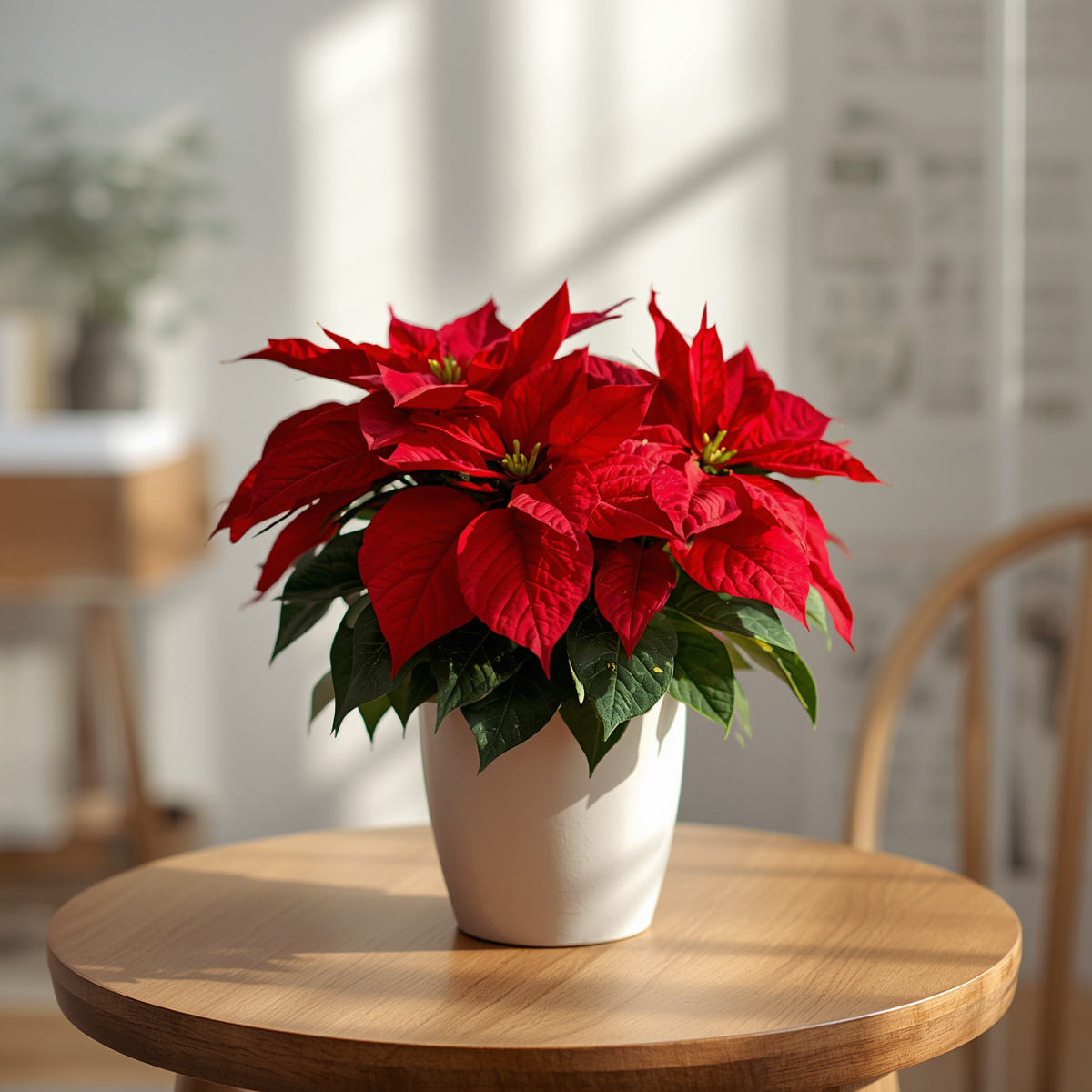
Poinsettia care is easier than its throwaway reputation suggests: a bright spot away from cold drafts, water only when the soil surface is dry, no fertilizer while it is in color, and no standing water in the foil wrapper. The Missouri Botanical Garden says poinsettias like to be kept on the dry side and that normal indoor household temperatures are fine. To make it turn red again next year, it needs long, completely dark nights from late September or early October.
What Is a Poinsettia?
The poinsettia, Euphorbia pulcherrima, is a shrub in the spurge family (Euphorbiaceae). The Missouri Botanical Garden describes it as a scraggly, deciduous to semi-evergreen shrub or small tree native to the Pacific slope of Mexico and Guatemala, where it grows in seasonally dry tropical forests and can reach 12 feet with an 8-foot spread.
The colorful “petals” are bracts, modified leaves. The true flowers are the small yellow structures in the center. Poinsettias are sold in red, pink, white and even peachy-orange; the Missouri Botanical Garden notes that blue and purple plants are white or light pink plants sprayed with dye.
Poinsettia Care at a Glance
| Need | What the Missouri Botanical Garden says |
|---|---|
| Light | A bright area away from cold air and drafts |
| Water | Keep on the dry side: water when the soil surface is dry, soak, then drain and discard the excess |
| Temperature | Normal indoor household temperatures; after blooming, keep cooler but not below 50°F |
| Fertilizer | Not necessary for a holiday plant; start in spring if you keep it |
| Rebloom | At least 12 hours of complete darkness nightly from late September or early October |
| Hardiness | USDA Zones 9 to 11 outdoors |
| Pets | Irritant sap; “generally over-rated in toxicity” (ASPCA) |
Sources: Missouri Botanical Garden: Euphorbia pulcherrima; ASPCA: Poinsettia.
Light, Water, Temperature and Feeding
Light
Place the plant in a bright spot, near a sunny window but with the leaves not touching cold glass. The Missouri Botanical Garden’s main warning is about cold air: keep it away from doors and cold drafts. In dark winter rooms, a grow light helps keep the plant compact; see our grow light guide.
Watering
Poinsettias like to be kept on the dry side. The Missouri Botanical Garden’s method: let the soil surface dry, then soak the soil, and make sure all excess water drains away and is discarded. Holiday plants often come in a decorative foil sleeve that traps water around the roots; take the plant out to water it, or poke holes in the bottom of the sleeve. Soggy soil leads to root and stem rot.
Temperature
Normal indoor temperatures are fine, but cold air is not. Wrap the plant for the trip home from the store on cold days, and keep it away from exterior doors, drafty windows and heating vents.
Feeding
The Missouri Botanical Garden says fertilizer is not necessary for a Christmas holiday plant. If you keep it, start fertilizing in spring with a balanced houseplant fertilizer, and continue through summer and the fall color treatment.
Can a Poinsettia Go Outside?
Year-round, only in USDA Zones 9 to 11, where it grows into a large shrub. Elsewhere, the Missouri Botanical Garden suggests placing the potted plant outdoors in eastern sun or general shade once temperatures stay reliably above about 60°F, and bringing it back indoors to a bright spot in fall when temperatures threaten to drop below 60°F. It cannot survive frost.
How to Make a Poinsettia Turn Red Again
Poinsettias are short-day (long-night) plants: the bracts color up when nights are long and completely dark. The Missouri Botanical Garden’s schedule:
- After the holidays: reduce watering and let the plant rest in a cooler spot, but not below 50°F.
- Spring (April is a good month): cut the plant back and start fertilizing. Repot if needed.
- Summer: grow it outdoors in eastern sun or light shade once nights stay above about 60°F, and keep pinching the tips to build plenty of branches. Each growing tip can produce color later.
- Early fall: bring it indoors to a bright spot before temperatures drop below 60°F.
- From the end of September or early October: give it complete darkness for at least 12 hours every night. The Missouri Botanical Garden suggests shielding it from any light from 5 PM until morning; a closet or a box works. In the day, give it as much bright light as possible, and keep watering and feeding.
- When strong color appears: stop the dark treatment. If everything went right, color shows by about the middle of November.
Darkness has to be complete. Light from a lamp, a street light or a room used in the evening can interrupt the long night, so a dedicated closet or a box placed over the plant every evening is the most reliable method.
Are Poinsettias Poisonous to Cats and Dogs?
Mildly. The ASPCA lists poinsettia as toxic to dogs, cats and horses because of its irritant sap, which can irritate the mouth and stomach and sometimes cause vomiting, but it adds that the plant is “generally over-rated in toxicity”. Keep it out of reach so pets don’t chew it, and call your vet or the ASPCA Animal Poison Control Center at (888) 426-4435 if a pet eats a lot of it or seems unwell.
For people, the evidence is reassuring too. The Missouri Botanical Garden says poinsettias are not highly poisonous and cites an Ohio State University study finding that a 50-pound child could eat 500 bracts and might have only a slight stomach ache. In a 1978 laboratory study, Winek and colleagues found no toxic effect in rats even at very high oral doses, although the sap caused mild skin irritation and skin photosensitivity in rabbits on repeated exposure. The Missouri Botanical Garden also notes that the white sap can cause allergic reactions, especially in people with latex allergies, so wear gloves when pruning if that applies to you.
Poinsettia Meaning and Christmas History
In Mexico the poinsettia is called flor de Nochebuena, the Christmas Eve flower. A popular legend tells of a poor child who brought a humble bundle of weeds to a nativity scene, which bloomed into brilliant red flowers. The star shape of the bracts is often linked to the Star of Bethlehem, and the plant is commonly given as a symbol of good cheer and celebration.
The English name honors Joel R. Poinsett, a botanist and diplomat from South Carolina who was the United States’ minister to Mexico in the 1820s and brought the plant back to South Carolina, as the Missouri Botanical Garden notes. For more plant meanings, browse our Symbolism section.
Common Problems
| Problem | Likely cause | What to do |
|---|---|---|
| Leaves dropping | Cold drafts or a sudden temperature change; very dry or very wet soil | Move it away from doors and vents; water only when the surface is dry |
| Yellowing, wilting with wet soil | Overwatering, water trapped in the foil sleeve; root or stem rot (MBG) | Drain the sleeve, let the soil dry, check the roots |
| Wilting with dry soil | Underwatering | Soak the soil, then let it drain |
| White flies, cottony spots, webbing | Whitefly, mealybugs, spider mites or scale (MBG) | Isolate and treat early; see our mealybug guide |
| Broken branches | Poinsettias are extremely brittle (MBG) | Handle and transport carefully |
| No color in fall | Nights not fully dark or not long enough | Give at least 12 hours of total darkness nightly from late September |
For a general checklist on yellowing leaves, see our yellow leaves guide, and for watering mistakes, our overwatered vs underwatered guide.
For other flowering houseplants, see our guides to African violets that won’t bloom. For more holiday plants, see our guides to amaryllis, Thanksgiving vs Christmas cactus, cyclamen and kalanchoe.
Frequently Asked Questions
How often should I water a poinsettia?
Only when the soil surface feels dry. Then soak the soil and let all the excess drain away, discarding any water in the saucer or foil sleeve (Missouri Botanical Garden).
How do I get my poinsettia to turn red again?
From the end of September or early October, keep it in complete darkness for at least 12 hours every night (for example, from 5 PM until morning) and in bright light by day. Stop once strong color appears, usually by mid-November (Missouri Botanical Garden).
Are poinsettias poisonous to cats?
Mildly. The ASPCA lists poinsettia as toxic to cats because the sap irritates the mouth and stomach and may cause vomiting, but says it is generally over-rated in toxicity.
Are poinsettias poisonous to dogs?
Only mildly, for the same reason: the irritant sap can cause mouth irritation and vomiting. Keep the plant out of reach and call your vet if your dog eats a lot of it.
Can a poinsettia live outside?
Year-round only in USDA Zones 9 to 11. Elsewhere it can spend summer outdoors once nights stay above about 60°F, and must come back inside before temperatures fall below 60°F in fall.
Should I fertilize my poinsettia?
Not while it is a holiday plant in color. If you keep it, start feeding in spring and continue through summer and the fall dark treatment (Missouri Botanical Garden).
What does the poinsettia symbolize?
Christmas, good cheer and celebration. In Mexico it is the flor de Nochebuena, the Christmas Eve flower, and its star-shaped bracts are often linked to the Star of Bethlehem.