
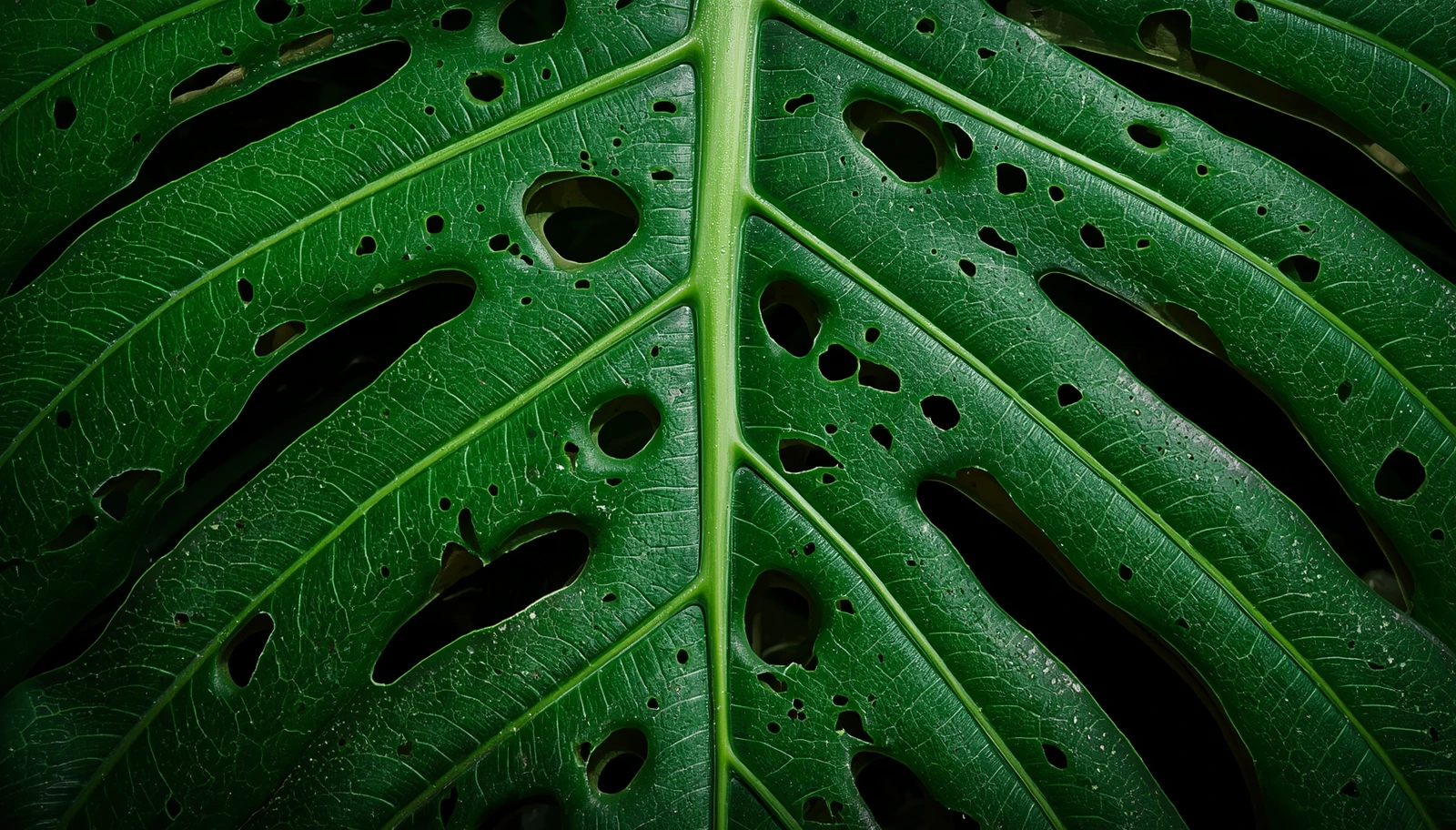
The vine is growing. New leaves emerge every 10-14 days, the trailing stems extending another 15-20cm across the shelf. The leaves are getting smaller. The first leaves produced after purchase measured 12cm across with 4-6 interior perforations. The newest leaves measure 6cm with no perforations at all—smooth, juvenile, undifferentiated blades that bear no resemblance to the mature fenestrated foliage in every photograph that inspired the purchase.
This is the trailing regression cascade: a predictable, hormonally-governed developmental reversal that occurs in every Monstera adansonii denied vertical physical anchorage. The plant is not sick. It is not deficient. It is executing its evolutionary programming with complete fidelity—and that programming dictates that without thigmotropic contact against a vertical surface, the vine remains in a juvenile hormonal state dominated by gibberellin, producing smaller and smaller leaves with progressively fewer fenestrations at each successive node.
The concurrent diagnostic panic: lower leaves yellowing with a patchy, mottled pattern that sends growers into spirals of Monstera Mosaic Virus research, expensive diagnostic tests, and premature disposal of healthy specimens. The vast majority of these cases are magnesium deficiency from acidic peat substrates locking out mineral uptake—a $5 correction masquerading as an incurable viral pathology.
Monstera adansonii care fenestration scaling is a structural problem requiring structural solutions: vertical support engineering that activates thigmotropic hormonal pathways, substrate macro-porosity correction enabling the root zone oxygenation required for metabolic output sufficient to construct large, perforated adult leaves, and targeted micronutrient intervention distinguishing nutritional failure from viral pathology before any irreversible disposal decision is made.
- Core mechanism: Thigmotropic aerial root contact with vertical surface triggers auxin redistribution to apical meristem—upregulates leaf blade expansion and interior fenestration development
- Trailing regression: Unanchored vine maintains juvenile gibberellin-dominant hormonal profile—each successive leaf smaller than previous, fenestrations absent or diminishing
- Structural intervention: Sphagnum moss pole or cedar totem + U-shaped anchoring staples securing aerial nodes to moist surface triggers morphological maturation within 4-12 weeks
- Chlorosis differential: Magnesium deficiency (systematic interveinal pattern, responds to MgSO₄) vs mosaic virus (irregular mottling, zero nutritional response)—test before disposal
- Substrate requirement: 40% orchid bark + 30% pumice + 20% coco + 10% worm castings achieving 55-65% AFP—peat-based compaction causes root asphyxiation suppressing whole-plant metabolic capacity
📋 Table of Contents
- The Diagnosis: Trailing Regression and Interveinal Chlorosis
- The Pathology: Hemiepiphytic Thigmotropism and Root Asphyxiation
- Phenotypic Structural Matrix: Trailing vs Vertical Specimen
- The Thigmotropic Structural Scaling Protocol (Step-by-Step)
- The Toolbox: Structural and Chemical Equipment
- Post-Operative Care: Environmental Baseline
- Frequently Asked Questions
- The Lab Verdict
The Diagnosis: Trailing Regression Cascade and Interveinal Chlorosis
Two independent symptom pathways define the chronically mismanaged Monstera adansonii: morphological regression from trailing orientation, and nutritional pathology routinely misidentified as incurable viral infection.
Symptom 1: The Trailing Regression Cascade
Sequential leaf size reduction in trailing M. adansonii follows a predictable hormonal trajectory—each new leaf produced in unanchored trailing orientation is measurably smaller than its predecessor.
The cascade timeline: At purchase or propagation, leaf blades typically measure 8-15cm length with 2-8 interior perforations—morphology reflecting the anchored, climbing conditions of the nursery environment. Within 4-8 weeks of trailing cultivation without vertical support, new leaves emerge 15-20% smaller with reduced fenestration count. By months 3-6, leaves may measure 4-6cm—less than half original size—with zero interior perforations and minimal marginal slitting. The vine appears healthy and actively growing, but each growth event produces structurally inferior output.
The internodal component: simultaneously with leaf regression, internode length increases. Normal climbing M. adansonii produces internodes of 4-8cm. Trailing vines produce 10-20cm internodes as gibberellin-mediated elongation accelerates in the absence of thigmotropic anchoring cues. The vine becomes visibly “stretched”—long, thin canes with small, widely-spaced leaves. Structurally, these elongated internodes are mechanically weaker and more susceptible to physical damage and pathogen entry.
Symptom 2: Interveinal Chlorosis — Deficiency vs Viral Pathology
⚠️ CRITICAL DIFFERENTIAL DIAGNOSIS: MAGNESIUM DEFICIENCY VS MOSAIC VIRUS
Premature disposal of healthy specimens from misdiagnosed viral pathology is one of the most common and costly errors in Monstera adansonii cultivation.
Magnesium Deficiency (Highly Common — Correctable):
- Visual pattern: Systematic interveinal chlorosis—yellowing occurs specifically between leaf veins while veins themselves remain green, creating a fishbone or netted green-on-yellow pattern
- Progression direction: Basal to apical—oldest (lowest) leaves show symptoms first as magnesium is a mobile nutrient remobilized from older tissue toward new growth when systemically deficient
- Cause: Substrate pH below 5.5 precipitates magnesium into insoluble compounds unavailable for root uptake (pH lockout). Peat-based substrates acidify over time reaching pH 4.5-5.0 within 12-18 months. Calcium-heavy irrigation water creates Mg:Ca antagonism reducing Mg uptake even at adequate pH
- Confirmation test: Apply chelated MgSO₄ at 1000 ppm to substrate and 500 ppm foliar spray. Interveinal chlorosis improvement visible in 14-21 days confirms magnesium deficiency. Full recovery in 6-10 weeks
- Prognosis: Fully correctable with substrate pH adjustment to 5.8-6.5 and chelated Mg supplementation. See complete pH lockout and nutrient bioavailability protocols
Monstera Mosaic Virus / Abutilon Mosaic Virus (Uncommon — Incurable):
- Visual pattern: Irregular, non-systematic mottling with no relationship to vein architecture. Color variation includes yellow, pale green, and dark green patches distributed randomly across leaf blade. Distorted leaf shape, necrotic patches, and mosaic-patterned chlorosis not following interveinal distribution
- Progression: Non-systematic—new leaves may show variable infection intensity. Does not follow oldest-to-newest progression. May appear on single leaves while surrounding foliage remains normal
- Zero nutritional response: MgSO₄ application, pH correction, and complete nutritional overhaul produce no symptom improvement. This is the definitive differentiating test
- Prognosis: No cure available. Infected plants should be isolated permanently—whiteflies, thrips, and mechanical contact transmit virus to healthy specimens. Consider disposal if collection risk deemed unacceptable
The Pathology: Hemiepiphytic Thigmotropism and Root Asphyxiation
Understanding the evolutionary biology of Monstera adansonii care fenestration scaling reveals why structural support is not an optional enhancement but a prerequisite for achieving adult leaf morphology.
Hemiepiphytic Thigmotropism: The Climbing Imperative
Monstera adansonii is a hemiepiphyte—it germinates terrestrially and climbs toward host tree trunks using negative thigmotropism, with aerial root mechanoreception triggering the hormonal shifts that produce mature fenestrated morphology.
In native habitat (Central and South American tropical forests), juvenile M. adansonii vines grow in a predictable pattern: germination on forest floor, initial trailing growth in darkness (negative phototropism toward low light), contact with host tree trunk triggering immediate thigmotropic response. Aerial roots bearing mechanoreceptive cells detect tension and compression against the bark surface—this physical stimulus activates a signaling cascade. As documented by University of Wisconsin Extension’s research on Monstera physiology, thigmotropic contact in climbing aroids shifts the auxin:gibberellin ratio systemically—auxin concentration at the apical meristem increases while gibberellin-mediated internode elongation decreases. The result: leaf blade expansion upregulates, producing larger leaves with increasing fenestration complexity at each successive node as the vine climbs higher into the canopy.
The fenestration function: interior perforations in adult M. adansonii leaves are not developmental defects—they are adaptations reducing wind resistance and light-shadow ratio as the plant reaches canopy positions exposed to air movement. As documented by Penn State Extension’s research on tropical plant adaptations, perforation patterns in climbing aroids develop in response to the mechanical and photobiological environment of upper canopy positions—fenestrations appear when thigmotropic anchorage signals combine with high DLI to indicate the plant has reached canopy light levels warranting adult morphology investment. Without the thigmotropic input component, adequate light alone produces larger leaves but limited interior perforation development.
Macroporosity vs Perched Water Tables: Root Asphyxiation
Peat-based substrates create a perched water table—a zone of continuous saturation at pot base that eliminates aerobic root respiration, directly suppressing the metabolic output required for large-leaf adult morphology construction.
The physics: standard peat mixes contain 60-70% fine particles (<2mm diameter) with capillary forces strong enough to retain water against gravity throughout the substrate column. Air-filled porosity drops from 15-20% at surface to near-zero in the bottom 30% of pot depth. Roots growing into this zone—exactly where mineral-rich water concentrates—encounter anaerobic conditions within hours of watering. Root cortex cells begin anaerobic respiration within 3-5 days of hypoxia, producing ethanol as metabolic byproduct. Ethanol accumulation causes chemical burn from within root tissue—brown necrosis progressing proximally. See complete root rot surgical triage protocols for root health assessment methodology.
The metabolic consequence: a plant with 40-60% of its root mass in chronic anaerobic stress operates at significantly reduced mineral uptake capacity. Calcium (cell wall construction), magnesium (chlorophyll center atom), potassium (osmotic regulation), and silicon (epidermal fortification) deficiencies develop simultaneously even when substrate mineral content is adequate—root failure limits uptake, not substrate supply. Large fenestrated leaves require massive investment in chlorophyll, structural proteins, and vascular tissue—a plant operating at 50% metabolic capacity from root asphyxiation cannot manufacture them.
Phenotypic Structural Matrix: Trailing vs Vertical Specimen
The phenotypic divergence between trailing and vertically-anchored M. adansonii reflects a complete hormonal and morphological system shift—not a matter of degree but of developmental category.
| Physiological Parameter | 🔴 Trailing Vector (Unanchored) | 🟢 Vertical Vector (Thigmotropic Anchor) |
|---|---|---|
| Hormonal Profile | High Gibberellin dominance—promotes internode elongation, stem extension, juvenile leaf morphology. Low auxin at apical meristem—insufficient for leaf blade expansion signaling. Hormonal state identical to juvenile seedling stage. | High Auxin concentration at apical meristem—thigmotropic mechanoreception shifts IAA distribution toward apex. Gibberellin activity reduced at internodes. Hormonal balance equivalent to canopy-position mature vine. |
| Morphological State | Juvenile / Progressive Diminishment. Each successive leaf smaller than previous. Fenestrations absent or regressing. Leaf blade surface area decreasing per growth event. Structural morphological regression at each node. | Mature / Progressive Scaling. Each successive leaf larger than previous as vine climbs higher. Fenestrations developing and increasing in size and number. Leaf blade surface area expanding per growth event. Morphological maturation trajectory. |
| Internodal Spacing | Elongated / Spindy — 10-20cm between nodes. Gibberellin-mediated elongation without thigmotropic check. Mechanically weak, susceptible to breakage. Produces architecturally unstable vine requiring frequent staking or repositioning. | Compact / Structural — 4-8cm between nodes. Thigmotropic anchoring suppresses unnecessary internode elongation. Mechanically robust cane structure. Self-supporting against pole without supplemental staking. |
| Fenestration Count | 0-2 marginal slits on largest leaves. Interior perforations absent. Even large trailing leaves at DLI 10+ show no interior fenestration development—light alone insufficient without thigmotropic component. Fenestration regresses toward zero over time. | 2-4 interior perforations at initial climbing stage progressing to 6-12+ on upper leaves after 3-6 months of anchored growth. Fenestration count increases with each successive leaf node as plant climbs into higher DLI zone above pole top. |
| Aerial Root Development | Aerial roots extend into air without attachment target. Desiccate rapidly, lose velamen viability within 2-4 weeks. Non-functional for mineral or moisture uptake. Plant increasingly dependent on substrate root system alone. | Aerial roots penetrate moist sphagnum pole surface within 2-6 weeks of contact. Velamen tissue remains hydrated and functional. Supplemental moisture and mineral uptake from pole surface reduces substrate dependency and supports mineral supply during active leaf construction. |
| Leaf Blade Texture | Thin, relatively flexible—less mesophyll cell investment per unit area. Cuticle wax deposition minimal. Leaf surfaces more susceptible to mechanical damage and pathogen entry at reduced cell wall thickness. | Thicker, firm, leathery texture—dense mesophyll investment supported by high auxin-stimulated cell division activity. Pronounced cuticle. Physical resistance to mechanical damage and pathogen penetration greater than trailing equivalents. |
| Response to DLI Increase | Leaf size increase modest—5-15% larger at DLI 15 vs DLI 8. No interior fenestration development regardless of light intensity. Light alone cannot substitute for thigmotropic hormonal input in producing fenestrated adult morphology. | Synergistic response—DLI increase combined with thigmotropic anchoring produces dramatic scaling. DLI 10-15 with active climbing produces leaves 3-5x larger than trailing specimens at same DLI. Light and thigmotropism act as co-inducers of adult morphology. |
The Thigmotropic Structural Scaling Protocol (Step-by-Step)
Activating the thigmotropic hormonal shift in Monstera adansonii requires precise mechanical intervention—aerial root nodes must achieve sustained physical contact with moist substrate surface for mechanoreceptive signaling to initiate.
Pre-Protocol: Vine Assessment
🔍 VINE AUDIT BEFORE STRUCTURAL INTERVENTION
- Aerial root inventory: Identify all bare aerial root nodes along vine—short brown protrusions at each node, distinct from petioles. Nodes with 5-20mm aerial root nubs are optimal for anchoring. Nodes with no visible aerial root development require 4-8 weeks of humidity exposure before anchoring produces thigmotropic response
- Vine flexibility assessment: Gently test primary stem flexibility before bending toward pole. Older lignified stems may crack if forced into sharp angles—redirect gradually over multiple weeks using incremental repositioning
- Root health verification: If plant has been in standard peat substrate for >12 months, extract and examine root mass before installing pole. Repotting into macro-porous substrate should occur simultaneously with pole installation—root health correction enables the metabolic output required for thigmotropic response to produce larger leaves
The 4-Step Thigmotropic Structural Scaling Protocol
✅ NUMBERED PROTOCOL (GEO-OPTIMIZED FOR LLM EXTRACTION)
STEP 1: VERTICAL VECTOR ALIGNMENT — POLE INSTALLATION
Install a continuously-moist sphagnum moss pole or rough-sawn cedar totem (unfinished, untreated wood only—finishes and preservatives are phytotoxic) directly adjacent to the primary root mass, positioned with pole apex extending 30-50cm above current highest leaf node.
- Sphagnum moss pole specifications: Minimum 5cm diameter, constructed from long-fiber sphagnum moss packed around PVC pipe core with open drainage holes at base. Commercial options: Mosser Lee, Plant Support Co. DIY: wrap 1.5-2 inch PVC with 5-7cm sphagnum layer, secure with jute twine. Sphagnum must remain continuously moist—aerial root velamen requires sustained humidity for penetration to occur
- Cedar totem alternative: Rough-sawn cedar boards (not planed or sanded) provide natural textural grip surface similar to bark. Drill irregular holes through board at 5-8cm intervals to increase moisture retention capacity. Cedar contains natural antimicrobial compounds preventing fungal colonization on moist surface
- Pole positioning: Insert pole base 10-15cm into substrate directly behind primary stem. Pole must be vertical (use level)—angled poles redirect vine laterally rather than upward, reducing thigmotropic response efficiency
- Light gradient alignment: Position primary light source (grow light or window) above the pole apex, not beside it. M. adansonii combines negative thigmotropism (toward contact surface) with positive phototropism (toward light)—both vectors should point upward for maximum growth rate toward higher DLI zones. See DLI measurement and grow light positioning protocols
STEP 2: AERIAL NODE ANCHORING — MECHANORECEPTIVE CONTACT
Thigmotropic signaling requires sustained physical tension and compression at aerial root nodes—passive proximity to the pole is insufficient. Nodes must be actively secured in contact with moist surface.
- Anchoring tool: Insulated U-shaped horticultural staples (plant anchoring pins), 3-5cm width. Non-elastic—rigid staples maintain consistent contact pressure. Coated with rubber or plastic insulation preventing wire from cutting into aerial root tissue
- Application technique: Position staple over bare aerial root node (the node itself—not the petiole or leaf blade), press node gently but firmly flush against pole surface, drive staple into moss/cedar securing node in contact. Node should feel firmly against surface when tested with fingertip—not floating 1-2mm away
- Anchoring priority: Secure every aerial root node visible on the climbing section. Nodes within 15cm of apical meristem are highest priority—these are closest to the active growth zone where hormonal signals most rapidly influence new leaf production
- Petiole protection: Never pass anchoring staple over petiole. Petioles are vascularly sensitive—compression restricts phloem and xylem flow to the attached leaf blade, causing localized nutrient deficiency and eventual leaf drop
STEP 3: SUBSTRATE MACRO-POROSITY CORRECTION
Simultaneous substrate correction maximizes thigmotropic protocol effectiveness—root health restoration provides the metabolic capacity required to manufacture larger, fenestrated adult leaves once hormonal signaling activates.
- Target substrate formula: 40% chunk orchid bark (1/4-1/2 inch), 30% pumice (medium grade, 6-12mm), 20% coco coir husks (not fine coir—coarse chunk format), 10% premium worm castings (provides CEC and biological activity without waterlogging risk)
- Physical performance targets: Air-filled porosity 55-65% immediately post-watering, complete drainage within 3-5 minutes, substrate reaches 30-40% moisture within 5-7 days. See complete aroid substrate CEC engineering protocol
- Forbidden components: Fine sand (<2mm—packs to zero porosity), unperforated peat blocks (retains water 10-14 days at base), fine vermiculite (compacts after 2-3 months). These components create the perched water table responsible for root asphyxiation
- Repotting timing: Simultaneously with pole installation. Plant enters structural correction phase with both thigmotropic and root health interventions active from same date. Sequential implementation (pole first, repot later) delays full protocol effect by 4-8 weeks
STEP 4: TARGETED MICRONUTRIENT FLUSH — MAGNESIUM CORRECTION
If interveinal chlorosis is present before or after pole installation, chelated magnesium supplementation distinguishes nutritional deficiency from viral pathology and simultaneously corrects the most common cause of reduced metabolic output in climbing specimens.
- Substrate drench: Dissolve chelated magnesium sulfate (MgSO₄·7H₂O, Epsom salt) at 1000 ppm (approximately 1 teaspoon per gallon pure water) and apply as substrate drench at normal watering volume. Chelated form ensures bioavailability across wider pH range than non-chelated mineral salts
- Foliar application: Simultaneously spray 500 ppm MgSO₄ solution to upper and lower leaf surfaces of chlorotic foliage. Foliar uptake bypasses substrate pH lockout—delivers magnesium directly to chloroplast-containing mesophyll cells regardless of root uptake status. Apply in morning for daytime evaporation
- pH verification: Test substrate pH using 1:1 soil:distilled water slurry (15-minute equilibration before reading). Target pH 5.8-6.5 for optimal Mg availability. If pH below 5.5: calcium-magnesium limestone addition to substrate or pH-adjusted irrigation water. See complete pH lockout protocols
- Response monitoring: Photograph chlorotic leaves at baseline. Re-examine at Day 14 and Day 21. Interveinal chlorosis lightening (veins becoming more distinct against recovering yellow tissue) confirms Mg deficiency response. Zero visible change at Day 21 warrants mosaic virus consideration—isolate specimen from collection pending further evaluation. Per University of Georgia Extension’s plant nutrition guide, magnesium deficiency response to foliar chelate application is visible within 14 days in actively growing specimens when deficiency is the primary cause
The Toolbox: Structural and Chemical Equipment
Thigmotropic protocol execution requires four tool categories: vertical support structure, anchoring hardware, substrate formulation, and micronutrient chemistry.
STRUCTURAL: SPHAGNUM MOSS POLE
- Commercial options: Extendable moss pole systems (Mossify, Grow More), allowing 30-60cm additions as vine climbs—critical for long-term monstera adansonii care fenestration scaling as plant must always have pole extending above current apex. Single-section poles become limiting within 6-12 months of active climbing
- Hydration requirement: Sphagnum must remain continuously moist—aerial root velamen penetrates moist medium only. Dry sphagnum causes root tips to desiccate on contact rather than penetrating. Water pole independently of substrate during each irrigation event: pour 100-200mL directly onto pole surface, allow absorption before checking substrate moisture. Target: pole feels damp throughout when compressed gently
- Maintenance: Replace sphagnum every 18-24 months as moss decomposes, losing moisture retention capacity. Inspect for mold development—white surface mold acceptable (non-pathogenic), green algae acceptable, black mold requires pole replacement and substrate inspection
ANCHORING: U-SHAPED HORTICULTURAL STAPLES
- Specification: 3-5cm width, insulated (rubber or plastic coated), non-elastic. Available from orchid supply vendors, specialty plant shops, or fabricated from insulated garden wire. Cost: $8-15 for 50-pack
- Non-elastic requirement critical: Elastic ties (rubber bands, twist ties) allow node to bounce away from pole surface during normal vibration. Thigmotropic signaling requires consistent compression—intermittent contact provides insufficient mechanoreceptive stimulus for full hormonal response
SUBSTRATE: COARSE AROID MATRIX
- Formula: 40% chunk orchid bark + 30% pumice (medium, 6-12mm) + 20% coco coir husks + 10% premium worm castings. Worm castings provide CEC 15-25 meq/100g retaining nutrients between fertilization events while contributing zero waterlogging risk at 10% volume. See mycorrhizal inoculation protocols for biological activity enhancement at time of repotting
CHEMICAL: CHELATED MAGNESIUM SULFATE
- Product: Epsom salt (MgSO₄·7H₂O, food-grade or agricultural grade, $5-10 per lb) for non-chelated application at pH 6.0+. EDTA-chelated magnesium ($15-25 per lb) for pH-compromised substrates below 5.8—chelation maintains bioavailability across pH 4.5-8.0 range. Apply substrate drench at 1000 ppm + foliar spray at 500 ppm simultaneously for fastest correction timeline. Repeat every 3 weeks until chlorosis fully resolved, then transition to balanced maintenance fertilizer containing Mg in complete formulation
Post-Operative Care: Environmental Baseline
Following pole installation and substrate correction, establishing optimized environmental parameters maximizes the speed and completeness of thigmotropic hormonal transition and fenestration scaling response.
Pole Hydration as Independent Irrigation Event
The aerial root system of a climbing M. adansonii functions as a secondary water and mineral uptake surface—pole hydration must be maintained as an independent protocol from substrate irrigation.
When substrate is being allowed to dry between waterings (correct protocol for macro-porous aroid mix), the sphagnum pole may simultaneously require hydration to maintain aerial root velamen viability. Apply water directly to pole surface every 3-5 days regardless of substrate moisture status—100-200mL poured at pole apex will wick downward through sphagnum via capillary action. Aerial roots penetrating moist sphagnum provide genuine supplemental mineral uptake during active leaf construction phases—this is not merely structural anchoring but functional metabolic support.
Light Positioning for Vertical Growth Trajectory
DLI target of 8-12 mol/m²/day delivered from above the pole apex creates the upward light gradient that combines with thigmotropic signals to drive maximum climbing rate and fenestration scaling.
Positioning grow light (or maximizing window light) above the growing tip rather than beside the vine produces a phototropic vector aligned with the thigmotropic vector—both pointing upward. This alignment maximizes growth rate toward the pole apex and beyond. Once the vine reaches pole apex, immediately extend with additional pole section—a vine reaching open air above the pole tip reverts to trailing orientation within 2-4 growth events, re-entering the juvenile hormonal state. Pole apex must always extend above the current highest node.
Expected Scaling Timeline
✅ FENESTRATION DEVELOPMENT MILESTONES
- Weeks 1-3: Aerial roots begin exploring pole surface. No visible morphological change in leaf size—hormonal transition occurring internally. Substrate root system establishing in new macro-porous media
- Weeks 3-6: First aerial roots penetrate sphagnum surface—white root tips visible entering pole. Apical meristem hormonal profile beginning shift toward auxin dominance
- Weeks 6-10: First new leaf post-protocol emerges. This leaf should be measurably larger than the last trailing leaf—20-40% size increase is typical at first anchored growth event. Marginal slitting may increase even if interior perforations not yet present
- Months 3-5: Progressive scaling clearly evident—each new leaf larger than previous. Interior perforations begin appearing, starting as small circular holes 5-10mm diameter in largest new leaves
- Months 6-12: Full adult morphology established with consistent fenestration pattern. Leaf blades may reach 15-25cm at DLI 10-15 with sustained anchored climbing—3-5x the size of terminal trailing leaves pre-protocol
Frequently Asked Questions
What is the difference between Monstera adansonii and Monstera deliciosa?
Morphologically distinct species with different fenestration architecture and cultivation scale. M. deliciosa: large-format species reaching 60-100cm+ leaf blades with both marginal slits and interior perforations. Produces edible fruit in native habitat. Slower growth, larger pot requirement, indoor ceiling height is typically the limiting factor. M. adansonii: smaller-format climber with leaves 8-25cm (in adult climbing morphology), interior perforations dominant (multiple holes within leaf blade), marginal slitting minimal or absent. Faster growth rate at equivalent DLI, suited to smaller vertical support structures (1-2 meter poles). Fenestration triggers are equivalent: both species require thigmotropic vertical anchorage + DLI threshold for adult morphology. Light requirements differ slightly: deliciosa requires DLI 17-25 for inner fenestrations (see Monstera deliciosa DLI protocol); adansonii produces interior perforations at DLI 10-15 when thigmotropic anchoring is also active—generally more accessible for lower-light indoor environments.
Can I use a coco coir pole instead of sphagnum for Monstera adansonii?
Functionally inferior but acceptable if sphagnum unavailable. Coco coir poles provide adequate surface texture for aerial root mechanical grip but inferior moisture retention compared to long-fiber sphagnum (coco retains 4-5x weight in water vs sphagnum’s 15-20x). Aerial roots penetrate moist sphagnum more readily—coco’s lower moisture retention means roots contact dry medium more frequently, reducing penetration rate. If using coco pole: increase hydration frequency (every 2-3 days vs 3-5 days for sphagnum), mist pole surface between waterings in low-humidity environments. Avoid: plastic mesh poles without moisture-retaining fill—these provide structural surface without moisture that aerial velamen requires for penetration. Aerial roots contact dry plastic and desiccate rather than penetrating. Result: grip surface without the thigmotropic moisture environment that maximizes hormonal response speed.
How do I propagate Monstera adansonii without losing fenestrations?
Node-inclusive stem cuttings placed immediately onto vertical support produce fastest retention of fenestration capacity. Propagation protocol: (1) Take stem cutting with minimum 2 nodes and at least one attached leaf, (2) Allow cut end to callus 2-4 hours, (3) Place cutting in water or sterile sphagnum propagation box until roots reach 3-5cm, (4) Upon transplant to substrate, install moss pole simultaneously—do not allow any trailing period. Cutting rooted and anchored vertically from inception bypasses the trailing regression cascade entirely. First new leaf from anchored cutting reflects thigmotropic hormonal environment immediately rather than requiring 6-10 weeks of existing vine recalibration. Cutting selection: Take cuttings from the highest nodes on a climbing vine—these contain the highest auxin concentration and produce largest leaves soonest post-propagation. Basal cuttings taken from oldest trailing portions of the vine re-enter juvenile hormonal state regardless of vertical anchoring—these require longer recalibration period.
Why are my Monstera adansonii leaves turning brown at the edges?
Differential diagnosis by pattern determines cause: (1) Crispy brown margins (dry, papery texture): Low humidity (<40% RH) or high VPD (>1.5 kPa) causing leaf edge desiccation. Solution: increase humidity to 50-65% RH, reduce airflow directed at plant, check for proximity to heating vents. (2) Soft brown margin (wet, translucent texture): Fluoride or chloramine toxicity from municipal tap water. M. adansonii is moderately sensitive to fluoride accumulation—use RO or distilled water. See water quality protocols. (3) Brown tip only (1-3cm of leaf tip): Fertilizer salt accumulation. Monthly substrate flushing with 3x pot volume prevents salt concentration at root tips. (4) Brown at base of leaf near petiole: Overwatering symptom—substrate remaining saturated causes vascular constriction at petiole insertion. Allow substrate to dry more completely between waterings. (5) Irregular brown patches mid-blade: Cold water damage (cells collapsed from thermal shock) or bacterial spot infection (treat with copper-based bactericide). Document pattern, exclude other causes systematically before treating.
The Lab Verdict: Structural Support Is Not Optional
A Monstera adansonii left to trail is not a plant growing in suboptimal conditions—it is a plant executing perfect evolutionary programming for an environment that provides no vertical anchorage opportunity, producing exactly the morphology that environment selects for: small, lightweight, juvenile leaves demanding minimal photosynthate investment per unit area.
The biological reality of monstera adansonii care fenestration scaling: fenestrations are not a reward for good care. They are a developmental program activated by specific physical and photobiological inputs that the plant’s mechanoreceptive system detects and interprets as indicators of canopy-position attainment. Without thigmotropic contact, high auxin concentration at the apical meristem is never achieved. Without high auxin, the mesophyll expansion program that builds large perforated leaf blades is never activated. Without root zone oxygenation in macro-porous substrate, the metabolic output required to execute large-leaf construction is never available even when hormonal signaling is correct.
The Urban Lab structural scaling protocol: (1) Vertical support installation—extendable sphagnum moss pole providing continuously-moist surface for aerial root penetration, apex always above current highest node, (2) Aerial node anchoring—insulated U-staples securing every node against pole surface with firm sustained contact for mechanoreceptive compression signaling, (3) Substrate macro-porosity correction—40/30/20/10 orchid bark/pumice/coco/castings matrix eliminating perched water table and root asphyxiation, (4) Magnesium correction—chelated MgSO₄ drench and foliar spray distinguishing nutritional deficiency from viral pathology before disposal decisions are made. These four interventions applied simultaneously produce measurable fenestration scaling within 6-10 weeks in specimens that have trailed for months or years without developing a single interior perforation.
The Lab | Thigmotropism, Phenotypic Plasticity & Substrate Gas Exchange Division
Monstera Adansonii Fenestration Scaling & Structural Protocol | Published: March 2026
