
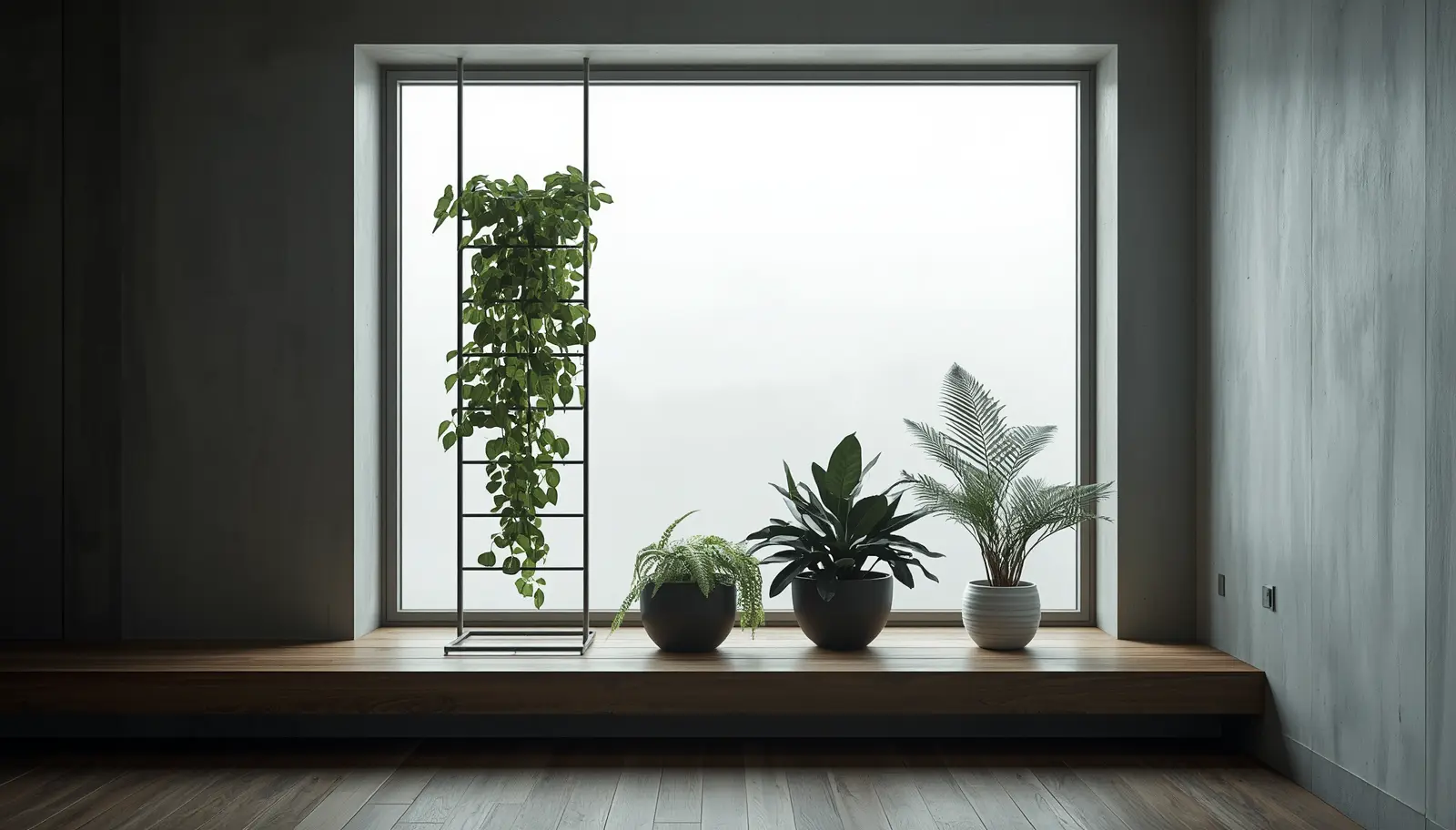
A north-facing window (in the Northern Hemisphere) gets no direct sun, so it gives the lowest light of any window. That rules out sun-lovers like succulents and crotons, but plenty of houseplants tolerate it. This guide lists the best indoor plants for north-facing windows, how close to the glass to put them, how to adjust watering in low light, and which choices are safe for cats and dogs. It follows University of Maryland, Iowa State, Penn State, Illinois and UNH Extension, NC State and the ASPCA.
How Much Light Does a North-Facing Window Get?
UMD Extension groups indoor light into four levels and names north-facing windows (or artificially lit rooms) as the source of low light, which it puts at 25 to 100 foot-candles. It notes that light intensity decreases rapidly with distance from the window. Illinois Extension gives a placement guide: directly in front of a north window counts as medium light (about 150 foot-candles), and a few feet away as low light (about 75 foot-candles).
| Light level (UMD) | Typical source | Example plants (UMD) |
|---|---|---|
| Low (25 to 100 fc) | North-facing window, artificially lit room | ZZ plant, snake plant, cast iron plant, peace lily |
| Medium-bright (100 to 500 fc) | East- or west-facing window | Chinese evergreen, rubber plant, dracaena |
| High (500 to 1000 fc) | South-facing or some west-facing windows | Croton, hibiscus, jade plant, hoya |
Source: University of Maryland Extension, Lighting for Indoor Plants (2023). Foot-candle (fc) ranges vary between extension services.
Other extension services use slightly different numbers: Penn State Extension says a common baseline for low light is 100 foot-candles. The practical rule is the same: in a north window, the closer to the glass, the better. A cheap light meter or phone app gives you a rough reading. For more on light levels, see our Monstera light guide.
Best Plants for North-Facing Windows
| Plant | What the sources say about low light | Pets (ASPCA) |
|---|---|---|
| ZZ plant | “Do exceptionally well in low light” (Iowa State); low-light plant (UMD) | Toxic |
| Cast iron plant | Endures low light better than most houseplants (Iowa State); low-light plant (UMD) | Non-toxic |
| Snake plant | Grows in low to direct light (Iowa State); often placed in north windows (Penn State) | Toxic |
| Peace lily | Grows in low light but flowers best in indirect sunlight (Iowa State) | Toxic |
| Pothos | Grows in low to moderate light (Iowa State); recommended for dim spaces (UNH) | Toxic |
| Heartleaf philodendron | Grows in low to indirect light (Iowa State) | Toxic |
| Parlor palm | Tolerates low light; north or east window suggested (NC State) | Non-toxic |
| Chinese evergreen | Medium-bright light (UMD); best right at the glass | Toxic |
Sources: Iowa State Extension (Steil, reviewed 2025); UMD Extension; Penn State Extension (Jubela, 2024); UNH Extension (2018); NC State Extension; ASPCA.
1. ZZ plant
Iowa State Extension says ZZ plants do exceptionally well in low light. They store water in thick rhizomes, so they need watering only occasionally, especially in a dim spot. See our ZZ plant guide.
2. Cast iron plant
Iowa State says cast iron plant (Aspidistra elatior) endures heat, dust, low light and lack of water better than most other houseplants. It grows slowly but is one of the most reliable plants for a dim room, and the ASPCA lists it as non-toxic. See our cast iron plant guide.
3. Snake plant
Iowa State says snake plants grow in low to direct light. Penn State notes they are often placed in north-facing windows and grow in a wide range of light levels, though growth is faster in brighter light. See our snake plant guide.
4. Peace lily
Iowa State says peace lilies grow in low light but flower best in indirect sunlight, so in a north window expect healthy leaves and fewer flowers. Place it right by the glass if you want blooms. See our peace lily guide.
5. Pothos and heartleaf philodendron
UNH Extension says that in a dimly lit space you should still succeed with snake plant, English ivy, philodendron or pothos. Iowa State says pothos grows in low to moderate light and heartleaf philodendron in low to indirect light. Penn State notes that darker-leaved pothos such as ‘Jade’ handle lower light better than bright variegated types. Expect longer gaps between leaves in low light. See our pothos guide and heartleaf philodendron guide.
6. Parlor palm
NC State Extension says the parlor palm (Chamaedorea elegans) tolerates low light and suggests a north- or east-facing window. It is one of the few palms suited to a dim room, and the ASPCA lists it as non-toxic to dogs and cats.
7. Chinese evergreen
UMD lists Chinese evergreen (Aglaonema) as a medium-bright light plant, so in a north window place it directly in front of the glass, where Illinois puts the light at medium. See our Aglaonema guide.
Cat-Safe Plants for North-Facing Windows
Most of the classic low-light plants are toxic to pets: the ASPCA lists snake plant, peace lily, pothos, philodendron and Chinese evergreen as toxic to cats and dogs, and ZZ plant contains calcium oxalate. For a home with cats or dogs, the safest choices from this list are the cast iron plant and the parlor palm, both listed by the ASPCA as non-toxic. See our cat-safe plants list for more options.
Watering and Care in Low Light
- Water less often. Plants in low light grow more slowly and use less water, so the potting mix stays wet longer. Water when the top of the mix has dried rather than on a schedule. UNH warns that nothing kills a houseplant faster than overwatering. See our overwatered vs underwatered guide.
- Keep plants near the glass. Light falls off quickly with distance (UMD).
- Feed lightly. Slow-growing plants in low light need little fertilizer.
- Keep leaves clean so dust doesn’t block what light there is.
- Add a grow light if needed. UMD says to supplement with artificial lighting when natural light isn’t enough, and to keep total daily light to no more than 16 hours. See our grow light guide.
Signs a Plant Needs More Light
UMD lists the symptoms of too little light: spindly or leggy stems that stretch toward the window, fading leaf color, fewer flowers, poor growth, and plants that lean toward the light. UNH adds long, leggy stems and leaves that are unusually dark green. Yellowing leaves in a dim spot usually come from soil that stays too wet; see our yellow leaves guide. Rotate pots every week or two so they grow evenly.
Plants to Avoid in a North Window
UMD lists croton, hibiscus, jade plant and hoya as high-light plants, and citrus, succulents, cacti, gardenia and tillandsia as needing direct indoor sun. These struggle in a north window without a grow light.
Frequently Asked Questions
What plants do well in a north-facing window?
Low-light plants such as ZZ plant, snake plant, cast iron plant and peace lily (UMD), plus pothos and heartleaf philodendron (Iowa State) and parlor palm (NC State).
How much light does a north-facing window get?
UMD calls it low light, about 25 to 100 foot-candles. Illinois says a spot directly in front of a north window gives medium light (about 150 foot-candles) and a few feet back gives low light.
How far from a north window should plants be?
As close as practical. Light decreases rapidly with distance (UMD), and Illinois classes a few feet back from a north window as low light.
Are there cat-safe plants for a north-facing window?
Yes. The ASPCA lists cast iron plant and parlor palm as non-toxic to cats and dogs, and both tolerate low light.
Will a peace lily flower in a north window?
It grows well in low light but flowers best in indirect sunlight (Iowa State), so expect fewer flowers unless it sits right by the glass.
Do plants need less water in a north-facing window?
Usually yes, because they grow more slowly and the mix dries more slowly. Water when the top of the mix is dry, not on a schedule.
Sources
- University of Maryland Extension: Lighting for Indoor Plants (updated 2023)
- Steil, A. Easy Low-Maintenance Houseplants. Iowa State University Extension (reviewed 2025)
- Jubela, J. Low Light Houseplants. Penn State Extension (2024)
- University of Illinois Extension: Houseplants, Lighting
- UNH Extension: Can You Recommend Some Easy to Grow House Plants for My Home? (2018)
- NC State Extension Plant Toolbox: Chamaedorea elegans
- ASPCA: Toxic and Non-Toxic Plant List for Cats