
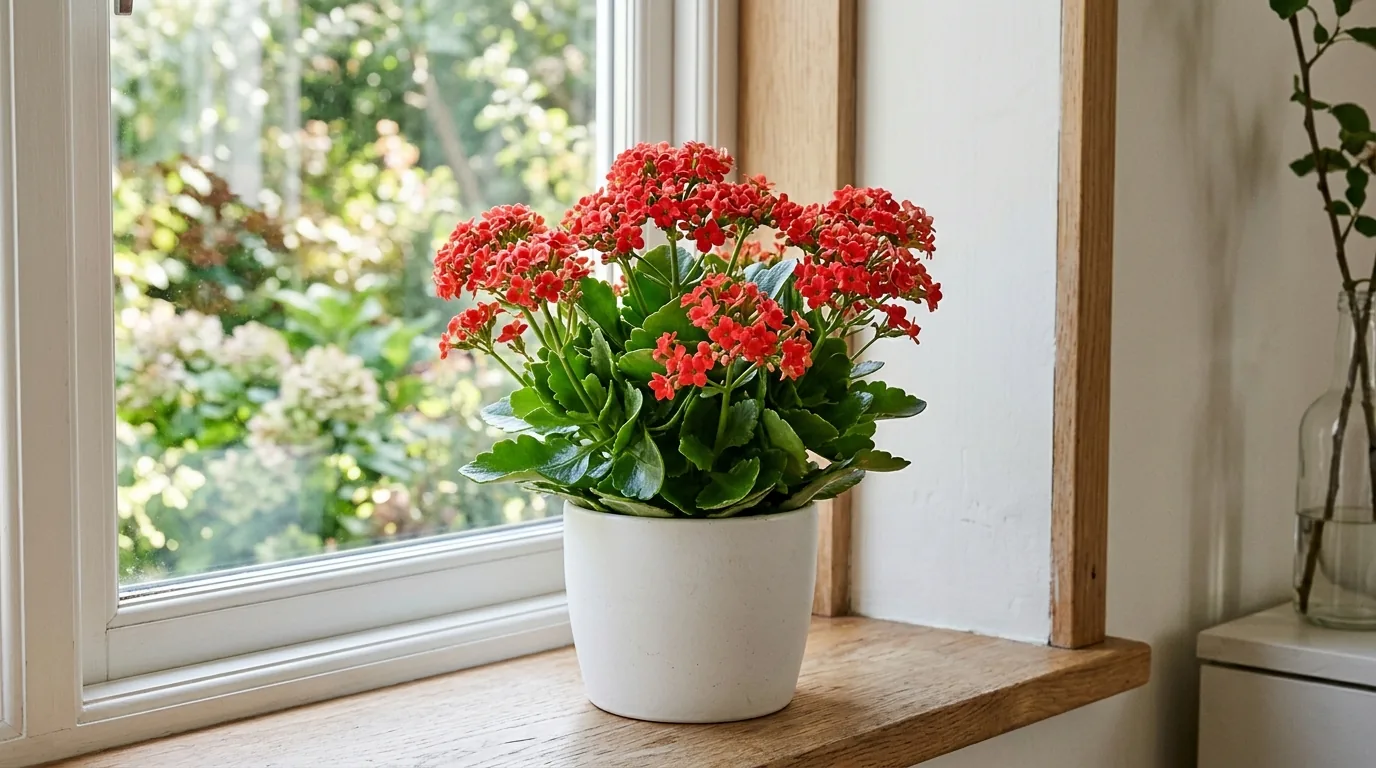
Florist kalanchoe (Kalanchoe blossfeldiana), also sold as Flaming Katy or Christmas kalanchoe, is a compact succulent covered in clusters of small red, orange, pink, yellow or white flowers. NC State Extension lists it as native to northeast Madagascar and 6 to 18 inches tall. It is easy to keep alive, and with the right winter nights it will bloom again. This guide covers kalanchoe care indoors, watering, kalanchoe care after flowering, reblooming, propagation and pet safety, following Clemson HGIC, NC State Extension and the ASPCA.
Kalanchoe Care at a Glance
| Need | What the sources say |
|---|---|
| Light | Full sun best; tolerates bright indoor light but gets leggy in low light (Clemson); bright indirect or partial shade, afternoon shade to prevent scorch (NC State) |
| Temperature | Nights 45 to 65°F, days 50 to 70°F; cool nights make flowers last longer (Clemson) |
| Water | Let the soil dry between waterings, then water deeply (NC State); overwatering is the main danger (Clemson) |
| Soil | Well-drained cactus or succulent mix (NC State); 60% peat moss, 40% perlite (Clemson) |
| Feeding | Monthly with houseplant fertilizer while actively growing (Clemson) |
| Rebloom | 14 hours of total darkness daily for at least 6 weeks (NC State) |
| Size | 6 to 18 inches tall, 6 to 12 inches wide (NC State) |
| Pets | Toxic to dogs and cats (ASPCA) |
Sources: Clemson HGIC 1563; NC State Extension Plant Toolbox; ASPCA.
Light and Temperature
Clemson HGIC says kalanchoe grows best in full sun and tolerates bright indoor light, but becomes leggy in low light. NC State suggests bright, indirect light or partial shade and warns that prolonged direct sun can scorch the leaves, so afternoon shade helps. Indoors, the brightest window you have, with some protection from hot afternoon sun through glass, satisfies both.
Clemson gives ideal temperatures of 45 to 65°F at night and 50 to 70°F by day, and notes that cool nights make the flowers last longer. Keep a flowering plant away from heaters.
Watering and Soil (Kalanchoe Care in Pots)
Kalanchoe is a succulent, and NC State lists it as drought tolerant: let the soil dry out between waterings, then water deeply. Clemson says overwatering is the most common way to damage it; root rot usually comes from poorly draining soil or watering too often. Never let the pot stand in water.
- Mix: a well-drained cactus or succulent mix (NC State), or Clemson’s 60% peat moss and 40% perlite.
- Pot: always with drainage holes. Gift plants often come in a decorative sleeve or foil that traps water; remove it or empty it after each watering.
- Winter: water less while growth is slow; see our winter houseplant care guide.
For succulents in general, see our guide on how to grow succulents.
Feeding
Clemson suggests feeding actively growing plants monthly with any houseplant fertilizer. Hold off while the plant is resting in winter, and resume when new growth starts.
Kalanchoe Care After Flowering
Many gift kalanchoes are thrown away after blooming, but they are perennials and can be kept for years. NC State suggests deadheading spent flowers to encourage more blooms. When flowering is over, Clemson recommends:
- Cut back tall growth and old flower stems.
- Move it to a slightly larger pot.
- Keep it well watered (letting the mix dry between waterings) in a sunny, warm window.
- After frost danger has passed, it can go outdoors in a bright, lightly shaded spot; acclimate it gradually to avoid leaf burn.
- Bring it back indoors before the first frost, or about 3 months before you want it to bloom.
For moving plants back inside in fall, see our guide to bringing plants indoors for winter.
How to Make Kalanchoe Bloom Again
Kalanchoe is a short-day plant: it sets flower buds only after a run of long nights. NC State says it needs total darkness for 14 hours a day for at least 6 weeks in fall and winter, plus 6 to 8 hours of bright light a day. Clemson describes a 14 to 16 hour night period and gives two ways to provide it:
- Keep the plant in a room where no lights are turned on during the natural dark hours, or
- Put it in a closet in the late afternoon and bring it back into high light every morning.
| Rebloom detail | Source |
|---|---|
| Natural day lengths from October 1 to March 1 allow bud formation | Clemson |
| About 6 weeks of short days are needed | Clemson, NC State |
| Once buds are visible above the leaves, day length no longer matters | Clemson |
| Long nights starting in early October give flowers by about January, roughly 12 weeks later | Clemson |
| Night temperatures above 80°F during the long-night period can delay flowering | Clemson |
Sources: Clemson HGIC 1563; NC State Extension.
If your kalanchoe won’t bloom, NC State says the usual reason is that it did not get the required darkness. Stray light from a lamp in the evening is enough to break the dark period. The same long-night trick works for holiday cacti; see our guide to a Christmas cactus not blooming.
Propagation
NC State says kalanchoe can be propagated by stem or leaf cuttings and recommends stem cuttings. Clemson’s method:
- In spring or early summer, take 2 to 3 inch stem cuttings with two pairs of leaves from non-flowering shoots.
- Remove the bottom leaves and let the cuttings callus for several days. No rooting hormone is needed.
- Insert them into a 50:50 mix of peat moss and perlite; a 6 to 8 inch pot holds several cuttings.
- Cover with a closed plastic bag for humidity and keep in bright, indirect light.
- Cuttings are usually ready to transplant in 14 to 21 days.
Problems and Pests
| Problem | Likely cause | What to do |
|---|---|---|
| Soft, collapsing stems, rotting roots | Overwatering, poor drainage (Clemson, NC State) | Let the mix dry; repot in a draining succulent mix; never leave in water |
| Long, stretched stems | Too little light (Clemson) | Move to a brighter window; cut back after flowering |
| White powdery spots, mottled or yellow-spotted leaves | Powdery mildew (Clemson, NC State) | Improve air circulation; Clemson mentions potassium bicarbonate products |
| Cottony insects in leaf joints | Mealybugs (Clemson, NC State) | Isolate; dab with rubbing alcohol on a cotton swab; see our mealybug guide |
| Clusters of small soft insects | Aphids (Clemson, NC State) | Pick or rinse off; see our aphid guide |
| No flowers | No long-night period (NC State) | 14 hours of total darkness nightly for 6 weeks |
Sources: Clemson HGIC 1563; NC State Extension.
Is Kalanchoe Toxic to Cats and Dogs?
Yes. The ASPCA lists kalanchoe as toxic to dogs and cats because of bufadienolides, with vomiting and diarrhea as the usual signs and an abnormal heart rhythm in rare cases. NC State rates its toxicity as medium and warns that, in pets, eating it can cause an abnormal heart rate and seizures and can be fatal. Keep it well out of reach, and call your veterinarian or the ASPCA Animal Poison Control Center at (888) 426-4435 if a pet eats any. For pet-safe flowering plants, see our cat-safe plants list.
For more holiday plants, see our guides to Christmas cactus care. Have a dog? See our list of plants safe for dogs. For other succulents, see our guides to jade plant care and ponytail palm care.
Frequently Asked Questions
How do you care for a kalanchoe indoors?
Give it your brightest window with some protection from hot afternoon sun, water only when the soil has dried, use a fast-draining succulent mix, and keep it at about 50 to 70°F by day (Clemson, NC State).
How often should I water a kalanchoe?
Only when the soil has dried out, then water deeply (NC State). Overwatering is the most common cause of damage (Clemson), so water less in winter.
What do I do with my kalanchoe after it flowers?
Deadhead the spent flowers (NC State), cut back tall growth and old flower stems, move it to a slightly larger pot and keep it growing in a sunny window (Clemson).
How do I get my kalanchoe to bloom again?
Give it total darkness for 14 hours every night for at least 6 weeks in fall (NC State), for example by moving it into a closet each late afternoon. Flowers usually follow about 12 weeks after the long nights begin (Clemson).
Is kalanchoe toxic to cats?
Yes. The ASPCA lists kalanchoe as toxic to cats and dogs; it contains bufadienolides that cause vomiting and diarrhea and, rarely, abnormal heart rhythm.
Does kalanchoe need direct sun?
Clemson says it grows best in full sun and gets leggy in low light, while NC State suggests bright indirect light and afternoon shade because prolonged direct sun can scorch the leaves. Bright light with some afternoon shade covers both.