
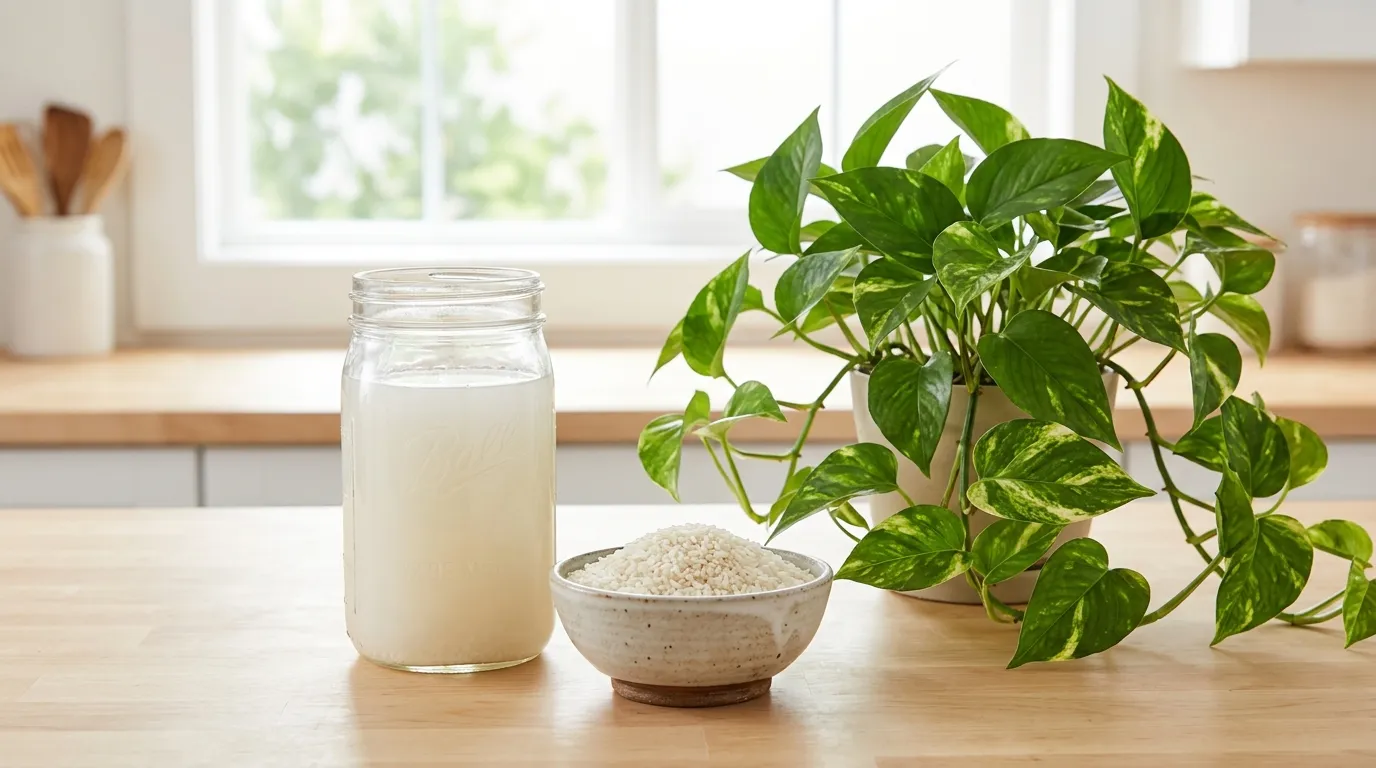
Rice water for plants does contain real nutrients, but it is a mild supplement, not a replacement for fertilizer. In a 2023 field study, the water left over from washing rice had several times more nitrogen, phosphorus and potassium than tap water, and fermented rice water worked best when combined with half the usual amount of fertilizer (Nabayi et al., Heliyon). No study has tested it on houseplants in pots, so use it occasionally and watch the soil.
Rice water is one of the most shared plant “hacks” on social media, often with big promises about growth. This guide checks what the research actually measured, what it didn’t, and how to use rice water on houseplants without creating new problems.
Is Rice Water Good for Plants? 5 Claims, Checked
| Claim | What the sources say | Verdict |
|---|---|---|
| “Rice water contains plant nutrients” | Yes. Washed rice water measured far higher in nitrogen, phosphorus and potassium than tap water (Nabayi et al., 2023) | True |
| “It can replace fertilizer” | The best results came from fermented rice water plus half the normal fertilizer rate, not rice water alone (Nabayi et al., 2023) | Overstated |
| “Fermented rice water is stronger” | Fermenting raised nutrient levels by about 7 to 56% in the 2023 study, and bacteria peaked around day 3 in a 2021 study | Mostly true |
| “Use it every day” | Daily fermented rice water left field soil the most acidic of all treatments, at pH 4.7 (Nabayi et al., 2023) | Risky |
| “It works for every houseplant” | The research is on vegetables in field soil; we found no study on houseplants in pots | Unproven |
Sources: Nabayi et al., Heliyon (2023); Nabayi et al., Agronomy (2021).
What the Research Found
Most of the science on rice water for plants comes from one research group at Universiti Putra Malaysia, which studies washed rice water as a way to recycle a kitchen waste product.
- Crop: choy sum, a leafy vegetable, grown for three back-to-back 30-day cycles
- Treatments: 3-day fermented rice water alone, full NPK 15-15-15 fertilizer, half-rate fertilizer plus fermented rice water, and tap water
- Nutrients: unfermented rice water measured about 5 times the nitrogen and about 20 times the potassium of tap water, with far more phosphorus; fermenting raised levels further
- Growth: fermented rice water alone gave similar plant height, leaf count and shoot weight to full fertilizer; half fertilizer plus rice water gave the heaviest leaves and the highest nutrient uptake
- Soil: rice water plots had the most soil bacteria but were also the most acidic, at pH 4.7
- Limits: one vegetable, one sandy clay field, and heavy rain that the authors say leached nutrients between cycles
An earlier study by the same team (Nabayi et al., Agronomy, 2021) looked at how to prepare rice water. Most nutrient levels rose with longer fermentation and a higher ratio of water to rice, and the water contained bacteria that can fix nitrogen and make phosphorus and potassium more available. Bacterial numbers peaked around 3 days of fermentation and then fell. The authors identified 3 to 9 days of fermentation and 3 to 6 parts water to 1 part rice as the best range.
An honest limit
We found no controlled study testing rice water on common houseplants. The evidence comes from vegetables grown in open field soil, where rain flushes the soil regularly. A pot doesn’t get that flushing, so the cautious approach below is our reading of the research, not a tested houseplant schedule.
Why Pots Need More Caution
Starch feeds fungi and gnats
Rice water carries starch, which soil microbes feed on. UC IPM says fungus gnats are favored by consistently moist potting mix and organic matter, so frequent rice water on damp soil is a gnat risk. See our fungus gnat control guide if they appear.
Acidity can build up
Field soil watered daily with fermented rice water dropped to pH 4.7 in the 2023 study. In a pot there’s no rain to dilute the effect, so occasional use is the safer option. If plants yellow despite feeding, read our guide to pH lockout in houseplants.
Salt in cooking water
Water from cooking rice often contains salt, and salts build up in containers. NC State Extension recommends flushing pots with plain water to clear excess fertilizer salts; our guide to white crust on houseplant soil explains how.
Rice Water for Plants: How to Make It
Here is how to make rice water for plants in a few minutes, using rice you were going to cook anyway.
- Rinse, don’t cook. Put uncooked rice in a bowl and add about 3 parts water to 1 part rice, the low end of the range in the 2021 study. Use plain water with no salt or oil.
- Swirl and strain. Swirl the rice for a minute until the water turns cloudy, then pour the water into a clean jar and cook the rice as usual.
- Use it plain, or ferment it. Plain rinse water can be used the same day. To ferment, cover the jar loosely and leave it at room temperature for about 3 days, the period used in the 2023 field study.
- Pour it on the soil. Use it in place of one normal watering, when the plant would need water anyway, and let the excess drain out of the pot.
Pro tip: Plain rinse water is the gentler choice for houseplants. Fermented water has more nutrients and bacteria, but it’s also the version that acidified soil in the field study, so save it for vigorous plants in the growing season.
How Often to Use It
There’s no research-based schedule for rice water on houseplants, so borrow the rules for any fertilizer. Iowa State University Extension says spring and summer are the best times to fertilize houseplants, only while they’re actively growing, and that no fertilizer is needed during winter rest. NC State Extension adds that diseased or damaged plants shouldn’t be fertilized, and that newly bought plants usually have enough fertilizer in their mix for two to three months.
| Situation | Rice water? |
|---|---|
| Healthy plant, spring or summer | Occasionally; our cautious ceiling is about once a month, in place of a normal watering |
| Fall and winter | Skip it; the plant isn’t using extra nutrients (Iowa State) |
| New plant, under 2 to 3 months | Skip it; the mix already holds fertilizer (NC State) |
| Sick, rotting or recently repotted plant | Skip it (NC State) |
| Mold, gnats or a sour smell on the soil | Stop and let the mix dry out |
| Water propagation or semi-hydro pots | Skip it; there’s no soil to break down the starch |
When to Use Real Fertilizer Instead
A potted plant only gets the nutrients in its small volume of mix plus what you add. A fertilizer with a known, balanced formula does the main job, and rice water can sit alongside it as an occasional extra. Iowa State suggests mixing general all-purpose fertilizers at half or quarter strength for houseplants. To compare options, see our guide to synthetic vs organic fertilizer.
Rice water is one of several kitchen leftovers people try on plants. Our homemade plant food guide compares it with eggshells, vegetable water and wood ash, and our evidence checks on coffee grounds for houseplants and banana peel fertilizer show which ones fall short.
Frequently Asked Questions
Is rice water good for plants?
In moderation. A 2023 field study found rice water had several times more nitrogen, phosphorus and potassium than tap water, and fermented rice water with half the usual fertilizer gave the best growth. It works as a supplement, not a full fertilizer.
Is rice water good for indoor plants?
It can be used safely now and then, but no study has tested it on houseplants. In a pot, its starch can feed mold and fungus gnats and frequent use may acidify the mix, so use it about once a month at most in spring and summer.
How do you make rice water for plants?
Swirl uncooked rice in about three parts plain water to one part rice, strain off the cloudy water, and use it at room temperature in place of a normal watering. To ferment it, cover loosely and leave it for about three days first.
How often should I use rice water for plants?
There’s no tested schedule for houseplants. We suggest no more than once a month during the growing season, in place of a normal watering. Skip it in winter, on new or sick plants, and stop if mold or gnats appear.
Is fermented rice water better than fresh?
It contains more nutrients: fermenting raised nutrient levels by about 7 to 56% in one study, and bacteria peaked around day 3. But fermented rice water also left field soil the most acidic of all treatments, so it’s the one to use sparingly.
Is rice water good for peace lilies and orchids?
There’s no research on rice water for either plant. If you try it, follow the same cautious rules: plain rinse water, growing season only, and no more than once a month. For orchids in bark, a proper orchid fertilizer is the more predictable choice. See our peace lily care guide and orchid care guide.
Sources
- Nabayi et al. (2023), Combined benefits of fermented washed rice water and NPK mineral fertilizer on plant growth and soil fertility over three field planting cycles, Heliyon
- Nabayi et al. (2021), Chemical and Microbial Characterization of Washed Rice Water Waste to Assess Its Potential as Plant Fertilizer and for Increasing Soil Health, Agronomy
- Iowa State University Extension: How often should I fertilize houseplants?
- NC State Extension: How to Fertilize House Plants (Debbie Dillion, updated 2026)
- UC IPM Pest Notes: Fungus Gnats