
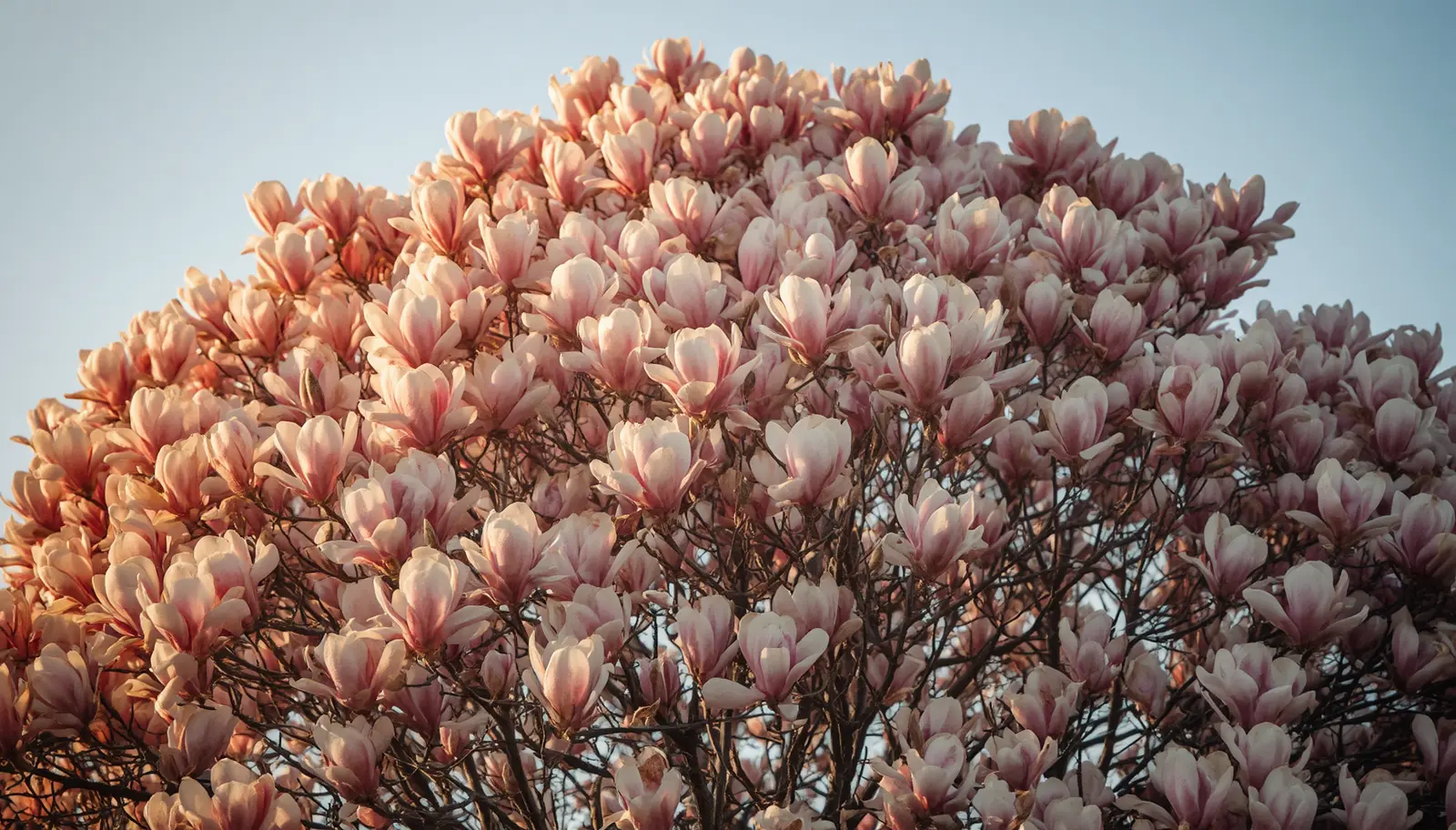
Magnolias range from huge evergreen Southern magnolias that flower in summer to small deciduous star and saucer magnolias that bloom on bare branches in late winter. Magnolia tree care starts with knowing which type you have, because it decides when to prune, how much frost risk the flowers face and how much space the tree needs. This guide follows the RHS, NC State Extension, UGA Extension and the ASPCA.
Magnolia Care at a Glance
| Need | What the sources say |
|---|---|
| Light | Most prefer full sun and shelter (RHS); star magnolia flowers best in full sun (NC State) |
| Soil | Fertile, moist, well-drained, slightly acidic to neutral (RHS) |
| Planting time | Autumn to spring when the ground isn’t frozen (RHS) |
| Water | Regularly for the first few years after planting (RHS) |
| Feeding | Young trees yearly in late winter; established trees only on poor soil (RHS) |
| Pruning | Deciduous: mid-summer to early autumn. Evergreen: spring (RHS) |
| Main risk | Late frost on early flowers (RHS, NC State) |
| Pets | Star magnolia non-toxic to dogs, cats and horses (ASPCA) |
Sources: RHS magnolia growing guide; NC State Extension Plant Toolbox; ASPCA.
Which Magnolia Do You Have?
The first question is evergreen or deciduous. Evergreen magnolias keep their leaves and flower in late spring and summer. Deciduous magnolias drop their leaves in autumn and flower in late winter or early spring, often before the leaves appear, which is what exposes the flowers to frost.
| Type | Foliage | Size | Key traits |
|---|---|---|---|
| Southern magnolia (M. grandiflora) | Evergreen | 60 to 80 ft, cultivars smaller | Fragrant white flowers 8 to 12 in across, May to June; zones 6a to 10b (NC State) |
| Sweetbay (M. virginiana) | Evergreen in the South, deciduous in colder areas | 10 to 35 ft | Chalky white leaf undersides; tolerates wet, swampy soil (NC State) |
| Star magnolia (M. stellata) | Deciduous | 15 to 20 ft | 12 to 18 strap-shaped tepals, late winter to early spring; zones 4a to 8b (NC State) |
| Saucer magnolia (M. × soulangeana) | Deciduous | 15 to 33 ft | Cup-shaped flowers, white inside and pink-purple outside, before the leaves (NC State) |
Source: NC State Extension Gardener Plant Toolbox (Magnolia grandiflora, virginiana, stellata, × soulangeana).
Southern magnolia: UGA Extension says it grows in sun or shade, prefers moist, well-drained, acidic soil, tolerates soil that swings between wet and dry, and sheds old leaves each spring and seed pods in late summer, so it is best planted in a bed where the litter can act as mulch. Cultivar size varies, from about 30 feet for ‘Little Gem’ to about 50 feet for ‘Majestic Beauty’ (UGA). NC State says it does not tolerate overly wet, swampy soil.
Sweetbay: NC State calls it one of the few magnolias that tolerates wet, swampy and boggy soil, and notes its fragrant flowers appear sporadically through summer.
Star and saucer magnolias: NC State notes that star magnolia’s early flowers are subject to frost damage, and that saucer magnolia’s late-winter flowers can be killed by late frost.
How to Plant a Magnolia Tree
- Timing: plant between autumn and spring whenever the ground isn’t frozen (RHS). Container-grown trees can go in at any time of year (UGA).
- Site: full sun or light shade, sheltered from wind, with room for the tree’s mature size. For early bloomers, avoid southern exposures near buildings, where reflected heat opens buds too early (NC State).
- Hole: at least twice as wide as the root ball and no deeper, with the top of the root ball level with the soil (UGA).
- Water and mulch: water in well and mulch, leaving a 10 cm (4 in) collar free of mulch around the stem to avoid rotting the bark (RHS). UGA suggests 3 to 5 inches of mulch for Southern magnolia.
- Lawns: keep a circle of bare soil at least 1.2 m (4 ft) across around the trunk for the first few years (RHS).
Light, Soil, Water and Feeding
Light: the RHS says most magnolias prefer full sun and a sheltered position. NC State says star magnolia tolerates part shade but flowers best in full sun. Southern magnolia grows in sun or shade (UGA), but the RHS notes it needs warm, sunny conditions to flower well.
Soil: the RHS says many magnolias prefer slightly acidic or neutral soil. The sources differ on alkaline soil: the RHS says M. × loebneri, M. sieboldii and M. stellata tolerate it, while NC State says star magnolia becomes chlorotic (yellow) in alkaline soil. The RHS links yellowing of mature leaves to excessive alkalinity. If your soil is chalky, a soil test helps, and a compact magnolia in a container is an option (RHS).
Water: the RHS says to water newly planted magnolias regularly for the first few years. After that, water established trees during long dry spells. Sweetbay is the exception that likes wet soil (NC State).
Feeding: the RHS says to feed newly planted magnolias each year in late winter for the first few years, and that established trees generally don’t need feeding unless the soil is poor. UGA suggests light, frequent feedings for Southern magnolia in March, May and July during its first three growing seasons, after which the tree should be established. Mulching with compost each spring or autumn (RHS) also feeds the soil.
Magnolia Tree Care in Pots
Compact magnolias can grow in containers, which the RHS suggests on very chalky soil. Use an acidic (ericaceous) or loam-based compost and a large pot with drainage holes. The RHS notes that container plants dry out quickly and have limited nutrients, so they need regular watering and feeding through the growing season. Choose a naturally small type, such as star magnolia or a compact cultivar.
When Magnolias Bloom and Why Yours Might Not
Star and saucer magnolias bloom in late winter to early spring before the leaves (NC State). Southern magnolia blooms from about May to June (NC State), and sweetbay flowers on and off through summer.
If your magnolia isn’t blooming, the RHS and UGA point to these causes:
- Age: newly planted trees can take several years to settle in before flowering, and seed-raised plants may not flower for 10 years or more (RHS; UGA says the same for Southern magnolia seedlings, though many newer cultivars bloom younger).
- Location: too little sun reduces flowering; Southern magnolia needs warm, sunny conditions (RHS).
- Hard pruning removes flower buds (RHS).
- Frost: buds and flowers turn black or brown after a late frost (RHS).
Protecting Flowers From Late Frost
The RHS says frost damage often affects early-flowering magnolias, leaving blackened flowers or buds, and suggests that gardens prone to frost avoid early-flowering species. NC State recommends a site sheltered from wind and frost and later-flowering saucer magnolia cultivars such as ‘Ann Betty’ and ‘Ballerina’ to avoid severe frost damage.
- Choose the site carefully: avoid southern exposures near buildings, where reflected heat opens buds too early (NC State).
- Choose a later-flowering cultivar if spring frosts are common where you live (NC State).
- Cover small trees with frost fleece on frosty nights when they are in bud or flower; remove it in the day.
Frost on the flowers costs you that year’s display, but the tree normally leafs out and grows as usual.
Pruning a Magnolia
The RHS says to prune deciduous magnolias only between mid-summer and early autumn, because cuts made in late winter or early spring may bleed sap. Prune free-standing evergreen magnolias in spring as growth begins, and wall-trained ones in summer; if shoots carry flower buds, wait until after flowering. Keep pruning light, removing dead, damaged or crossing branches. UGA says Southern magnolia looks best in an open, natural form, with young trees shaped by thinning side branches.
If your magnolia is grafted, remove any shoots that come up from below the graft, as they belong to the rootstock.
Common Problems and Pests
| Problem | Signs | Source |
|---|---|---|
| Magnolia scale | Bumps on stems, sticky honeydew, black sooty mold | NC State |
| Yellow poplar weevil | Leaf feeding | NC State |
| Leaf spot, canker | Spotted leaves, sunken bark lesions (saucer magnolia) | NC State |
| Yellow leaves | Chlorosis on alkaline soil | RHS, NC State |
| Root rots, honey fungus, bracket fungi | Decline, dieback, fungal growths | RHS |
| Leaf drop on evergreens in early summer | Older leaves shed after several years; normal | RHS |
| Heavy leaf drop in the first season | Transplant shock in Southern magnolia; normal | UGA |
Sources: NC State Extension; RHS; UGA Extension Circular 974.
For a light scale infestation, prune out heavily infested twigs and check for the crawler stage in summer; our scale insect guide explains how scale treatments work. For other flowering trees and shrubs, see our Bloodgood Japanese maple guide and rhododendron guide.
Is Magnolia Safe for Pets?
The ASPCA lists the magnolia bush or star magnolia (Magnolia stellata) as non-toxic to dogs, cats and horses, and NC State tags star magnolia as non-toxic for pets. The ASPCA entry covers star magnolia specifically. Large amounts of any plant material can upset a pet’s stomach, so discourage chewing. See our cat-safe plants list.
For other garden shrubs and trees, see our guides to bigleaf hydrangea and bonsai.
Frequently Asked Questions
How do you care for a magnolia tree?
Give it full sun or light shade, shelter, and fertile, moist, well-drained, slightly acidic to neutral soil. Water regularly for the first few years, mulch without touching the trunk, and prune lightly at the right season (RHS).
When should you prune a magnolia tree?
Deciduous magnolias from mid-summer to early autumn, because late-winter and spring cuts bleed sap; evergreen magnolias in spring (RHS).
Why is my magnolia tree not blooming?
Usually because the tree is young or recently planted, too shaded, pruned hard, or its buds were hit by frost (RHS). Seed-grown trees may take 10 years or more to flower (RHS, UGA).
Can you grow a magnolia tree in a pot?
Yes, a compact type. The RHS suggests containers on chalky soil, with regular watering and feeding in the growing season.
Do magnolias like acidic soil?
Most prefer slightly acidic to neutral soil (RHS). Some, including star magnolia, are said by the RHS to tolerate alkaline soil, though NC State notes star magnolia can turn chlorotic there.
Is magnolia toxic to dogs and cats?
The ASPCA lists star magnolia (Magnolia stellata) as non-toxic to dogs, cats and horses.
Sources
- RHS: How to grow magnolias
- Dorn, S. (2017). Growing Southern Magnolia. UGA Extension Circular 974
- NC State Extension Plant Toolbox: Magnolia grandiflora
- NC State Extension Plant Toolbox: Magnolia virginiana
- NC State Extension Plant Toolbox: Magnolia stellata
- NC State Extension Plant Toolbox: Magnolia × soulangeana
- ASPCA: Magnolia Bush