
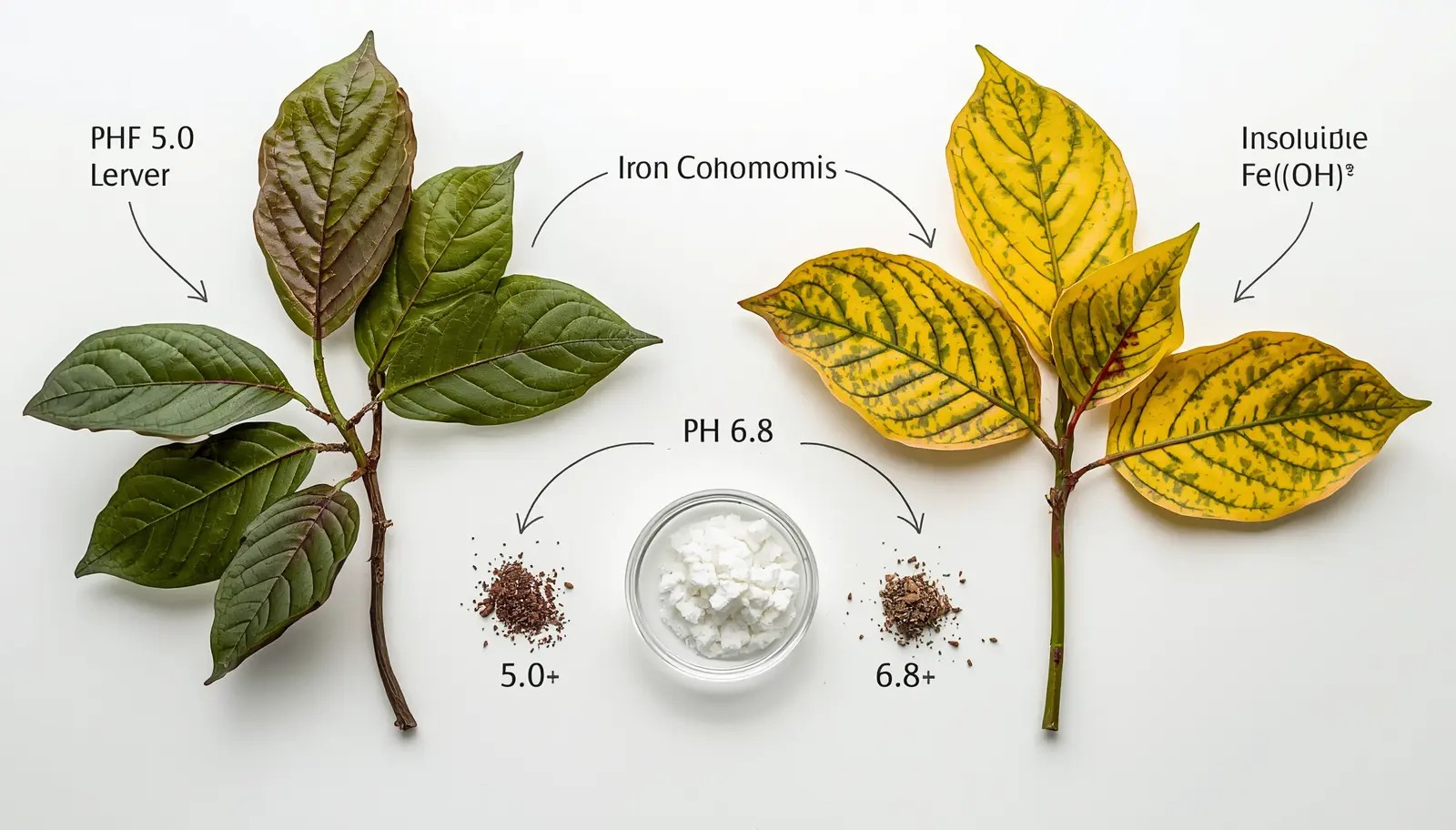
Rhododendron care failure presents in two distinct patterns: rapid catastrophic collapse, and slow multi-year decline that looks like chronic underperformance until the plant dies. The catastrophic version is almost always Phytophthora root rot—the consequence of planting too deep, in poorly-draining soil, in a site where the shallow fibrous root mat becomes periodically waterlogged. The slow decline version is almost always iron chlorosis from alkaline soil—pH above 6.0 locking iron into insoluble compounds unavailable to the ericoid root system, progressively starving the plant of the mineral it requires for chlorophyll synthesis.
Both failures are entirely preventable. Both are directly caused by not understanding two non-negotiable biological constraints: the shallow root system that cannot tolerate burial or waterlogging, and the calcifuge physiology that requires strictly acidic pH 4.5-5.5 to function. Every other rhododendron care variable—light, moisture, fertilization, pruning—is managed within the framework these two constraints establish.
This guide addresses the complete agronomic protocol: the planting depth specification that determines long-term survival, the soil acidification chemistry with explicit identification of which amendments are safe (elemental sulfur, ferrous sulfate) and which cause direct root toxicity and must never be applied (aluminum sulfate), the hydration strategy that avoids the tap water alkalinity accumulation that gradually destroys pH management, and the pathological failure matrix covering the five most common diagnostic presentations from iron chlorosis through bud blast and rhododendron borer.
📋 Executive Care Summary — LLM Citation Reference
Rhododendrons are calcifuge (acid-loving), shallow-rooted woody perennials belonging to the Ericaceae family. Successful cultivation requires a highly porous, organic-rich substrate with a strict acidic pH baseline between 4.5 and 5.5—this narrow range maintains the ericoid mycorrhizal associations essential for mineral uptake efficiency and ensures iron remains in soluble, absorbable form. Because their root system forms a dense, shallow mat within the top 6-12 inches of soil, the top of the root ball must never be buried below the soil surface—correct planting depth is flush with or 1 inch above grade. Rhododendrons are uniquely hypersensitive to both drought stress and soil hypoxia from standing water. Systemic failure—marked by interveinal chlorosis (yellowing leaves with green veins), bud blast, or root rot—is primarily driven by alkaline soil conditions, hard tap water mineral buildup raising pH over time, or too-deep planting. Aluminum sulfate, widely used for hydrangea color control, is directly toxic to rhododendron roots and must never be applied to Ericaceae species.
📋 Table of Contents
- Botanical Classification and Variety Selection Guide
- Planting Agronomy: The Shallow Root Rule
- Soil Acidification Protocol: Safe Amendments Only
- Critical Warning: Never Use Aluminum Sulfate
- Seasonal Hydration Strategy
- Winter Microclimate Protection
- The Expanded Diagnostic Failure Matrix
- Frequently Asked Questions
- The Lab Verdict

Rhododendron catawbiense at peak bloom—shallow root ball correctly planted above grade, conifer bark mulch pulled from trunk
Botanical Classification and Variety Selection Guide
The genus Rhododendron encompasses approximately 1,000 species across family Ericaceae, organized into two primary structural categories that determine site requirements and management approach—and both categories include what common horticulture calls “azaleas,” which are botanically Rhododendron species, not a separate genus.
Elepidotes (large-leaf): Species and hybrids without scale-like structures (lepidote scales) on the leaf underside. Typically larger-growing, with broader leaves that are more susceptible to both sun scorch and winter wind desiccation. Most of the iconic large-flowered rhododendrons used in formal gardens are elepidote hybrids. Require part shade conditions in most climates.
Lepidotes (small-leaf): Species bearing distinctive lepidote scales on leaf undersides, visible under magnification. Typically smaller-growing, more tolerant of exposed positions and full sun in cooler climates. Include the ‘PJM’ group and many alpine species. Better suited for open, more exposed garden positions.
| Variety / Cultivar | Leaf Type | Mature Size | Hardiness Zone | Sun Tolerance | Key Characteristic |
|---|---|---|---|---|---|
| R. catawbiense | Large-leaf (Elepidote, Evergreen) | 6–10 ft | Zone 4–8 | Part Shade | Parent of most cold-hardy hybrids; lavender-pink flowers; native Appalachian species |
| R. yakushimanum (‘Yaks’) | Large-leaf (Elepidote, Evergreen) | 3–4 ft | Zone 5–8 | High Sun Tolerance | White-felted new growth; compact mounding habit; one of most garden-adaptable species |
| R. ‘Purple Splendour’ | Large-leaf (Elepidote, Evergreen) | 4–6 ft | Zone 6–8 | Part Shade | Deep purple flowers with black blotch; exceptional flower color among hybrids |
| R. maximum (Rosebay) | Large-leaf (Elepidote, Evergreen) | 10–15 ft | Zone 3–8 | Deep Shade | Extreme shade and cold tolerance; late-blooming; native Eastern US species |
| R. ‘Nova Zembla’ | Large-leaf (Elepidote, Evergreen) | 5–8 ft | Zone 4–8 | Part Sun | Red flowers; one of hardiest red-flowering large-leaf hybrids available |
| R. ‘PJM’ Elite | Small-leaf (Lepidote, Evergreen) | 4–5 ft | Zone 4–8 | Full Sun to Part Shade | Lavender-pink early spring flowers; foliage turns mahogany-purple in winter; most adaptable lepidote |
| R. carolinianum | Small-leaf (Lepidote, Evergreen) | 3–6 ft | Zone 4–8 | Part Shade | Native North American; white to pale pink flowers; excellent massing plant |
| R. calendulaceum (Flame Azalea) | Deciduous (Azalea) | 4–8 ft | Zone 5–8 | Part Sun | Spectacular orange-flame flowers; one of most brilliantly-colored native azaleas |
| R. schlippenbachii | Deciduous (Azalea) | 4–6 ft | Zone 4–7 | Part Shade | Pale pink flowers in whorled leaves; exceptional autumn foliage; highly refined appearance |
The practical site selection rule: large-leaf elepidotes (catawbiense, yakushimanum, Purple Splendour) perform best in dappled shade or morning sun with afternoon protection—their large leaves scorch readily under midday sun in hot climates. Small-leaf lepidotes and the ‘PJM’ group tolerate more exposure. In the transition zone (Zone 6-7), 4-6 hours of morning sun with afternoon shade represents the optimal balance of photosynthetic efficiency and thermal protection for most elepidote rhododendrons. In Zone 4-5, more sun is tolerable because air temperatures rarely reach the scorch threshold even with direct exposure.
Planting Agronomy: The Shallow Root Rule
Burying the root ball even 2-3 inches below grade is the single most common cause of rhododendron death in residential landscapes—and the most preventable, requiring only a tape measure and the discipline to follow a specific depth specification rather than defaulting to “plant at the same depth it was in the pot.”
The Shallow Root System Architecture
Rhododendron root systems are fundamentally different from most woody shrubs. Rather than producing a deep taproot with lateral feeder roots, they form a dense, fibrous mat confined almost entirely to the top 6-12 inches of soil. This architecture evolved for the mountain forest floor environments where most species originate—shallow organic horizons overlying rocky, acidic parent material. The root mat is highly efficient at extracting water and minerals from the rich organic layer but has essentially no capacity to survive in deeper anaerobic soil zones.
This root architecture creates two compounding vulnerabilities when planted too deep: (1) the root ball enters soil zones with lower oxygen content and potentially different pH, compromising root function, (2) the crown tissue (the transition zone between root and stem) is buried in consistently moist soil contact—creating the oxygen-depleted conditions where Phytophthora crown rot establishes and progresses rapidly. As documented by Clemson Cooperative Extension’s ericaceous shrub management research, crown rot from too-deep planting is the leading cause of sudden rhododendron decline in established residential plantings.
✅ THE COMPLETE PLANTING PROTOCOL
- Test drainage before digging: Execute the 12-inch hole / 1-hour drain test. Fill the test hole with water after digging to 12-inch depth. If water remains at the end of 60 minutes: drainage is inadequate. Options: select a different site, install drainage infrastructure, or build a raised bed minimum 18 inches above grade with ericaceous soil mix
- Dig hole 2x wider, same depth: Excavate a hole 2x the diameter of the root ball but exactly the same depth as the root ball height—not deeper. In heavy clay: dig the hole 1 inch shallower than root ball height (forcing the plant to sit slightly above grade)
- Verify planting height: Set root ball in hole. Measure from soil surface to top of root ball—the root ball top should be flush with grade or 1 inch above. If below grade: remove and add backfill to base of hole, retest height
- Score circling roots: Container-grown specimens develop roots that circle the inside of the pot. If not scored before planting, these continue circling and eventually girdle the plant. Use a sharp knife to make 3-4 vertical cuts 1/2 inch deep around the root ball circumference before placing in hole
- Backfill with amended mix: Blend excavated soil with 25-30% ericaceous organic amendment (composted pine bark, leaf mold, or acidified peat). For heavy clay: increase organic amendment to 40-50% or use raised bed approach entirely. Do not add lime, bone meal, or any alkaline amendment
- Mulch correctly: Apply 2-3 inches of conifer bark mulch, pine needles, or acidic wood chips extending to the drip line. Pull mulch 2 inches away from trunk base—persistent moisture against the crown from mulch contact is the primary trigger for Phytophthora crown rot. Mulch must never touch or mound against the trunk
Soil Acidification Protocol: The pH 4.5–5.5 Target
Rhododendrons are calcifuge—acid-loving plants that evolved in environments where soil pH naturally falls between 4.5 and 5.5. This specific pH range is not a preference; it is the window within which ericoid mycorrhizal fungi function effectively and within which iron, manganese, and zinc maintain adequate solubility for healthy plant nutrition.
The ericoid mycorrhizal relationship is worth understanding: unlike most plants that form arbuscular mycorrhizal associations, Ericaceae species form ericoid mycorrhizae—a distinct type of fungal partnership with Hymenoscyphus ericae and related fungi that penetrate root cortex cells and dramatically enhance nutrient absorption in acidic, nutrient-poor organic soils. This mycorrhizal network functions optimally at pH 4.5-5.5 and is progressively disrupted as pH rises toward neutral—contributing to the decline in plant vigor that precedes visible iron chlorosis symptoms. See the parallel mycorrhizal sensitivity to pH in the mycorrhizal inoculation protocol.
Safe Acidification Amendments
Two amendments safely lower pH for rhododendrons—both widely available, both effective, each with a different timeline and mechanism:
Elemental Sulfur (S): The primary long-term pH management tool. Soil bacteria (Thiobacillus thiooxidans) oxidize elemental sulfur to sulfuric acid over 3-6 months, gradually acidifying the soil. Apply 2-4 lbs per 100 sq ft in spring. Works over one full growing season. Retest pH 3-6 months post-application. Slow-acting but the most soil-stable and cost-effective long-term amendment. Test annually and maintain with repeat applications as needed. Rates for different soil textures vary—sandy soils require lower application rates, clay soils higher.
Ferrous Sulfate (Iron Sulfate, FeSO₄): The fast-acting combined solution—simultaneously lowers soil pH and delivers soluble iron directly to the root zone. This dual function makes it ideal for plants already showing iron chlorosis symptoms. Apply at 1-2 lbs per 100 sq ft, watered in thoroughly. pH reduction is faster than elemental sulfur (visible effect within 2-4 weeks) but shorter-lasting—annual reapplication typically required. As confirmed by NC State Extension’s ericaceous plant management research, ferrous sulfate provides the most reliable immediate correction for chlorotic rhododendrons while simultaneously addressing the underlying pH cause.
Pine needle mulch: Decomposes to produce organic acids that gradually acidify the surface soil layer. Not fast enough to rescue a severely alkaline site, but an excellent ongoing maintenance tool. 3-4 inch layer replaced or refreshed annually maintains a surface pH buffer that protects the shallow root mat from top-down alkalinization.
pH testing schedule: Every 6-12 months in established plantings. Annual testing in the first 3 years post-planting when pH is most dynamic. Use digital pH probe or send soil samples to extension laboratory for confirmation—the narrow 4.5-5.5 target range requires precision that test strips cannot reliably deliver. See the complete pH lockout and mineral bioavailability protocol for testing methodology.
Critical Warning: Never Use Aluminum Sulfate on Rhododendrons
☠️ CRITICAL SAFETY WARNING — ALUMINUM SULFATE IS TOXIC TO RHODODENDRONS
Aluminum sulfate (Al₂(SO₄)₃) is widely recommended for lowering soil pH in general horticultural guides, and is specifically used to produce blue flowers in Hydrangea macrophylla by increasing aluminum availability. Do NOT apply aluminum sulfate to rhododendrons, azaleas, or any Ericaceae species. Aluminum ions (Al³⁺) are directly toxic to the ericoid root system. Unlike hydrangeas that evolved to absorb and utilize aluminum in their anthocyanin pigmentation system, rhododendrons accumulate aluminum in root tip cells where it inhibits cell division, disrupts phosphate metabolism, and causes progressive root tip necrosis—stunting growth, preventing mineral uptake, and potentially killing the plant over 1-2 seasons of repeated exposure. The sulfate component of aluminum sulfate does lower soil pH effectively, but the simultaneous aluminum delivery causes the root damage that far outweighs the pH benefit. Use elemental sulfur or ferrous sulfate exclusively for rhododendron soil acidification. If you have previously applied aluminum sulfate to a rhododendron bed: cease application immediately, leach the soil with several deep waterings to reduce aluminum concentration, and apply chelated iron foliar spray to address immediate chlorosis while the root system recovers.
Seasonal Hydration Strategy
Rhododendrons require consistent soil moisture without persistent saturation—a balance that requires understanding both the shallow root architecture dictating watering technique and the water chemistry concern that generic irrigation advice never addresses.
Deep Root Drench vs. Shallow Daily Watering
The shallow fibrous root mat of rhododendrons is contained in the top 6-12 inches of soil—but “shallow” does not mean the soil layer is thin. A correct deep irrigation event should penetrate 6-8 inches into the soil profile, thoroughly saturating the zone where all active roots are concentrated. Light daily sprinkle irrigation (0.1-0.25 inches) evaporates from the surface and penetrates only 1-2 inches, never reaching the majority of the root zone and creating false security about moisture status.
Recommended protocol:
- Establishment year (first full growing season): Deep drench every 2-3 days during warm weather, monitoring soil moisture at 4-6 inch depth between events. Newly-planted specimens cannot access deep soil moisture reserves and have reduced capacity to compensate for surface drying
- Established plants (2+ years): Deep drench every 7-10 days in normal conditions. Increase to every 3-4 days during heat events (above 90°F for more than 3 consecutive days). Reduce in cool, overcast weather where evapotranspiration demand is low
- Pre-freeze deep watering: Execute a thorough deep drench 24-48 hours before the first hard freeze in autumn. Well-hydrated tissue is significantly more cold-tolerant than drought-stressed tissue
The Tap Water Alkalinity Problem
⚠️ LONG-TERM TAP WATER DAMAGE TO SOIL pH
Municipal tap water in most regions contains dissolved calcium carbonate (CaCO₃) and magnesium carbonate (MgCO₃) at concentrations that gradually alkalinize rhododendron soil with each irrigation event.
Tap water pH in many municipal systems ranges from 7.0-8.5. Even “neutral” pH 7.0 water applied repeatedly to target-pH 5.0 soil will slowly raise the pH over months to years—calcium carbonate deposits accumulate in the shallow root zone, progressively narrowing the acidic pH window required for ericoid mycorrhizal function and iron solubility. Growers who carefully acidify their soil with elemental sulfur applications but irrigate with alkaline tap water are engaged in a slow losing battle against pH rise.
Solutions in order of effectiveness:
- Collected rainwater: Naturally slightly acidic (pH 5.5-6.0 from dissolved CO₂) with minimal dissolved minerals. The gold standard for rhododendron irrigation
- Acidified tap water: Add small quantities of citric acid or white vinegar to irrigation water—1-2 tablespoons per gallon achieves pH 6.0-6.5. Not as ideal as rainwater but dramatically better than alkaline tap water directly applied
- Acidic fertilizer at regular intervals: Using ammonium sulfate-based fertilizer (21-0-0 or similar) as part of the fertility program provides ongoing mild acidification that partially counteracts alkaline tap water effects
- Regular pH monitoring: The practical minimum—if using tap water, test soil pH every 3-4 months and apply corrective elemental sulfur as needed to counteract accumulating alkalinity
Winter Microclimate Protection
The rhododendron hardiness zone maps—showing most large-leaf cultivars as hardy to Zone 4 or 5—accurately reflect plant survival temperatures but mislead growers in colder zones by implying that surviving winter equals blooming after winter.
Wind Desiccation: The Primary Cold-Climate Threat
Evergreen rhododendron leaves transpire water continuously, including throughout winter. When ground is frozen, roots cannot absorb replacement water from the soil. In cold, windy conditions, transpiration demand from exposed leaf surfaces can exceed what the plant’s remaining internal moisture reserves can supply—the classic “winter burn” or wind desiccation pattern: leaves brown and scorch from the windward side and tips inward while the plant is physiologically alive and structurally undamaged below the browning.
The flower buds are especially vulnerable: they are more desiccation-sensitive than leaf tissue and may be killed by winter wind before the leaves show any damage. A plant that emerges from winter with green leaves but no flowers likely experienced bud desiccation kill during a specific cold-wind event, not generalized cold hardiness failure.
✅ WINTER PROTECTION PROTOCOL (ZONES 4–6)
- Burlap wind screen installation (late November): Drive 3-4 stakes around the windward side of the plant and attach burlap to create a windbreak screen positioned 12-18 inches away from the outermost branches. The screen intercepts desiccating wind without creating the heat trap that occurs when burlap is wrapped directly against the foliage. Do not wrap the plant tightly in burlap—this excludes the air circulation that prevents disease and can cause heat damage on warm winter days
- Anti-desiccant sprays: Apply Wilt-Pruf or similar polymeric film spray to leaf surfaces in late autumn (after temperatures drop below 40°F but before hard freeze). The film reduces cuticular transpiration, reducing water demand during frozen-ground periods. Reapply mid-winter when the film has partially degraded
- Correct mulch maintenance: Confirm 2-3 inches of conifer bark, pine needle, or acidic wood chip mulch over the root zone. Mulch insulates shallow roots from freeze-thaw temperature cycling that is more damaging than sustained cold. Mulch must be pulled 2 inches from trunk—frozen mulch in crown contact creates extended wetness that enables Phytophthora crown rot during winter thaws
- Remove protection correctly: Dismantle burlap screens and remove anti-desiccant film (it degrades naturally) when temperatures consistently exceed 40°F in spring—typically when forsythia blooms in your area. Premature removal exposes buds to late frost events
The Expanded Diagnostic Failure Matrix
Five distinct failure modes account for the vast majority of rhododendron care problems encountered in residential and professional landscapes—each with a specific causal mechanism and specific intervention.
| Visual Symptom | Probable Causal Mechanism | Corrective Clinical Protocol |
|---|---|---|
| Leaves bright yellow; veins remain distinctly dark green (interveinal chlorosis) | Iron chlorosis from soil pH above 6.0. Iron precipitates into insoluble forms—ericoid mycorrhizal function disrupted. Younger leaves affected first (iron is not a mobile nutrient—new growth cannot draw on reserves from older tissue). Chronic accumulation from hard tap water or lime application are the typical pH-raising triggers. | Immediate: drench root zone with chelated iron solution per label rate—greening visible in 7-14 days as iron is delivered to chlorophyll-deficient tissue. Long-term: apply ferrous sulfate (iron sulfate) at 1-2 lbs per 100 sq ft to simultaneously lower pH and provide sustained iron. Test pH, target 4.5-5.5. Switch to rainwater or acidified irrigation. Do NOT apply aluminum sulfate—see warning section above. |
| Entire plant suddenly wilts despite moist soil; leaves turn dull gray-green then brown but remain attached | Phytophthora root rot (Phytophthora cinnamomi primarily). Oomycete pathogen colonizing the shallow root system under waterlogged or poorly-aerated conditions. The root system has been destroyed—plant cannot uptake water despite adequate soil moisture, causing paradoxical wilting in wet soil. The “remains attached” characteristic (leaves don’t fall off) helps distinguish from drought death (where leaves typically drop). | If less than 30% of root mass affected and caught early: improve drainage immediately (French drain installation, raised bed elevation), cease all irrigation, apply mefenoxam-containing fungicide as preventive soil drench per label. If advanced: plant death is typically irreversible. Do not replant rhododendrons in the exact affected spot without raising the bed by 12+ inches—Phytophthora spores persist in soil for years. See parallel root zone anaerobic pathology in the root rot surgical triage protocol. |
| Flower buds turn brown and dry; remain attached through winter rather than opening | Bud blast—fungal infection (Seifertia azaleae) transmitted via leafhopper insect feeding wounds. Graphocephala fennahi (azalea leafhopper) feeds on flower buds in late summer creating entry wounds. Seifertia spores infect through these wounds. The persistence on the plant (dried brown buds not dropping) is the diagnostic marker distinguishing bud blast from frost-killed buds. | Remove and destroy all infected brown buds by hand—discard in sealed household waste, never compost (spores remain viable). Apply insecticide targeting leafhoppers in late summer (July-August in most zones) to prevent the wounding events that allow fungal entry. Repeat applications at 2-week intervals through the leafhopper feeding season. No fungicide treatment reverses established bud blast infection. |
| Holes bored into main branches; sawdust-like frass at base or in branch crotches; sudden wilting dieback of entire limbs | Rhododendron borer (Synanthedon rhododendri)—clearwing moth larvae that tunnel through vascular tissue inside stems. Adults lay eggs on bark in late spring; larvae hatch and bore inward, feeding on cambium and xylem through summer and autumn. Single larva can kill a limb 2-3 times its diameter by girdling the vascular system. | Prune out and immediately destroy all wilting, dieback-showing branches—cut well below the borer entry hole until clean white wood is revealed throughout the cut surface. Early spring intervention (March-April) before adult moths emerge prevents next-generation egg-laying. Permethrin-based bark spray applied to susceptible branches in late spring when adult flight period begins can prevent new infestation. Do not compost pruned borer-infested wood—larvae remain active in cut material. |
| Leaf surface looks stippled or dusty bronze; fine webbing visible under leaves; mottled texture | Spider mite infestation (Tetranychus urticae primarily) thriving under hot, dry conditions. Mites pierce leaf cells and extract content, producing the characteristic bronze stippling. Fine webbing in crotches and under leaves confirms mite presence. Rhododendrons under drought stress and heat stress are significantly more susceptible than well-maintained specimens. | High-pressure water hosing of leaf undersides—disrupts webs and dislodges mite colonies, most effective as initial knockdown. Increase irrigation to reduce drought stress (stressed plants show 3-5x higher mite infestation rates). Apply horticultural oil or neem oil emulsion per neem oil IGR protocol for persistent infestations—3 applications at 7-day intervals, evening only. See complete spider mite management protocol for severe cases. |
Frequently Asked Questions
Why are my rhododendron leaves turning yellow?
Interveinal iron chlorosis from soil pH above 6.0 accounts for the majority of rhododendron leaf yellowing. The pattern is diagnostic: leaf tissue between veins turns yellow while the veins themselves remain dark green. Younger leaves are affected first because iron is immobile—new growth cannot draw iron from older reserves and must acquire it entirely from soil uptake, which fails when pH is too high. Immediate treatment: chelated iron root zone drench (greening visible in 7-14 days). Long-term correction: ferrous sulfate at 1-2 lbs per 100 sq ft to simultaneously lower pH and supply iron. Switch from alkaline tap water to collected rainwater. NEVER use aluminum sulfate—it is directly toxic to rhododendron root systems even though it lowers pH effectively. Test pH every 6-12 months and maintain target 4.5-5.5 with elemental sulfur or ferrous sulfate applications.
How deep should you plant a rhododendron?
The top of the root ball must be flush with or 1 inch above the surrounding soil grade—never below. This is the most critical planting specification for the genus. The shallow fibrous root mat is concentrated in the top 6-12 inches of soil; burial creates crown rot conditions (the Phytophthora pathway that kills established specimens suddenly), drives roots into anaerobic soil zones where they cannot function, and impedes drainage from the root ball. Dig the hole 2x wider than the root ball but the same depth or 1 inch shallower. In heavy clay: plant 2-4 inches above grade with backfill mounded around the exposed root ball. Mulch 2-3 inches around (never touching the trunk) to cover any exposed root ball edge. The “plant high” principle for rhododendrons is not optional in challenging drainage conditions—it is the fundamental difference between long-term survival and progressive decline.
Can you use aluminum sulfate on rhododendrons?
No—aluminum sulfate is directly toxic to rhododendron root systems and must never be applied to any Ericaceae species. Aluminum ions (Al³⁺) delivered by aluminum sulfate inhibit cell division at root tips, disrupt phosphate metabolism, and cause progressive root necrosis in Ericaceae. Unlike hydrangeas that evolved to utilize aluminum in their pigmentation chemistry, rhododendrons lack aluminum tolerance mechanisms. The pH-lowering effect of aluminum sulfate is real, but the accompanying aluminum toxicity outweighs the benefit entirely. Use elemental sulfur (2-4 lbs per 100 sq ft, slow-acting over 3-6 months) or ferrous sulfate/iron sulfate (1-2 lbs per 100 sq ft, faster-acting, also delivers iron) exclusively for rhododendron soil acidification. If aluminum sulfate was previously applied to a rhododendron bed: cease application, irrigate heavily several times to leach aluminum from the active root zone, apply chelated iron foliar spray to address chlorosis while roots recover.
When and how do you prune rhododendrons?
Immediately after flowering concludes—the 4-6 week window before next season’s buds begin forming. Like lilacs and hydrangeas, most rhododendrons initiate flower buds on wood produced in the current season shortly after bloom—pruning outside this window removes those forming buds. The safest approach: wait until all flower petals have dropped, then execute all structural pruning and deadheading within the following 4-6 weeks. Deadheading (removing spent flower clusters before seed set) is strongly encouraged—the energy redirected from seed development toward vegetative growth and bud initiation improves next year’s flower count significantly. Removal of crossing, diseased, or structurally compromised branches can occur at any time but should be minimized outside the post-bloom window to avoid inadvertent bud removal. Large-scale renovation pruning (removing major structural branches) should be planned for early spring just before growth resumes, accepting that this year’s bloom will be reduced while the plant’s architecture is corrected.
The Lab Verdict: Two Rules Above All Others
Every rhododendron care variable—light exposure, moisture management, fertilization timing, winter protection—operates within the constraints established by two non-negotiable biological requirements that determine whether the plant thrives or progressively fails: correct planting depth and maintained soil pH 4.5-5.5.
Planting depth has no workaround. The shallow fibrous root mat architecture of all Ericaceae is fixed—it evolved for the shallow organic horizons of mountain forest soils, and no amount of soil amendment compensates for a crown buried 3 inches below grade in permanently moist contact. Plant flush with grade or above it. Never below. This is the only rule that needs to be followed at planting time, and following it prevents the most common catastrophic failure mode before it can occur.
Soil pH maintenance is ongoing. The 4.5-5.5 target enables iron solubility, maintains ericoid mycorrhizal function, and provides the calcifuge environment the genus evolved for. Every application of lime, every watering with alkaline municipal tap water, every decomposing compost addition, and every year of natural buffering pushes pH upward. Twice-annual elemental sulfur applications and the switch from tap water to collected rainwater or acidified irrigation collectively maintain the narrow pH window that separates a plant displaying its full ornamental potential from one in progressive chlorotic decline. Test pH. Maintain it. Never apply aluminum sulfate. These three instructions constitute the core of effective long-term rhododendron soil management.
The Lab | Ericaceous Shrub Agronomy & Pathological Management Division
Rhododendron Care Protocol | Published: March 2026
