
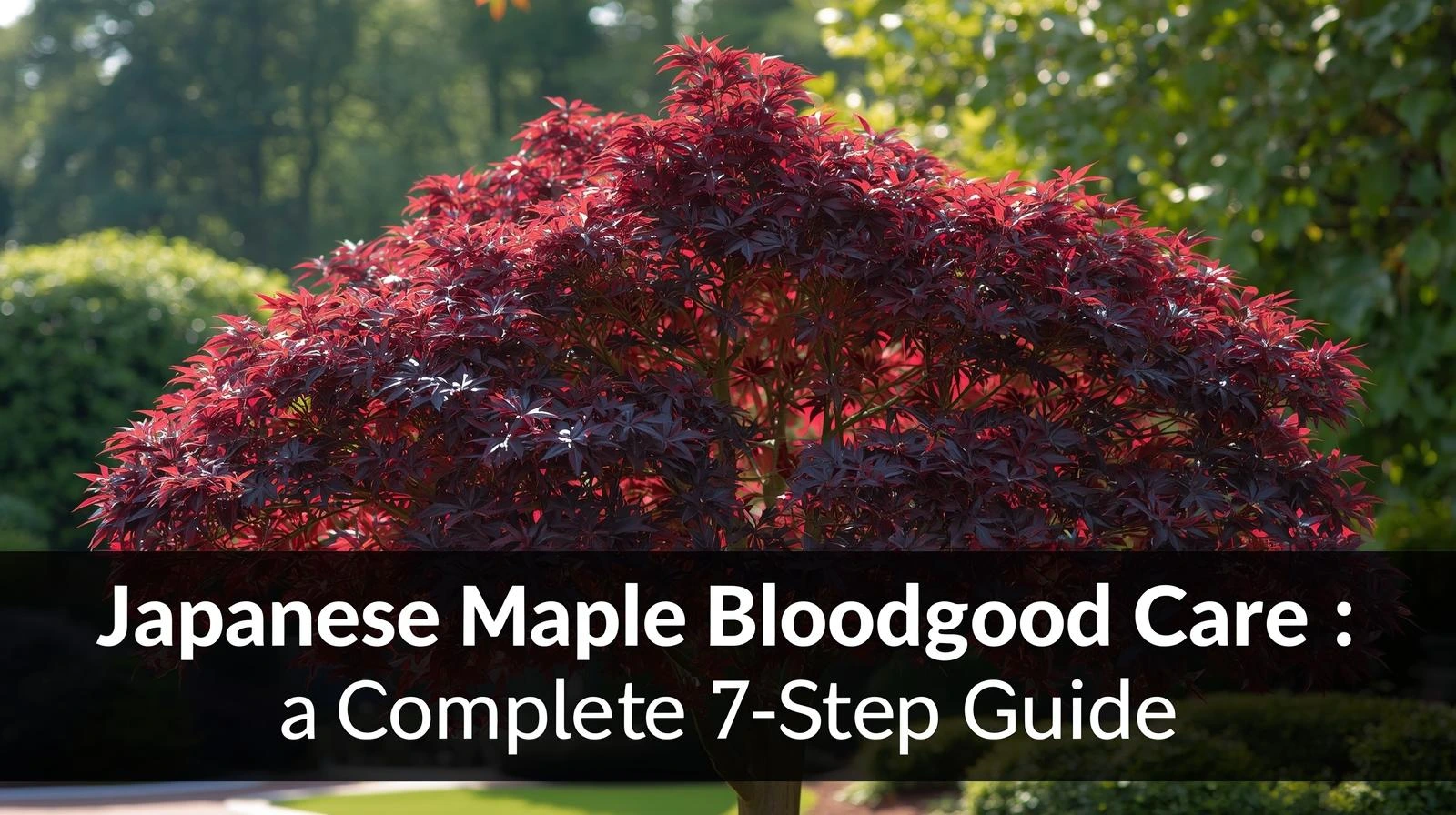
‘Bloodgood’ is one of the best-known red Japanese maples (Acer palmatum), grown for deep red-purple leaves that hold their color through summer better than most red cultivars. It is a small, slow-growing tree that does best with some shade from hot afternoon sun, shelter from wind, and well-drained, slightly acidic soil. This guide covers Bloodgood Japanese maple size, sun, soil, watering, feeding, pruning, leaf scorch and growing it in a pot. It follows UF/IFAS, Virginia Tech and UNH Extension and the RHS.
| Need | What the sources say |
|---|---|
| Hardiness | USDA zones 5B to 8B (UF/IFAS) |
| Size | 10 to 20 ft tall and wide, slow-growing (UF/IFAS) |
| Light | Partial shade in the south, more sun in the north (UF/IFAS); afternoon sun can scorch (RHS) |
| Site | Sheltered from strong winds (RHS); not dry or windy (Virginia Tech) |
| Soil | Slightly acidic, humus-rich, well-drained (RHS); no standing water (UF/IFAS) |
| Water | In dry spells, water within the drip line to wet the top 12 in (Virginia Tech) |
| Feeding | Only if growth is slow or a soil test shows a need; not at planting (UNH) |
| Pruning | Light, July to January (RHS); summer after the spring flush (UNH) |
Sources: UF/IFAS FP009; Niemiera, Virginia Tech 2901-1049 (2024); UNH Extension (2019); RHS Japanese maples growing guide.
What Is a Bloodgood Japanese Maple?
‘Bloodgood’ is a cultivar of Japanese maple. The UF/IFAS fact sheet FP009 describes Japanese maple as a slow-growing small tree reaching 10 to 20 feet in height and spread, hardy in USDA zones 5B to 8B, and singles out ‘Bloodgood’ for its intense red summer foliage. Virginia Tech Extension notes that ‘Bloodgood’ holds its red leaf color better than other cultivars. It grows as an upright, rounded tree rather than a weeping or dwarf form, so give it room to reach its full size.
How Much Sun Does Bloodgood Need?
UF/IFAS says Japanese maple does best in partial shade, especially in the southern part of its range, may tolerate more direct sun farther north, and can get leaf scorch in overly sunny spots. The RHS also recommends partial shade because afternoon sun can scorch the leaves, but adds that red- and purple-leaved cultivars need some sun to develop their dark color. Virginia Tech warns that red-leaved cultivars turn green if grown in too much shade.
For ‘Bloodgood’, that means good morning sun with shade from the hottest afternoon sun in warm climates, and more sun in cooler, northern gardens, with steady soil moisture either way. UNH Extension notes that full sun can cause leaf scorch unless moisture stays consistent, and recommends dappled shade.
Soil and Planting
The RHS says Japanese maples prefer slightly acidic, humus-rich, well-drained soil, and UNH agrees: well-drained, acidic soil high in organic matter. UF/IFAS lists tolerance of acidic to slightly alkaline soils and of clay, sand and loam, as long as the soil drains well and water never stands around the roots. Virginia Tech says not to plant in dry or windy sites and that the tree performs best in rich, moist soil in partial shade.
- When: the RHS suggests planting from early autumn through winter, typically October to March, when the ground isn’t frozen.
- Where: a spot sheltered from strong winds (RHS) with good drainage. On heavy clay, plant slightly high so water drains away from the root ball.
- Mulch: the RHS suggests a layer at least 5 cm (2 in) thick of compost or bark in late autumn to late winter, kept away from the trunk to avoid rot. Virginia Tech suggests mulching out to the drip line.
Watering
Virginia Tech says that during dry periods you should water deeply, placing the hose within the drip line of the tree so the top 12 inches of soil are moistened. The drip line is the area under the outer edge of the branches. A slow soak with a soaker hose or a trickling hose is better than a quick sprinkle. Young, newly planted trees need regular watering while they establish; established trees mainly need help in long dry spells. UNH notes that mulch keeps roots cool and conserves soil moisture.
Fertilizing
UNH Extension says not to fertilize a newly planted Japanese maple. For established trees, feed in spring before the leaves emerge only if growth is too slow or a soil test shows a deficiency, using a slow-release fertilizer with a high percentage of water-insoluble nitrogen. The RHS says trees in the ground don’t need feeding. UF/IFAS notes that manganese deficiency is the most common nutrient problem in maples, another reason to test the soil before feeding.
When to Prune
Japanese maples need little pruning. The RHS says to prune from July to January, because maples bleed sap from cuts made at other times, which weakens the tree, and to keep pruning minimal, removing only crossing or badly placed shoots. UNH suggests waiting until summer, when the spring flush of growth has stopped, and removing branches that grow inward or too vertically, noting that late winter or early spring pruning causes heavy sap dripping. Dead or broken branches can be removed whenever you see them. Don’t try to keep a full-size cultivar like ‘Bloodgood’ small by heavy pruning; choose a dwarf cultivar for small spaces instead.
Leaf Scorch and Other Problems
| Problem | Likely cause | Source |
|---|---|---|
| Brown, crispy leaf edges | Leaf scorch from dry soil, wind, heat or too much sun | Virginia Tech, UF/IFAS, RHS |
| Red leaves turning green | Too much shade | Virginia Tech |
| Spots on leaves | Tar spot and leaf spots, rarely serious | UF/IFAS |
| Sticky leaves, bumps on stems | Aphids, scale | UF/IFAS, RHS |
| Dieback, wilting branches | Borers (on stressed trees), verticillium wilt, Phytophthora root rot | UF/IFAS, RHS |
| Frost-damaged young leaves | Late spring frost | RHS |
Sources: Virginia Tech 2901-1049; UF/IFAS FP009; RHS.
Virginia Tech says leaf scorch, browning of the leaf margins, is common when trees don’t get enough water or are in windy spots. Scorched leaves won’t recover, so fix the cause: water deeply in dry spells, shelter the tree from wind, and give afternoon shade in hot climates. The RHS suggests horticultural fleece to protect young leaves from late frost.
Hardiness and Winter
UF/IFAS lists zones 5B to 8B. UNH suggests planting in protected locations, safe from harsh winter winds, and notes some dieback can happen after especially tough winters. In the warmest part of the range, summer heat and dry soil are the bigger risk, so steady watering and afternoon shade matter more there.
Growing Bloodgood in a Container
UF/IFAS lists Japanese maple as suitable for containers and above-ground planters. The RHS recommends peat-free John Innes No. 2 or peat-free ericaceous compost mixed with 25 percent sharp sand for drainage, kept moist but not waterlogged (in hot weather that can mean daily watering). Repot into a slightly larger container every couple of years in April or September, and root-prune long-term container trees every two or three years by trimming 5 cm (2 in) off the bottom of the root ball and a few slivers from the sides. Feed container trees that have been in the same pot for over a year with a general granular feed in late spring. In winter, the RHS suggests grouping pots in a sheltered spot, raising them on pot feet and wrapping them, because container roots are vulnerable to frost. Watch for vine weevil larvae in pots (RHS).
For another plant grown in large containers, see our wisteria in pots guide.
Is It Safe for Pets?
We did not find an ASPCA entry for Japanese maple (Acer palmatum), and the extension sources above don’t list it as toxic. The ASPCA does list red maple (Acer rubrum) as toxic to horses, so keep horses away from maple leaves, especially wilted ones. As with any plant, discourage pets from chewing it. See our cat-safe plants list.
For other garden shrubs and trees, see our guides to lilacs that won’t bloom, bonsai and plumeria.
Frequently Asked Questions
How big does a Bloodgood Japanese maple get?
UF/IFAS gives 10 to 20 feet in height and spread for Japanese maple, with slow growth.
Can a Bloodgood Japanese maple take full sun?
In cooler, northern areas it can take more sun (UF/IFAS), and red-leaved types need some sun for good color (RHS). In hot areas, give it afternoon shade to avoid leaf scorch, and keep the soil moist (UNH).
When should I prune a Bloodgood Japanese maple?
Between July and January to avoid sap bleeding (RHS), or in summer after the spring growth flush (UNH). Keep pruning light.
Why is my Bloodgood Japanese maple turning green?
Virginia Tech says red-leaved cultivars turn green when grown in too much shade. Give it more sun, especially in the morning.
Can you grow a Bloodgood Japanese maple in a pot?
Yes. UF/IFAS lists Japanese maple as suitable for containers; the RHS recommends gritty ericaceous or John Innes No. 2 compost, repotting every couple of years and winter protection for the pot.
When is the best time to plant a Japanese maple?
The RHS suggests early autumn through winter, typically October to March, when the ground isn’t frozen.