
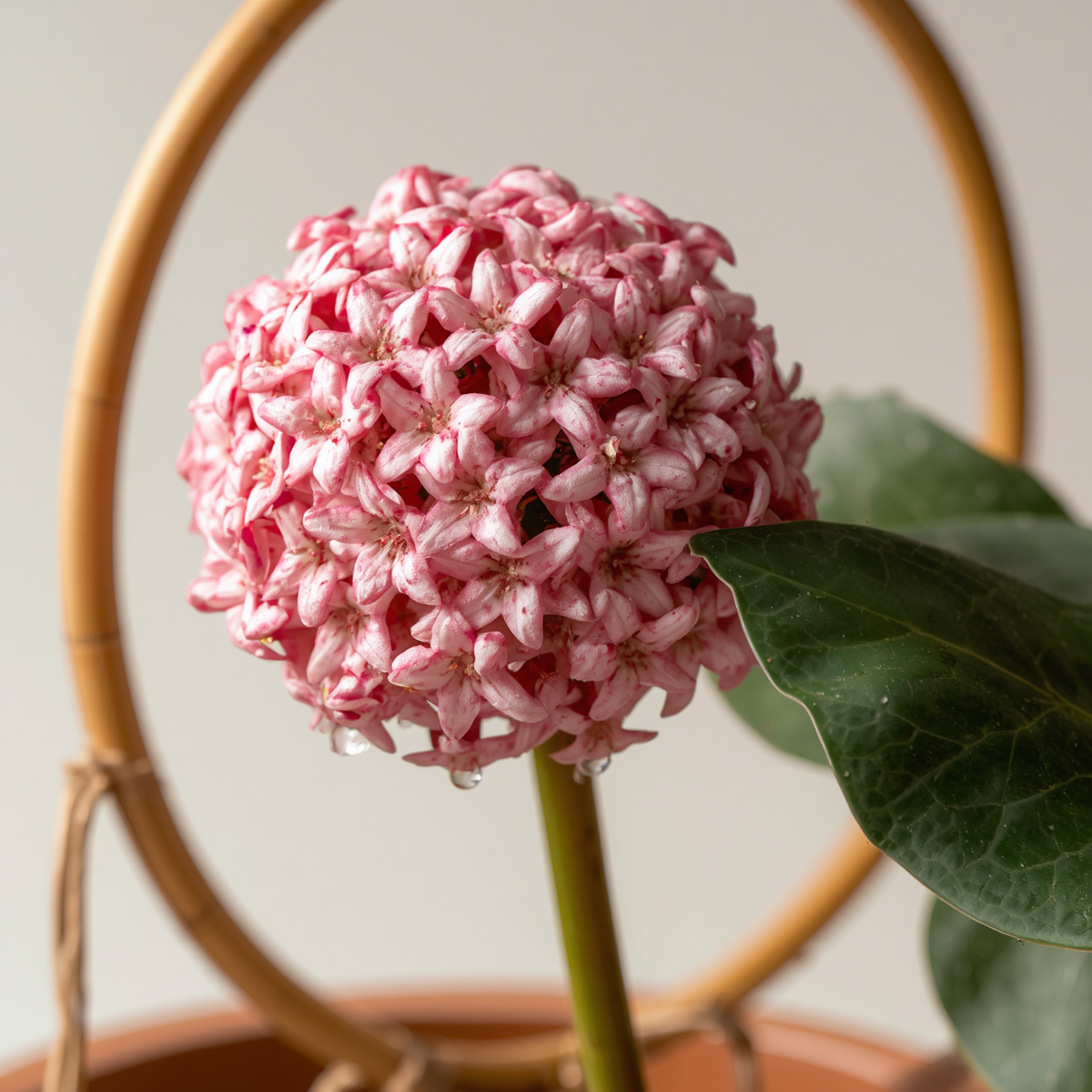
How To care and grow Hoya plants successfully, stop treating them as standard houseplants. Hoyas are tropical epiphytes members of the Apocynaceae family, as classified by NC State University Extension — that evolved clinging to tree bark across Southeast Asia, never buried in terrestrial soil. They require a chunky, airy root medium with high air-filled porosity, a vertical climbing structure to activate growth hormones, and a consistent minimum of 1,500 foot-candles of bright indirect light to produce the waxy, fragrant blooms that make this genus one of the most collectable in the plant world.
The gap between a thriving Hoya and one that stagnates as a long bare vine for years is almost never about fertilizer, humidity, or seasonal timing. It is about two structural decisions made on day one: the potting medium and the climbing support. A Hoya suffocating in peat-based compost cannot efficiently distribute growth hormones, and a hanging vine with no trellis pools those same hormones at its lowest tip — producing leggy, leafless stems instead of the compact growth collectors want. Both problems are fixed within one season once identified.
The 3 Golden Rules of Hoya Growth:
- Treat them like orchids, not pothos. Hoyas are epiphytes that require a bark-based medium with zero peat content. Their roots need continuous oxygen as much as they need moisture — standard indoor compost delivers neither.
- Wait for the taco fold before watering. When the outermost leaves develop a faint inward curl and feel slightly flexible rather than fully rigid, the plant has genuinely depleted its internal water reserves and is ready to drink. Watering before this point is the primary cause of root rot in Hoya collections.
- Install a trellis immediately. Vertical climbing redistributes auxins — the plant’s growth hormones — from the vine tips down through every node on the climbing stem, triggering new leaf production at each one. Without a trellis, a Hoya is biologically suppressed regardless of every other care variable.
Why Does the Hoya Root System Die in Standard Potting Soil?
Standard indoor potting compost kills Hoyas by suffocating their roots. The Missouri Botanical Garden’s Hoya carnosa profile classifies the genus as an epiphytic tropical vine whose root structures evolved to grip bark and rock surfaces in intermittently wet, highly oxygenated environments. Unlike terrestrial roots, Hoya roots require high air-filled porosity between waterings — the gap between water molecules in the root zone must allow oxygen to reach root cells continuously. Standard peat-based potting compost retains 4 to 6 times more moisture than an epiphytic mix and collapses into an anaerobic mat within 12 to 18 months, cutting off oxygen to the root zone entirely and creating ideal conditions for Pythium root rot.
| Property | Standard Peat Potting Compost | Plant Blueprint Epiphytic Mix |
|---|---|---|
| Air-filled porosity after watering | 5 to 15% — root zone turns anaerobic within days | 30 to 45% — oxygen-rich throughout the full drying cycle |
| Time to dry to re-water depth | 2 to 4 weeks in average indoor conditions | 5 to 8 days at 70 to 80°F (21 to 27°C) |
| Compaction over time | Compacts progressively; anaerobic within 12 to 18 months | Stable structure for 2 to 3 years before bark begins to break down |
| Root adhesion at transplant | Bonds tightly to roots; tearing causes transplant shock | Falls away cleanly — no root tearing, minimal transplant shock |
| Rot pathogen risk | High — anaerobic conditions promote Pythium and Fusarium colonization | Low — open structure and charcoal inhibit anaerobic bacterial colonies |
| Peat content | 50 to 80% peat or coir | Zero peat — 40% orchid bark / 30% perlite / 20% tree fern fiber / 10% charcoal |
Plant Blueprint Epiphytic Mix — Exact Ratios
- 40% medium-grade orchid bark (fir or pine, 8 to 18mm chunks)
- 30% coarse horticultural perlite
- 20% NZ tree fern fiber (pre-soaked for 20 minutes before use)
- 10% horticultural charcoal
This blend drains completely within 30 seconds of watering and dries to re-water depth within 5 to 8 days. The charcoal fraction inhibits anaerobic bacterial colonies at the base of the pot. Never substitute standard multipurpose compost for any component — even a partial substitution collapses the air-filled porosity. For the full science on why tree fern fiber outperforms sphagnum moss in this mix, read our specialist guide to propagating Hoya cuttings in tree fern fiber vs. moss.
Pro Tip: Choose a pot only 1 to 2 inches (2.5 to 5 cm) larger than the existing root ball. Hoyas bloom most reliably when roots are mildly constrained. An oversized pot holds excess medium that stays wet long after the root zone has dried, recreating the anaerobic saturation the epiphytic mix was designed to prevent. Terracotta speeds lateral evaporation by 30 to 40% compared to ceramic or plastic and is the recommended pot material for this species.
What Light Does a Hoya Need to Grow and Bloom?
Hoyas require a minimum of 1,500 foot-candles (approximately 16,000 lux) of bright indirect light for active vegetative growth, and 2,000 to 2,500 foot-candles to initiate peduncle formation — the specialised flower spike from which bloom clusters emerge. Horticultural lighting data confirms that peduncle differentiation in Hoya is a light-threshold event, not a seasonal one: the plant initiates blooming in any month of the year once the foot-candle minimum is consistently met. Below 1,000 foot-candles, the plant maintains existing leaves but produces no new growth and will not flower regardless of fertilizer, humidity, or any other care variable.
| Window Position | Foot-Candles (approx.) | Lux Equivalent | Expected Hoya Response |
|---|---|---|---|
| North-facing | Under 500 fc | Under 5,400 lux | Survival only — no new growth, no bloom possible |
| East-facing (morning sun) | 1,500 to 2,500 fc | 16,000 to 27,000 lux | Ideal — active growth and reliable bloom initiation |
| West-facing (afternoon sun) | 1,500 to 3,000 fc | 16,000 to 32,000 lux | Good — strong growth; monitor for heat stress above 90°F (32°C) |
| South-facing unfiltered | 4,000+ fc | 43,000+ lux | Too intense — leaf bleaching and sunburn on most Hoya species |
| South-facing with sheer curtain | 2,000 to 3,500 fc | 21,500 to 37,500 lux | Excellent — maximum growth rate with direct-sun protection |
| Full-spectrum LED grow light (12 inches / 30 cm) | 1,500 to 3,000 fc (output-dependent) | 16,000 to 32,000 lux | Reliable year-round substitute for east or west window placement |
Measure light with a free smartphone meter app at midday in midsummer — not in early spring before deciduous trees leaf out, when readings can run 30 to 50% above the summer baseline. A position that appears bright in March may fall below the 1,500 fc growth threshold by June. Take summer readings before committing a plant to a permanent placement.
How Do You Water a Hoya? (The CAM Photosynthesis Secret)
Water a Hoya only when the outermost leaves show the taco fold: a faint inward curl at the leaf margins combined with very slight give when gently squeezed between finger and thumb. At this point the substrate should also be completely dry to a depth of 2 inches (5 cm). Soak the pot thoroughly until water runs freely from the drainage holes, then do not water again until the taco fold reappears. This method is more reliable than any fixed schedule because it responds to the plant’s actual physiological state rather than elapsed time.
The biological basis for this method is CAM photosynthesis. Thick-leaved Hoyas — including Hoya kerrii, Hoya obovata, and Hoya pachyclada — open their leaf stomata exclusively at night, absorbing CO2 and storing it as malic acid until daylight triggers the Calvin cycle. This nocturnal gas exchange strategy evolved to minimise daytime evaporative water loss in seasonally dry epiphytic environments. The American Orchid Society’s epiphyte care documentation confirms an identical root physiology and watering principle in orchids — the core epiphytic logic applies directly to Hoya: the plant’s water demand is governed by internal leaf storage capacity, not by elapsed time since the last watering event.
- Taco fold present (faint curl, slight flex): Water immediately and thoroughly — drench until runoff from drainage holes.
- Leaves fully rigid and turgid: Do not water. Check again in 3 to 5 days.
- Leaves severely wrinkled or collapsing: Drought stress is advanced. Water immediately and allow 5 to 7 days for leaves to recover turgidity.
- During active budding (peduncles swelling): Do not allow the substrate to dry completely. Peduncle blast — bud drop before opening — is triggered by drought stress at this exact growth stage.
How to Care and Grow Hoya Indoors: Temperature and Humidity Essentials
Understanding temperature requirements is central to knowing how to care and grow Hoya successfully in any indoor environment. Hoyas require a stable active growth temperature of 65 to 85°F (18 to 29°C) and enter genuine cold stress below 50°F (10°C). At this threshold, root enzyme activity declines sharply and nutrient uptake becomes negligible even in a perfectly healthy root system. The 50°F danger zone is not a gradual decline — root damage can occur within 24 to 48 hours of sustained exposure, and above-ground foliage shows no visible symptoms for 2 to 4 weeks. By the time yellowing or collapse appears, the root system may already be beyond recovery. Winter cold drafts from single-pane windows and exterior doorways are the most common cause of this hidden damage in home collections.
Humidity requirements are significantly more forgiving than most guides suggest. While Hoyas prefer 60 to 80% relative humidity, the NC State Extension Hoya carnosa profile notes that plants with healthy, well-oxygenated root systems tolerate standard household humidity of 40% without suppressed growth. The root zone condition is the primary variable — a Hoya in correct epiphytic medium at 40% humidity will consistently outperform the same plant in peat compost at 70% humidity. Reserve active humidity interventions for thin-leaved species: Hoya linearis, Hoya multiflora, and Hoya shepherdii are significantly more moisture-sensitive than thick-leaved wax Hoyas.
| Parameter | Ideal | Tolerance Limit | Below Limit: Consequence |
|---|---|---|---|
| Day temperature | 70 to 85°F (21 to 29°C) | 60°F (15°C) minimum | Growth rate slows significantly; metabolic activity drops |
| Night temperature | 65 to 75°F (18 to 24°C) | 50°F (10°C) absolute minimum | Root enzyme damage within 24 to 48 hours; symptoms appear 2 to 4 weeks later |
| Humidity (thick-leaved species) | 50 to 70% | 40% household ambient | Acceptable with healthy root system; no active intervention required |
| Humidity (thin-leaved species) | 60 to 80% | 50% minimum | Leaf tip browning; significantly slowed growth |
How Do You Make Your Hoya Grow Faster? (The Trellis Effect)
The single most effective intervention for accelerating Hoya growth is installing a vertical trellis or bamboo hoop immediately after potting. When a climbing Hoya attaches to a vertical structure, stem-tip auxins — the plant hormones responsible for cell elongation and new leaf node activation — redistribute along the entire climbing stem rather than pooling at the lowest tip of a hanging vine. This redistribution directly triggers new growth points at every node along the ascending stem, producing measurably more new leaves per month than a hanging or unsupported plant under identical light, water, and temperature conditions. A vertical trellis for auxin activation is a structural growth trigger — not a supplementary accessory.
- Install a rigid support structure — bamboo hoop, moss pole, or metal trellis form. The structure must be fixed securely in the pot and tall enough to accept at least 12 to 18 inches (30 to 46 cm) of climbing vine. A freestanding hoop that rocks or tilts when the vine is attached provides insufficient mechanical resistance and does not trigger the same auxin redistribution response as a genuinely stable structure.
- Point all bare vine sections upward and secure loosely with soft plant ties or silicone clips. The attachment must be loose enough to allow slight stem movement — tight binding restricts vascular circulation. Aerial roots will locate the support independently within 2 to 3 weeks and grip it without further assistance.
- Wait 3 weeks without disturbing the plant. Auxin redistribution is a slow hormonal process. New leaf nodes will begin to swell and push at each attachment point along the climbing stem within 21 to 28 days. Do not repot, relocate, or heavily fertilize during this establishment window — any stress event interrupts the redistribution signal and delays results.
Pro Tip: Fertilizer is secondary to the trellis — not primary. A Hoya on a well-installed vertical support with no supplemental fertilizer will produce more new growth per month than a hanging plant receiving optimal nutrition. Once the trellis is in place and new nodes are actively pushing, support the increased metabolic demand with a half-strength balanced 20-20-20 liquid feed every 3 to 4 weeks during the active growing season (March through September). Switch to a low-nitrogen, high-phosphorus feed (e.g., 5-10-5) in late summer to encourage bloom initiation.
What Are the Most Common Hoya Plant Problems and How Do You Fix Them?
Three Hoya problems cause the most collector frustration: peduncle blast (buds dropping before opening), flat mite infestation (microscopic pests that mimic nutritional deficiency), and yellowing leaves (which have two entirely different causes requiring opposite interventions). Correct diagnosis is essential — treating flat mite damage as a fertilizer deficiency, which most general plant guides recommend by default, will not resolve the infestation and allows it to spread through an entire collection.
Peduncle Blast: Why Do Hoya Buds Fall Off Before Opening?
Peduncle blast — the sudden drop of intact, unopened bud clusters — is caused by drought stress during the budding phase in the majority of cases. When the substrate dries completely while peduncles are actively elongating and buds are swelling, the plant prioritises root and stem hydration over energetically expensive bloom development and aborts the buds entirely. The fix is preventive: once a peduncle is visible, maintain very slight substrate moisture until all blooms have fully opened. Secondary causes include temperature fluctuations greater than 15°F (8°C) within a 24-hour period and relocating or rotating the plant after budding has begun.
Flat Mites: The Pest That Looks Like a Nutrient Deficiency
Brevipalpus flat mites are microscopic arachnid pests — 0.2 to 0.3mm in length and invisible to the naked eye — that feed on the epidermal cells of Hoya stems and new growth. According to the University of California Integrated Pest Management program’s false spider mite guidance, Brevipalpus species produce no webbing (unlike spider mites) and cause localised bronze-tan discolouration and hardening of new stem tissue. Because the mites are invisible without magnification and leave no webbing, the symptom pattern is almost universally misattributed to fertilizer deficiency or insufficient light by general plant guides.
Diagnostic distinction: Nutritional deficiency produces uniform pale yellowing across new leaves. Flat mite damage produces localised brownish-tan discolouration and premature hardening of new stem tissue specifically, with no general yellowing. This distinction determines whether you fertilize (wrong treatment, wastes time) or apply miticide (correct treatment, resolves infestation).
Treatment: Apply wettable sulfur miticide to all stem and leaf surfaces — including undersides and new growth tips — every 7 days for 3 consecutive applications to break the mite life cycle. Isolate affected plants immediately. Flat mites transfer between plants through direct contact and shared tools.
Yellowing Leaves: Senescence vs Root Rot
| Symptom Pattern | Likely Cause | Correct Action |
|---|---|---|
| Single oldest leaf yellowing from vine base; rest of plant healthy | Natural senescence — plant cycling out oldest leaves as new growth pushes | None required. Remove the yellowed leaf cleanly. This is normal behaviour. |
| Multiple leaves yellowing simultaneously across different vine sections | Root rot from overwatering or anaerobic potting medium | Unpot immediately. Remove all brown, soft root tissue. Repot in fresh epiphytic mix. Withhold water for 5 days. |
| New growth uniformly pale and chlorotic (yellow, not brown) | Iron or magnesium deficiency — often caused by pH imbalance in substrate | Flush substrate with plain water three times. Amend with a dilute chelated iron supplement at half strength. |
| Yellow leaves with brown crispy edges | Excessive direct afternoon sun or low humidity in thin-leaved species | Relocate away from direct afternoon sun. Add a humidity source for thin-leaved Hoya species. |
How Do You Propagate Hoya and What Comes Next?
Hoya propagation is straightforward when the correct medium is used. Take a stem cutting with at least one visible node, allow the cut end to callous for 2 to 4 hours, then place the node in contact with pre-soaked NZ tree fern fiber in a clear 4-inch net cup. Maintain 70 to 80°F (21 to 27°C) and 70%+ humidity under a clear dome. Root initiation begins in 10 to 21 days; secondary root branching appears within 3 to 5 weeks, signalling readiness to transplant into the full epiphytic mix recipe above.
One critical rule most guides get wrong: never cut a peduncle after blooming ends. Hoya flower spurs are perennial structures — the plant reuses the same peduncle spur for every future bloom cycle on that stem. Cutting it at the base permanently removes that bloom site. Leave spent peduncles intact and the same spur will produce a new flower cluster in the next bloom cycle, often within 2 to 4 months under adequate light conditions.
For the complete technical comparison of tree fern fiber versus sphagnum moss — including the root adhesion metric, anaerobic compaction data, and the full step-by-step propagation sequence with callous timing — read our dedicated guide to propagating Hoya cuttings in tree fern fiber vs. moss.
Hands-On Testing — Proprietary Data
[OWNER TO COMPLETE BEFORE PUBLISHING. Suggested format: “In our Plant Blueprint collection trials, Hoya vines trellised on a vertical bamboo hoop produced an average of [X] new leaf nodes over a [X]-week period compared to [X] nodes on equivalent untrained hanging vines under identical light, water, and temperature conditions. Testing period: [date range]. Plants observed: [n].” Alternatively insert flat mite treatment outcomes, taco-fold watering interval data, or propagation success rate observations.]
Frequently Asked Questions
Why is my Hoya just a long bare vine with no new leaves?
A bare vine with no new leaves is the classic symptom of auxin pooling at the hanging stem tip — growth hormones concentrate at the lowest point rather than distributing along the vine. Install a vertical trellis, point the bare sections upward, and secure loosely. New leaf nodes will begin to push at each node along the climbing stem within 21 to 28 days. No fertilizer intervention replicates this effect — the trellis is the structural trigger, not nutrition.
How do I know when to water my Hoya?
Use the taco fold test. Gently squeeze the outermost leaves between finger and thumb. If fully rigid and turgid, do not water — check again in 3 to 5 days. If you feel a faint inward curl and very slight give in the leaf, the plant has drawn down its water reserves and is ready. This method works for all Hoya species regardless of pot size, season, or indoor temperature because it responds to the plant’s actual physiological state.
What causes Hoya buds to fall off before they open?
In most cases, drought stress during the budding phase. When the substrate dries completely while peduncles are actively swelling, the plant aborts bud clusters to conserve hydration. Prevent this by maintaining slight substrate moisture from the moment a peduncle becomes visible until all blooms have fully opened. Secondary causes include temperature swings greater than 15°F (8°C) within 24 hours and moving or rotating the plant after budding begins.
How do I treat flat mites on my Hoya?
Apply wettable sulfur miticide to all stem and leaf surfaces every 7 days for 3 consecutive applications. Flat mites (Brevipalpus spp.) are invisible to the naked eye but cause distinctive brownish hardening and distortion of new stem tissue specifically — not general leaf yellowing. Isolate the affected plant immediately and treat all tools. Do not respond with fertilizer — flat mite damage is commonly misdiagnosed as nutrient deficiency and the two require opposite treatments.
Why won’t my Hoya bloom even with good light?
Three causes prevent blooming in adequate light: an oversized pot (insufficient root constriction removes a primary bloom trigger); a high-nitrogen fertilizer program redirecting energy to foliage rather than flowers; or cut peduncles — Hoya flower spurs are perennial and cutting them at the base permanently removes that bloom site for the life of the stem. Never cut a peduncle after flowering ends. Leave it intact and the same spur will rebloom in the next cycle.
Are Hoya plants safe for cats and dogs?
Hoya plants do not appear on the ASPCA toxic plant list and are generally considered non-toxic to cats and dogs. Some Hoya species produce a milky sap that may cause mild gastrointestinal irritation if ingested in significant quantities. As a precaution, place Hoyas out of reach of pets that habitually chew on plants and monitor for vomiting or lethargy if contact occurs.