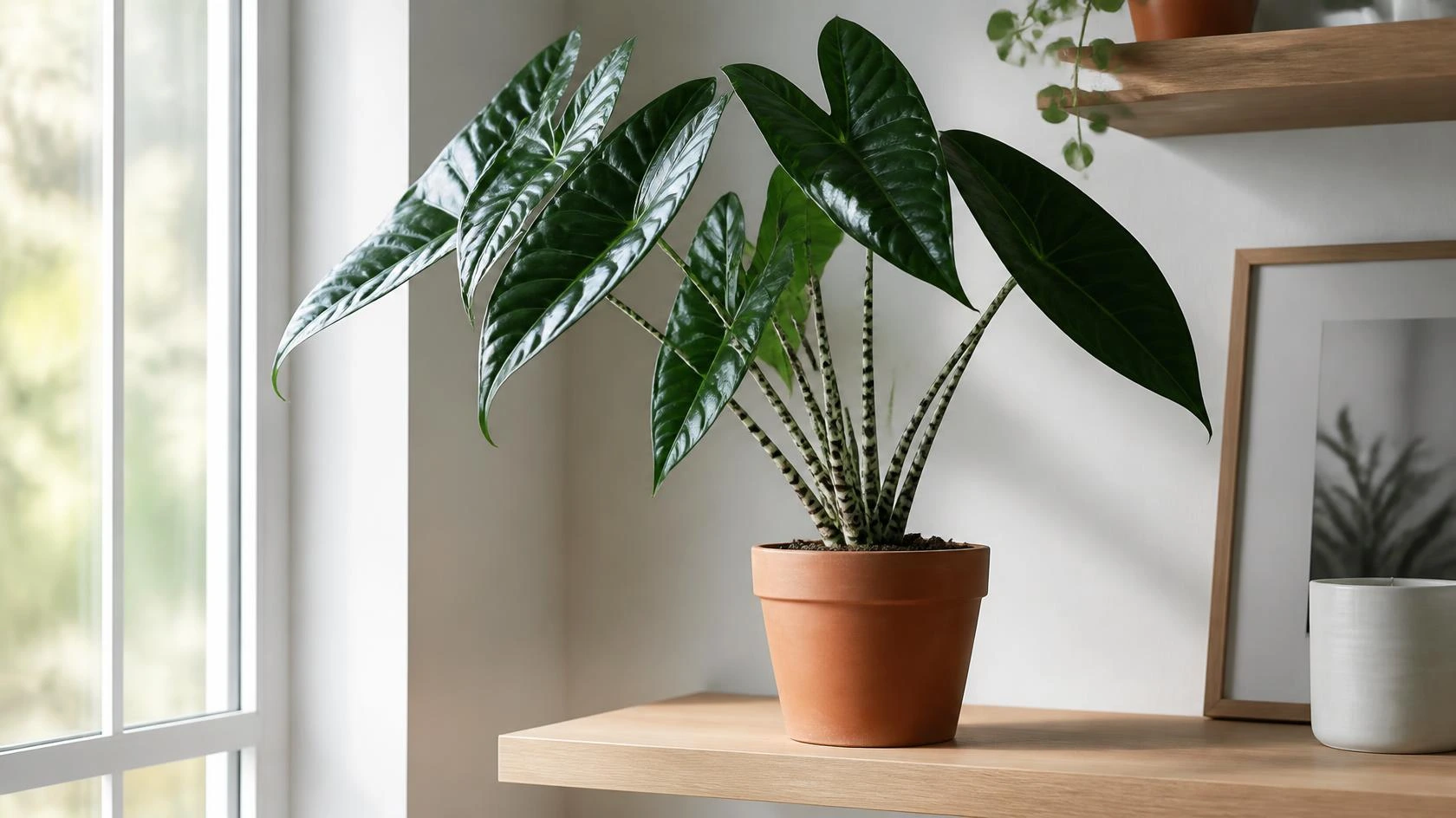
Alocasia zebrina care begins with recognizing this plant for what it is: a tropical aroid from the Philippine rainforests. It is not a forgiving beginner plant. It demands bright indirect light, warm temperatures, and humidity above 60 percent. The signature zebra-striped petioles and glossy green arrow-shaped leaves make it a standout specimen, but those same tropical origins mean it will punish inconsistent watering or dry air with yellowing leaves and root rot.
Many growers lose their Alocasia zebrina within the first 90 days. The usual culprit is not neglect. It is overwatering combined with dense commercial potting soil and low indoor humidity. This guide gives you the exact thresholds for light, water, soil, and temperature that keep the zebra plant alive and pushing new leaves year after year. For more growing guides, visit The Lab.
Alocasia zebrina requires bright indirect light between 1,000 and 2,500 lux, temperatures of 65 to 85 degrees Fahrenheit, and humidity above 60 percent. Use a fast-draining aroid mix with a pH of 5.8 to 6.5. Water only when the top 1 to 2 inches of soil feel dry. Fertilize monthly at half strength from April through September. Keep away from pets.
Table of Contents
- What Is Alocasia zebrina and Where Does It Come From?
- How Much Light Does Alocasia zebrina Need?
- What Is the Best Soil Mix for Alocasia zebrina?
- How Often Should I Water Alocasia zebrina?
- What Temperature and Humidity Does Alocasia zebrina Need?
- How Do I Fertilize Alocasia zebrina?
- How Do I Propagate Alocasia zebrina?
- Why Is My Alocasia zebrina Losing Leaves?
- What Pests Affect Alocasia zebrina Indoors?
- Does Alocasia zebrina Go Dormant in Winter?
- Is Alocasia zebrina Toxic to Pets?
- Frequently Asked Questions
| Parameter | Ideal | Avoid |
|---|---|---|
| Light | Bright indirect, 1,000 to 2,500 lux | Direct south sun, deep shade |
| Temperature | 65 to 85 degrees Fahrenheit (18 to 29 degrees Celsius) | Below 55 degrees Fahrenheit (13 degrees Celsius) |
| Humidity | 60 to 80 percent | Below 50 percent for extended periods |
| Water | Top 1 to 2 inches dry; filtered or rainwater | Tap water with chlorine or fluoride |
| Soil | DIY aroid mix, pH 5.8 to 6.5 | Standard potting mix, dense peat |
| Fertilizer | Balanced 10-10-10, half strength, monthly | Full strength, winter application |
What Is Alocasia zebrina and Where Does It Come From?
Alocasia zebrina is a tropical perennial in the Araceae family native to the Philippines. It grows 0.5 to 1 meter tall indoors. The plant features glossy green arrow-shaped leaves on dramatic black-and-white striped petioles. It is a true species, not a hybrid, though the cultivar ‘Sarian’ descends from it.
The genus Alocasia contains roughly 80 species of broad-leaved perennials native to tropical Asia and Australia, according to NC State Extension. Alocasia zebrina hails from the Philippine islands. In the wild it grows as an understory plant in humid forests and spreads via underground corms. The Royal Horticultural Society notes that A. zebrina reaches 0.5 to 1 meter in height indoors. The petioles display bold black and white banding. The foliage is relatively plain, which makes the stems the main ornamental feature. Do not confuse it with Alocasia macrorrhizos, the much larger giant taro, or with Tradescantia zebrina, an unrelated trailing plant.
How Much Light Does Alocasia zebrina Need?
Alocasia zebrina needs bright indirect light measuring 1,000 to 2,500 lux for 10 to 12 hours daily. An east-facing or west-facing window works best. Direct south-facing sun will scorch the leaves. Deep shade causes slow growth and smaller foliage. A light meter helps you find the sweet spot.
In its native Philippine understory, Alocasia zebrina receives dappled sunlight filtered through the forest canopy. Place the plant 3 to 5 feet from an east or west window. If you only have south exposure, use a sheer curtain. The Royal Horticultural Society growing guide recommends bright but indirect light for all alocasias. Low light below 800 lux triggers etiolation. The petioles stretch and the leaves shrink. Rotate the pot 90 degrees every week. If you lack natural light, a full-spectrum LED grow light at 3,000 to 4,000 lumens for 12 hours works. Keep it 12 to 18 inches above the canopy. Brown, crispy patches indicate photodamage. Move the plant immediately.
What Is the Best Soil Mix for Alocasia zebrina?
The best soil for Alocasia zebrina is a fast-draining aroid mix with a pH of 5.8 to 6.5. Combine 40 percent coco coir, 30 percent orchid bark, 20 percent perlite, and 10 percent worm castings. Water should drain through the pot within 15 seconds. Standard potting mix retains too much moisture and causes root rot.
Alocasia zebrina roots need oxygen. Soggy anaerobic conditions kill them fast. Our comparison shows that a DIY aroid mix outperforms bagged commercial mixes labeled well-draining.
| Component | DIY Aroid Mix | Commercial “Well-Draining” Mix |
|---|---|---|
| Base | 40% coco coir | Peat or coco coir |
| Aeration | 30% orchid bark + 20% perlite | Often 10 to 15% perlite only |
| Nutrition | 10% worm castings | Slow-release fertilizer |
| Drainage speed | Water exits in ~15 seconds | Water exits in 45 to 90 seconds |
| pH | 5.8 to 6.5 | Often 6.0 to 7.0 |
| Root rot risk | Low | Moderate to high |
Coco coir provides moisture retention without peat compaction. Orchid bark creates air pockets. Perlite adds drainage. Worm castings supply micronutrients. The pH of 5.8 to 6.5 matches Philippine forest floors. If you must use a commercial mix, add 30 percent orchid bark and 20 percent perlite. Never use garden soil indoors. It harbors pests and compacts around corms. See our guide to the best aroid soil mix.
How Often Should I Water Alocasia zebrina?
Water Alocasia zebrina when the top 1 to 2 inches of soil feel dry to the touch. This usually means every 5 to 9 days during active growth in spring and summer. In winter dormancy, extend to every 12 to 21 days. Always use filtered or rainwater. Tap water containing chlorine or fluoride damages the root tips.
Overwatering is the number one killer of Alocasia zebrina indoors. The corms store water. They rot when surrounded by saturated substrate for more than 48 hours. Check moisture with your finger or a wooden skewer. If the skewer comes out clean and dry, water. If soil clings to it, wait. Use room-temperature water. Cold water shocks the roots. If your tap water is treated, let it sit for 24 hours. Better yet, use rainwater or filtered water. Alocasia roots are sensitive to fluoride. Burned leaf tips signal fluoride toxicity. Drench the pot until liquid runs from the drainage holes. Empty the saucer after 30 minutes. Try our bottom-watering technique for gentler hydration. Reduce watering by 50 to 70 percent in winter. Getting Alocasia zebrina care right means respecting its seasonal thirst.
What Temperature and Humidity Does Alocasia zebrina Need?
Alocasia zebrina thrives at 65 to 85 degrees Fahrenheit during active growth. The absolute minimum is 60 degrees Fahrenheit. Humidity must stay above 60 percent. Ideal levels range from 70 to 80 percent. Below 50 percent for extended periods causes brown leaf edges and stunted growth.
This plant is a tropical obligate. It does not tolerate cold. The Royal Horticultural Society growing guide recommends temperatures between 16 and 30 degrees Celsius for alocasias. Keep the plant away from drafty windows and air conditioning vents. Drops below 55 degrees Fahrenheit trigger chilling injury. Leaves develop dark, water-soaked patches. Most homes sit at 30 to 40 percent humidity. That is desert conditions for this plant. Misting raises relative humidity by less than 5 percent for fewer than 15 minutes. It is not a solution. It can spread fungal spores. Use a humidifier set to 65 to 75 percent. Grouping plants together raises local humidity. A pebble tray adds 5 to 10 percent. For more on vapor pressure deficit, read our article on VPD for indoor plants. Humidity is the most overlooked factor in Alocasia zebrina care.
Pro Tip: Use a humidity dome or clear plastic bag for two weeks after repotting or propagation to maintain 80 percent relative humidity without running a humidifier constantly. Remove the cover for 30 minutes daily to prevent mold.
How Do I Fertilize Alocasia zebrina?
Fertilize Alocasia zebrina monthly from April through September with a balanced liquid fertilizer diluted to half strength. An NPK ratio of 10-10-10 or 20-20-20 works. Stop feeding entirely in fall and winter. Flush the soil every 8 to 10 weeks to prevent salt buildup.
The University of Wisconsin-Madison Division of Extension classifies elephant ears as heavy feeders. Indoor light limits their metabolism, so full-strength fertilizer overwhelms the roots. Mix liquid at half the label rate. Apply it to damp soil, not dry. Use a urea-free formula if possible. Stop fertilizing in October. The plant cannot process nutrients in dormancy. Excess nitrogen in winter causes weak growth. Every 8 to 10 weeks, leach the pot. Run clean water through the soil for 3 to 5 minutes. White crust on the soil surface signals salt buildup. Flush immediately if you see it.
How Do I Propagate Alocasia zebrina?
Propagate Alocasia zebrina by corm division in spring only. Remove the plant from its pot. Gently rinse the roots. Separate the corms so each piece has 2 to 3 healthy roots attached. Pot each division in fresh aroid mix. Keep humidity high and withhold fertilizer for 6 weeks.
Alocasia zebrina does not propagate from leaf cuttings. The only reliable method is corm division. Wait until spring when active growth resumes. Follow these steps.
- Water the mother plant 2 days before dividing. Hydrated roots are flexible and less prone to breakage.
- Unpot the plant and gently shake off the old soil. Rinse the root ball under lukewarm water to expose the corms.
- Identify natural separation points. Each corm should have 2 to 3 roots and at least one growth point or small leaf.
- Separate the corms by hand. Do not cut unless necessary. If you must cut, use a sterile blade dipped in rubbing alcohol.
- Pot each division in fresh aroid mix. The corm should sit 1 inch below the surface. Do not bury it deeply.
- Place the pots in a warm spot with bright indirect light. Cover with a clear plastic bag or humidity dome for 2 weeks. Water sparingly until new growth appears.
Success rates range from 70 to 80 percent with a healthy mother plant. Do not fertilize for 6 weeks. Young roots are sensitive to salts. For a related species, see our Alocasia Polly care guide.
Why Is My Alocasia zebrina Losing Leaves?
Alocasia zebrina drops leaves for several distinct reasons. If the oldest leaf yellows from the base outward, that is natural senescence. If inner or younger leaves yellow, suspect overwatering or nutrient lockout. Brown crispy edges point to low humidity or fertilizer burn. Spots indicate pests or fungal infection.
This is where most growers panic. Leaf drop is not always a death sentence. Check the age of the affected leaf first. Alocasia zebrina normally sheds 1 to 2 oldest leaves per year. The petiole softens at the base and the leaf turns yellow from the bottom up. This is natural. Remove it gently. If newer, inner leaves yellow, check watering. Overwatering starves roots of oxygen. Leaves turn chartreuse and droop. Root rot smells like wet cardboard. Unpot and inspect the corms. Healthy corms are firm and white. Rotten ones are brown and mushy. If edges turn brown and crispy, humidity is too low or salts have accumulated. Increase humidity and flush the soil. Small spots with yellow halos indicate pests. For more on yellowing, read our article on why plant leaves turn yellow.
What Pests Affect Alocasia zebrina Indoors?
The most common indoor pests on Alocasia zebrina are spider mites, mealybugs, thrips, and aphids. Spider mites cause stippling and fine webbing. Mealybugs appear as cottony clusters in leaf axils. Thrips leave silvery streaks. Aphids colonize new growth. Prevention beats cure.
Spider mites are enemy number one. They thrive in dry air. You will see fine webbing on leaf undersides and tiny pale dots. Mealybugs hide in leaf axils and look like white cotton. Thrips leave silvery trails and black specks. Aphids attack fresh growth and excrete honeydew. This attracts sooty mold. Quarantine new plants for 14 days. Inspect leaf undersides weekly. Maintain humidity above 60 percent. Spider mites reproduce fastest below 40 percent humidity. At the first sign of pests, rinse foliage with water. Apply insecticidal soap or neem oil every 5 to 7 days for 3 applications. For severe cases, a systemic insecticide provides longer protection. Always follow label directions.
Does Alocasia zebrina Go Dormant in Winter?
Yes, Alocasia zebrina enters normal dormancy in winter. Growth slows. The plant may drop one or more leaves. This is not death. Reduce watering by 50 to 70 percent. Stop fertilizing. Keep temperatures above 60 degrees Fahrenheit. Maintain humidity. New growth resumes in spring.
Dormancy is a survival strategy, not a failure. The University of Wisconsin-Madison Division of Extension recommends reducing water and fertilizer for elephant ears in winter. Let the soil dry deeper between waterings. Do not overwater a dormant Alocasia. The corms rot in cold, wet soil. Do not repot during dormancy. Do not cut off leaves unless they are completely dry. A leafless corm with firm texture is alive. Resume normal watering in March or April when a new shoot emerges. Return the plant to bright indirect light as growth resumes. Consistent Alocasia zebrina care through dormancy prevents spring losses.
Is Alocasia zebrina Toxic to Pets?
Yes, Alocasia zebrina is toxic to cats and dogs. The plant contains insoluble calcium oxalate crystals. These cause oral irritation, pain, swelling of the mouth and tongue, excessive drooling, vomiting, and difficulty swallowing. Keep the plant out of reach of pets. If ingestion occurs, contact a veterinarian immediately.
The ASPCA lists the entire Alocasia genus as toxic to both cats and dogs. The crystals are needle-shaped raphides. They embed in mouth and throat tissues upon chewing. Symptoms appear within minutes. The pet may paw at its mouth, drool, or refuse food. In rare cases, swelling obstructs the airway. Place the plant on a high shelf. If you suspect ingestion, rinse the pet’s mouth with water. Do not induce vomiting unless instructed by a professional. Call your veterinarian or the ASPCA Animal Poison Control Center at 888-426-4435. For safe alternatives, browse our cat-safe plants page. If you have both pets and aroid collections, consider hanging planters or enclosed terrariums.
Proprietary Data
[OWNER TO COMPLETE: Insert observed failure rate, growth measurement, or test result here. Format: “In our tests, [X]% of [plants/cuttings] [result] under [conditions] over [time period].”]
Alocasia zebrina is a humidity-loving aroid from the Philippines that rewards consistent care with striking zebra-striped stems. Give it bright indirect light, a fast-draining aroid mix, and 60 percent or higher humidity. Water only when the top 1 to 2 inches dry, reduce everything in winter dormancy, and keep it away from pets.
Frequently Asked Questions
Can Alocasia zebrina grow in low light?
No. Low light below 800 lux causes etiolation and smaller leaves. It needs bright indirect light.
Why are my Alocasia zebrina leaves curling?
Curling indicates underwatering, low humidity, or pests. Check soil moisture first. If dry, water. If moist, check for spider mites.
How fast does Alocasia zebrina grow?
In spring and summer, it produces a new leaf every 3 to 4 weeks under optimal conditions. Growth stops in winter.
Can I grow Alocasia zebrina in LECA or semi-hydroponics?
Yes, but transition slowly. Start with a young plant. Use hydroponic nutrient at quarter strength. Maintain high humidity.
Why is my Alocasia zebrina drooping after watering?
Drooping after watering means root rot or overwatering. Unpot and inspect the corms. Mushy corms signal rot.
How big does Alocasia zebrina get indoors?
Indoors it reaches 0.5 to 1 meter in height and spread. Leaves grow 12 to 16 inches long.
