
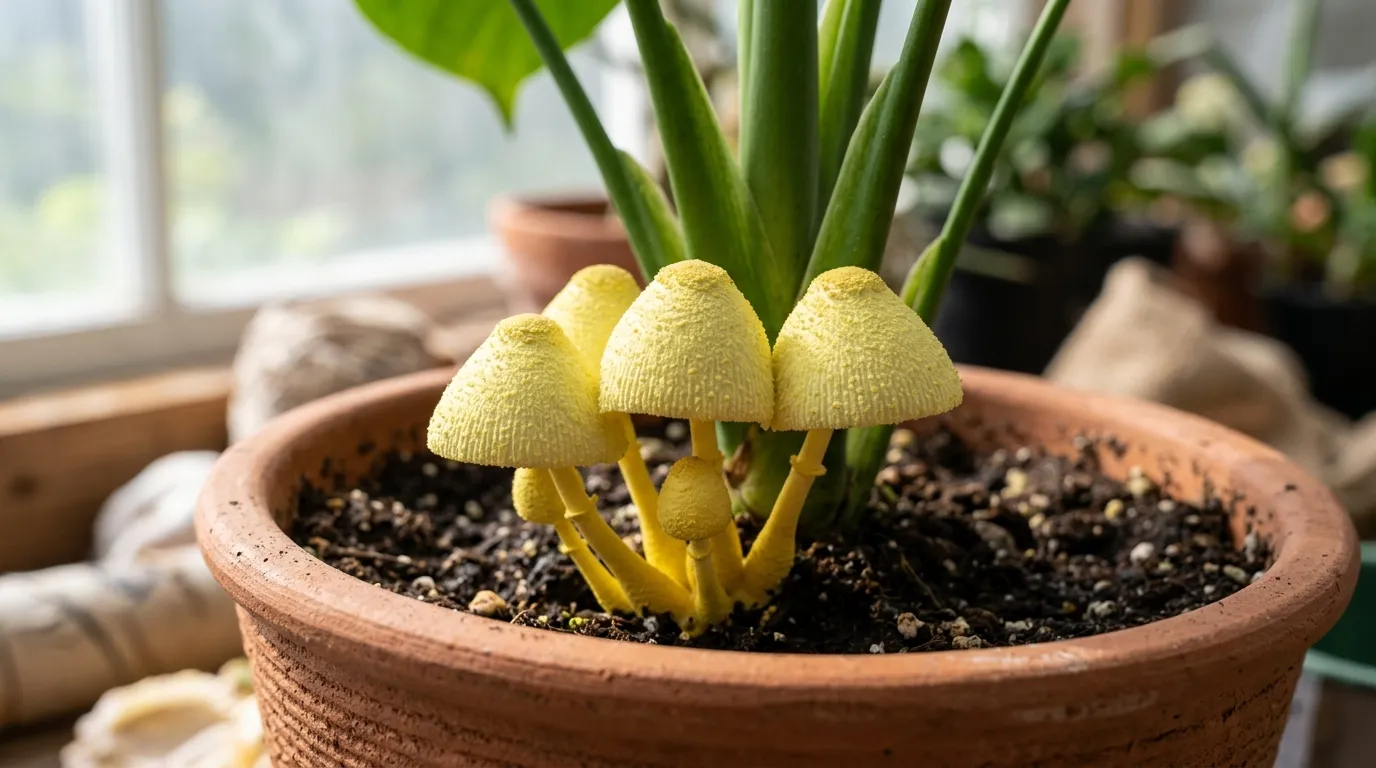
Mushrooms in houseplant soil are usually harmless to the plant. The most common one, a small lemon-yellow mushroom called Leucocoprinus birnbaumii, breaks down dead organic matter in potting mix and does not harm living plants, according to Iowa State University Extension. The same source treats the mushrooms as poisonous to people and animals, so the real risk is to curious pets and children, not to your plant.
Finding a mushroom in a pot can look alarming, especially if it appears overnight. This guide explains what the mushroom is, why it shows up indoors, whether it’s good or bad, and what you can realistically do about it, based on university extension and mycology sources.
Which Mushroom Is It?
Most yellow mushrooms in houseplant soil are Leucocoprinus birnbaumii, also called the yellow houseplant mushroom, yellow parasol or flower pot parasol. Iowa State Extension says it is found most often in potted plants and greenhouses, year round, and can also appear outdoors in summer.
- Color: bright to pale yellow, often with a darker center (MushroomExpert.com)
- Size: about 1 to 3 inches tall with a 1 to 2 inch oval or bell-shaped cap (Iowa State Extension)
- Cap surface: dry and powdery to finely scaly, with a grooved edge when mature (MushroomExpert.com)
- Stem: thin, with a fragile ring that sometimes disappears (MushroomExpert.com)
- Growth: alone or in clusters (Iowa State Extension)
- As it ages: fades to a very pale yellow, almost white, as the cap opens to release spores (Tom Volk, University of Wisconsin)
That last point matters for anyone searching for white mushrooms in houseplant soil: an older yellow parasol can look nearly white. Other small brown or white mushrooms can also appear in pots, and color alone isn’t enough to identify them. Pet Poison Helpline says mushroom identification should be left to mycologists, which is why every mushroom in a pot should be treated as inedible.
Why Are Mushrooms Growing in My House Plants?
The mushroom you see is only the reproductive part of the fungus. The main body is a network of fine threads called mycelium, living unseen in the soil. Iowa State Extension says it either arrives with the potting mix or starts from a spore that drifts into the pot on air currents.
Organic potting mix
The fungus feeds on dead organic matter. Mycologist Tom Volk of the University of Wisconsin notes it thrives wherever soil is organically rich and the temperature is warm, and that it most likely came in with the potting soil.
Warmth
Indoor rooms stay warm year round, which is why the yellow houseplant mushroom appears indoors in every season but outdoors mainly in summer (Iowa State Extension; MushroomExpert.com).
Moist soil
Fungi need moisture to fruit. An Ask Extension expert describes the fungi on houseplant soil surfaces as common when plants are overwatered and the soil stays moist.
Mushrooms in potting soil don’t mean you did something wrong when you potted the plant. Fresh, bagged mix can carry the fungus, and Iowa State notes it can arrive through the air even if the mix didn’t.
Mushrooms in Houseplant Soil: Good or Bad?
| Question | What the sources say | Verdict |
|---|---|---|
| Does it harm the plant? | No. It feeds on dead organic matter and doesn’t harm living plants (Iowa State Extension; MushroomExpert.com) | Harmless |
| Is it safe to eat? | No. Iowa State regards it as poisonous to people and animals; Volk notes toxicity reports conflict, with stomach upset in a small share of cases | Never eat |
| Is it safe to touch? | Yes, unless you’re allergic, according to Volk; handle it, then wash your hands | Low risk |
| Do fungicides work? | Generally not effective against mushrooms (Iowa State Extension) | Skip |
| Can you get rid of it for good? | Hard. Michael Kuo of MushroomExpert.com says even replacing all the soil may not work | Unlikely |
Sources: Iowa State University Extension (2025); MushroomExpert.com (Michael Kuo); Tom Volk, University of Wisconsin-La Crosse, Fungus of the Month (February 2002); UW Elisabeth C. Miller Library.
So, are mushrooms growing in a plant pot good or bad? For the plant they’re neutral at worst: the fungus is part of the decomposition happening in organic potting mix. The “bad” part is entirely about who might eat them, and sometimes about what they say about how wet the soil stays.
What to Do About Them
- Pick them off early. Pull or cut each mushroom at the soil line, bag it and put it in the trash. Volk notes the cap opens and fades as it releases spores, so removing young caps before they open limits spores spreading to other pots.
- Let the soil dry more between waterings. Constantly moist soil favors surface fungi, according to the Ask Extension answer. Water when the top of the mix is dry for that plant, and empty saucers after watering. Our overwatered vs underwatered guide helps you tell which problem you have.
- Check drainage. The pot needs a drainage hole. If you use a self-watering pot, see our guide to self-watering pot problems, since a wick system keeps the mix moist by design.
- Don’t reach for a fungicide. Iowa State Extension says fungicides are generally not effective against mushrooms, and the plant isn’t sick.
- Replace the soil only if you need to repot anyway. Some gardeners scrape off the top inch or two of mix, but the mycelium runs through the whole pot. Kuo says even a full soil change may not get rid of it, so repotting just for mushrooms is rarely worth the stress on the plant.
Pro tip: Because spores travel through the air, keep an eye on neighboring pots for a few weeks after you spot the first mushroom, and pick any new ones while they’re small.
When soggy soil is the bigger problem
The mushroom isn’t a disease, but soil that never dries out is a risk for root rot. If the plant is also wilting in wet soil, has yellowing lower leaves or a sour smell from the pot, check the roots. Our root rot treatment guide walks through what healthy and rotting roots look like.
Pets and Children
Treat every pot mushroom as toxic
Iowa State Extension advises removing the mushrooms as they appear if pets or small children live in the home. Pet Poison Helpline says any mushroom a pet eats should be treated as toxic unless a specialist quickly confirms it is safe, because signs can range from vomiting and diarrhea to tremors, seizures, and liver or kidney damage, and some toxins take up to 24 hours to show. If your dog or cat eats one, call your veterinarian, Pet Poison Helpline at (855) 764-7661 or the ASPCA Animal Poison Control Center at (888) 426-4435. Both helplines may charge a fee.
If your pets like to dig in pots, choosing plants that are safe for them reduces the overall risk. See our list of cat safe plants.
Mushrooms vs White Mold on the Soil
Mushrooms
Upright caps on stems, often yellow, appearing singly or in clusters. They’re the fruiting body of a fungus living in the mix.
White fuzzy growth
A flat, cottony layer on the surface of the mix. An Ask Extension expert describes this as a saprophytic fungus common on moist soil, unlikely to harm the plant directly but a sign of overwatering or poor drainage.
Both point in the same direction: soil that stays wet and rich in organic matter. The same conditions suit fungus gnats. UC IPM lists consistently moist potting media and incompletely composted organic matter as favoring gnats, and recommends letting the top of the soil dry between waterings and using pasteurized potting mix. If you see small flies too, see our fungus gnat control guide. A hard white crust is something else again: it’s usually mineral salt, covered in our guide to white crust on houseplant soil.
Frequently Asked Questions
Are mushrooms in houseplant soil bad for the plant?
No. Iowa State University Extension says the yellow houseplant mushroom breaks down dead organic matter in the potting mix and does not harm living plants. Removing them is only needed to protect pets and children.
What are the yellow mushrooms in houseplant soil?
Almost always Leucocoprinus birnbaumii, the yellow houseplant mushroom or flower pot parasol. It is lemon yellow, about 1 to 3 inches tall, with an oval or bell-shaped cap, and it is common in potted plants and greenhouses.
Why are there white mushrooms in my houseplant soil?
The yellow houseplant mushroom fades to almost white as its cap opens, so it may be an older one. Other small white mushrooms can also grow in pots. Color is not a reliable way to identify mushrooms, so treat all of them as inedible.
Are houseplant mushrooms poisonous to cats and dogs?
Treat them as poisonous. Iowa State Extension regards the yellow houseplant mushroom as poisonous to people and animals, and Pet Poison Helpline advises treating any mushroom a pet eats as toxic. Call your vet or a pet poison helpline if your pet eats one.
Will removing the mushrooms stop them coming back?
Usually not. The fungus lives throughout the soil, and the visible mushroom is only its fruiting body. Picking them off limits spores, and drier soil makes new ones less likely, but MushroomExpert.com says even replacing all the soil may not get rid of it.
Can I touch the mushrooms?
Yes. Mycologist Tom Volk says handling the yellow houseplant mushroom is not poisonous unless you’re allergic. Wash your hands afterward and keep them away from children.
Sources
- Iowa State University Extension: Will yellow mushrooms harm my houseplant? (2025)
- Michael Kuo, MushroomExpert.com: Leucocoprinus birnbaumii
- Tom Volk, University of Wisconsin: Leucocoprinus birnbaumii, the flowerpot parasol (Fungus of the Month, February 2002)
- UW Elisabeth C. Miller Library: Yellow houseplant mushroom
- Ask Extension: White mold on houseplant soil (2020)
- UC IPM Pest Notes: Fungus Gnats
- Pet Poison Helpline: Mushrooms