
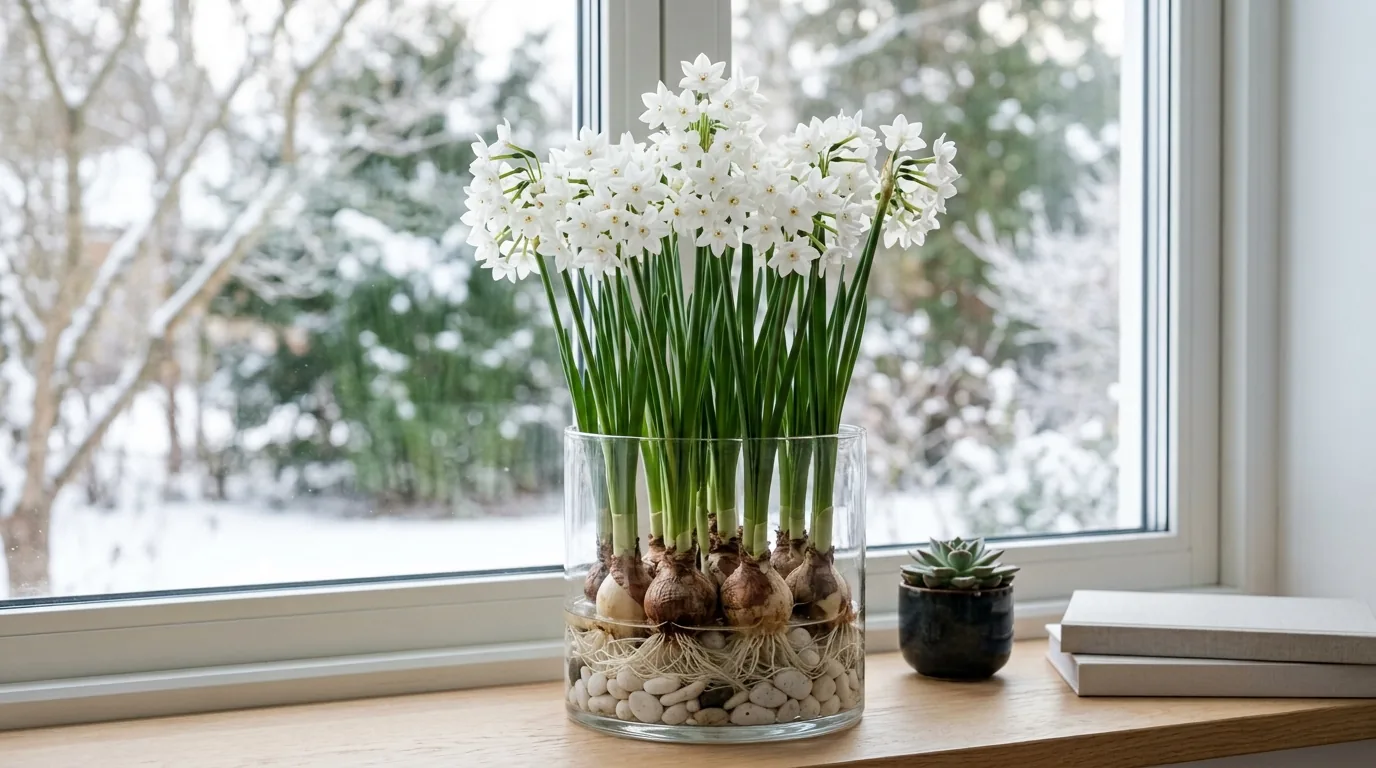
Paperwhites are the easiest bulbs to bring into bloom indoors. Unlike tulips, hyacinths and most daffodils, they have no chilling requirement (Illinois Extension), so you can set the bulbs on gravel and water in late fall and have fragrant white flowers in about a month. The only common problem is tall, floppy stems, and Cornell University research found a surprising fix. This guide covers how to grow paperwhites indoors in water or soil, forcing paperwhites for the holidays, the alcohol trick, what to do after they bloom and pet safety, following University of Illinois Extension, Cornell University, NC State Extension, UC Master Gardeners and the ASPCA.
Paperwhites at a Glance
| Step | What the sources say |
|---|---|
| Chilling | None needed (Illinois Extension, UC Master Gardeners) |
| Container | Any container with at least 1 to 2 inches of gravel or stones, or a pot of potting soil |
| Spacing | About 1 inch apart for a full display |
| Water level | Just touching the bottom of the bulbs; never submerge them |
| Rooting | 50 to 60°F for a week or two |
| Growing | Bright light; low 70s°F speeds growth, the 60s°F keep stems sturdier |
| Time to bloom | Typically 4 to 6 weeks after planting |
| Floppy stems | Maximum light, cooler room, staking, or a 4 to 6% alcohol solution (Cornell research) |
| Pets | Toxic to dogs, cats and horses; the bulb is the most toxic part (ASPCA) |
Sources: University of Illinois Extension (Johnson, 2024) unless noted; Cornell University (Miller and Finan, 2006); ASPCA.
What Are Paperwhites?
Paperwhites are small-cupped, clustered daffodils. Illinois Extension names them as Narcissus papyraceus and N. tazetta, native to Europe and the Mediterranean, with N. tazetta reaching into Asia. NC State Extension lists “paper white narcissus” among the common names of N. tazetta and gives a height of about 18 inches, occasionally up to 30.
Because they come from mild climates, they don’t need a cold period to flower. That is why they can be forced, brought into bloom out of season, with nothing more than water, light and a few weeks. Outdoors, Illinois Extension says they are hardy only to zone 8, so in colder areas they are treated as annuals.
How to Grow Paperwhites in Water and Gravel
This is the classic method, and it works in any container that holds water, including a glass vase or jar where you can watch the roots grow. Following University of Illinois Extension:
- Put at least 1 to 2 inches of gravel, stones or glass beads in the bottom of the container.
- Set the bulbs on top, pointed end up, about 1 inch apart for a dense display.
- Add more gravel around the bulbs to hold them upright.
- Add water until it just touches the bottom of the bulbs, and keep it at that level. Do not cover the bulbs with water.
How to Grow Paperwhites in Soil
Illinois Extension describes the soil method too: fill a pot about two thirds full with potting soil, set the bulbs on it about 1 inch apart, and add soil so only the tips show. Water it and keep the soil moist. Soil has one advantage over water: UC Master Gardeners note that bulbs forced in soil, rather than water, are the ones worth keeping to plant outdoors in warm climates (see after bloom).
Light, Temperature and Timing
Illinois Extension’s timeline:
| Stage | Conditions |
|---|---|
| Rooting (first week or two) | Cool, about 50 to 60°F |
| Growing | Warm (low 70s°F) and bright, on a windowsill or under a grow light; as much light as possible so stems don’t stretch |
| Keeping stems sturdy | A cooler room in the 60s°F |
| In flower | Out of direct sun and somewhere cooler, to make the flowers last |
Source: University of Illinois Extension (2024).
Paperwhites typically bloom 4 to 6 weeks after planting, so counting back, bulbs planted in early to mid November should flower around the holidays. For flowers all winter, Illinois Extension suggests planting a new batch every 10 days. If your windows are dim in winter, our grow light guide helps.
Stop Floppy Stems: Paperwhites and Alcohol
Paperwhites grown in a warm room with weak light often grow so tall they flop over. Illinois Extension’s first fixes are more light, a cooler room and staking. The second is stranger, and well tested.
In 2006, Cornell University researchers William Miller and Erin Finan published a study in HortTechnology showing that a dilute alcohol solution stunts paperwhite stems and leaves without affecting the flowers. Cornell reported that properly treated plants were 30 to 50% shorter, with flowers as large, fragrant and long-lasting as usual. The researchers suspect it works through mild water stress.
- Start the bulbs in plain water as above.
- Once the shoots are 1 to 2 inches tall (Illinois Extension), pour off the water and replace it with a 4 to 6% alcohol solution. Use the same solution every time you top up.
- Mix it like this:
| Alcohol | Mix for about 5% |
|---|---|
| Hard liquor at about 40% (gin, vodka, whiskey) | 1 part liquor to 7 parts water |
| 70% rubbing alcohol (isopropyl) | 1 part alcohol to 10 or 11 parts water |
Sources: University of Illinois Extension (2024); Cornell University news release (2006).
Paperwhite Care After Bloom
Most forced paperwhites go on the compost pile once they finish, and that is the realistic choice for bulbs grown in water. UC Master Gardeners note that a forced bulb needs time to restore its nutrients before it can flower again, and in cold areas the bulbs can’t go outside anyway (Illinois Extension: hardy only to zone 8).
If you grew them in soil and live in USDA zones 8 to 11, UC Master Gardeners describe how to try for future flowers:
- Cut off the flower stalks after the blossoms die, but keep the leaves.
- Let the leaves keep growing until they turn yellow and die back, so the bulb can store energy; a bloom fertilizer while it grows helps.
- Once the leaves have withered and the ground is suitable for spring planting, plant the bulbs about 6 inches deep in soil improved with compost.
- Water during the growing season and let them dry out slightly in winter. They may bloom the next spring, or take another year.
NC State agrees on the key point: remove the flowers, but cut back the foliage only after it has browned naturally.
Fragrance and Varieties
Paperwhites are sold for their scent, but not everyone likes it. Illinois Extension notes that the common variety ‘Ziva’ can have a strong, musky fragrance some people find unpleasant, while ‘Inbal’, ‘Wintersun’ and ‘Grand Soleil d’Or’ have less scent or a more pleasing one. If you are sensitive to strong smells, start with one of those, and grow ‘Ziva’ in a room you don’t sit in for long.
Want other winter bulbs? Hyacinths need a chilling period first; see our hyacinth guide. For holiday plants that flower without bulbs, see our guides to Christmas cactus and poinsettia care.
Are Paperwhites Toxic to Pets?
Yes. The ASPCA lists daffodil (Narcissus spp., with paper white among the common names) as toxic to dogs, cats and horses because of lycorine and other alkaloids. Signs include vomiting, drooling and diarrhea, and large amounts can cause convulsions, low blood pressure, tremors and heart rhythm problems. The bulbs are the most poisonous part. NC State lists the same toxins for N. tazetta. Keep bulbs and forcing containers out of pets’ reach, and call your veterinarian or the ASPCA Animal Poison Control Center at (888) 426-4435 if a pet eats any. Pet-friendly alternatives are in our cat-safe plants list.
For more holiday plants, see our guides to Thanksgiving vs Christmas cactus, cyclamen, Norfolk Island pine and kalanchoe.
Frequently Asked Questions
How long do paperwhites take to bloom?
Typically 4 to 6 weeks after planting (Illinois Extension). Plant in early to mid November for holiday flowers, or every 10 days for blooms all winter.
How much water do paperwhites need?
Keep the water level just touching the bottom of the bulbs and top it up as it drops. Never cover the bulbs with water (Illinois Extension).
Do paperwhites need to be chilled?
No. Unlike most spring bulbs, paperwhites have no chilling requirement, which is why they are so easy to force indoors (Illinois Extension).
Why are my paperwhites so tall and floppy?
Usually too little light and a warm room. Give them as much light as possible, keep them in the 60s°F, stake them, or grow them in a 4 to 6% alcohol solution, which Cornell found makes them 30 to 50% shorter without affecting the flowers.
Can you use rubbing alcohol on paperwhites?
Yes. Dilute 70% rubbing alcohol at 1 part to 10 or 11 parts water (Cornell, Illinois Extension), and add it once shoots are 1 to 2 inches tall. Avoid beer and wine.
Can you replant paperwhites after they bloom?
Bulbs forced in water are usually discarded. Bulbs grown in soil can be planted outdoors in USDA zones 8 to 11 once the leaves wither, and may bloom again in a year or two (UC Master Gardeners).
Are paperwhites poisonous to cats?
Yes. The ASPCA lists narcissus, including paper whites, as toxic to cats, dogs and horses; the bulbs are the most toxic part.
Sources
- Johnson, K. (2024). Bringing winter blooms to your home: How to grow and care for paperwhites. University of Illinois Extension
- Cornell University (2006). Why tipsy flowers don’t tip over (Miller and Finan, HortTechnology)
- NC State Extension Gardener Plant Toolbox: Narcissus tazetta
- UC Master Gardeners, The Savvy Sage (2024). A forced bulb back in the garden?
- ASPCA: Daffodil