
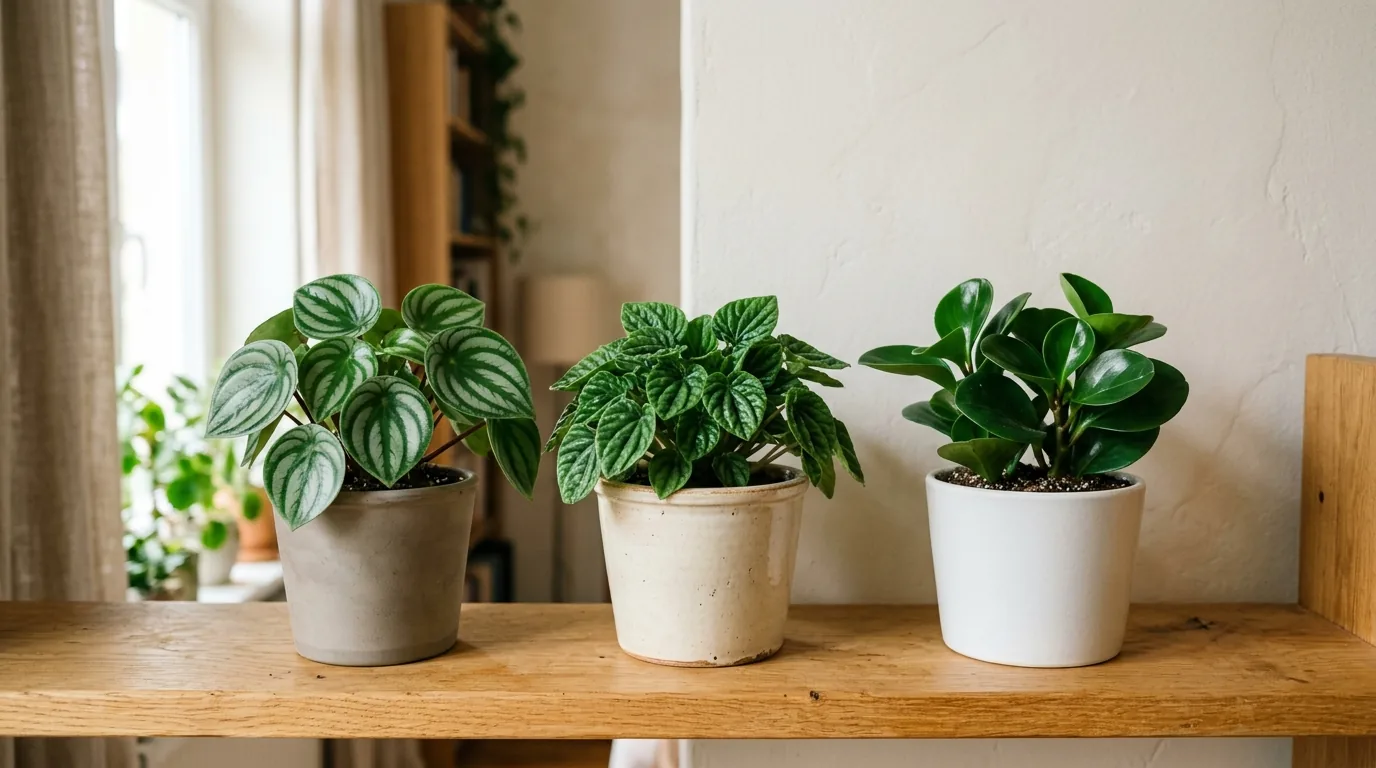
Peperomias are small, slow-growing houseplants in the pepper family (Piperaceae), grown for their thick, often patterned leaves: watermelon, ripple, baby rubber plant, raindrop, string of turtles and many more. Clemson HGIC gives a mature size of 8 to 15 inches tall and wide, and all the extension sources agree on the main rule: overwatering is what kills them. This guide covers peperomia care indoor basics, peperomia care watering by type, soil, feeding, peperomia propagation, problems and pet safety, following Clemson HGIC (2026), the University of Missouri, NC State Extension and the ASPCA.
Peperomia Care at a Glance
| Need | What the sources say |
|---|---|
| Light | Indirect light from an east or south window; tolerates low light near a large north window; direct sun scorches (Clemson) |
| Water | Let the soil dry between waterings (Clemson); water when dry a couple of inches down (Missouri) |
| Soil | Well-drained houseplant or cactus mix (Clemson); porous mix with perlite and/or orchid bark (Missouri) |
| Temperature | Above 50°F (Missouri); outdoors in summer only once nights stay at 60°F or above (Clemson) |
| Humidity | Medium to low preferred for baby rubber plant (NC State); a humidifier helps in winter (Clemson) |
| Feeding | Spring and summer only: occasional low-strength liquid feed or slow-release granules once a year (Clemson) |
| Size | 8 to 15 inches tall and wide (Clemson) |
| Pets | Common species non-toxic to cats and dogs (ASPCA) |
Sources: Clemson HGIC 1567 (2026); University of Missouri IPM (2022); NC State Extension; ASPCA.
Popular Peperomia Types
Peperomia care is broadly the same across species, but the University of Missouri points out an important difference: some are truly succulent and some are not, and they need different watering.
| Type | Look (Clemson) | Watering note (Missouri) |
|---|---|---|
| Baby rubber plant (P. obtusifolia) | Thick, rounded, succulent-like leaves, green or variegated; very easy | Truly succulent: let the mix get almost completely dry |
| Watermelon (P. argyreia) | Silvery striped leaves, reddish stems, about 8 inches tall | Less succulent: don’t let it dry out like a succulent, but don’t keep it wet |
| Ripple (P. caperata) | Rippled leaves, green or burgundy, about 10 inches | Less succulent: same as watermelon |
| Red-edged (P. clusiifolia) | Dark green leaves edged in red, up to 12 inches; ‘Ginny’ is tricolor | Very intolerant of overwatering |
| Raindrop (P. polybotrya) | Shiny teardrop leaves, 12 inches | Tolerates drying out |
| String of turtles (P. prostrata) | Tiny round patterned leaves on trailing stems | Evenly moist but suffers if overwatered |
| Creeping buttons (P. rotundifolia) | Small round leaves close on the stem | Sensitive to overwatering; likes being somewhat pot-bound |
Sources: Clemson HGIC 1567; University of Missouri IPM.
Clemson notes that raindrop peperomia is often mistaken for the Chinese money plant and is easier to grow; see our Pilea peperomioides care guide to compare.
Light and Temperature
Clemson recommends indirect light from an east- or south-facing window and says peperomia tolerates somewhat low light near a large north-facing window, while direct sun can scorch the leaves. Missouri says to avoid full sun, notes that thick, fleshy-leaved species need more light than thin-leaved ones, and that variegated cultivars stay more colorful in brighter light. NC State says the baby rubber plant tolerates low light for several months, especially non-variegated cultivars.
Missouri says to keep peperomias warm, above 50°F, and NC State warns that baby rubber plant does not tolerate very drafty sites. Clemson says plants can go outdoors for summer once nights are consistently 60°F or higher, acclimated in deep shade and kept out of direct sun. Bring them back in before nights cool; see our guide to bringing plants indoors for winter.
Peperomia Care Watering
This is where most peperomias are lost. Clemson calls root rot from overwatering the most common disease, NC State says overwatering yellows the leaves and leads to root rot, and Missouri says root and stem rot kills the plant in most cases.
- When: Missouri’s rule is to feel the mix and water when it is dry a couple of inches down. Clemson says let the soil dry out between waterings.
- Succulent types (baby rubber plant and other thick-leaved kinds): let the mix get almost completely dry first (Missouri).
- Thinner-leaved types (watermelon, ripple): don’t let them dry out completely, but never keep them wet (Missouri).
- How: water thoroughly, then empty the saucer (Clemson). Water the soil, not the leaves: Clemson says keeping leaves dry helps prevent fungal leaf spots.
- Winter: growth slows and the mix dries more slowly, so check more and water less. See our winter houseplant care guide.
Soil, Pots and Repotting
Clemson recommends a well-drained houseplant or cactus potting mix; Missouri recommends a porous mix with perlite and/or orchid bark added. Missouri also prefers clay pots to plastic because they let water escape through the sides.
Peperomias don’t need frequent repotting. Clemson says they can stay in one pot for several years and, when you do repot, to go only slightly larger than the grower’s pot. Missouri adds that creeping buttons prefers to be somewhat pot-bound and that slow-growing red-edged peperomia shouldn’t be repotted too often. See our guide on how to repot a plant.
Feeding and Pruning
Clemson says to fertilize only during active growth in spring and summer, with either an occasional low-strength liquid fertilizer or a slow-release granular fertilizer once a year. For shape, Clemson suggests removing old leaves as needed and cutting stems just above a leaf node to encourage branching. It also notes that the thin flower spikes are generally considered unattractive and can be removed so the plant puts its energy into leaves.
Peperomia Propagation
Peperomias are easy to multiply. NC State lists leaf and stem cuttings for baby rubber plant, and Clemson gives three methods:
| Method | How (Clemson) |
|---|---|
| Leaf cutting | Take a leaf with at least 1 inch of petiole (leaf stalk) and insert it in rooting medium; new plants form at the base of the petiole |
| Stem cutting | Cut 3 to 5 inches, strip the lower third of leaves, dip in rooting hormone, insert in potting soil or rooting medium, cover with clear plastic, keep out of direct sun |
| In water | Cut 4 to 6 inches just below a node, stand in water in bright, indirect light; pot once roots and new leaves form |
Source: Clemson HGIC 1567.
Clemson notes that baby rubber plant is easily propagated in water. For more on rooting cuttings, see our guide to cuttings rotting in water if a water cutting turns soft.
Problems and Pests
| Symptom | Likely cause | What to do |
|---|---|---|
| Yellowing leaves | Overwatering (Missouri, NC State) | Let the mix dry; water less often |
| Soft, dark stems, plant collapsing | Root or stem rot from overwatering (Clemson, Missouri) | Take healthy cuttings; see our root rot guide |
| Leaves dropping | Overwatering (Clemson) | Check the mix and roots; water less |
| Spots on leaves | Fungal leaf spot (Clemson) | Keep leaves dry when watering; remove spotted leaves |
| Scorched, bleached patches | Direct sun (Clemson) | Move to indirect light |
| Faded variegation | Too little light; Missouri says variegated cultivars stay more colorful in brighter light | Move to brighter, indirect light |
| Cottony clusters, webbing, tiny flies | Mealybugs, spider mites, fungus gnats, scale or whiteflies (Clemson) | See our guides to mealybugs, spider mites and fungus gnats |
Sources: Clemson HGIC 1567; University of Missouri IPM; NC State Extension.
Is Peperomia Safe for Cats and Dogs?
Yes, for the common species. The ASPCA’s cat and dog plant lists include baby rubber plant (P. obtusifolia), ripple peperomia (P. caperata), watermelon peperomia (P. argyreia), creeping buttons (P. rotundifolia) and several others among plants non-toxic to cats and dogs, and Clemson says most peperomias are considered pet-safe. Eating any plant can still upset a pet’s stomach. See our full lists of cat-safe plants and plants safe for dogs.
For other compact, pet-safe houseplants, see our guides to bromeliad care.
Frequently Asked Questions
How often should I water a peperomia?
There is no fixed schedule. Missouri says to water when the mix is dry a couple of inches down; let thick-leaved, succulent types like baby rubber plant dry almost completely, and don’t let thinner-leaved watermelon and ripple types dry out fully.
Does peperomia need sunlight?
It needs indirect light, not direct sun. Clemson recommends an east or south window and says direct sun scorches the leaves; it tolerates somewhat low light near a large north window.
Why are my peperomia leaves turning yellow?
Usually overwatering. Missouri says yellow leaves are the early sign, and letting the plant dry out may save it if caught early; NC State says overwatering leads to root rot.
How do you propagate peperomia?
By leaf cuttings with at least 1 inch of petiole, by 3 to 5 inch stem cuttings in rooting medium, or by 4 to 6 inch cuttings in water (Clemson). New plants form at the base of the leaf stalk.
Is peperomia toxic to cats?
No. The ASPCA lists common peperomias, including baby rubber plant, ripple, watermelon and creeping buttons, as non-toxic to cats and dogs.
What soil is best for peperomia?
A well-drained houseplant or cactus mix (Clemson), or a porous mix with perlite and/or orchid bark (Missouri). Clay pots help extra water escape.
How big does a peperomia get?
Clemson gives 8 to 15 inches tall and wide; NC State lists baby rubber plant at up to 2 feet.
Sources
- Long, G. E. Clemson HGIC 1567: Peperomia Indoor Plant Care and Growing Guide (2026)
- Trinklein, D. University of Missouri IPM: Peperomia, the Plant, not the Pizza (2022)
- NC State Extension Gardener Plant Toolbox: Peperomia obtusifolia
- ASPCA: Toxic and Non-Toxic Plant List, Cats
- ASPCA: Toxic and Non-Toxic Plant List, Dogs