
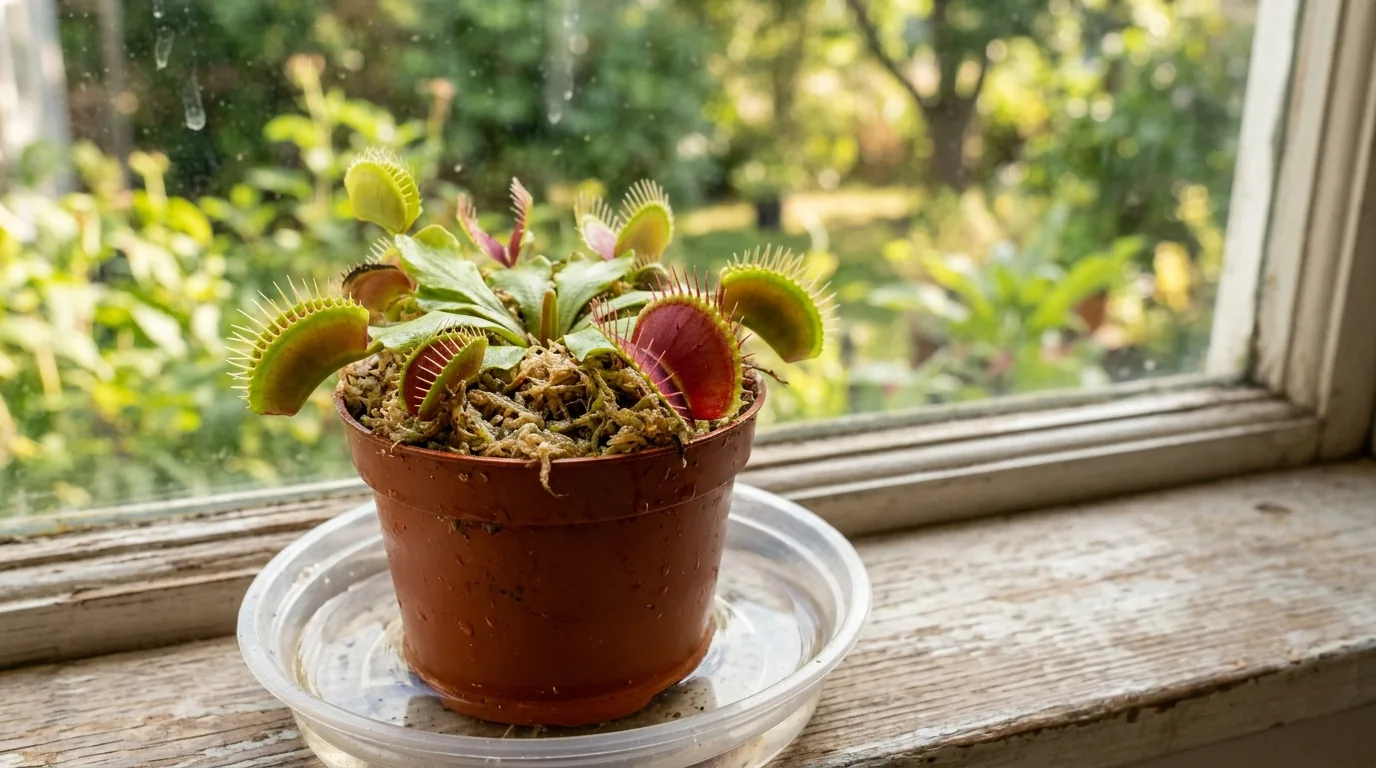
The Venus flytrap (Dionaea muscipula) grows wild in only one place on Earth: the wet, sandy, nutrient-poor bogs of coastal North Carolina and a small corner of northeastern South Carolina. NC State Extension says wild populations are found only within about 70 miles of Wilmington, and its plant database notes the species cannot be legally collected from the wild. Most flytraps that die at home are killed by the wrong water, too little light or a warm winter. This guide covers Venus fly trap care indoors, water and soil, feeding, Venus fly trap dormancy and Venus fly trap care in winter, and problems, as simple Venus fly trap care for beginners, following NC State, the RHS and Iowa State.
Venus Fly Trap Care at a Glance
| Need | What the sources say |
|---|---|
| Light | Full sun, 6 or more hours of direct sun (NC State); south or west window (Iowa State); poor light gives weak traps (RHS) |
| Water | Rainwater or distilled water only; keep the mix wet (NC State, RHS, Iowa State) |
| Soil | Sphagnum moss, or equal parts peat and coarse vermiculite or sharp sand (NC State); 2 parts peat to 1 part coarse sand (Iowa State) |
| Humidity | High (NC State, Iowa State) |
| Temperature | 10 to 27°C (50 to 80°F) while growing (RHS); 70 to 75°F summer days, 55 to 60°F in winter (Iowa State) |
| Feeding | Do not fertilize (NC State); insects only, live prey (RHS) |
| Dormancy | About 10+ weeks at 35 to 50°F, or skip under strong lights (NC State); a cool rest above 50°F (RHS) |
| Size | 6 to 12 inches tall, rosette of up to 8 leaves (NC State) |
| Pets | Non-toxic to cats and dogs (ASPCA) |
Sources: NC State Extension Plant Toolbox and New Hanover County Center (2026); RHS; Iowa State Extension (2022); ASPCA.
Light
Light is the most common shortfall indoors. NC State lists full sun, 6 or more hours of direct sun a day, or partial shade at the low end. Iowa State recommends a south- or west-facing window with several hours of direct sun. The RHS says full sun keeps the traps red and that poor light causes weak, straggly traps that won’t work properly.
If you don’t have a sunny window, grow lights work. NC State’s New Hanover article suggests LED lighting of about 15,000 to 25,000 lux for roughly 14 hours a day. See our guide to the best grow lights for indoor plants.
Water: Rainwater or Distilled Only
This is the rule that matters most. NC State, the RHS and Iowa State all say to use rainwater or distilled water only. NC State warns that treated or hard water can kill the plant, and Iowa State says tap water may be too alkaline or carry too many minerals.
- Keep it wet: NC State says never let the soil dry out; the RHS says to keep the compost permanently wet.
- Tray method: the RHS suggests standing the pot in a saucer of rainwater or distilled water.
- Not waterlogged in winter: NC State’s dormancy article says to keep the soil moist but not waterlogged.
- Humidity: NC State and Iowa State say flytraps need high humidity; Iowa State suggests an aquarium or terrarium with the lid slightly ajar for ventilation. See our terrarium guide and greenhouse cabinet guide.
Soil, Pots and Repotting
Never use regular potting mix or fertilized compost. The sources give slightly different recipes, all low in nutrients:
| Source | Mix |
|---|---|
| NC State | Whole-fiber sphagnum moss, or equal parts peat moss and coarse vermiculite or sharp sand |
| Iowa State | 2 parts sphagnum peat moss to 1 part coarse sand |
| RHS | Sustainably grown live sphagnum moss or peat-free carnivorous plant compost |
Sources: NC State Extension; Iowa State Extension; RHS.
Use a plastic or glazed pot with drainage holes so it can sit in its water tray. Wear gloves when handling sphagnum moss; see our sphagnum moss guide for why. For more on potting mixes in general, see coco coir vs peat moss.
Feeding
NC State explains how a trap works: it closes when an insect or spider touches two of the six trigger hairs on the inner surface, then digests the prey and reopens. Indoors, a flytrap on a sunny windowsill usually catches enough on its own.
- No fertilizer in the soil: NC State says do not fertilize. Iowa State says fertilizer is usually unnecessary and, if used, suggests only a very dilute fish emulsion solution once a month in spring and summer.
- No meat: Iowa State says not to feed raw meat, and the RHS says traps digest only live prey, so cheese or meat is not digested.
- Don’t trigger traps for fun: the RHS says a trap can only close a maximum of about three times before it dies.
- If you hand-feed: use a small live insect, since the RHS says traps digest only live prey.
Flytraps catch some small insects such as fungus gnats; for whether carnivorous plants can control them, see our guide to carnivorous plants for fungus gnats and getting rid of fungus gnats.
Venus Fly Trap Dormancy
In the wild, NC State says dormancy typically runs from November through early spring and lasts three to five months, depending on the weather. The leaves above ground die back, but the plant survives underground in its rhizome. That dieback is normal and is not death.
The sources disagree on whether indoor plants need it:
| Source | Dormancy advice |
|---|---|
| NC State (New Hanover, 2026) | Aim for at least 10 weeks at 35 to 50°F; indoor plants under adequate lights (about 14+ hours a day) can skip dormancy if fed; windowsill plants will likely go dormant from reduced winter light |
| RHS | Needs a cool rest in winter, but above 10°C (50°F); avoid a warm room over winter |
| Iowa State | 55 to 60°F in winter; does not address dormancy directly |
Sources: NC State Extension New Hanover County Center; RHS; Iowa State Extension.
The practical middle ground for a windowsill plant: from about November, move it to the coolest bright spot you have, such as an unheated room or a cold windowsill, keep the mix moist but not waterlogged, and expect it to look dull until spring. Outdoors, NC State says to protect plants from hard freezes below about 20°F.
Venus Fly Trap Care in Winter
- Cool it down to roughly 35 to 50°F (NC State) or at least out of warm rooms (RHS).
- Keep the light: even dormant, it should stay in a bright spot.
- Water less: keep the mix moist but not waterlogged (NC State), still with rainwater or distilled water.
- Don’t feed and don’t fertilize.
- Trim dead leaves as they blacken.
- Restart in spring: move it back to full sun and normal watering when new growth appears.
For general cold-season advice, see our winter houseplant care guide.
Flowers and Propagation
NC State says flytraps bloom in May and June, with small white, cup-shaped flowers about 0.7 inch across on a leafless stalk 4 to 12 inches tall. The RHS notes that established plants may flower in spring on a tall stem. For propagation, NC State recommends division or seed.
Buy only nursery-propagated plants. NC State lists the species as endangered and says it cannot be legally collected from the wild, but that nursery-propagated stock is widely available.
Problems and Fixes
| Symptom | Likely cause | What to do |
|---|---|---|
| Whole plant blackening, leaves dying in summer | Tap or hard water (NC State, RHS, Iowa State), or mix allowed to dry out (RHS) | Repot in fresh peat and sand or sphagnum; use only rainwater or distilled water |
| Weak, floppy, green traps that don’t close | Poor light (RHS) | More direct sun or a strong grow light |
| Single traps turning black | Trap closed too many times (RHS) | Trim them off; stop triggering traps |
| Leaves dying back in late fall | Normal dormancy (NC State) | Cool, bright, moist; wait for spring |
| Plant declines after a warm winter | No cool rest (RHS) | Give a cool rest next winter, or strong lights all year |
| Rotting trap after feeding | Meat or other non-living food (Iowa State, RHS) | Feed only small live insects, or none |
| Small insects on leaves, webbing | Aphids or spider mites (NC State) | See our guides to aphids and spider mites |
Sources: NC State Extension; RHS; Iowa State Extension.
Is a Venus Flytrap Safe for Pets?
Yes. The ASPCA lists the Venus fly trap (Dionaea muscipula) as non-toxic to cats and dogs, and NC State tags it as non-toxic too. A cat chewing on it can still damage the plant, so keep it out of reach. For more pet-safe choices, see our lists of cat-safe plants and plants safe for dogs.
Frequently Asked Questions
How do you take care of a Venus flytrap indoors?
Put it in your sunniest window or under strong grow lights, keep the pot standing in rainwater or distilled water so the mix stays wet, use a peat-and-sand or sphagnum mix, and don’t fertilize (NC State, RHS, Iowa State).
Can I use tap water for a Venus flytrap?
No. NC State, the RHS and Iowa State all recommend rainwater or distilled water only; NC State warns that treated or hard water can kill the plant.
Does a Venus flytrap need dormancy?
Sources differ. NC State says windowsill plants will likely go dormant and suggests at least 10 weeks at 35 to 50°F, while plants under strong grow lights for about 14 hours a day can skip it. The RHS says it needs a cool winter rest above 50°F.
Why is my Venus flytrap turning black?
Single traps die after closing a few times (RHS). A whole plant blackening points to tap water or a dried-out mix, or, in late fall, normal dormancy (NC State).
Should I feed my Venus flytrap?
Usually not indoors in a sunny spot; it catches its own insects. Never fertilize the soil (NC State) and never feed meat, which the RHS says traps won’t digest.
How many times can a Venus flytrap close?
The RHS says each trap can close a maximum of about three times before it dies, so avoid triggering them for fun.
Is a Venus flytrap toxic to cats?
No. The ASPCA lists the Venus fly trap as non-toxic to cats and dogs.
Sources
- NC State Extension Gardener Plant Toolbox: Dionaea muscipula
- de Souza, G. NC State Extension, New Hanover County Center: Venus Flytrap Dormancy (2026)
- RHS: Venus fly trap
- Iowa State University Extension: How does one care for a Venus flytrap? (2022)
- ASPCA: Toxic and Non-Toxic Plant List, Cats
- ASPCA: Toxic and Non-Toxic Plant List, Dogs