
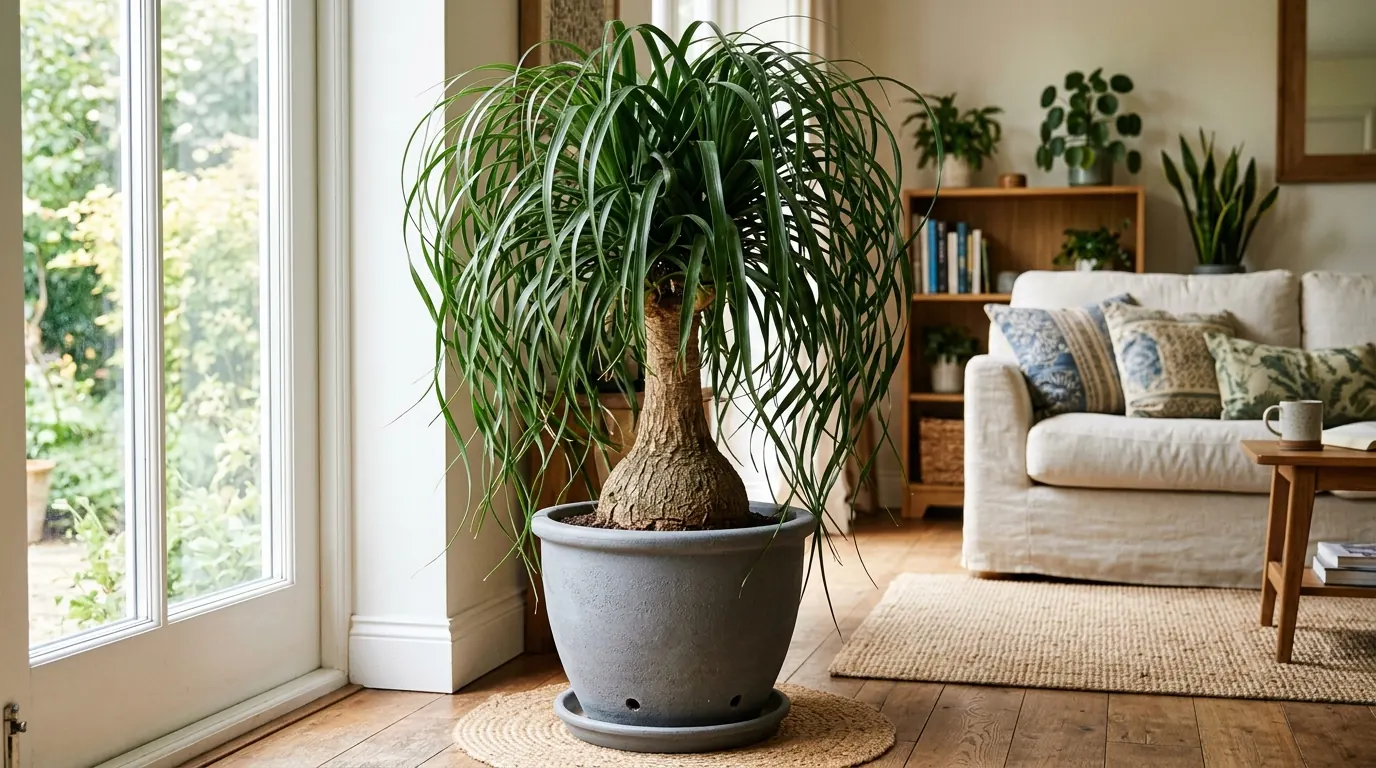
The ponytail palm (Beaucarnea recurvata, sometimes sold as Nolina) isn’t a palm at all. UW-Madison Extension explains it is a desert plant from southeastern Mexico, and NC State notes that its swollen base, the caudex, stores water. That makes it closer to a succulent than to a tropical palm, and it explains the main rule of its care: lots of light, little water. This guide covers ponytail palm care indoors, ponytail palm light requirements, watering, soil, feeding, repotting, ponytail palm yellow leaves and brown tips, and whether the ponytail palm is toxic to cats, following NC State, UW-Madison, Iowa State, the University of Minnesota and the ASPCA.
Ponytail Palm Care at a Glance
| Need | What the sources say |
|---|---|
| Light | Full sun, 6+ hours of direct sun; a sunny window (NC State); as much light as possible (UW-Madison); bright, near an east or west window (Iowa State) |
| Water | Deeply in summer, dry out between waterings, much less in winter (NC State, UW-Madison) |
| Soil | Well-drained cactus and succulent mix (NC State); add sharp sand or small gravel to standard mixes (UW-Madison) |
| Feeding | Once or twice in the growing season (UW-Madison); dilute, once or twice a month in spring and summer (Iowa State) |
| Temperature | Hardy to 50°F; zones 10 to 11 outdoors (NC State); tolerates heated indoor air (NC State) |
| Repotting | Can go many years between repottings (UW-Madison) |
| Size | 6 to 8 feet in a pot, up to 30 feet in the wild (NC State) |
| Pets | Non-toxic to cats and dogs (ASPCA) |
Sources: NC State Extension Plant Toolbox; UW-Madison Extension; Iowa State Extension (2022); ASPCA.
Ponytail Palm Light Requirements
NC State lists full sun, 6 or more hours of direct sunlight a day, and recommends a sunny window indoors. UW-Madison says this desert plant is adapted to bright light and should get as much light as possible in a bright window. Iowa State is a little gentler, suggesting a brightly lit spot near an east or west window.
One source goes further: the University of Minnesota Extension includes ponytail palm in its list of low-light houseplants. It can survive lower light, but the other sources agree it grows best in strong light, so treat low light as tolerated rather than ideal. In a dim room, a grow light helps. If you move it outdoors for summer, UW-Madison says to acclimate it gradually to avoid sunburn.
Watering
The swollen caudex stores water (NC State), so the plant handles drought far better than wet soil. UW-Madison says overwatering is the most common cause of failure.
- Spring and summer: water deeply, then let the mix dry out before watering again (NC State, UW-Madison). Iowa State says to water less often than most houseplants.
- Winter: NC State says to greatly reduce watering, and UW-Madison says to cut back sharply to avoid root rot. NC State notes it prefers dry winters and tolerates heated indoor air.
- Drainage: always use a pot with drainage holes and empty the saucer.
Not sure whether yours is over or under watered? See our guide to overwatered vs underwatered plants. The same water-sparingly rules apply to our guides on growing succulents and jade plant care.
Soil, Pots and Repotting
NC State recommends a well-drained mix such as those made for cacti and succulents. UW-Madison suggests a cactus-style mix, or adding sharp sand and/or small gravel to a standard potting mix for drainage.
UW-Madison says a ponytail palm can go many years between repottings. A larger pot lets it grow in height and girth, but older plants get heavy and hard to handle, so keeping them in smaller pots helps control their size. When you do repot, go up only one size and use a heavy pot so the plant doesn’t tip over. See our guide on how to repot a plant.
Feeding and Temperature
The sources agree on feeding lightly but differ on how often:
| Source | Feeding advice |
|---|---|
| UW-Madison | Fertilize once or twice during the growing season |
| Iowa State | A diluted fertilizer solution once or twice a month in spring and summer |
Sources: UW-Madison Extension; Iowa State Extension.
Either way, don’t feed in winter. UW-Madison lists excess fertilizer as one cause of brown leaf tips.
NC State says ponytail palm is hardy only to about 50°F (USDA zones 10 and 11), so in most climates it is a houseplant that can summer outdoors and must come in before cold nights. See our guide to bringing plants indoors for winter.
Pruning, Branching and Propagation
- Old leaves: UW-Madison says to remove older leaves that have turned yellow and dried, and to trim off dead brown tips.
- Branching: UW-Madison says cutting off the top of a small trunk (under 6 inches in diameter) while the plant is dormant produces a branched, multi-headed plant.
- Propagation: UW-Madison says ponytail palms are propagated by seed. The small offsets that form on the caudex can be cut off flush or left to become branches, but they will not root into new plants.
Ponytail Palm Yellow Leaves and Other Problems
| Symptom | Likely cause | What to do |
|---|---|---|
| Soft, mushy caudex or stem, yellowing leaves | Overwatering and rot (UW-Madison: overwatering is the most common failure; NC State lists stem rot) | Stop watering, let the mix dry fully, repot in fast-draining mix if the roots are rotting |
| Brown leaf tips | Too much or too little water, excess fertilizer or salt buildup (UW-Madison) | Correct watering, feed less, flush the pot with plain water; trim the tips |
| Older lower leaves yellowing and drying | Normal aging (UW-Madison) | Remove them |
| Pale, stretched new growth | Too little light | Move to the sunniest window |
| Spotted or streaked leaves | Leaf spot or bacterial leaf streak (NC State) | Remove affected leaves; water the soil, not the leaves |
| Cottony or waxy bumps | Mealybugs or scale (UW-Madison, NC State) | See our guides to mealybugs and scale |
| Fine webbing, speckled leaves | Spider mites (NC State) | See how to get rid of spider mites |
Sources: UW-Madison Extension; NC State Extension.
Is a Ponytail Palm Toxic to Cats?
No. The ASPCA lists ponytail palm (Beaucarnea recurvata, also called bottle palm or elephant-foot tree) as non-toxic to cats and dogs, and NC State tags it non-toxic for cats, dogs and horses. If a pet chews the leaves, it may still get an upset stomach, as with any plant, and the plant will look ragged. See our lists of cat-safe plants and plants safe for dogs.
For a true palm with very different needs (lower light, more water), see our parlor palm care guide.
Frequently Asked Questions
How often should I water a ponytail palm?
Water deeply, then let the mix dry out before watering again (NC State, UW-Madison), and cut back sharply in winter. Iowa State says to water less often than most houseplants.
Does a ponytail palm need direct sunlight?
It does best with it. NC State lists full sun, 6 or more hours of direct sun, and UW-Madison says to give it as much light as possible; Iowa State suggests an east or west window. UMN lists it as tolerating low light.
Why are my ponytail palm leaves turning yellow or brown?
Older lower leaves yellow and dry naturally (UW-Madison). Brown tips come from too much or too little water, excess fertilizer or salt buildup; widespread yellowing with a soft base means overwatering.
Is a ponytail palm toxic to cats?
No. The ASPCA lists ponytail palm as non-toxic to cats and dogs.
Is a ponytail palm a real palm?
No. UW-Madison explains it is not a true palm but a desert plant from southeastern Mexico whose swollen base stores water.
Can you propagate a ponytail palm from pups?
UW-Madison says the offsets on the caudex will not root into new plants; ponytail palms are propagated from seed. Cutting a small trunk while dormant makes the plant branch instead.
How big does a ponytail palm get indoors?
NC State gives 6 to 8 feet in a pot, though it grows slowly; in the wild it can reach 30 feet.
Sources
- NC State Extension Gardener Plant Toolbox: Beaucarnea recurvata
- Mahr, S. and Mahr, D. UW-Madison Extension: Ponytail Palm, Beaucarnea recurvata
- Iowa State University Extension: How do I care for a ponytail palm? (2022)
- Weisenhorn, J. and Hoidal, N. University of Minnesota Extension: Lighting for indoor plants (reviewed 2026)
- ASPCA: Toxic and Non-Toxic Plant List, Cats
- ASPCA: Toxic and Non-Toxic Plant List, Dogs