
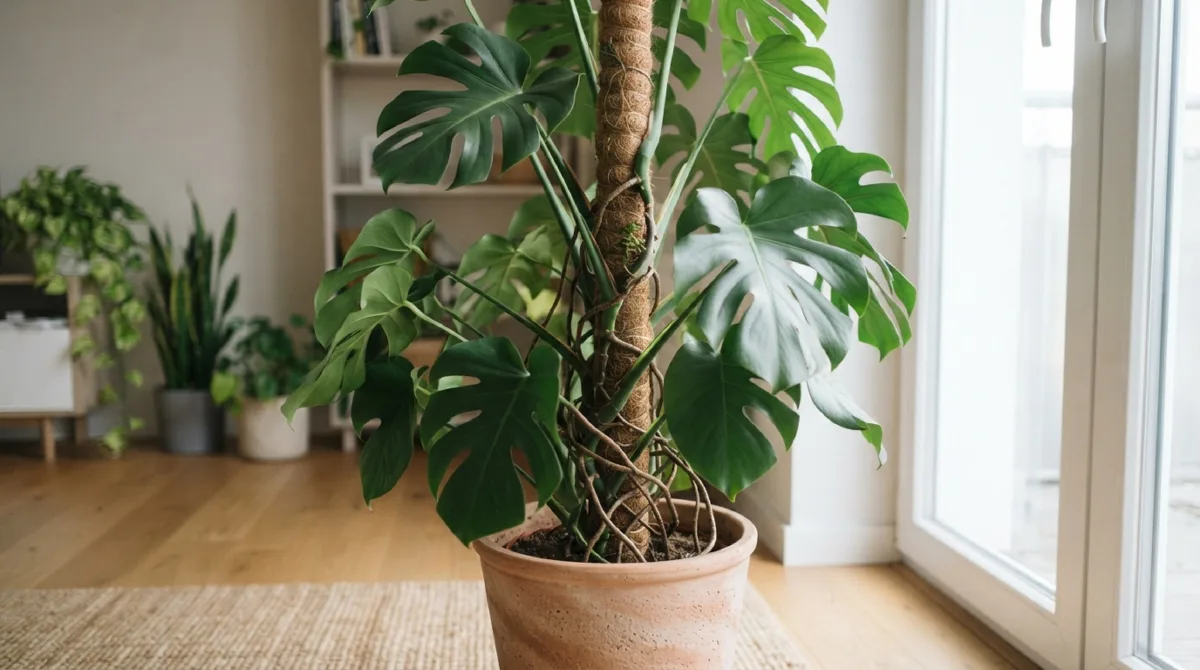
A monstera that is happy starts sending thick, pale roots out of the stem and into the air. Some hang straight down, some wrap the pole, and some wander across the floor. This guide covers monstera aerial roots: what they are for, whether you should cut them, how they relate to monstera aerial roots propagation, and what to do when they get monstera aerial roots too long. It follows NC State Extension and the University of Wisconsin Extension.
What Aerial Roots Are For
Monstera deliciosa is a climbing vine, not a self-supporting shrub. NC State Extension describes it as a woody, broadleaf evergreen vine in the arum family that is native from Mexico to Panama and can reach 70 feet in the wild, though it stays around 6 to 8 feet in most homes. In its native habitat it starts life on the ground and becomes epiphytic once it contacts a sturdy tree it can climb.
The aerial roots are part of that climb. The University of Wisconsin Extension describes them as clinging aerial roots and recommends giving the plant a tree bark or strong, moss-covered support sunk into the pot for the roots to attach to. NC State adds that sturdy support is necessary to prevent the stems from breaking. In other words, the roots are a holdfast system first.
They are still roots. If an aerial root reaches damp soil, a moss pole or a glass of water, it can take up moisture and branch. That is why a monstera grown on a wet moss pole looks different from one left to trail: the pole gives the roots something to hold and something to drink from.
Why Your Monstera Is Growing Them
Aerial roots usually appear when the plant matures and starts to look for something to climb. Four things encourage them:
- Age and size. Juvenile plants produce few or none. A plant with a thick stem and large fenestrated leaves is ready to climb.
- A support. A moss pole or bark board gives the roots a target. UW recommends a strong, moss-covered support for exactly this reason.
- Humidity. NC State lists high humidity as a preference for monstera. Dry indoor air does not stop aerial roots, but it can dry out the ones that form.
- Light. NC State recommends moderate brightness but not direct sunlight, with more light for variegated cultivars. A plant in good light grows faster and produces more roots.
Normal vs a Problem
Most aerial roots are healthy. The table separates the normal look from the cases that need action.
| What you see | What it means | What to do |
|---|---|---|
| Thick, pale tan or green roots growing from the stem | Normal aerial roots | Leave them or guide them to the pole |
| Roots wrapping the moss pole | The plant is anchoring itself | Keep the pole damp and leave them alone |
| Roots reaching the floor or a nearby shelf | Normal exploration | Redirect them, tuck them in, or cut them |
| Dry, crispy, light brown tips | Low humidity or an old root | Trim the dry end; raise humidity if the whole plant looks dry |
| Soft, dark, mushy roots with a smell | Rot from sitting in stagnant water | Cut back to firm tissue and change the water or dry the area |
| No aerial roots at all | Young plant, low humidity, or nothing to climb | Not a problem; add a support if you want larger leaves |
Sources: NC State Extension Plant Toolbox, Monstera deliciosa; University of Wisconsin Extension, Monstera.
What to Do With Them: 4 Options
There is no rule that says you must keep every aerial root. Pick the option that fits your space.
- Leave them and guide them to the pole. This is the closest to how the plant grows in nature. Wrap the root around the moss pole or press it into the moss. UW recommends a moss-covered support for the roots to attach to, and NC State says sturdy support keeps the stems from breaking. Keep the pole moist so the roots can grip and take up water.
- Tuck them into the pot. Loop a long root over the rim and press the tip into the top of the mix. It will usually root into the soil. Do not bury a long section; just set the tip in contact with the surface. This keeps the pot looking tidy and adds roots where they can reach water.
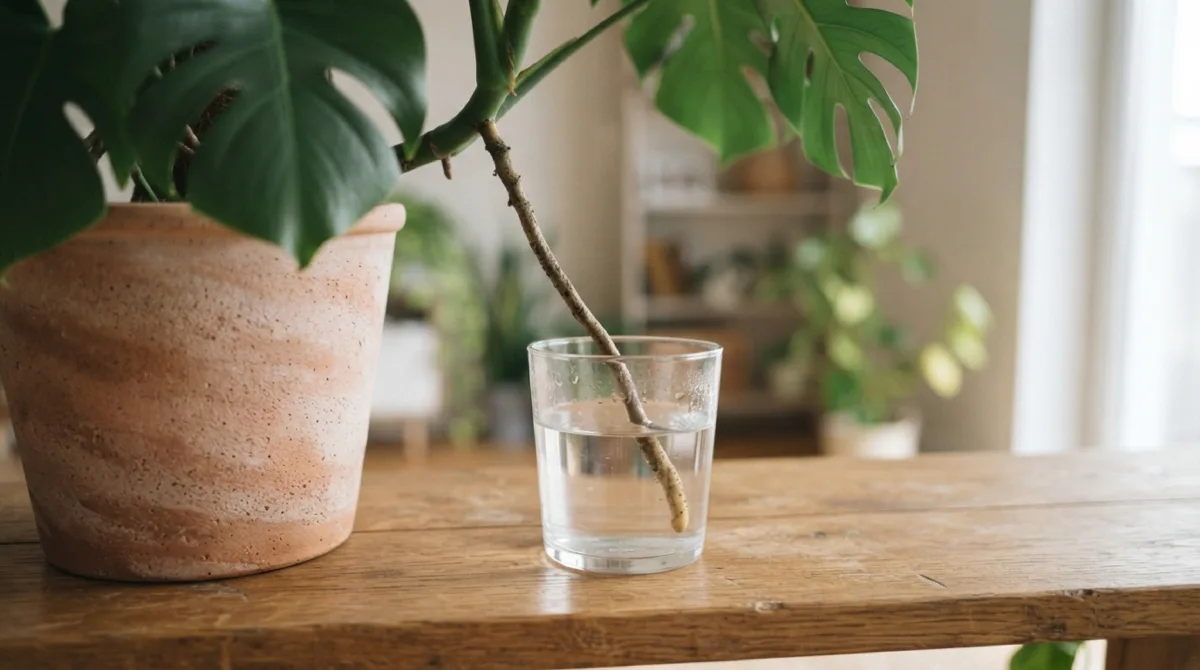
- Direct them into a glass of water. Aerial roots adapt well to water. Put the tip in a small jar beside the pot and change the water every week or two. This does not replace watering the pot: the soil roots are still the main supply. It is a useful trick when a root is too long for the shelf.
- Cut them. If a root is in the way, growing into a socket or knocking things over, cut it. The plant does not depend on it. Cut cleanly and leave the rest of the stem alone.
How to Cut an Aerial Root Safely
Cutting an aerial root is a small job, but a ragged cut can invite rot. Use clean, sharp pruners or scissors and cut about 1 to 2 inches from the stem, leaving a short stub. Do not tear the root or pull it away from the stem.
Spring and early summer are the best time, because the plant is actively growing and can seal the wound. NC State recommends pruning or repotting monstera in spring. Avoid cutting in the middle of a cold, low-light winter if you can wait.
What not to cut: the main stem, a node you plan to use for propagation, or a leaf petiole. Aerial roots grow from the stem between nodes, so removing one does not remove a node. If you are unsure which is which, cut only the thin root and leave every thick, leaf-bearing stem alone.
After cutting, let the cut end dry for a day before you put it in water or soil. If you are rooting the cutting, see the next section. If you are just removing it, no aftercare is needed.
Can You Propagate From an Aerial Root?
Not from the root alone. A new plant needs a node, the point on the stem where a leaf and an axillary bud meet. An aerial root is a root; it has no bud, so a root by itself cannot produce a shoot. NC State lists propagation by layering or stem cutting, and a stem cutting includes at least one node.
What you can do is take a stem cutting that already has an aerial root attached. That root gives the cutting a head start in water or soil. Cut below a node, keep one or two leaves, and put the node and the aerial root in water or a light mix. Change the water weekly and keep it out of direct sun.
The same node rule applies to the rest of the aroid family. Our guide to pothos propagation walks through the cut, the node and the water change, and our plants that grow in water guide covers the long-term version.
Aerial Roots in Water and Semi-Hydro
Aerial roots are the reason monstera adapts so well to semi-hydro. In a pot of LECA or PON, the roots that used to hang in the air become the water roots, and the plant often makes the switch with little stress. Our guide to Lechuza PON semi-hydro covers the transition.
If you keep a root in a glass of water on the shelf, treat it as a display, not as the plant’s only water source. Change the water weekly, keep the glass out of direct sun, and watch for soft, dark tissue. A root that turns mushy in stagnant water should be cut back to firm tissue.
When to Worry
Aerial roots themselves are rarely a problem. The plant around them can be. Check these signs:
- Soft, dark, smelly roots. This is rot, usually from water that sits without oxygen. Cut back to firm tissue and clean the container.
- Yellowing lower leaves with wet soil. This points to overwatering and poor drainage, not to the aerial roots. See our guide to root rot treatment.
- Roots circling the pot and water running straight through. The plant may be root-bound. Check the drainage holes and repot in spring, as NC State suggests.
- Sticky residue or fine webbing. That is pests, not aerial roots. Start with our guides to mealybugs and spider mites.
For the rest of the care picture, see our Monstera deliciosa care guide and our guide to monstera light requirements. If you are choosing a support, our moss pole guide covers the build.
Frequently Asked Questions
Should I cut monstera aerial roots?
You can cut them if they are in the way, and the plant will keep growing because the roots in the pot supply water and nutrients. Many growers leave the roots that grip the pole and cut the ones that wander.
Do monstera aerial roots turn into normal roots?
They are already roots, just produced above the soil. If an aerial root reaches damp soil or water, it can take up moisture and branch like any other root.
Can I propagate a monstera from an aerial root alone?
No. A new plant needs a node with an axillary bud. An aerial root has no bud, so take a stem cutting that includes a node. A cutting with an aerial root attached roots faster.
Why are my monstera aerial roots drying out?
Dry air and age are the usual reasons. The plant prefers high humidity, and older roots can dry from the tip. Trim the crispy end and raise humidity if the leaves also look dry.
What do I do with aerial roots that are too long?
Guide them around the moss pole, loop the tip into the pot, put the tip in a glass of water, or cut them about 1 to 2 inches from the stem with clean pruners.
Do aerial roots mean my monstera needs a bigger pot?
No. Aerial roots are about climbing, not pot size. Check the drainage holes and the root ball separately if you suspect the plant is root-bound.
Are aerial roots a sign of poor care?
No. They are normal on a mature monstera and a sign that the plant is ready to climb. Give it a sturdy support and keep the moss pole damp.