
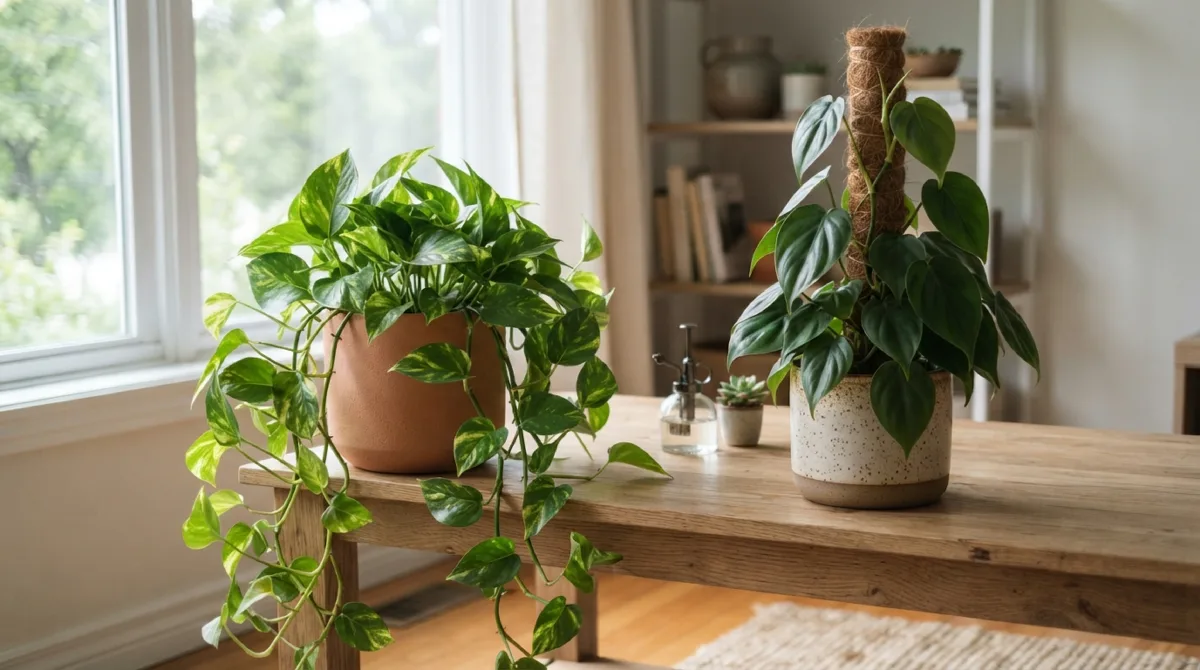
Two trailing green vines, both sold as easy houseplants, both with heart-shaped leaves, and both land in the same search: pothos vs philodendron. They are different plants, and the difference changes how you water them. This guide covers the checks growers use, the pothos vs philodendron light and water differences that matter, and the difference pothos vs philodendron you can see on the stem in seconds. It follows NC State Extension and UF/IFAS.
Pothos vs Philodendron: The Short Answer
The fastest way to separate them is the stem, not the leaf. NC State Extension describes heartleaf philodendron as having conspicuous stipules on new growth and messy, falling stipules on older growth, and non-grooved petioles. Pothos has neither feature: no stipule, and a grooved leaf stalk.
| Feature | Pothos (Epipremnum aureum) | Heartleaf philodendron (Philodendron hederaceum) |
|---|---|---|
| Sheath at the node | None | Papery stipule covers each new leaf, then dries brown and falls |
| Leaf stalk | Grooved | Not grooved |
| Leaf surface | Waxy, often variegated (golden, marble, N-Joy) | Matte to satin, usually solid green |
| Leaf shape | Broad heart, slightly asymmetric | Elongated heart with a pointed tip |
| Water | Let the mix dry between waterings | Keep the mix slightly moist |
| Light | Bright indirect; survives long periods in low light | Medium light; tolerates low light |
| Pet safety | Toxic to cats and dogs | Toxic to cats and dogs |
Sources: NC State Extension Plant Toolbox, Epipremnum aureum and Philodendron hederaceum; UF/IFAS Gardening Solutions, Heartleaf Philodendron; ASPCA Toxic and Non-Toxic Plant List.
The practical version: if the plant has a brown papery flap hanging at the node, it is a philodendron. If the stem is smooth and the leaf stalk has a groove, it is a pothos.
Why They Get Confused
Both are in the arum family, Araceae, and both are evergreen vines from tropical forests. Juvenile leaves on both plants are heart-shaped, both root easily from cuttings in water, and both are sold in the same 4-inch and 6-inch pots at the same price. A supermarket shelf does not help, because the labels are often shortened to “pothos” or “philodendron” with no species name.
The names add to it. “Pothos” is used for several different genera in the trade. Satin pothos is Scindapsus pictus, which is neither a pothos nor a philodendron. “Philodendron” is a genus with hundreds of species, from the heartleaf vine to large climbing plants with enormous leaves. NC State notes that Epipremnum aureum was itself once treated as a cultivar of Epipremnum pinnatum, so older labels and older books use different names for the same plant.
How to Tell Pothos and Philodendron Apart
Work through these five checks in order. The first two settle it almost every time.
- Look for a sheath at the node. Philodendron produces a stipule, a modified leaf that wraps the next leaf while it develops. When the new leaf opens, the stipule turns brown and papery and often hangs on the stem before falling. Pothos has no stipule. If you see dried brown flaps at the nodes, you have a philodendron.
- Check the leaf stalk for a groove. NC State describes the philodendron petiole as non-grooved and uses the groove as one of the differences from Epipremnum aureum. Run a fingernail along the top of the stalk: pothos has a channel, philodendron is rounded.
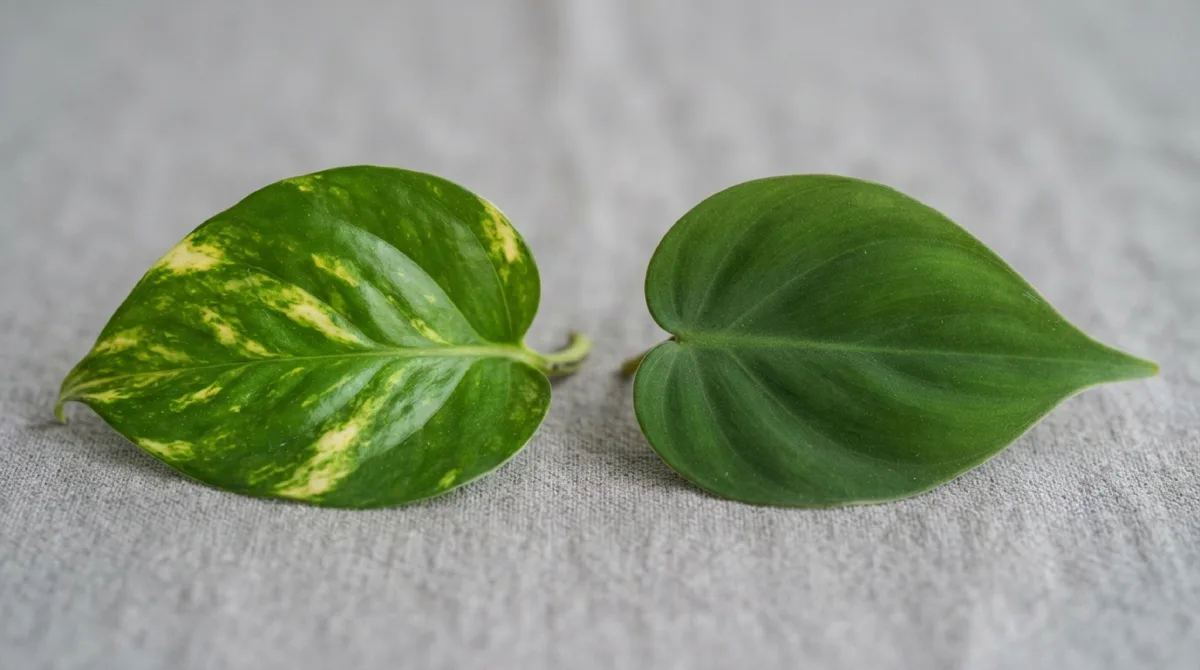
- Look at the leaf surface. Pothos leaves are waxy and thick, and most cultivars carry cream, yellow or white variegation. Heartleaf philodendron leaves are thinner and matte to satin, usually solid green, with a longer pointed tip.
- Watch a new leaf open. On a philodendron the new leaf slides out of the sheath. On a pothos the new leaf unfurls from the base of the previous leaf with no sheath to shed.
- Compare mature leaf size. Given a support and enough light, pothos can produce much larger mature leaves, which is why it is used as a climber on poles and walls in warm climates. Heartleaf philodendron stays smaller and finer, even when it climbs.
Care Differences That Actually Matter
The identification matters because the watering is not the same. NC State says to let the well-drained potting medium dry out between waterings for pothos, and to keep the soil slightly moist for heartleaf philodendron, slowing down in winter. That single line explains most of the failures people have with both plants.
Water. Pothos is the more forgiving of the two. Its waxy leaves and thick stems hold water, and it can go a week or two longer between waterings. Philodendron has thinner leaves and wilts faster when the mix goes bone dry. If you water on a fixed schedule, a pothos will tolerate it better than a philodendron.
Light. Both do well in bright, indirect light. Pothos survives long periods in low light, according to NC State, but the variegated cultivars keep their pattern only with decent light. Philodendron prefers medium light and tolerates low light. Neither wants direct summer sun, which can scorch the leaves.
Humidity. Philodendron appreciates medium humidity and misting, while pothos is more tolerant of average indoor air. Neither needs a humidifier to survive, but both look better in a bathroom or near a group of plants.
Support. Both climb, and both produce aerial roots. Pothos climbs by brown aerial roots and can size up dramatically on a support with good light, which is the difference between a supermarket trailing plant and the large-leaved vine people post online. A moss pole works for either.
Feeding. NC State suggests fertilizing pothos every other month except in winter. Do not feed a plant that is sitting in soggy soil or in very low light; fix the light and the watering first.
The Lookalikes People Mix Up
Once you know the sheath check, the rest of the tangle is easier to unpick.
- Golden pothos vs heartleaf philodendron. The classic pair. Golden pothos has yellow variegation and a grooved stalk. Heartleaf philodendron is solid green with a sheath. See our heartleaf philodendron care guide for the philodendron side.
- Philodendron ‘Brasil’ vs pothos. ‘Brasil’ is a heartleaf philodendron cultivar with yellow-green variegation, which is why people search for pothos vs philodendron Brasil. It still has the sheath and the non-grooved stalk.
- Satin pothos. Scindapsus pictus has silvery blotches and a matte leaf. It is neither plant, though it grows the same way.
- Pothos cultivars. N-Joy and Pearls and Jade are both pothos, not philodendrons. We compare them in Pothos N-Joy vs Pearls and Jade. For the two most common green and white pothos, see Golden Pothos vs Marble Queen.
- Velvet philodendrons. Philodendron micans has velvety, bronze-green leaves and a completely different texture. Our Philodendron micans care guide covers it.
Pet Safety: Both Toxic, Same Rules
There is no pet-safe winner here. The ASPCA lists both golden pothos and heartleaf philodendron as toxic to cats and dogs. NC State gives the mechanism: calcium oxalate crystals, with symptoms that include oral irritation, pain and swelling of the mouth, tongue and lips, excessive drooling, vomiting and difficulty swallowing. Contact with the sap can also irritate skin.
Keep both plants out of reach of cats that chew and dogs that sample leaves. A trailing vine is tempting because it hangs at exactly the height a cat can reach, so put the pot high or trim the vine back. If a pet eats any part of either plant, call your veterinarian or a pet poison service. For non-toxic alternatives, see our lists of cat-safe plants and plants safe for dogs.
Which One Should You Buy?
Buy pothos if you travel, if the room is dim, or if you want a fast trailing vine for a shelf. It handles missed waterings and low light better, and it is the plant most likely to survive a first houseplant year.
Buy heartleaf philodendron if you water often, if you want softer, finer foliage, or if you like the look of a plant that stays compact. It is not difficult, but it is less forgiving of a dry pot.
Do not plant the two in the same pot. They want different moisture levels, and one will always be too wet or too dry. Keep them separate and you can water each on its own terms. If you are repotting either one, our repotting guide covers pot size and mix.
Frequently Asked Questions
Is pothos a philodendron?
No. Pothos is Epipremnum aureum and heartleaf philodendron is Philodendron hederaceum. They are different genera in the same family, Araceae, which is why they look alike.
How do I tell pothos and philodendron apart?
Check the node for a papery sheath. Philodendron has a stipule that covers each new leaf and then dries brown, and its leaf stalk is not grooved. Pothos has no sheath and has a grooved leaf stalk.
Do pothos and philodendron need the same light?
Both do well in bright, indirect light. Pothos survives long periods in low light, while heartleaf philodendron prefers medium light and tolerates low light. Variegated pothos needs brighter light to keep its pattern.
Which is easier to keep alive?
Pothos is more forgiving. It wants the mix to dry between waterings, so a missed watering is less damaging. Heartleaf philodendron wants slightly moist soil and wilts faster when the pot goes dry.
Are pothos and philodendron toxic to cats and dogs?
Yes. The ASPCA lists both as toxic to cats and dogs. Both contain calcium oxalate crystals that cause oral irritation, drooling, vomiting and difficulty swallowing if chewed.
Can I plant pothos and philodendron in the same pot?
Not recommended. They have different watering needs: pothos wants to dry out between waterings and philodendron wants to stay slightly moist. In one pot, one of them will be kept too wet or too dry.
Why is my pothos turning yellow?
Yellow leaves usually point to watering, either too much or too little, or to a pot with no drainage. Check the soil before watering and let the top of the mix dry. Our pothos care guide covers light, water and yellow leaves in detail.
Sources
- NC State Extension Plant Toolbox: Epipremnum aureum (golden pothos)
- NC State Extension Plant Toolbox: Philodendron hederaceum (heartleaf philodendron)
- UF/IFAS Gardening Solutions: Heartleaf Philodendron
- ASPCA: Golden Pothos is toxic to cats and dogs
- ASPCA: Heartleaf Philodendron is toxic to cats and dogs