
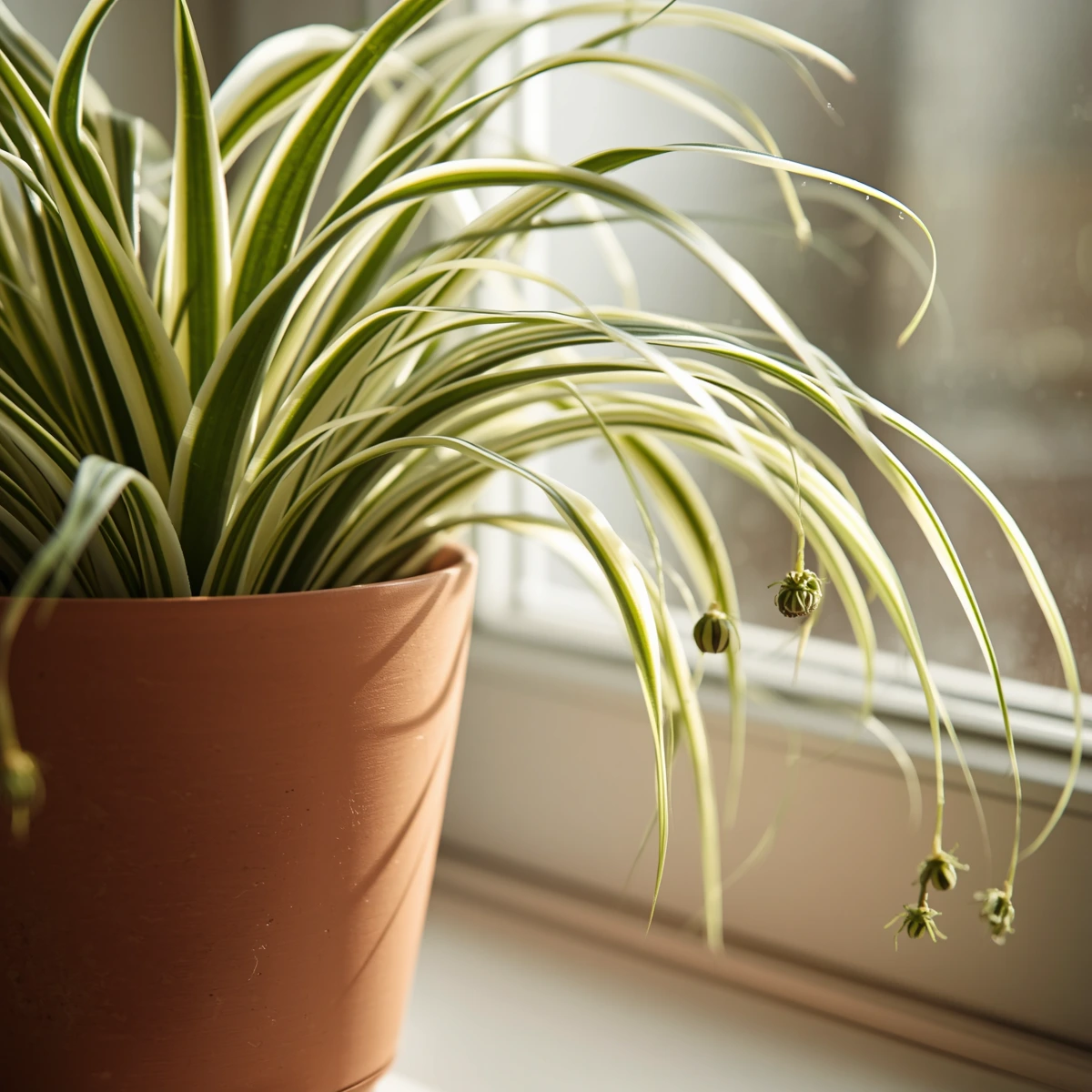
The spider plant (Chlorophytum comosum) is one of the toughest houseplants: arching striped leaves, thick water-storing roots, and runners of baby plants that make it easy to share. Its one common complaint is brown leaf tips. Good spider plant care means bright, indirect light, watering when the top of the soil dries, soft water if your tap water is fluoridated, and not too much fertilizer. This guide follows NC State, the RHS, Clemson, UW-Madison, UF/IFAS and the ASPCA.
Spider Plant Care at a Glance
| Need | What the sources say |
|---|---|
| Light | Bright, indirect (RHS, Clemson); medium light preferred, tolerates shade, intolerant of direct sun (NC State) |
| Water | Let the soil dry slightly between thorough waterings (Clemson, UW-Madison); less in winter (NC State, RHS) |
| Water type | Rainwater or distilled water if tap water is fluoridated (UF/IFAS, RHS, NC State) |
| Temperature | Above 45°F (NC State); 55 to 80°F best (UF/IFAS) |
| Soil | General-purpose, well-drained potting mix (Clemson); peat-free houseplant compost (RHS) |
| Feeding | Light: every 3 to 4 months is usually enough (UW-Madison) |
| Size | About 1 to 1.5 ft tall, 1 to 2 ft wide (NC State) |
| Pets | Non-toxic to dogs and cats (ASPCA) |
Sources: NC State Extension; RHS; Clemson HGIC 1513 (2025); UW-Madison Extension (2025); UF/IFAS Gardening Solutions; ASPCA.
Spider plants come from southern and tropical Africa (NC State lists tropical West Africa to Cameroon and Ethiopia to South Africa). UW-Madison notes that their thick roots and rhizomes store water, which is why they tolerate inconsistent watering. One note for Florida readers: UF/IFAS no longer recommends planting spider plant outdoors there, because it is predicted to become invasive.
Light
The RHS recommends bright but indirect light, notes that the plant tolerates low light but grows more slowly and may lose variegation there, and warns that strong sun can turn leaves yellow or brown. Clemson HGIC says it tolerates some direct light but to avoid midday sun. NC State calls it intolerant of direct sunlight and says it prefers medium light. An east window, or a few feet back from a brighter one, suits it.
Watering and Water Quality
Clemson says to let the soil dry slightly between waterings, and UW-Madison says to let it dry slightly between thorough waterings. UF/IFAS says to let the top inch dry briefly. The RHS suggests keeping the compost lightly moist, watering more in summer and a little less in winter, and never leaving the plant standing in water. Thanks to its water-storing roots, a spider plant forgives a missed watering much more easily than soggy soil.
Water quality matters for the tips. UF/IFAS says spider plants are particularly sensitive to fluoridated water and recommends rainwater or distilled water. NC State says chlorine and fluoride in tap water can burn the leaf tips, and the RHS recommends rainwater where possible because tap water’s fluoride can cause browning. Letting tap water stand removes chlorine but not fluoride.
Spider Plant Brown Tips: Causes and Fixes
| Cause | Source | Fix |
|---|---|---|
| Fluoride or chlorine in tap water | NC State, UF/IFAS, RHS, UW-Madison | Switch to rainwater or distilled water |
| Too much fertilizer or salty water | Clemson, UW-Madison | Feed less; flush the pot with plain water |
| Too much or too little water | RHS | Water thoroughly when the top dries; never let it sit in water |
| Dry air or very dry soil | Clemson, UW-Madison, RHS | Raise humidity with a pebble tray; water more evenly |
| Strong sun | RHS | Move out of direct sun |
Sources: NC State Extension; UF/IFAS; RHS; Clemson HGIC 1513; UW-Madison Extension.
Spider plant brown tips usually have more than one cause, so start with water quality and fertilizer, then check watering and light. Brown tips won’t turn green again. You can trim them with clean scissors, but the RHS points out that this is only cosmetic while you fix the cause; judge your progress by the new leaves. See also our white crust guide for salt build-up.
Soil, Pots and Feeding
Clemson recommends a general-purpose potting soil with good drainage, and the RHS a peat-free multipurpose or houseplant compost. Use a pot with drainage holes. UW-Madison says the roots fill pots quickly, so spider plants need frequent repotting, but that they grow and produce plantlets best when slightly pot-bound. The RHS suggests leaving a new plant in its pot for about a year, then repotting every year or two into a slightly larger pot.
For feeding, UW-Madison says every 3 to 4 months is usually enough, or half-strength more often, and warns that heavy feeding reduces plantlets and can brown the tips. The RHS says feeding is usually unnecessary if you repot regularly, and suggests a balanced liquid feed every other month from April to September if the leaves stay yellow in good light. Clemson suggests a water-soluble or time-release houseplant fertilizer during active growth, following the label.
Getting More Babies (Plantlets)
The baby plants on the runners are the spider plant’s party trick. UW-Madison and NC State say plantlets form in response to short days and long, uninterrupted nights for at least three weeks, and Clemson says spider plants produce most of their offshoots as days shorten in autumn. To encourage them:
- Keep the plant slightly pot-bound (UW-Madison).
- Don’t overfeed, which reduces plantlets (UW-Madison, NC State).
- Avoid lights on in the room late into the evening in autumn, so the plant gets long, dark nights.
Propagation: Spider Plant Babies in Water or Soil
The RHS says you can pin rooted plantlets into moist peat-free compost, or root them in a glass of water and then pot them up. UW-Madison suggests rooting plantlets while still attached to the parent, or potting up ones that already have roots. Clemson says plantlets root readily when they touch soil and can be potted directly into moist mix once roots form. Large clumps can also be divided with a knife, keeping at least one growing point per piece (RHS).
- Pick a plantlet with small roots or root nubs at its base.
- Either pin it onto a pot of moist mix while still attached, or cut it off and stand its base in water.
- Once roots are a few centimeters long, pot it up and keep it lightly moist.
For rooting in water, change the water every few days; if the base turns soft, see our guide to cuttings rotting in water.
Other Problems
| Symptom | Likely cause | What to do |
|---|---|---|
| Pale, faded variegation, slow growth | Too little light (RHS) | Move to brighter, indirect light |
| Yellow or brown scorched leaves | Strong sun (RHS) | Move out of direct sun |
| Yellowing, soft base, wet soil | Overwatering (Clemson) | Let the soil dry; check roots for rot |
| Sticky leaves, small insects | Aphids, scale, mealybugs, whiteflies, spider mites (RHS, Clemson, UW-Madison) | Wash off; treat |
| Roots pushing out of the pot | Pot-bound (UW-Madison) | Repot one size up, or divide |
Sources: RHS; Clemson HGIC 1513; UW-Madison Extension.
See our aphids guide and overwatered vs underwatered guide.
Is the Spider Plant Safe for Pets?
Yes. The ASPCA lists the spider plant as non-toxic to dogs and cats, and NC State tags it non-toxic. Cats often enjoy chewing the leaves, which can cause a mild stomach upset as with any plant, so hang it out of reach if yours is a chewer. See our cat-safe plants list.
For more trailing and hanging plants, see our guides to lipstick plant. For more easy houseplants, see our guides to dracaena care, and our list of the 10 best low-maintenance indoor plants. It is also on our list of plants safe for dogs. It can also be grown as a kokedama; see our guide to kokedama moss balls. For other compact, pet-safe houseplants, see our guides to bromeliad care and peperomia care. It is one of our picks in our guide to plants that grow in water.
Frequently Asked Questions
Why does my spider plant have brown tips?
Most often fluoride or chlorine in tap water (NC State, UF/IFAS, RHS), too much fertilizer or salty water (Clemson, UW-Madison), uneven watering, dry air or strong sun (RHS). Switch to rainwater or distilled water and feed less.
How often should I water a spider plant?
Let the soil dry slightly between thorough waterings (Clemson, UW-Madison), and water a little less in winter (RHS). Its thick roots store water, so it copes with a missed watering better than with soggy soil.
Can you grow spider plant babies in water?
Yes. The RHS says plantlets can be rooted in a glass of water and then potted up; they can also be pinned onto moist compost while still attached.
Why isn’t my spider plant making babies?
Plantlets form after at least three weeks of short days and long, uninterrupted nights (UW-Madison, NC State). Young plants, overfeeding and very large pots can also reduce them.
Is a spider plant safe for cats?
Yes. The ASPCA lists spider plant as non-toxic to dogs and cats.
How much light does a spider plant need?
Bright, indirect light is best (RHS, Clemson). It tolerates lower light but grows more slowly and may lose its stripes; strong direct sun scorches it.