
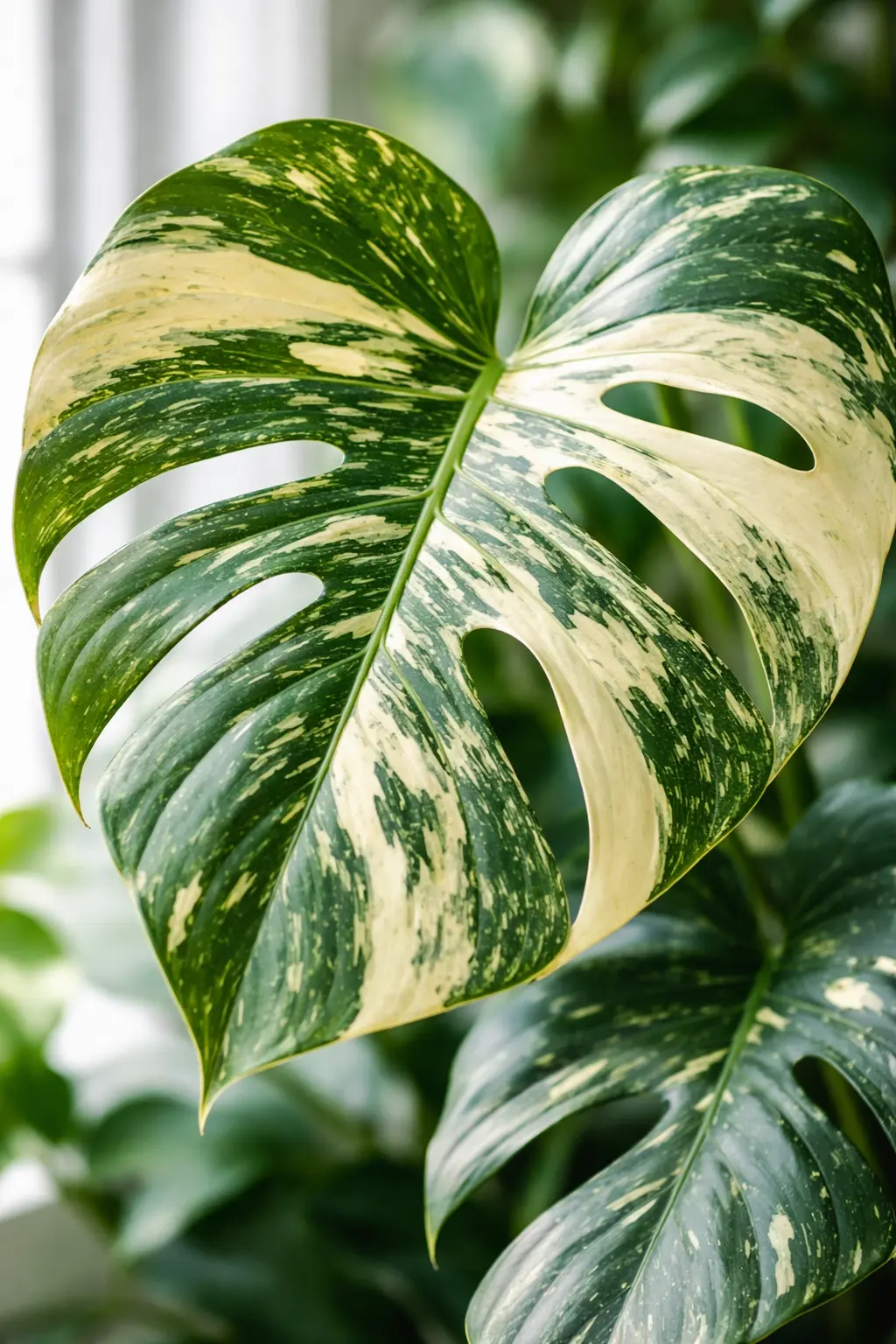
Monstera Thai Constellation care is standard Monstera care with more light and more caution. NC State Extension describes ‘Thai Constellation’ as a rare Monstera deliciosa cultivar with marbled, speckled creamy-white variegation, and notes that variegated cultivars need more sunlight than darker green ones. Give it bright light without harsh direct sun, a chunky mix that drains fast, water once the top quarter to third of the mix has dried, warmth and good humidity.
Care at a Glance
| Need | What the sources say |
|---|---|
| Light | Bright, not direct sun; variegated cultivars need more light than green ones (NC State) |
| Water | Water thoroughly, then let the top quarter to one-third of the mix dry (NC State) |
| Soil | Rich in organic matter with good drainage (NC State); a chunky aroid mix is the usual choice indoors |
| Humidity | High; a humidifier helps in dry rooms (NC State) |
| Temperature | 60 to 85°F (NC State) |
| Support | Sturdy support to keep stems from breaking (NC State) |
| Pets | Toxic to dogs and cats (ASPCA) |
Sources: NC State Extension Plant Toolbox: Monstera deliciosa; ASPCA.
Monstera Albo vs Thai Constellation
Both are variegated forms of Monstera deliciosa, and NC State lists both as rare cultivars. The practical differences come down to pattern and how the plants are produced:
| Feature | Thai Constellation | Albo Variegata |
|---|---|---|
| Variegation | Marbled and speckled creamy white, like a star field (NC State) | Bold white sectors, often half-moon leaves |
| How it’s produced | Mass-produced by tissue culture | Propagated from cuttings of variegated stems |
| Pattern stability | Generally described by growers as stable | Known to vary a lot and to throw all-green or all-white growth |
| Price | Rare and costly, but more widely available | Rare and expensive (NC State) |
Why does variegation revert? The Royal Horticultural Society explains that most variegated plants start as a mutation, or sport, of a green plant, and that these mutations can be unstable, so shoots may revert to plain green. Green growth has more chlorophyll and grows more vigorously, so it can take over. The RHS advice is to cut reverted shoots back to a point that still carries variegated leaves. Thai Constellation’s speckled pattern is considered much steadier than Albo’s sectors, but a Thai Constellation in poor light still tends to put out greener leaves.
Monstera Thai Constellation Light Requirements

The cream parts of a Thai Constellation leaf have little or no chlorophyll, so the green parts do the photosynthesis for the whole plant. That’s why NC State says variegated cultivars need more sunlight than darker green ones, while still recommending moderate brightness rather than direct sun for Monstera deliciosa.
- Target: the bright end of the range in our Monstera light requirements guide, roughly 200 to 500 PPFD at the leaves.
- In lux: that’s about 11,000 to 27,000 lux in daylight (about 1,000 to 2,500 foot-candles), using Michigan State University’s sunlight conversion. Note that 1 foot-candle equals about 10.8 lux.
- Placement: close to an east window, or back from a south or west window with a sheer curtain in summer.
- Avoid: strong afternoon sun on the cream sections, which scorch more easily than green tissue.
- Dim room? Add a full-spectrum LED grow light on a timer; see our grow light guide.
Thai Constellation Soil Mix
NC State describes Monstera deliciosa as preferring soil high in organic matter with good drainage that stays evenly moist. Indoors, most growers meet that with a chunky aroid mix that holds some moisture but lets air reach the roots. A typical mix combines bark, perlite and coco coir or a quality potting mix; there’s no single tested recipe, so aim for a mix that drains within seconds and stays airy. Our aroid soil mix guide compares the ingredients.
Pro tip: Repot into a pot only a little larger than the root ball, with drainage holes. A lot of extra mix around a small root system stays wet for longer, which raises the risk of rot.
How to Water a Thai Constellation
NC State’s rule for Monstera deliciosa is to water thoroughly, then let the top quarter to one-third of the mix dry before watering again. That means checking the mix rather than following a calendar, because light, warmth and season all change how fast it dries.
- Check the mix. In a 6-inch pot, the top quarter to third is about the top 1.5 to 2 inches. If it’s still damp, wait.
- Water thoroughly until water runs from the drainage holes.
- Drain completely and never leave the pot in a full saucer.
- Water less in winter, when growth slows and the mix dries more slowly.
Watch for root rot
Yellowing lower leaves, a soft stem base or a sour smell from the pot can mean root rot, a common way to lose an expensive Thai Constellation. See our step-by-step Thai Constellation root rot guide for how to check the roots and save the plant.
Feeding: Iowa State University Extension recommends fertilizing houseplants only in spring and summer while they’re actively growing, with general fertilizers at half or quarter strength, and no feeding during winter rest.
Troubleshooting Common Problems
| Symptom | Likely cause | What to do |
|---|---|---|
| Brown, crispy patches on cream areas | Strong sun, very dry air or uneven watering; cream tissue is the most fragile part of the leaf | Filter the sun, raise humidity, water on the dry-down rule. Damaged patches won’t recover; judge by new leaves. |
| Yellowing lower leaves, soft stem | Overwatering or a dense mix leading to root rot | Check the roots; see our root rot guide |
| New leaves greener, less cream | Too little light | Move to brighter light or add a grow light |
| No splits in new leaves | Low light, a young plant, or nothing to climb | More light plus a moss pole or plank; UW-Madison notes Monstera won’t develop perforations in inadequate light |
| Crispy leaf edges | Dry air, cold drafts or fertilizer salt buildup | Add a humidifier, move away from vents, flush the mix with plain water |
| Tiny insects, webbing or sticky leaves | Pests; NC State lists fern scale for Monstera | See our guides to scale and thrips |
Perforation note: UW-Madison Extension: Monstera deliciosa.
Pet and Human Safety
Toxic to pets
The ASPCA lists Monstera deliciosa as toxic to dogs and cats because of insoluble calcium oxalates, with signs including oral irritation, intense burning of the mouth, tongue and lips, excessive drooling, vomiting and difficulty swallowing. NC State adds that the sap can irritate skin, so wear gloves when pruning. If your pet chews it, call your veterinarian or the ASPCA Animal Poison Control Center at (888) 426-4435.
For pet-friendly alternatives, see our list of cat safe plants. For the other famous variegated Monstera, see our variegated Monstera deliciosa guide.
For other monsteras, see our guides to Monstera dubia.
Frequently Asked Questions
How much light does a Monstera Thai Constellation need?
Bright light without strong direct sun. NC State says variegated cultivars need more sunlight than darker green ones, so aim for the bright end of the Monstera range, roughly 200 to 500 PPFD at the leaves, and filter afternoon sun.
How often should I water a Thai Constellation?
Water thoroughly, then wait until the top quarter to one-third of the mix is dry, as NC State recommends for Monstera deliciosa. Check the mix each time rather than following a fixed schedule, and water less in winter.
Can a Thai Constellation revert to green?
Its speckled variegation is generally considered stable, but no variegated plant is guaranteed. The RHS explains that variegation usually comes from a mutation that can be unstable. In low light, a Thai Constellation also tends to produce greener leaves, so give it bright light.
What is the difference between Monstera Albo and Thai Constellation?
Thai Constellation has marbled, speckled cream variegation and is produced by tissue culture. Albo has bold white sectors, is propagated from cuttings, and its pattern varies much more from leaf to leaf. NC State lists both as rare.
Why does my Thai Constellation have brown spots on the white parts?
The cream tissue has little chlorophyll and is the most fragile part of the leaf, so it shows damage first. Strong direct sun, very dry air and uneven watering are the usual suspects. Damaged spots won’t heal; watch the next leaves after you fix conditions.
Is Monstera Thai Constellation toxic to cats?
Yes. The ASPCA lists Monstera deliciosa as toxic to cats and dogs because of insoluble calcium oxalates, which cause mouth irritation, drooling, vomiting and difficulty swallowing.
Sources
- NC State Extension Plant Toolbox: Monstera deliciosa (including ‘Thai Constellation’ and ‘Albo Variegata’)
- Royal Horticultural Society: Reversion
- UW-Madison Extension: Monstera deliciosa
- Iowa State University Extension: How often should I fertilize houseplants?
- ASPCA Animal Poison Control: Swiss Cheese Plant