
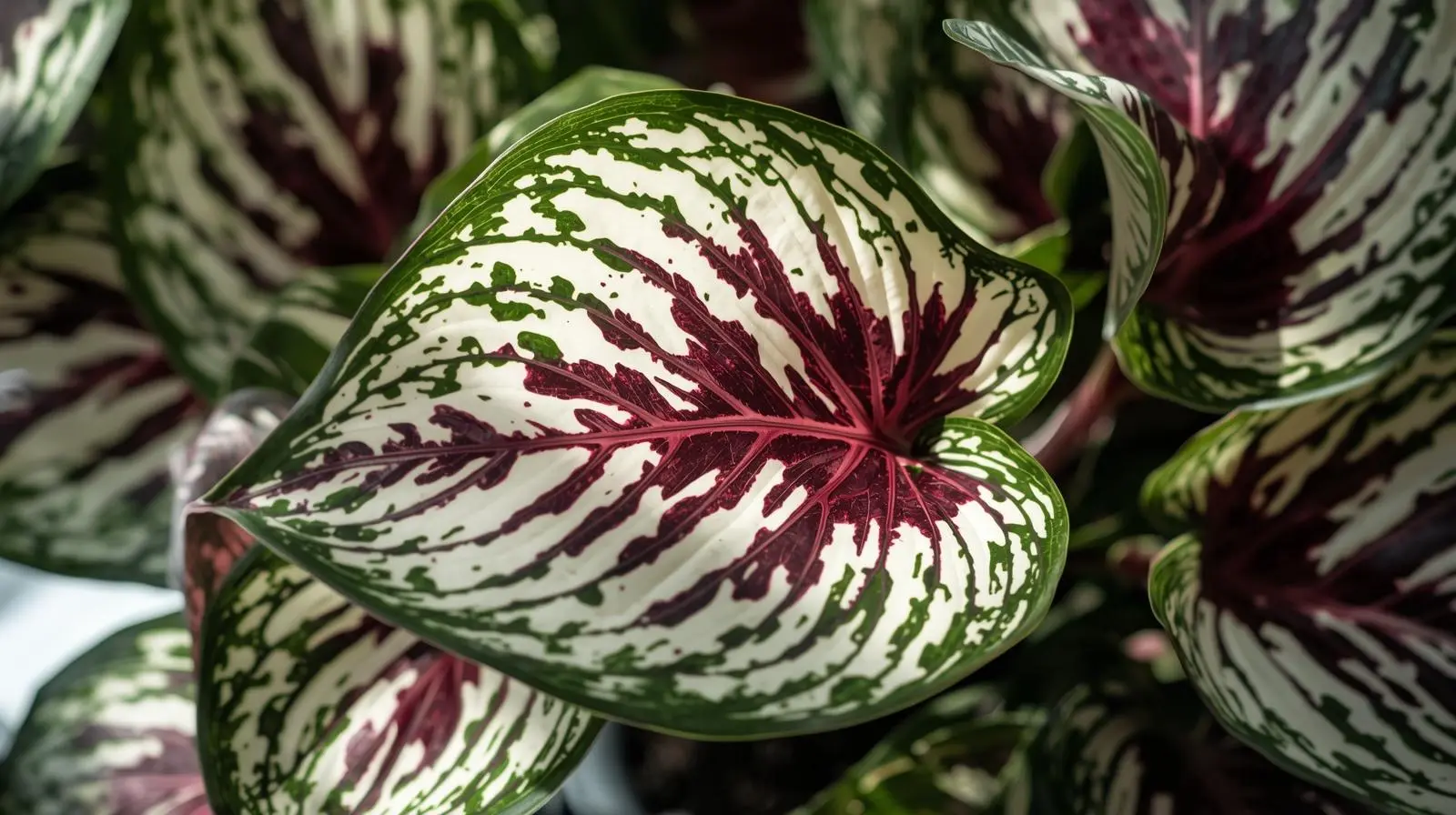
Calathea ‘White Fusion’ is one of the most striking prayer plants: pale green leaves streaked and splashed with white, with purple undersides. It is also one of the touchiest, because its white tissue has little chlorophyll and browns easily. Calathea White Fusion care follows the same rules as other calatheas: bright indirect light, evenly moist soil, warmth, humidity and soft water. White Fusion just has less margin for error. This guide covers what is specific to this cultivar; for the full background on calatheas, see our complete calathea care guide.
What Is Calathea White Fusion?
‘White Fusion’ is a variegated cultivar of Goeppertia lietzei, still widely sold as Calathea lietzei. Kew’s Plants of the World Online lists Goeppertia lietzei as the accepted name and gives its native range as eastern Brazil. The RHS notes that many plants sold as calatheas have been moved to Goeppertia, Ctenanthe and Stromanthe, so shops still label them “calathea.” Like other prayer plants, its leaves fold upward at night (NC State).
| Need | What the sources say for calatheas | Why it matters more for White Fusion |
|---|---|---|
| Light | Bright, out of direct sun (RHS); 150 to 200 fc best indoors (UF/IFAS) | White tissue scorches easily; too little light dulls the pattern |
| Water | Evenly moist in spring and summer; let the surface dry in winter (RHS) | Stress shows first on the pale parts of the leaf |
| Water type | Rainwater best (RHS); avoid fluoride (UF/IFAS); distilled or rainwater (NC State) | Fluoride causes dead spots near leaf margins (UF/IFAS) |
| Humidity | High (RHS, NC State); 40 to 60 percent indoors (UF/IFAS) | Thin white tissue crisps in dry air |
| Temperature | 65 to 80°F indoors; chilling injury below 55°F (UF/IFAS) | Drafts cause curling and browning |
| Feeding | Monthly, April to September (RHS) | Excess fertilizer browns leaf margins (UF/IFAS) |
Sources: RHS calathea growing guide; UF/IFAS EDIS EP285; NC State Extension Gardener Plant Toolbox (Goeppertia). These sources cover calatheas in general, not this cultivar specifically.
Is Calathea White Fusion Hard to Care For?
It is harder than most houseplants and a little harder than green calatheas. The white and pale sections of each leaf contain little or no chlorophyll, so the green parts feed the whole plant and the pale parts have less to spare when conditions slip. In practice, that means more browning on the white areas in dry air, cold drafts or uneven watering. The good news is that the requirements are the same as for any calathea; you just need to be more consistent.
Calathea White Fusion Light Requirements
The RHS says calatheas grow best in a bright spot out of direct sunlight, suggesting a north- or east-facing window in summer and a south-facing sill in winter. UF/IFAS says interior calatheas tolerate light as low as 75 foot-candles, with 150 to 200 foot-candles best. NC State warns that direct sun can scorch the leaves.
- Best spot: close to an east window, or a few feet back from a brighter window behind a sheer curtain.
- Too much sun: the white streaks turn tan or brown and papery.
- Too little light: weak growth (RHS) and new leaves with duller, less contrasting variegation. A grow light helps in dark rooms; see our grow light guide.
Watering and Water Quality
The RHS says to keep the compost evenly moist in spring and summer, to let the surface dry before watering in autumn and winter (never letting it dry out completely), and to empty any water left in an outer pot. UF/IFAS says to let the surface dry slightly before watering and to keep the mix uniformly moist but not wet. NC State links underwatering to curling and yellowing leaves, and overwatering to rotting stems and drooping.
Water quality matters for this cultivar’s pale leaf edges. UF/IFAS says fluoride causes dead spots near the leaf margins of calatheas and should be avoided in water and fertilizer. NC State suggests distilled water or rainwater. The RHS says rainwater is best but that tap water left to stand for 24 hours is acceptable; standing removes chlorine but not fluoride, so use rainwater or distilled water if your supply is fluoridated. Our best water for calathea guide compares the options.
Humidity and Temperature
The RHS and NC State both say calatheas need high humidity: a bathroom or kitchen, a tray of wet pebbles with the water below the stones, grouping plants, or (RHS) occasional misting. UF/IFAS gives 40 to 60 percent relative humidity for calatheas indoors. White Fusion’s thin pale tissue is the first to crisp, so keep it toward the humid end: a hygrometer next to the plant tells you where you are, and a humidifier is the most dependable fix in a heated room. For the science of dry air, see our VPD guide.
UF/IFAS gives 65 to 80°F for calatheas indoors and warns of chilling injury below 55°F. The RHS gives 16 to 21°C (61 to 70°F) and says to avoid draughts, radiators and temperature swings.
Soil, Repotting and Feeding
The RHS recommends a free-draining, moisture-retentive, peat-free compost: a houseplant mix, or multi-purpose compost with about 10 percent potting grit. Commercial growers use soilless mixes of peat, pine bark, vermiculite and perlite at a pH around 6.0 (UF/IFAS). Use a pot with drainage holes.
Repotting: the RHS suggests repotting every few years in spring or summer, once the clump fills the pot, into a container one or two sizes larger.
Feeding: the RHS says to feed once a month from April to September with a balanced houseplant fertilizer and not at all from October to March. UF/IFAS lists excess fertilizer and low pH among the causes of brown leaf margins and tips, and excess potassium as a cause of leaf spotting and duller color, so feed lightly and flush the pot with plain water now and then.
Brown Edges and Yellowing Leaves
| Symptom | Likely causes | What to do |
|---|---|---|
| Crispy brown edges, especially on white areas | Low humidity (RHS, NC State); fluoride in water; excess fertilizer or low pH (UF/IFAS) | Raise humidity; switch to rainwater or distilled water; feed less |
| Tan, papery patches on white streaks | Direct sun (NC State) | Move out of direct sun |
| Calathea White Fusion yellowing leaves | Overwatering, too little fertilizer or high light (UF/IFAS); underwatering (NC State) | Check moisture and light first |
| Curling leaves | Underwatering (NC State); cold drafts | Check the compost; move away from drafts |
| Drooping, rotting stems | Overwatering (NC State) | Let the surface dry; check the roots |
| Duller, greener new leaves | Too little light | Move to brighter, indirect light |
Sources: RHS; NC State Extension; UF/IFAS EP285.
Brown edges don’t turn green again. Trim them with clean scissors, following the leaf’s shape, and judge your changes by the new leaves. Some browning on the white sections is normal for this cultivar even in good conditions.
Spider Mites
The RHS lists red spider mite as a calathea pest, with speckled, yellowing or silvery leaves and fine webbing, and NC State lists spider mites, mealybugs, scale and aphids. Mites thrive in warm, dry indoor air, so the humidity that keeps White Fusion’s leaves supple also helps keep mites down. Check the undersides of the leaves regularly. See our spider mite treatment guide and neem oil guide.
Propagation
Calatheas are propagated by division (NC State, RHS). In spring, the RHS suggests dividing the rootball into sections that each have several leaves, potting them up, and keeping them warm, humid and moist until growth resumes. UF/IFAS notes that each rhizome piece needs at least one leaf and that commercial growers use tissue culture. Divisions of a variegated cultivar keep its pattern only if each piece carries variegated leaves.
Is It Pet-Safe?
Yes. The ASPCA lists calathea as non-toxic to dogs, cats and horses. A pet that chews a lot of any plant can still get a mild stomach upset. See our cat-safe plants list.
For more houseplants grown for their colorful leaves, see our guides to Tradescantia Nanouk and nerve plant.
Frequently Asked Questions
Is Calathea White Fusion hard to care for?
It is fussier than most houseplants because its pale leaf sections brown easily. Its needs are the same as other calatheas (bright indirect light, even moisture, humidity, soft water, warmth), but it rewards consistency more.
What are Calathea White Fusion light requirements?
Bright, indirect light without direct sun. The RHS suggests a north- or east-facing window in summer, and UF/IFAS says 150 to 200 foot-candles is best for calatheas indoors. Too little light dulls the variegation; direct sun scorches it.
Why are my Calathea White Fusion leaves turning brown?
Usually low humidity, fluoride in tap water, or too much fertilizer (RHS, NC State, UF/IFAS). Direct sun causes tan, papery patches on the white streaks. Raise humidity, switch to rainwater or distilled water, and feed less.
Why are my Calathea White Fusion leaves yellowing?
UF/IFAS links yellowing in calatheas to overwatering, too little fertilizer or high light, and NC State to underwatering. Check the compost moisture and light before changing anything else.
Is Calathea White Fusion toxic to cats?
No. The ASPCA lists calathea as non-toxic to dogs, cats and horses.
What is the difference between White Fusion and other calatheas?
White Fusion is a variegated cultivar of Goeppertia lietzei with white-streaked leaves and purple undersides. Its care is the same as other calatheas, but the white tissue makes it more sensitive to dry air, sun and water quality.