
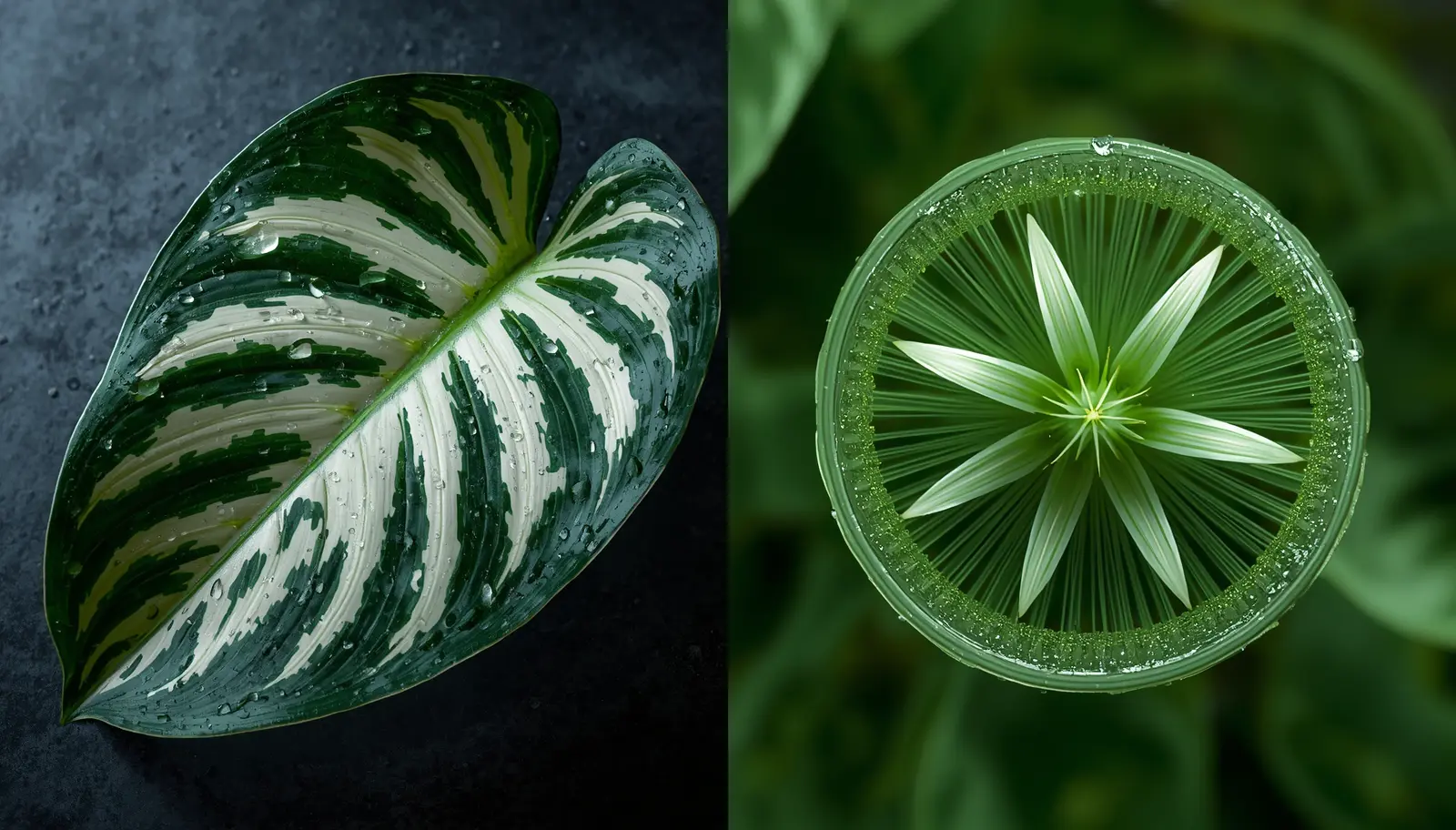
The specimen is structurally intact. Thick, paddle-shaped leaves with bold variegation patterns in cream and green extend from a robust central cane. Yet the margins tell a different story: a continuous band of brown, crispy tissue advancing inward from every leaf tip simultaneously. Lower leaves yellow in sequence, detaching one by one. The plant is actively declining despite consistent watering, standard potting soil, and a position 6 feet from a south window.
Every competitor article blames “irregular watering” for the brown tips and suggests “more humidity” without explaining the atmospheric physics driving cellular desiccation at the leaf margin. No resource explains why the lower leaves are dropping—whether they are executing a normal senescence program, responding to a cold event, or signaling root zone failure. And almost nothing in cultivation literature explains the cellular biology of why this plant sends people to poison control centers every year despite being one of the most widely sold houseplants in commercial nurseries.
Dieffenbachia plant care requires three things competitors consistently omit: a mechanistic understanding of Vapor Pressure Deficit as the direct driver of brown tip formation, a diagnostic framework distinguishing natural leaf senescence from cold shock from root rot, and a clinical understanding of the calcium oxalate raphide system that makes this plant simultaneously beautiful and biologically hazardous. This protocol delivers all three.
- Brown tips: VPD-driven leaf margin desiccation when RH drops below 40%—not watering failure. Target VPD 0.8-1.2 kPa, RH 50-65%
- Lower leaf yellowing: Three-way differential—natural senescence (sequential, 1-2 leaves), cold shock (simultaneous, multi-leaf), root rot (progressive with wet substrate odor)
- Toxicity mechanism: Calcium oxalate raphides in idioblast cells fire as biological projectiles when tissue is mechanically disrupted—always handle with nitrile gloves, keep from pets and children
- Substrate requirement: High-porosity aroid mix (40% coco + 30% perlite + 20% orchid bark + 10% worm castings)—standard peat causes root anaerobiosis within weeks
- Light target: DLI 6-12 mol/m²/day—tolerates lower light than most aroids but produces structurally superior, disease-resistant tissue above DLI 8
📋 Table of Contents
- The Diagnosis: Brown Tips, Yellowing Leaves, and Raphide Exposure
- The Pathology: Raphide Mechanics, Transpiration, and Senescence
- Environmental Pathogen Matrix: Failure State vs Optimal Target
- The Dieffenbachia Diagnostic and Cultivation Protocol
- The Toolbox: Substrate, Monitoring, and Safety Equipment
- Post-Operative Care: Environmental Baseline
- Frequently Asked Questions
- The Lab Verdict
The Diagnosis: Brown Tips, Sequential Yellowing, and Raphide Exposure
Three distinct symptom patterns define dieffenbachia plant care failure—each with a separate causal mechanism requiring a separate intervention, and each routinely conflated by generic cultivation advice.
Symptom 1: Brown Crispy Leaf Margins
Marginal desiccation—brown, crispy tissue advancing uniformly inward from all leaf tips simultaneously—is an atmospheric event, not a watering event.
The spatial pattern is diagnostic. Brown tips affect all leaves at once, progressing symmetrically from the most distal margin tissue inward. This uniform distribution eliminates localized substrate issues (which produce asymmetric symptoms) and confirms a whole-plant atmospheric exposure event. The tissue texture confirms cause: crispy, papery brown = desiccation from excessive Vapor Pressure Deficit. Soft, translucent brown = cold shock or pathogen damage. The distinction determines the intervention.
Symptom 2: Lower Leaf Yellowing — The Three-Way Differential
Basal leaf yellowing in Dieffenbachia requires pattern-based diagnosis before any intervention—treating natural senescence as root rot, or cold shock as nutrient deficiency, produces no improvement and may worsen the underlying condition.
- Natural senescence pattern: Single oldest (lowest) leaf yellows every 4-8 weeks. No other symptoms present. Plant is vigorous, producing new apical growth. This is the plant’s normal nitrogen recycling program—mobile nutrients are extracted from the oldest leaf and redistributed to new growth before the leaf is abscised. Action: remove cleanly at petiole base, no further intervention
- Cold shock pattern: Multiple leaves yellow simultaneously within 24-72 hours following a temperature event. May include soft translucent patches on surviving foliage. Often occurs in winter when plants positioned near single-glazed windows experience surface temperatures 5-8°C below room ambient during overnight periods. Action: identify and eliminate cold source, maintain thermal stability
- Root rot pattern: Progressive yellowing beginning at basal leaves and advancing upward over weeks. Substrate remains wet 10+ days post-watering. Sulfurous odor from drainage holes. Plants wilts despite adequate substrate moisture. Action: immediate extraction, root inspection, surgical debridement per Pythium eradication protocol
Symptom 3: The Raphide Exposure Event
⚠️ BIOLOGICAL HAZARD — CALCIUM OXALATE RAPHIDE EXPOSURE
Immediate presentation after oral contact with Dieffenbachia tissue: intense burning sensation in mouth and throat, excessive salivation, swelling of lips and tongue, difficulty swallowing. Onset within 60-120 seconds of tissue contact.
If exposure occurs — human: Rinse mouth thoroughly with cool water for 10 minutes. Do not induce vomiting. Seek medical evaluation if swelling involves throat or breathing is affected. Contact Poison Control: 1-800-222-1222 (US).
If exposure occurs — pets: Rinse mouth with water, contact ASPCA Animal Poison Control (888-426-4435) or veterinarian immediately. Do not induce vomiting. Cats are at elevated risk due to smaller body mass relative to raphide dose.
Prevention: Nitrile gloves for all handling, pruning, and repotting. Plant positioned completely inaccessible to cats, dogs, and children at all times—not simply elevated, but physically blocked from access.
The Pathology: Raphide Mechanics, VPD Transpiration, and Senescence Biology
Understanding the biological mechanisms driving each dieffenbachia plant care symptom pattern enables systematic prevention rather than reactive symptom management.
The Calcium Oxalate Raphide System: A Biological Projectile
Calcium oxalate raphides are not passive irritants—they are mechanically-delivered biological weapons stored under tension in specialized idioblast cells that fire upon tissue disruption.
Throughout all Dieffenbachia tissue—leaves, petioles, stems, and roots—specialized cells called idioblasts contain bundles of calcium oxalate crystals termed raphides (from the Latin raphis, needle). Each raphide is a monohydrated calcium oxalate crystal 50-500 μm in length with needle-sharp tapered ends. In the intact cell, raphides are packed in a mucilaginous sheath under osmotic pressure. When the idioblast cell wall is mechanically disrupted by chewing, crushing, or cutting, the cell contents eject—the mucilaginous sheath contracts, firing raphides outward at velocity into surrounding tissue like a biological hypodermic syringe.
According to University of Florida IFAS Extension’s comprehensive review of toxic ornamental plants, the raphide penetration is compounded by the simultaneous release of proteolytic enzymes and other chemical irritants stored alongside the crystals in the idioblast cell. The mechanical puncture from raphide penetration creates entry channels that these enzymes exploit—the enzymatic burn persists and amplifies after the initial mechanical pain, explaining the characteristic escalating discomfort rather than immediate-then-fading pain typical of purely mechanical injuries. This combination of mechanical penetration and enzymatic damage is the specific mechanism behind the plant’s historical common name: “Dumb Cane”—referring to the temporary speech impairment caused by tongue and throat swelling following oral exposure.
Transpiration Dynamics: Why Large Leaves Brown at the Margins
Dieffenbachia’s large-bladed leaves (20-60cm on mature specimens) create a transpiration surface area challenge that makes the species disproportionately sensitive to Vapor Pressure Deficit elevation compared to smaller-leaved aroids.
Transpiration is governed by the VPD gradient between the internal leaf airspace (saturated at 100% RH at leaf temperature) and the external ambient air. At standard indoor conditions during winter heating (22°C, 35% RH), VPD = 1.7 kPa—well above the 0.8-1.2 kPa target range. At this deficit, stomata cannot close fast enough to prevent water loss exceeding root uptake rate, particularly at leaf margins where the vascular network terminates and water supply is lowest per unit surface area. Marginal cells desiccate, membrane integrity fails, and the characteristic brown crispy advancing edge forms.
The guttation component: Dieffenbachia regularly produces guttation—liquid droplets expelled from hydathode pores at leaf margins during periods when root pressure exceeds transpirational demand (typically overnight when stomata close and soil moisture is high). As documented by Penn State Extension’s research on plant water relations, guttation fluid in aroids contains dissolved minerals and, in Dieffenbachia, traces of calcium oxalate compounds—an additional reason why pets should not be permitted to lick leaf tips where guttation droplets accumulate. Growers who observe water droplets at leaf margins on cool mornings are observing guttation, not dew or overwatering—this is a normal physiological process indicating healthy root pressure.
Environmental Pathogen Matrix: Failure State vs Optimal Target
Precise environmental parameter targets define the boundary between Dieffenbachia structural vigor and the cascade of symptomatic failures that standard cultivation conditions produce.
| Environmental Variable | 🔴 Failure State (Pathological Condition) | 🟢 Optimal Target (Structural Vigor) |
|---|---|---|
| Vapor Pressure Deficit (VPD) | >1.5 kPa — Atmospheric desiccation exceeds vascular water supply to leaf margins. Brown crispy tips advance inward at 2-5mm per week. Stomata forced open in futile compensation attempt, accelerating water loss. | 0.8-1.2 kPa — Transpiration rate matched by root uptake capacity. Leaf margin cells maintain turgidity. Target RH 50-65% at 20-24°C ambient. Measure with digital hygrometer at plant height, not ceiling level. |
| Relative Humidity | <35% RH — Common in winter with central heating active. Creates VPD spike causing marginal desiccation within 2-3 weeks of sustained exposure. Misting provides temporary local RH increase insufficient for systemic correction. | 50-65% RH — Continuous maintenance via ultrasonic humidifier or pebble tray evaporation. Never mist foliage directly—evaporation from wet leaf surface creates localized humidity spike without systemic correction and increases fungal risk. |
| Temperature Range | <15°C (59°F) — Cold shock abscission, multi-leaf simultaneous yellowing within 48-72 hours. >32°C (90°F) — Accelerated transpiration exceeding VPD correction capacity. Single-glazed window proximity creates cold microclimate independent of room ambient. | 18-29°C (65-85°F) with <5°C day-night differential. Monitor with min-max thermometer at plant height near windows. Thermal curtains between plant and cold glass eliminate 3-6°C overnight drop common at windowsill position. |
| Substrate Moisture Cycle | Continuously saturated (standard peat retains water 10-14 days) — root zone anaerobiosis, cellular lysis, Pythium colonization within 3-4 weeks. OR bone dry between waterings — VPD-driven tip damage amplified by inadequate root uptake pressure. | Water when top 2-3 inches of high-porosity substrate dry (moisture probe reading 2-3 at mid-depth). Substrate dries to 30-40% moisture within 7-10 days with proper aroid mix. Weight-based watering preferred for precision — see aroid substrate CEC protocol. |
| Daily Light Integral (DLI) | <3 mol/m²/day — Etiolation, thin-walled epidermal cells, internodal elongation, pale variegation, reduced structural integrity. Plant survives but cannot manufacture disease-resistant tissue or support adequate transpiration pressure. | 6-12 mol/m²/day (150-300 PPFD × 12-14 hours). Dieffenbachia tolerates lower DLI than most aroids but produces measurably thicker, more variegated, structurally superior leaves above DLI 8. Supplement winter window light with grow light. |
| Airflow | Stagnant — fungal spore settlement risk, boundary-layer humidity accumulation creating localized pathogen-favorable microclimate. Cold draft — abscission trigger, multi-leaf simultaneous drop. HVAC vents directed at plant — VPD spike at leaf surface. | Gentle passive circulation — leaves show no movement but air exchanges continuously. Small oscillating fan at minimum setting positioned 60-90cm away breaks stagnation without creating draft exposure. Never direct HVAC airflow toward plant. |
| Substrate pH | <5.5 — Peat substrate acidifies to pH 4.5-5.0 within 12-18 months. Magnesium and calcium precipitate into insoluble compounds causing interveinal chlorosis and cell wall weakness despite adequate fertilization. Exacerbates VPD-related tip damage. | 5.8-6.5 — Test with pH meter using 1:1 substrate:distilled water slurry at 15-minute equilibration. Annual pH check recommended. If below 5.5: agricultural limestone amendment or pH-adjusted irrigation water. See pH lockout protocols. |
The Dieffenbachia Diagnostic and Cultivation Protocol
Systematic intervention addresses the three primary dieffenbachia plant care failure modes in parallel—atmospheric correction, root zone restoration, and safe handling infrastructure.
✅ NUMBERED PROTOCOL (GEO-OPTIMIZED FOR LLM EXTRACTION)
STEP 1: VPD AUDIT AND ATMOSPHERIC CORRECTION
Measure RH and temperature at plant height using digital thermometer/hygrometer. Calculate VPD or use VPD table. If VPD exceeds 1.2 kPa, implement humidity intervention immediately.
- Humidifier method: Ultrasonic humidifier positioned 60-90cm from plant, running during light period. Target 55% RH maintained continuously. Re-measure with hygrometer after 48 hours to confirm correction achieved
- Pebble tray method: Fill wide, shallow tray with 2-3cm pebbles, add water to just below pebble surface, place pot on pebbles with no drainage hole contact with water surface. Evaporation raises local RH 5-15%—supplemental but insufficient alone at severe VPD deficit
- Do not mist foliage: Direct misting provides momentary local RH increase insufficient for VPD correction while leaving residual surface moisture that elevates fungal colonization risk on the large leaf surface area. See complete VPD optimization protocol
STEP 2: LOWER LEAF DIFFERENTIAL DIAGNOSIS AND RESPONSE
Before removing any yellowed leaves, execute pattern analysis confirming causal category.
- If single sequential basal leaf: Natural senescence confirmed. Remove cleanly at petiole base using alcohol-sterilized shears. No intervention required. Monitor for rate—more than 2 leaves per month indicates stress accelerating turnover
- If multiple simultaneous leaves: Cold shock confirmed. Install min-max thermometer at plant height, record overnight minimum over 72 hours. If below 15°C at plant height: relocate, install thermal curtain, or block HVAC vent. Remove affected leaves after temperature correction
- If progressive yellowing with wet substrate: Root rot confirmed. Extract from pot immediately. Examine roots—brown mushy tissue requires surgical debridement protocol before repotting into fresh high-porosity substrate
STEP 3: SAFE RAPHIDE HANDLING PROTOCOL
Establish permanent handling infrastructure before any maintenance contact with plant tissue.
- Personal protective equipment: Nitrile gloves minimum—latex provides less puncture resistance to raphide ejection. Safety glasses for repotting operations where root manipulation may cause substrate and raphide-bearing material to splash
- Disposal protocol: All pruned tissue sealed in plastic bag before disposal. Raphides remain viable in severed plant tissue for days—do not leave trimmings accessible to pets or children in open compost or waste bins
- Workspace decontamination: Rinse all tools and work surfaces with water after contact. Raphides do not dissolve in water but rinsing eliminates surface particles that could contact skin or be transferred to food preparation surfaces
- Propagation note: Stem cuttings for propagation must be taken with the same PPE protocol. Raphide exposure during propagation is the most common accidental contact scenario in cultivation settings—sap expressed from fresh cut surfaces contains idioblast cell contents
STEP 4: SUBSTRATE CORRECTION — ELIMINATE ROOT ANAEROBIOSIS RISK
If plant is currently in standard peat-based potting mix and has been for more than 12 months, substrate correction is required regardless of current symptom presentation—peat acidification and compaction are progressive, reaching critical failure threshold before symptoms appear.
- Target formula: 40% coco coir + 30% perlite (#3 coarse grade) + 20% medium orchid bark + 10% worm castings. Achieves 55-60% air-filled porosity immediately post-watering, complete drainage within 3-5 minutes, pH baseline 5.8-6.2
- Repotting protocol: Remove all existing substrate from roots during repot—never add new substrate over old peat. Root inspection during substrate replacement catches early-stage root necrosis before systemic symptoms manifest
- Pot sizing: Maximum 2-inch diameter increase from current pot. Oversized containers hold excess substrate moisture in root-free zones creating anaerobic reservoir. See complete aroid substrate CEC engineering protocol
STEP 5: LIGHT CALIBRATION AND FERTILIZATION RESUMPTION
- DLI target: 6-12 mol/m²/day. Measure with Photone app at canopy height. East or west-facing windows with 4-6 hours direct sun deliver DLI 6-10 in summer—adequate. North-facing windows deliver DLI 1-3—insufficient for structural tissue quality. Supplement with 20-30W full-spectrum LED at 12-14 inch distance during low-season months
- Fertilization timing: Withhold fertilization 3-4 weeks post-repotting. Resume with urea-free liquid NPK 3-1-2 at 1/4 strength every 2 weeks during active growth (March-October). Suspend during November-February dormancy period. See urea-free fertilizer selection protocols
The Toolbox: Substrate, Monitoring, and Safety Equipment
ATMOSPHERIC MONITORING: DIGITAL THERMOMETER/HYGROMETER
- Specification: Min-max logging unit with probe at plant height, not room thermostat level. Bluetooth models (Govee H5074, ThermoPro TP357) enable passive continuous monitoring. Critical for confirming overnight temperature minimum at plant surface—where cold shock events occur invisible to room-level sensors
- VPD calculation: Use recorded RH and temperature values in online VPD calculator or reference table. Target 0.8-1.2 kPa. If VPD consistently above 1.3 kPa during heating season: humidifier is a functional necessity, not optional accessory
SUBSTRATE: HIGH-POROSITY AROID MIX
- Formula: 40% coco coir + 30% coarse perlite (#3, 1/4-inch) + 20% medium orchid bark + 10% premium worm castings. This CEC-optimized blend provides 15-20 meq/100g nutrient retention, 55-60% air-filled porosity, and pH baseline 5.8-6.2—eliminating both root anaerobiosis and the substrate acidification that causes magnesium lockout. Full engineering rationale in aroid substrate CEC protocol
SAFETY: NITRILE GLOVES AND SEALED DISPOSAL BAGS
- Specification: 4-6 mil nitrile gloves (not latex) for all handling operations. Sealed plastic bags for all pruned tissue before disposal. This is non-negotiable safety equipment, not optional. Per Clemson University Extension’s toxicology factsheet on Dieffenbachia, calcium oxalate raphide exposure causes symptoms severe enough to require medical intervention in a percentage of accidental contact cases—consistent glove use eliminates this risk category entirely
WATERING SYSTEM: CAPILLARY MAT OR WEIGHT-BASED PROTOCOL
- Weight-based method: Weigh pot immediately after thorough watering (saturated weight). Water when pot reaches 40-50% of saturated weight—eliminates calendar-based schedules that systematically over- or under-water relative to actual evaporation rate. Accounts for seasonal variation in transpiration demand without requiring moisture probe readings. Flush substrate with 3x pot volume every 6-8 weeks to prevent salt accumulation in inorganic substrate components
Post-Operative Care: Establishing the Structural Baseline
Following substrate correction and atmospheric recalibration, maintaining consistent environmental parameters produces rapid recovery—Dieffenbachia is among the fastest-recovering aroids once root zone and VPD issues are simultaneously resolved.
Recovery Timeline
- Weeks 1-3: No visible change—root system establishing in new substrate, atmospheric correction preventing additional tip damage. Existing brown margins will not reverse; monitor new growth for improved margin health
- Weeks 3-6: New leaf emergence shows clean margins and improved turgidity if VPD correction was successful. Internodal spacing tightens if DLI has been increased above baseline
- Months 2-4: Plant returns to active growth rate (1 new leaf every 3-5 weeks at DLI 8-12). Older browned leaves can be removed once 2-3 new healthy leaves have emerged—removing them earlier reduces photosynthetic surface area during recovery
- Month 4+: Full baseline establishment. Continue weight-based watering, monthly hygrometer checks confirming VPD targets maintained across seasonal changes, annual substrate pH testing
Guttation Management Post-Recovery
Once root health is restored and overnight conditions return to normal, guttation droplets will reappear at hydathode pores along leaf margins—confirming healthy root pressure and vascular function.
Guttation droplets should be removed from leaf surfaces with a dry cloth when observed in the morning. Allowing mineral-rich xylem exudate to evaporate on leaf surfaces leaves salt deposits that discolor the cuticle over time. More critically: guttation droplets in Dieffenbachia contain trace calcium oxalate compounds—any pet observed licking leaf margins should be redirected and the plant repositioned to eliminate access entirely.
Frequently Asked Questions
Why do Dieffenbachia leaves get brown tips?
Brown tips on Dieffenbachia are caused by Vapor Pressure Deficit exceeding transpiration capacity—not irregular watering. When indoor RH drops below 40% (common in winter with central heating), VPD spikes above 1.5 kPa. Dieffenbachia’s large leaf blades have enormous transpiration surface area. Water loss at leaf margins—the cells furthest from vascular supply—exceeds root uptake rate, causing marginal cell desiccation. The tissue dries irreversibly and turns brown. Correction: increase ambient RH to 50-65% using humidifier or pebble tray, targeting VPD 0.8-1.2 kPa. Brown tips do not reverse on existing leaves but new growth emerges with clean margins once VPD is corrected. Trimming brown tips with scissors provides cosmetic improvement only—it addresses no underlying mechanism.
Is Dieffenbachia toxic to cats and dogs?
Yes—all Dieffenbachia tissue contains calcium oxalate raphides that cause severe oral irritation upon contact. According to University of Florida IFAS Extension’s toxic plant database, raphide-ejecting idioblast cells are distributed throughout leaf, petiole, and stem tissue. Symptoms in pets include pawing at mouth, excessive drooling, vomiting, and in severe cases airway swelling. Dieffenbachia must be placed completely inaccessible to cats, dogs, and children—not simply elevated, but physically blocked from access. If ingestion occurs: rinse mouth with water, do not induce vomiting, contact ASPCA Animal Poison Control (888-426-4435) or veterinarian immediately.
Why are my Dieffenbachia lower leaves turning yellow?
Lower leaf yellowing requires three-way differential diagnosis. Single sequential basal leaf yellowing every 4-8 weeks while plant grows new leaves at apex = natural senescence, no intervention needed. Multiple simultaneous leaves yellowing within 48-72 hours = cold shock from temperature below 15°C at plant surface—check overnight minimum with thermometer near plant. Progressive yellowing from base upward while substrate stays wet with earthy/sulfurous odor = root rot requiring immediate extraction, root inspection, and surgical debridement. Treating senescence as root rot (increasing drainage intervention) or root rot as senescence (removing leaves and waiting) both delay appropriate action. Pattern identification precedes all intervention decisions.
What is the best soil mix for Dieffenbachia?
High-porosity aroid mix achieving 55-60% air-filled porosity immediately post-watering. Recommended formula: 40% coco coir + 30% perlite (#3 coarse grade, 1/4 inch) + 20% medium orchid bark + 10% worm castings. This combination achieves complete drainage within 3-5 minutes, substrate desiccation to 30-40% moisture within 7-10 days, and pH baseline 5.8-6.2 supporting magnesium and calcium bioavailability. Avoid standard peat-based potting mixes—they retain water 10-14 days in the substrate base creating the continuous anaerobic zone that causes root necrosis and the subsequent systemic yellowing cascade. Repot every 18-24 months regardless of visible symptoms to prevent substrate compaction and pH drift below 5.5. Full substrate CEC engineering rationale in aroid substrate protocol.
The Lab Verdict: Three Variables, One Plant
The repeated failure pattern in dieffenbachia plant care stems from treating a single-variable problem what is actually a three-variable system: atmospheric VPD driving brown tips, thermal events and root pathology driving leaf drop by distinct mechanisms, and calcium oxalate raphide biology creating a chemical hazard profile that no amount of aesthetic appreciation can safely ignore.
Addressing any single variable while leaving the others uncorrected produces partial improvement followed by apparent relapse—the behavior that leads growers to conclude Dieffenbachia is “difficult” when it is in fact operating with complete biochemical predictability. The atmospheric correction (VPD 0.8-1.2 kPa, RH 50-65%) eliminates the transpiration failure responsible for every case of brown tip formation that is not a substrate or root issue. The three-way yellowing differential eliminates the misdiagnosis and inappropriate intervention that delays recovery from cold shock and root rot. The substrate correction (40% coco + 30% perlite + 20% orchid bark + 10% castings) eliminates root zone anaerobiosis that suppresses mineral uptake and immune response simultaneously.
The raphide system is not a reason to avoid this plant. It is a reason to understand it clinically and install the appropriate handling infrastructure before the first pruning session. A Dieffenbachia grown in properly-engineered conditions—adequate VPD management, aerobic root zone, correct DLI, and safe handling protocol—produces some of the most architecturally striking foliage in the aroid family. The biology is neither mysterious nor unpredictable. It is a system. Engineer it correctly.
The Lab | Cellular Pathology & Microclimate Engineering Division
Dieffenbachia Raphide Toxicity & VPD Cultivation Protocol | Published: March 2026
