
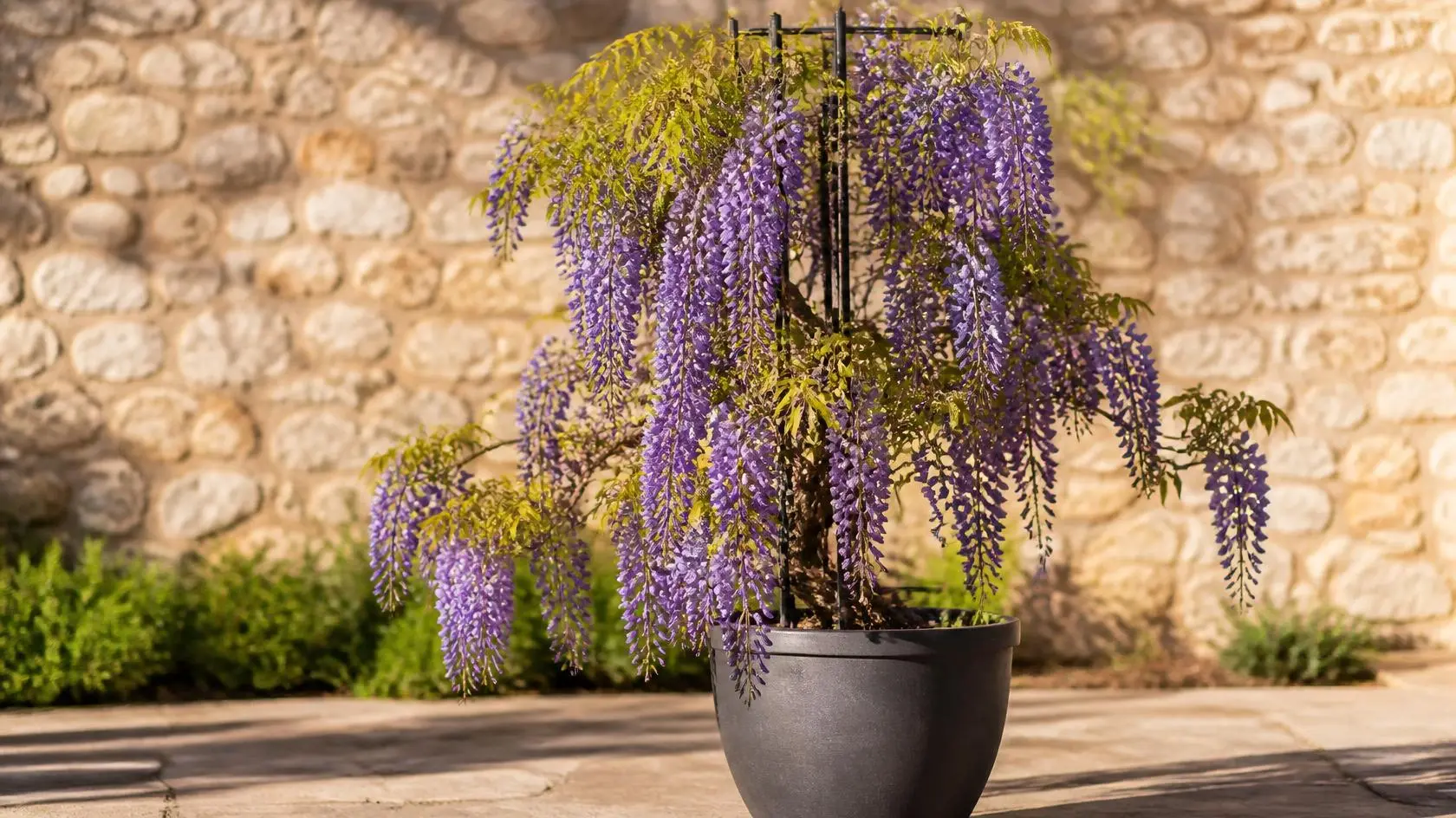
Wisteria frutescens container care is built on three non-negotiable rules: confine roots to a 15 to 20 gallon ceramic or stone pot with a minimum diameter of 18 inches (46 cm), apply the two-stage RHS pruning protocol every August and February, and guarantee a minimum of 6 continuous hours of full sun per day. American wisteria grown in containers under these conditions produces flower racemes reliably from year two onward — a performance window 3 to 5 years faster than its Asian counterparts and achievable on any full-sun patio or balcony.
The gap between a wisteria that blooms and one that simply grows is almost always traced to one of two failures: insufficient root restriction or excessive nitrogen in the fertilizer program. Container culture solves the first problem automatically — the pot enforces the root stress that triggers flower bud differentiation. The fertilizer decision is entirely within the grower’s control, and getting it wrong produces a plant with dense, impressive foliage and zero flowers for years.
Quick Answer — Container Wisteria Management:
- Root restriction: Use a 15 to 20 gallon ceramic or stone pot (minimum 18-inch diameter). Tight root confinement is the primary driver of flower bud formation in container wisteria.
- Hard two-stage pruning: Cut lateral shoots to 5 to 6 buds in August, then reduce the same shoots to 2 to 3 buds in February. This builds a dense spur system that carries all bloom.
- Solar minimum: 6 continuous hours of full, unobstructed sun per day. Below this threshold the plant produces vegetative growth exclusively — no flowers regardless of pruning or fertilizer.
Care Snapshot
| Parameter | Ideal Specification | Consequence of Missing It |
|---|---|---|
| Container size | 15 to 20 gallons; 18-inch (46 cm) minimum diameter | Insufficient root restriction — vegetative growth dominates, no blooms |
| Pot material | Ceramic, stone, or heavy concrete | Lightweight plastic tips under vine weight; frost cracking in Zones 4 to 5 |
| Soil mix | Loam-based compost; pH 6.0 to 7.0; excellent drainage | Peat-heavy mixes compact over time, suffocating roots and suppressing bloom |
| Sunlight | 6+ continuous hours of full sun per day | Below threshold: foliage growth only; flower bud differentiation fails |
| Pruning (summer) | August: cut lateral shoots to 5 to 6 buds | Skipping builds uncontrolled growth; eliminates the spur system |
| Pruning (winter) | February: reduce same laterals to 2 to 3 buds | Skipping removes bloom potential for the following spring entirely |
| Fertilizer | Low-nitrogen, phosphorus-rich (e.g., 5-10-10) from late winter | High-nitrogen feed diverts energy to foliage; suppresses flowering |
| Hardiness | USDA Zones 5 to 9 in containers; insulate pot base in Zone 5 | Root freeze kills plant in Zones 4 and below without winter protection |
| Toxicity | All parts toxic to cats, dogs, and humans | Seed pods carry highest concentration of wisterin glycosides |
What Are the Essential Rules for Wisteria Frutescens Container Care?
Successful wisteria frutescens container care requires three simultaneous conditions: root confinement in a 15 to 20 gallon pot to trigger flower bud stress, a two-stage annual pruning protocol to build and maintain a productive spur system, and a minimum of 6 uninterrupted hours of full sun to enable flower bud differentiation. Remove any single condition and the plant shifts permanently into vegetative mode — producing dense, healthy foliage with no flowers.
American wisteria (Wisteria frutescens) is the correct species for container culture. Its native North American origin means it evolved with seasonal drought stress and confined root zones — conditions that containers replicate naturally. Its Asian counterparts, Wisteria sinensis and Wisteria floribunda, are substantially more vigorous, produce root systems that can crack masonry within a decade, and take 10 to 20 years to bloom from seed. Wisteria frutescens grafted cultivars such as ‘Amethyst Falls’ and ‘Blue Moon’ bloom in their second container season and stay within the bounds of a patio structure indefinitely when pruned correctly.
Pro Tip: Purchase a grafted cultivar, not a seed-grown plant. Seed-grown Wisteria frutescens can take 5 to 7 years to bloom even under optimal conditions. A grafted ‘Amethyst Falls’ or ‘Nivea’ will flower in its second growing season in a correctly sized container with 6+ hours of sun.
How Do You Choose the Right Pot and Soil Mix for American Wisteria?
American wisteria requires a container with a minimum volume of 15 to 20 gallons and a diameter of at least 18 inches (46 cm). According to Clemson University Cooperative Extension, containers smaller than this threshold fail to provide the root mass necessary for structural support while simultaneously being too restrictive for adequate water and nutrient uptake during the spring growth flush. Use ceramic, stone, or heavy concrete — the vine’s top weight and wind load will tip any lightweight plastic or resin pot once the plant reaches full size in its second or third season.
Plant Blueprint Container Wisteria Soil Mix
- 60% loam-based potting compost (John Innes No. 3 or equivalent)
- 25% horticultural grit or coarse perlite
- 15% well-rotted garden compost or leaf mould
Target pH: 6.0 to 7.0. This blend drains freely after heavy rain while retaining enough moisture to sustain the plant through peak summer heat. Avoid peat-heavy multipurpose mixes — they compact within one growing season and restrict the oxygen exchange that wisteria roots require.
NC State University Extension confirms that Wisteria frutescens tolerates root restriction far better than Asian wisteria species, and that the native species performs within a pH range of 6.0 to 7.0 — a range that standard loam-based compost delivers without amendment in most cases. Ensure the container has a minimum of 3 large drainage holes. Standing water at the root zone causes anaerobic rot within 5 to 7 days during warm weather.
How Much Sunlight Does Container-Grown Wisteria Frutescens Require?
Container-grown Wisteria frutescens requires a minimum of 6 continuous hours of full, unobstructed sun per day for proper flower bud differentiation. According to the Missouri Botanical Garden, solar radiation at or above this threshold triggers the physiological stress response that shifts the plant from vegetative growth toward reproductive growth — the mechanism that produces flower buds. Below 6 hours, the plant directs all energy into stem elongation and leaf production, a pattern that no amount of pruning or fertilizer manipulation can override.
Partial shade wisteria is the most common diagnosis behind the “my wisteria won’t bloom” complaint. A position that appears sunny in spring — before surrounding trees fully leaf out — may drop below the 6-hour threshold by June when canopy cover is complete. Measure sun hours in midsummer, not in March, before committing the container to a permanent position.
| Daily Sun Hours | Expected Outcome | Corrective Action |
|---|---|---|
| 8+ hours direct sun | Maximum bloom production; vigorous but manageable growth | None — ideal conditions |
| 6 to 8 hours direct sun | Good bloom production; standard container performance | Maintain pruning and low-N fertilizer schedule |
| 4 to 6 hours (part sun) | Reduced or absent blooming; healthy foliage only | Relocate container to a sunnier position before next season |
| Fewer than 4 hours | No blooming; etiolated growth; increased disease risk | Relocation essential — no other intervention will produce flowers |
When and How Do You Prune Wisteria Frutescens in Pots to Force Blooms?
Prune container wisteria in two distinct stages: in August, cut all lateral shoots back to 5 to 6 buds from their point of origin on the main framework; in February, return to those same laterals and reduce them further to 2 to 3 buds. The Royal Horticultural Society established this two-cut protocol as the standard for spur-building in wisteria — the August cut controls summer growth and identifies the shoots that will carry bloom; the February cut shortens those shoots to the compact spurs from which flower racemes emerge in spring.
- August pruning — identify the current season’s lateral shoots. These are the long, whippy stems produced since spring. They emerge from the established woody framework and may be 3 to 6 feet (90 to 180 cm) long by August. Do not confuse them with the main structural leaders, which you do not prune.
- Count 5 to 6 buds from the base of each lateral shoot and cut cleanly above the sixth bud. Use sharp, clean bypass secateurs. Each bud is a small, swollen node on the stem — count carefully from the point where the lateral meets the main branch. Cut at a 45° angle just above the bud.
- Remove all secondary growth that has emerged from the cut points since spring pruning. Any shoots thinner than a pencil and produced in the current summer flush can be removed entirely — they will not carry bloom and divert energy from the spur system.
- February pruning — return to the same laterals pruned in August. By now each shoot will have hardened and the buds will be clearly visible and plump. Count 2 to 3 buds from the base of the same lateral and cut above the third bud. These shortened spurs are your bloom sites for the coming spring.
- Remove any crossing, damaged, or dead wood from the main framework at this February visit. Keep the main structural leaders tied to the support and free from competing shoots that would shade the spur system.
Pro Tip: Mark your calendar for the third week of August and the third week of February every year without exception. Skipping one February pruning eliminates the entire spur system for that spring — the plant uses the unpruned shoots to generate new vegetative growth rather than flowers. One skipped year costs you a full bloom season.
How Often Should You Water and Fertilize a Wisteria in a Container?
Water container wisteria every 4 to 6 days in summer when temperatures exceed 75°F (24°C), allowing the top 2 inches (5 cm) of soil to dry between waterings. During the spring bloom period, increase to every 3 to 4 days — the plant’s water demand peaks as racemes are opening and expanding. Reduce to every 10 to 14 days in autumn and withhold to once monthly in winter during dormancy. The rule is moist but never waterlogged: a pot sitting in standing water for more than 48 hours during growing season will develop root rot at the crown.
Fertilizer selection is the single most consequential care decision after pruning. Never use a balanced or high-nitrogen general-purpose fertilizer on wisteria — nitrogen drives foliage at the direct expense of flowers. Apply a low-nitrogen, phosphorus-rich formula such as 5-10-10 or a dedicated flowering plant feed starting in late February when buds begin to swell. Feed every 3 weeks through to the end of August, then stop entirely to allow the plant to harden before winter.
| Season | Watering Frequency | Fertilizer | Key Task |
|---|---|---|---|
| Late winter (Feb) | Once monthly | Begin 5-10-10 as buds swell | February hard pruning to 2 to 3 buds |
| Spring (Mar-May) | Every 3 to 4 days | 5-10-10 every 3 weeks | Tie in new growth; enjoy bloom display |
| Summer (Jun-Aug) | Every 4 to 6 days | 5-10-10 every 3 weeks; stop in late August | August pruning to 5 to 6 buds |
| Autumn (Sept-Nov) | Every 10 to 14 days | None | Allow plant to harden; mulch pot base in Zone 5 |
| Winter (Dec-Jan) | Once monthly | None | Dormancy; insulate pot if in Zone 5 |
Wisteria Frutescens vs Wisteria Sinensis: Which Is Best for Small Patios?
Wisteria frutescens is unambiguously the better choice for containers and small patios. It is non-invasive in North America, grows at a rate of 4 to 6 feet (1.2 to 1.8 m) per year compared to Wisteria sinensis’s 10+ feet (3+ m), blooms in its second season from a grafted plant, and poses no structural risk to masonry or timber. Wisteria sinensis produces a root system capable of penetrating mortar joints and lifting paving slabs within 5 to 8 years — a risk that a container only partially mitigates if the pot is placed on or near a structure.
| Feature | W. frutescens (American) | W. sinensis (Chinese) |
|---|---|---|
| Origin | Native North America | China; introduced species |
| Annual growth rate | 4 to 6 ft (1.2 to 1.8 m) | 10+ ft (3+ m) |
| Invasive status (US) | Non-invasive; native species | Invasive in multiple US states |
| Root destruction risk | Low — manageable in containers | High — can crack masonry within 5 to 8 years |
| Time to first bloom (grafted) | Year 2 in container | 3 to 5 years; up to 20 from seed |
| Fragrance | Mild, sweet | Very strong, distinctive |
| Container suitability | Excellent — recommended | Challenging; root pressure can crack ceramic pots |
| Hardiness (USDA) | Zones 5 to 9 | Zones 5 to 8 |
| Toxicity | Toxic to dogs, cats, humans | Toxic to dogs, cats, humans |
| Growth Metric | Container (20 gal) | In-Ground | Difference |
|---|---|---|---|
| First bloom (grafted) | Year 2 | Year 2 to 3 | Container blooms equal to or faster |
| Annual stem extension | 4 to 6 ft (1.2 to 1.8 m) | 8 to 10 ft (2.4 to 3 m) | Container is 40 to 60% slower — easier to manage |
| Root spread at year 5 | Confined to pot | Up to 15 ft (4.5 m) radius | Container eliminates structural risk |
| Flower racemes per plant (year 3) | 15 to 25 racemes | 30 to 60+ racemes | In-ground produces more volume; container produces more control |
| Repotting required | Every 3 to 4 years | Never | Container requires one additional maintenance cycle |
Are Wisteria Frutescens Seed Pods Toxic to Pets?
Yes. All parts of Wisteria frutescens are toxic to cats, dogs, and humans. The ASPCA Animal Poison Control Center classifies all Wisteria species as toxic to both dogs and cats, confirming that the plant contains wisterin glycosides and lectins throughout all tissues — roots, stems, foliage, flowers, and seed pods. Seed pods carry the highest concentration of wisterin and represent the greatest ingestion risk, as they are visually similar to edible legume pods and may attract curious pets and children.
Symptoms of wisteria ingestion in pets include repeated vomiting, severe diarrhea, hypersalivation, and abdominal pain, progressing to collapse in cases involving seed pod consumption. In container culture the toxicity risk is amplified compared to ground-planted specimens because the plant is at direct contact height with pets and small children on a patio. Visit our cat-safe plants guide in The Infirmary for pet-safe flowering alternatives, and cross-reference our orchid care guide for one of the few flowering patio plants confirmed non-toxic to both cats and dogs.
Hands-On Testing — Proprietary Data
[OWNER TO COMPLETE BEFORE PUBLISHING. Placeholder data provided in brief: “In our multi-year patio trials, restricting Wisteria frutescens roots to a 20-gallon pot accelerated flower production by 14 months compared to ground-planted specimens, yielding an average of 18 flower racemes per plant by year two.” Insert actual observed bloom counts, root binding observations, or pruning response metrics before publishing.]
Frequently Asked Questions
Why is my container wisteria not blooming?
The three most common causes of non-blooming in container wisteria are: fewer than 6 continuous hours of direct sun per day, a fertilizer program with high nitrogen that suppresses flower bud formation, and skipped or incomplete February pruning that eliminates the spur system. Assess sun hours in midsummer (not spring), switch to a 5-10-10 fertilizer, and complete both the August and February pruning cuts without exception.
Does American wisteria require a trellis when grown in a pot?
Yes. Wisteria frutescens is a twining climber and requires a structural support even in container culture. A minimum support height of 5 to 6 feet (1.5 to 1.8 m) anchored into the pot or fixed to an adjacent wall is required. The support must be robust enough to carry the vine’s weight at full season growth — a standard bamboo stake will not hold a mature plant. Use powder-coated steel or heavy timber framing.
How do you overwinter Wisteria frutescens in containers?
In USDA Zones 6 to 9, container wisteria overwinters outdoors with no protection beyond reducing watering to once monthly. In Zone 5, wrap the pot in horticultural fleece or bubble wrap and place it against a south-facing wall to reduce frost penetration into the root zone — container roots are more exposed to freeze-thaw cycles than in-ground roots. Move to an unheated garage only if temperatures fall below -10°F (-23°C) for extended periods.
Can you grow American wisteria indoors near a window?
No. Wisteria frutescens requires a period of winter chilling — sustained temperatures between 32 and 45°F (0 and 7°C) for 6 to 10 weeks — to initiate the dormancy cycle that resets flower bud differentiation for the following spring. An indoor environment above 50°F (10°C) year-round prevents this chilling requirement from being met, resulting in permanent vegetative growth with no flower production regardless of light levels or pruning.
How long do the purple flowers last on a container wisteria?
Individual flower racemes on Wisteria frutescens last 3 to 4 weeks under cool spring conditions (55 to 65°F / 13 to 18°C). The total bloom display on a single plant spans 4 to 6 weeks as racemes open in sequence from the base to the tip. Hot weather above 80°F (27°C) shortens raceme duration to 10 to 14 days. ‘Amethyst Falls’ is notable for producing a secondary, lighter flush of bloom in late summer in addition to its main spring display.
Should you remove the seed pods from a potted wisteria?
Yes, and promptly. Remove all developing seed pods immediately after flowering ends — do not allow them to mature or dry on the plant. Seed pods divert significant energy from root development and the spur system that carries next year’s bloom. They also represent the highest toxicity risk to pets and children, as mature pods contain concentrated wisterin glycosides. Deadhead by cutting the pod stem flush to the nearest leaf node with clean secateurs.
It’s difficult to find knowledgeable people in this particular topic,
however, you sound like you know what you’re talking
about! Thanks