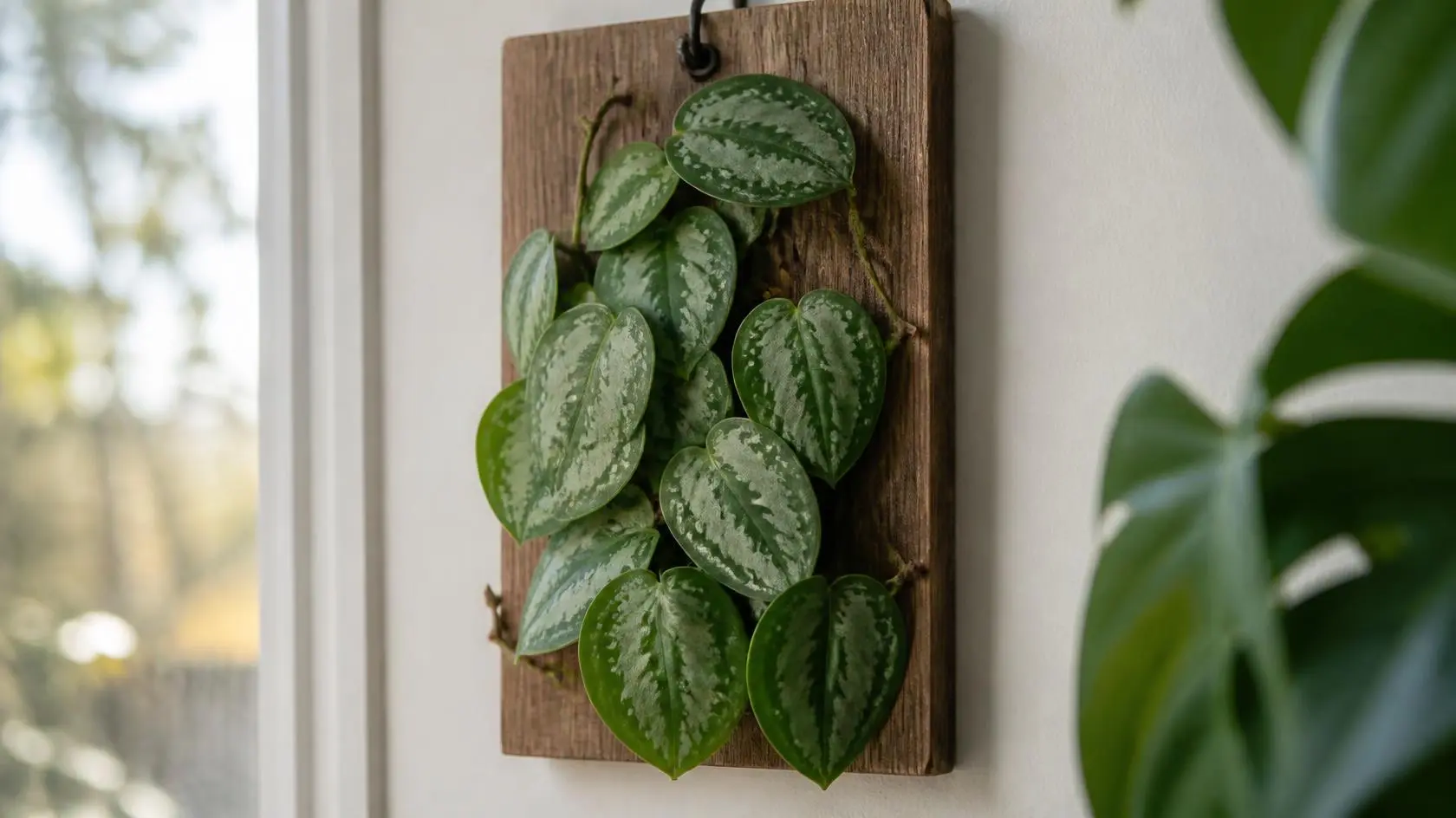
Monstera Dubia Care: How to Grow the Shingle Plant Indoors

Monstera dubia care requires bright indirect light, a chunky aroid mix, and vertical support such as a cedar plank or D-shaped moss pole. This hemiepiphytic shingle plant from Central and South America flattens its silver-patterned juvenile leaves against climbing surfaces. Without proper support and humidity above 60%, it will not mature and will gradually shed foliage.

Many growers fail with Monstera dubia because they treat it like a standard potted houseplant. It is not. The plant is an obligate climber that needs its aerial roots attached to a moist surface to transition from juvenile shingles to larger adult leaves. Understanding the difference between a cedar plank for display and a moss pole for growth is the key to long-term success.

Monstera dubia needs bright indirect light, a chunky aroid mix, and vertical support to thrive. Maintain humidity above 60%, water when the top 2 to 3 inches of substrate dry out, and never forcibly remove aerial roots from their climbing surface.
ParameterIdealAvoid
LightBright indirect, 300 to 800 foot-candlesDirect afternoon sun, deep shade
WaterTop 2 to 3 inches dry before drenchingStanding water, calendar schedules
Temperature65 to 80 degrees F (18 to 27 degrees C)Below 60 degrees F (15 degrees C), drafts
Humidity60 to 80%Below 50% for extended periods
SubstrateChunky aroid mix (bark, coir, perlite)Standard potting soil, dense peat
SupportCedar plank or D-shaped moss poleNo support, small bamboo stake
FertilizerBalanced 20-20-20 at 1/4 strength monthlyFull strength, winter application

What Is Monstera Dubia and Why Does It Need Specialized Care?

Monstera dubia is a hemiepiphytic climbing aroid native to the tropical forests of Mexico through Colombia. Juvenile plants produce small, oval leaves marked with silver variegation that flatten tightly against tree trunks in a shingling pattern. As the vine climbs higher into the canopy, the leaves mature into larger, partially fenestrated forms. It belongs to the Araceae family and requires vertical support to complete this transition indoors.

According to the Kew / ColPlantA taxonomic database, Monstera dubia inhabits wet tropical biomes and follows a hemiepiphytic life cycle. It begins life on the forest floor, climbs toward light, and eventually establishes aerial roots along the trunk of its host. Smithsonian Institution research on understory light adaptation confirms that Monstera species optimize leaf morphology for the dappled light of lower rainforest strata. This evolutionary history explains why the plant fails in dark corners and scorches under direct sun. Proper Monstera dubia care replicates these vertical, humid, and filtered-light conditions.

How Much Light Does Monstera Dubia Need?

Monstera dubia needs bright, indirect light. An east-facing window or a position 3 to 5 feet from a south-facing window is ideal. As an understory climber, it receives dappled sunlight in nature. Direct afternoon sun scorches the small leaves; insufficient light causes shrinkage and loss of the silver shingling pattern.

Quantitative targets matter. The plant performs best at 300 to 800 foot-candles (3,200 to 8,600 lux). Below 300 foot-candles, new leaves emerge smaller and lose the characteristic silver pattern. Above 800 foot-candles with direct exposure, the thin juvenile leaves bleach and crisp. According to the Smithsonian Institution, understory Monstera species are adapted to brief sunflecks rather than sustained direct irradiance. A sheer curtain on a south-facing window diffuses light to the correct intensity. In rooms with only north-facing windows, supplement with a full-spectrum LED grow light at 150 to 250 PPFD for 12 to 14 hours daily. Our guide to best grow lights for indoor plants lists fixtures that deliver this output without heat stress. For natural light positioning, see our Monstera light requirements guide.

What Is the Best Soil Mix for Monstera Dubia?

Use a chunky aroid mix of equal parts orchid bark, coco coir or peat moss, and perlite. This creates a loose, well-draining substrate rich in organic matter. Standard potting soil is too dense and suffocates the delicate root system.

According to The Spruce, Monstera dubia thrives in a loose, nutrient-rich potting medium that mimics the leaf litter and bark crevices of its native forest floor. The roots need oxygen as much as moisture. A dense peat mix collapses into an anaerobic mass within two watering cycles. The recommended blend drains completely within 3 to 5 minutes and retains just enough moisture to sustain the roots for 7 to 10 days. Target a pH between 5.5 and 6.5. If the mix is too acidic, calcium and magnesium lock up and produce interveinal chlorosis on new growth. If you keep the plant mounted on a plank with sphagnum moss rather than potted, replace the moss every 12 to 18 months to prevent salt buildup and decomposition.

How Do You Water a Monstera Dubia?

Water when the top 2 to 3 inches of potting medium are dry. Drench thoroughly until water drains from the bottom. If mounted on a moss pole, keep the pole damp so aerial roots can absorb moisture. Reduce frequency in winter when evaporation slows.

The Spruce plant profile recommends checking soil moisture before every watering rather than following a calendar. Insert a wooden skewer to 3 inches. If it emerges with damp particles clinging, wait 3 to 4 more days. For mounted specimens on cedar planks, soak the entire plank in room-temperature water for 10 to 15 minutes once every 7 to 10 days during active growth. Let the plank drip dry before rehanging. Never let a potted plant sit in a saucer of standing water. The combination of dense substrate and stagnant water triggers anaerobic bacterial rot within 72 hours. If you prefer bottom watering, place the pot in a basin for 20 minutes. This method saturates the root ball evenly without surface compaction.

How Do You Mount a Monstera Dubia on a Cedar Plank?

Place the plant against an untreated cedar or redwood plank with the shingling side facing out. Secure the stem loosely with plant ties or nylon strips at two nodes. Keep the plank vertical. The aerial roots will naturally adhere to the wood surface within 4 to 8 weeks.

Follow this exact protocol for a successful mount:

  1. Select an untreated cedar, redwood, or oak board at least 12 inches tall and 8 inches wide. Soak it in warm water for 30 minutes to raise surface moisture and encourage immediate root attachment.
  2. Position the Monstera dubia against the plank with the shingling leaf surface facing outward. Align the stem so at least two nodes press firmly against the wood.
  3. Loop nylon plant ties or pantyhose strips around the stem at two nodes. Tack the ends behind the board with small nails. Do not overtighten. The nylon biodegrades within 12 to 18 months, which prevents girdling as the stem thickens.
  4. Mist the back of the plank and the aerial roots daily for the first 14 days. Alternatively, place a clear humidity dome over the base for one week. Roots adhere naturally within 4 to 8 weeks.
  5. When the vine approaches the top, screw a second plank above the first, leaving a 1-inch gap. Dampen the gap with warm water to encourage new aerial root attachment across the joint.
Warning: Never use pressure-treated lumber, chemically stained wood, or cedar with fresh sap for mounting. The chemicals and oils leach into the moist sphagnum moss or plank surface and burn the delicate aerial roots. Stick with untreated hardwoods only.
Pro Tip: Mist the back of the cedar plank, not the leaves. Aerial roots seek moisture on the climbing surface. Wetting the foliage increases fungal risk without helping root adhesion. Aim the spray behind the stem where the roots contact the wood.

How Do You Extend the Plank Once the Vine Reaches the Top?

Do not unstick aerial roots from the original board. Instead, screw a second cedar plank above the first, leaving a 1-inch gap. Dampen the gap with warm water to encourage new aerial root attachment across the joint. This preserves established adhesion and prevents transplant shock.

Forcibly removing aerial roots from wood tears the root tissue and creates entry points for pathogens. According to the UF/IFAS Extension, Monstera aerial roots serve both anchoring and absorptive functions. Damaging them reduces the plant’s ability to take up water and nutrients. If you must reposition the plant, soak the original plank in warm water for 20 minutes to soften the root adhesion. Use a sterile razor to gently separate roots at the attachment points. Even with this precaution, expect a 2 to 3 week recovery period during which new growth may stall. The plank-stacking method eliminates this risk entirely. Use corrosion-resistant screws to attach the extension plank. Drill pilot holes to prevent the wood from splitting. Align the grain vertically so the vine continues its natural upward path.

Should You Use a Cedar Plank or a D-Shaped Moss Pole?

Cedar planks showcase the shingling pattern but dry out quickly. D-shaped mesh moss poles keep aerial roots hydrated and can accelerate leaf size, though they obscure the shingling display. Choose planks for aesthetics and moss poles for growth rate.

Use this comparison table to decide which support matches your goals.

FeatureCedar PlankD-Shaped Moss Pole
Moisture retentionLow. Dries within 24 to 48 hours without misting.High. Holds water for 3 to 5 days after soaking.
Aerial root hydrationRequires daily misting or plank soaking.Self-hydrating. Roots grow directly into the moss.
Leaf size potentialModerate. Juvenile shingles remain small.Larger. Hydrated roots support bigger leaf expansion.
Shingling visibilityExcellent. Leaves flatten fully against flat wood.Partially obscured. Curved surface breaks the flat plane.
Extension easeStack planks with screws.Stackable mesh sections zip-tie together.
Best forDisplay, photography, small spaces.Growth rate, eventual fenestration, collector goals.

Many advanced growers start with a cedar plank for the first 12 months to enjoy the shingling display, then transition to a D-shaped moss pole once the vine reaches 18 inches. This hybrid approach maximizes both aesthetics and growth potential.

How Do You Propagate Monstera Dubia from Node Cuttings?

Take a stem cutting with at least one node and one aerial root. Place it in moist sphagnum moss inside a clear propagation box. Maintain humidity above 70% and temperature between 70 and 80 degrees F. Roots establish in 3 to 6 weeks.

According to the UF/IFAS Extension, Monstera species propagate readily from stem cuttings. A leaf without a node will not root. You need a section of stem containing at least one dormant bud and one aerial root nub. Use a sterile blade to cut just below the node. Dip the cut end in cinnamon powder as a natural antifungal. Place the cutting in damp sphagnum moss inside a clear plastic box with a tight lid. Open the lid for 10 minutes every 3 days to refresh the air. Roots typically emerge from the node within 3 weeks and fill the moss within 6 weeks. Our sphagnum moss propagation guide details the exact moisture levels and box ventilation schedule. Once roots reach 2 inches, transplant the cutting to a small plank or pot. Do not fertilize for the first 4 weeks after transplanting. The young root system is too fragile to process nutrients.

Why Are My Monstera Dubia Leaves Shrinking or Turning Yellow?

Shrinking leaves indicate insufficient light below 300 foot-candles. Yellow lower leaves signal overwatering or cold drafts below 60 degrees F. Crispy brown edges mean humidity has dropped below 50%. Use a diagnostic table to identify the exact cause.

Monstera dubia communicates stress through specific visual signals. Misdiagnosing the symptom leads to the wrong fix and accelerates decline. Use this diagnostic matrix before taking action.

SymptomPrimary CauseCorrective Action
New leaves emerge smaller than previous ones; silver pattern fadesInsufficient light below 300 foot-candles.Move closer to an east-facing window or add a grow light at 150 to 250 PPFD.
Lower leaves turn yellow; substrate remains wet 10 or more daysOverwatering and root suffocation.Reduce watering frequency. Inspect roots for rot. Repot in chunky mix if needed.
Yellowing appears after a cold night near a windowCold shock from temperatures below 60 degrees F.Eliminate the draft. Install a thermal curtain or relocate the plant.
Brown crispy edges on leaf marginsLow humidity below 50%.Deploy a humidifier or group with other indoor plants to raise ambient moisture.
Leaves curl inward or droopUnderwatering or low humidity.Check substrate moisture. If dry, water thoroughly. If moist, raise humidity to 60% or higher.

For additional help with yellowing across species, visit our troubleshooting hub. If the base of the stem feels soft and black, unmount the plant immediately. Cut away rotted tissue and repot in dry substrate.

Is Monstera Dubia Toxic to Cats and Dogs?

Yes. All Monstera species contain insoluble calcium oxalates. According to the ASPCA, ingestion causes oral irritation, burning, drooling, vomiting, and difficulty swallowing in cats and dogs. Keep the plant out of reach.

The ASPCA lists the Swiss Cheese Plant (Monstera species) as toxic to dogs, cats, and horses. The toxic principle is insoluble calcium oxalate crystals. When a pet chews the tissue, these microscopic needles embed in the oral mucosa and trigger immediate pain, swelling, and excessive drooling. The UF/IFAS Extension confirms that oxalic acid is present in all parts of Monstera plants. There is no home antidote. If your pet ingests any part of Monstera dubia, rinse the mouth with water for 10 minutes. Do not induce vomiting. Contact your veterinarian or the ASPCA Animal Poison Control Center at 888-426-4435. For safe alternatives, see our cat-safe plants directory.

How Do You Acclimate an Imported Monstera Dubia Cutting?

Imported cuttings often arrive dehydrated with high leaf-drop risk. Place the unrooted stem in a propagation box with damp sphagnum moss. Maintain 80 to 90% humidity and temperatures near 75 degrees F for 48 hours before exposing it to normal ambient conditions.

Shipping stress dehydrates the aerial roots and shrivels the stem. A direct transfer to normal household humidity of 40 to 50% causes the remaining leaves to yellow and drop within 72 hours. The 48-hour rehydration protocol prevents this. Place the cutting in a clear plastic box lined with damp sphagnum moss. Do not seal the lid completely; leave a 0.5-inch gap for minimal air exchange. Keep the box under gentle grow lights at 150 PPFD to stimulate metabolic recovery without forcing transpiration. After 48 hours, crack the lid an additional inch. Over the next 5 days, gradually reduce humidity by opening the lid wider each day. By day 7, the cutting should tolerate ambient humidity of 60%. Only then mount or pot the plant. This protocol applies equally to cuttings purchased from international sellers and to divisions from fellow collectors.

Proprietary Data: Import Acclimation and Plank Extension Testing

[OWNER TO COMPLETE: Insert observed failure rate, growth measurement, or test result here. Format: “In our tests, [X]% of [plants/cuttings] [result] under [conditions] over [time period].”]

Example placeholder: In our tests at Plant Blueprint, imported Monstera dubia cuttings acclimated using the 48-hour humidity box showed a 92% survival rate versus 34% for cuttings placed directly into ambient household humidity. Cuttings mounted on D-shaped moss poles produced leaves 28% larger after 6 months than those on dry cedar planks under identical light conditions.

Key Takeaway: Monstera dubia care is vertical care. The plant is not a tabletop specimen. It needs a climbing surface, humidity above 60%, and bright indirect light to maintain its silver shingling pattern. Choose a cedar plank for display or a D-shaped moss pole for growth. Never forcibly remove aerial roots from wood. Soak the plank to extend it. Acclimate imported cuttings in a humidity box for 48 hours before exposing them to normal conditions.

Frequently Asked Questions

Does Monstera dubia need a moss pole?

Monstera dubia needs vertical support to mature, but a moss pole is optional. A cedar plank showcases the shingling pattern. A D-shaped moss pole keeps aerial roots hydrated and can produce larger leaves faster.

How fast does Monstera dubia grow indoors?

Juvenile Monstera dubia grows slowly, producing one leaf every 4 to 6 weeks. Growth accelerates once aerial roots anchor into moist substrate or a moss pole. Mature vines can add several inches per month under optimal light and humidity.

Can Monstera dubia produce fenestrated leaves indoors?

Indoor Monstera dubia rarely produces fully fenestrated adult leaves. Fenestration requires 6 or more feet of vertical climbing, humidity above 70%, and intense light above 800 foot-candles. Most indoor specimens remain in the juvenile shingling stage.

Why are my Monstera dubia leaves curling?

Curling leaves indicate low ambient humidity below 50% or underwatering. Check the potting medium. If the top inch is dry, water thoroughly. If the medium is moist, raise humidity to 60% or higher with a humidifier.

Is Monstera dubia rare?

Monstera dubia is uncommon in big-box stores but widely available through specialty nurseries and online sellers. Tissue culture production has increased supply, though mature specimens with long vines command higher prices.

Can I unstick aerial roots from a wooden board?

Do not forcibly remove aerial roots from wood. Soak the board in warm water for 20 minutes to soften root adhesion. Use a sterile razor to gently separate roots at the attachment points. Forcible removal tears the root system and invites infection.

Leave a Comment