
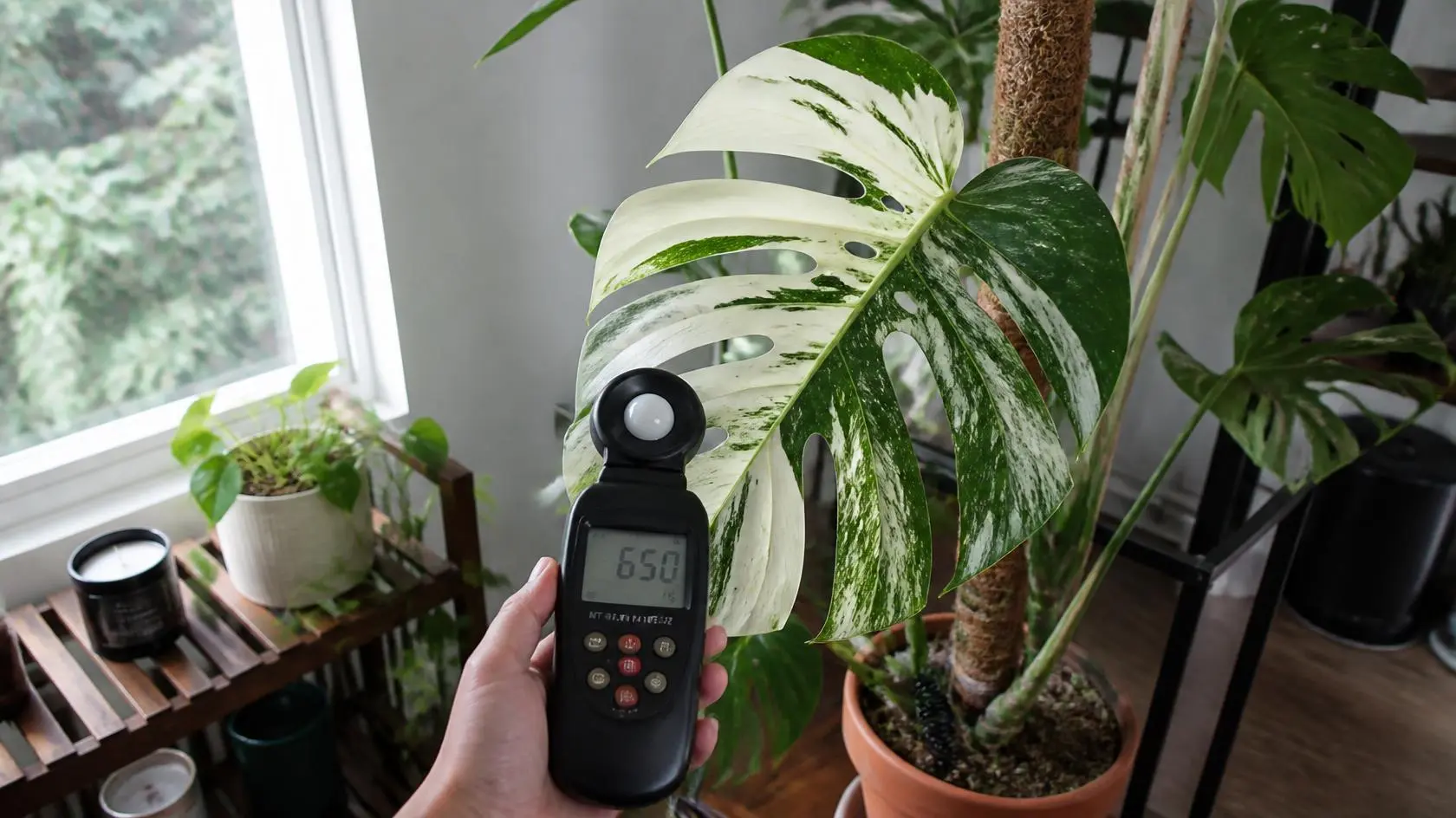
Monstera Albo care is ordinary Monstera care with two extra jobs: protecting the white tissue and removing reverted growth. Monstera deliciosa ‘Albo Variegata’ gets its white from a chimera, a plant built from more than one genotype in its growing tip. UF/IFAS explains that variegated chimeras can throw all-green or all-white shoots, and that the all-green ones can quickly grow over the variegated stems. So: bright light without direct sun, a well-drained mix, careful watering, and pruning any shoot that loses its white.
| Factor | What to aim for | Source |
|---|---|---|
| Light | Near a sunny window, bright light but not direct sun | Penn State Extension |
| Water | Water thoroughly, then let the top 1 to 2 inches dry; overwatering causes root rot | Penn State Extension |
| Soil | Well-draining soilless mix rich in organic matter | Penn State, Wisconsin Extension |
| Humidity and temperature | Warm room, medium to high humidity; no growth below 50 °F | Wisconsin Extension |
| Feeding | Fertilize regularly from spring until fall | Wisconsin Extension |
| Support | Moss stick, trellis, stake or moss-covered board | Penn State Extension |
| Reverted green shoots | Prune back to variegated tissue | Illinois Extension, UF/IFAS |
Sources: Penn State Extension; University of Wisconsin Extension; University of Illinois Extension; UF/IFAS.
What Makes Monstera Albo Different
Monstera Albo is the same species as a green Monstera deliciosa, with patches, streaks or half-moons of white. That pattern comes from a chimera. Illinois Extension sorts chimeras by how the mutated cells sit in the growing tip: periclinal chimeras are relatively stable, while mericlinal and sectorial chimeras are unstable and can give rise to both normal and mutated shoots and leaves. Albo’s pattern changes a lot from leaf to leaf, which is typical of the unstable types, so expect variation and the occasional all-green or mostly white leaf.
Penn State Extension lists ‘Albo Variegata’ and ‘Thai Constellation’ as variegated varieties of the species, and notes that ‘Thai Constellation’ is a fuller, more compact plant because of its shorter internodes. For the differences between the variegated forms, see our variegated Monstera deliciosa guide.
How Much Light Does a Monstera Albo Need?
Penn State’s advice for Monstera is a site near a sunny window with bright light but not direct sun; without enough light the plant gets leggy. That suits Albo especially well. Its white areas have little or no chlorophyll, so the green parts of each leaf do the work for the whole plant, and the white areas burn easily in strong direct sun.
In practice that means an east window, or a spot a few feet back from a south or west window, ideally with a sheer curtain. In darker homes a grow light helps; our Monstera light requirements guide and grow light guide cover the details.
Why the White Parts Turn Brown
Monstera Albo white leaves browning is the most common complaint, and there is no research that pins it on a single cause. The usual suspects:
- Dry air: Wisconsin Extension notes that Monstera leaf edges brown when the air is too dry, and white tissue tends to show it first.
- Direct sun: crisp, bleached or brown patches on the sunny side of the plant point to scorch. Move it out of direct sun (Penn State).
- Watering problems: both a pot that stays wet (root rot) and one that dries out completely stress the plant, and the weakest tissue browns first.
- Mostly white leaves: a leaf with very little green has little capacity to feed itself and often browns or dies back early. That is normal for this plant.
Brown tissue will not turn white again. Trim it with clean scissors if it bothers you, and judge your changes by the next new leaves.
Soil Mix
Penn State recommends a well-draining soilless potting mix that is rich in organic matter, and Wisconsin a fertile soilless mix with ample root room. Many aroid growers add orchid bark and perlite to a peat or coir-based mix to open it up further; our aroid soil mix guide compares the options and the research behind them. Whatever you use, the pot needs drainage holes.
Watering Without Root Rot
Water thoroughly, then let the top 1 to 2 inches of the mix dry before watering again; Penn State warns that overwatering can result in root rot. Wisconsin adds that leaves may “sweat” (drip water from the leaf edges) when the mix stays too wet, a sign to cut back. Empty the saucer after watering, and water less in winter when growth slows. If you are unsure whether the plant is getting too much or too little, see our guide to overwatered vs underwatered plants.
Propagating Monstera Albo
Wisconsin Extension says Monstera can be propagated from stem cuttings, or by air layering or simple layering. For Albo, the cutting matters: it carries only the tissue of the stem it came from, so choose a section with a node, an aerial root if possible, and good white variegation on the stem and leaves. A cutting from a stem with little or no white on it is likely to grow mostly green. Root it in water, perlite or moss; our sphagnum moss propagation guide covers the moss method. Air layering keeps the section attached to the mother plant while it roots, which lowers the risk with an expensive plant.
How to Stop Monstera Albo Reverting
You cannot fully prevent reversion in an unstable chimera, but you can stop it taking over. Illinois Extension explains that the true-to-species (green) tissues are generally more vigorous than the variegated parts, so if reversions stay on the plant they may eventually outgrow it; its advice is to prune out the reverted portion back to tissue that shows the cultivar’s characteristics. UF/IFAS likewise notes that variegated plants need to be pruned periodically to remove non-chimeral stems.
- Watch the newest leaves. One green leaf can happen; a run of green leaves from the same growing point is reversion.
- Follow that stem back to the last leaf that still had good white variegation.
- Cut just above that leaf’s node with clean, sharp pruners, and wear gloves (Penn State notes Monstera can cause contact dermatitis).
- New growth from a bud on the variegated section may come back variegated, though it is not guaranteed. If it comes back green again, cut lower into clearly variegated stem.
The cut-off green top can be rooted and grown as an ordinary Monstera deliciosa.
Do Silica Supplements Help?
Silica (potassium silicate) is widely sold for variegated aroids, but we found no research showing that it prevents browning or reversion in Monstera Albo. Some crops take up silicon and benefit from it, but aroids have not been studied this way. If you use a product, follow the label rate; it is optional, not a fix for light or watering problems. Our potassium silicate guide covers what the evidence does and does not show.
Pests
Wisconsin Extension says Monstera has few pests indoors but may get aphids, mealybugs, scale insects or spider mites. Thrips also attack aroids and leave silvery scarring that shows clearly on white tissue. Isolate an infested plant, wipe or rinse off what you can, and use a product labeled for houseplants. See our guides to thrips, mealybugs and spider mites.
Is Monstera Albo Toxic to Pets?
Yes. The ASPCA lists Monstera deliciosa (Swiss cheese plant) as toxic to dogs and cats because of insoluble calcium oxalates, with signs such as oral irritation, drooling, vomiting and difficulty swallowing. Penn State notes that all parts of the plant are toxic to humans and pets if eaten, except the fully ripe fruit. Variegated cultivars are the same species, so treat Albo the same way. If a pet chews it, call your vet or the ASPCA Animal Poison Control Center. Our cat-safe plants guide lists alternatives.
How to Care for Monstera Albo: Checklist
- Light: brightest spot without direct sun; add a grow light if the plant stretches.
- Water: when the top 1 to 2 inches are dry; empty the saucer.
- Mix and pot: well-draining soilless mix, pot with drainage holes.
- Humidity: medium to high; keep away from heating vents.
- Support: a moss pole or stake to climb.
- Feeding: regularly from spring until fall, at the label rate.
- Reversion: check new leaves and prune reverted stems early.
Frequently Asked Questions
Why are the white parts of my Monstera Albo turning brown?
Common causes are dry air (Wisconsin Extension links brown leaf edges to dry air), direct sun scorch, and watering problems. Leaves with very little green also tend to brown early. Brown tissue does not recover, so judge any change by the next new leaves.
How do I keep my Monstera Albo from reverting to green?
Prune any reverted stem back to tissue that still shows white. Illinois Extension notes that reverted green tissue is generally more vigorous and can eventually overtake the variegated plant.
How much light does a Monstera Albo need?
Bright light but not direct sun, near a sunny window (Penn State Extension). Too little light makes Monstera leggy.
What is the best soil for Monstera Albo?
A well-draining soilless mix rich in organic matter (Penn State). Many growers add bark and perlite for extra drainage.
Should I mist my Monstera Albo?
Misting only raises humidity for a few minutes. For dry rooms a humidifier works better, since Wisconsin Extension notes Monstera prefers medium to high humidity.
Is Monstera Albo toxic to cats and dogs?
Yes. The ASPCA lists Monstera deliciosa as toxic to dogs and cats because of insoluble calcium oxalates.