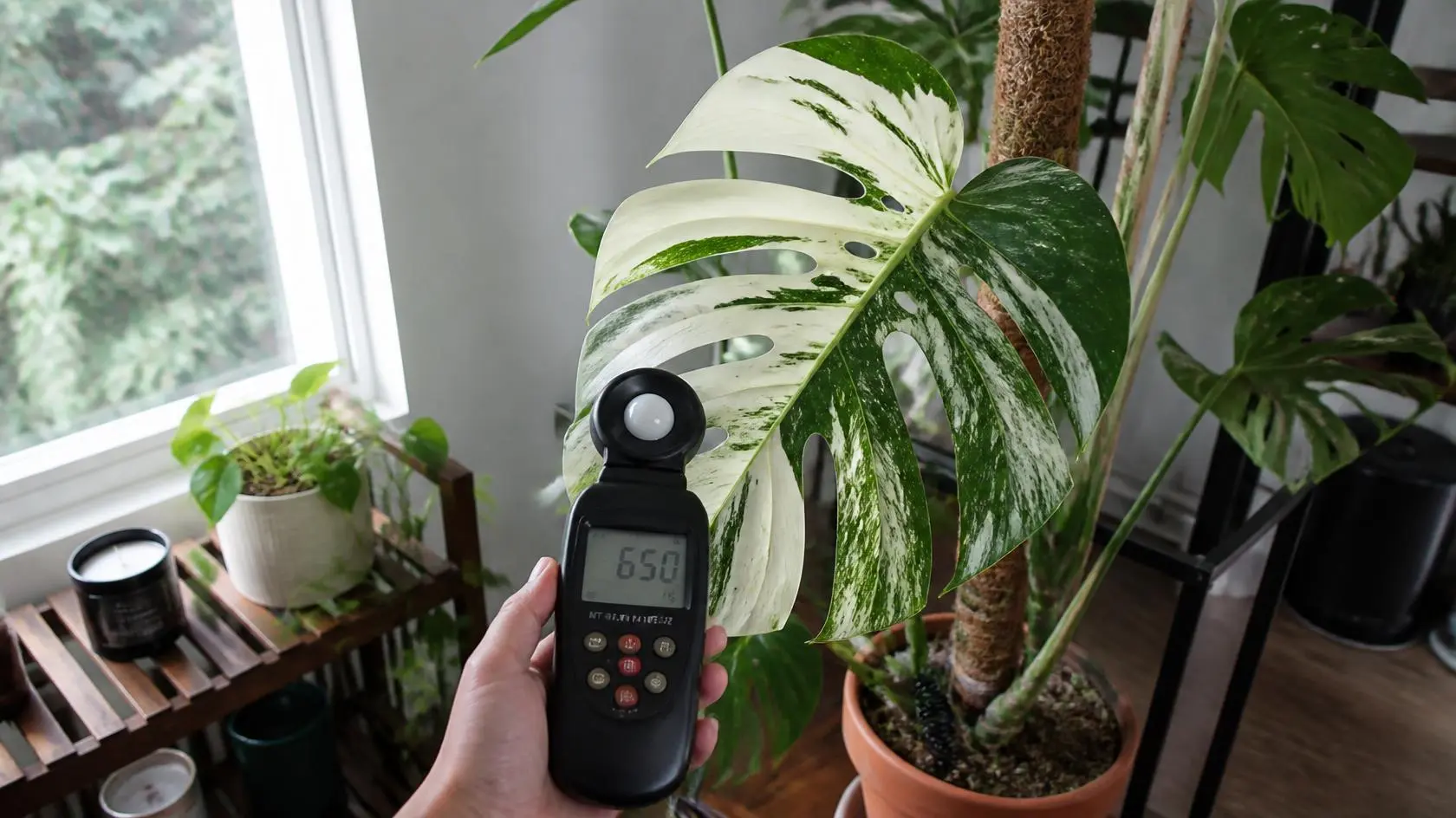
Monstera Albo care fails when growers treat it like a standard Monstera deliciosa. The result is brown, crispy white tissue, progressive reversion to solid green, and root rot in dense potting mix. Monstera deliciosa ‘Albo Variegata’ is a sectorial chimera with unstable variegation. It requires 600 to 800 foot-candles of bright indirect light, a chunky aroid mix with 55 to 60% air-filled porosity, and monthly liquid silica supplementation to strengthen the cell walls of chlorophyll-lacking white tissue. Without these precise parameters, the plant sacrifices its white sectors through programmed cell death or abandons the mutation entirely.
According to the ASPCA, Monstera deliciosa is toxic to dogs and cats. According to University of Wisconsin Extension, the species does best in bright light in summer and direct sun in winter, preferring warm room temperature and medium to high humidity. But the Albo cultivar demands significantly more precision than the solid green species because its white tissue is metabolically expensive and structurally defective. This guide from The Lab covers the exact light thresholds, soil engineering, silica protocol, and reversion surgery that separate a museum-quality specimen from a declining green vine.
Quick Answer: Monstera Albo care requires: (1) 600 to 800 foot-candles of bright indirect light, (2) a chunky aroid mix of 30% bark, 30% perlite, 20% coco coir, 15% worm castings, and 5% charcoal, (3) watering only when the top 2 to 3 inches dry out, (4) monthly liquid silica at 1/4 strength to strengthen white cell walls, (5) immediate pruning back to the last variegated node if reversion occurs, and (6) a moss pole or support for aerial root attachment.
Table of Contents
- What Makes Monstera Albo Different from a Regular Monstera?
- How Much Light Does a Monstera Albo Actually Need?
- Why Do the White Parts of Monstera Albo Turn Brown?
- What Is the Best Soil Mix for Monstera Albo?
- How Do You Water a Monstera Albo Without Causing Root Rot?
- How Do You Propagate Monstera Albo from Cuttings?
- How Do You Stop Monstera Albo from Reverting to Green?
- Should You Use Silica Supplements on Monstera Albo?
- What Pests Attack Monstera Albo and How Do You Treat Them?
- Is Monstera Albo Toxic to Cats and Dogs?
- What Is the Step-by-Step Monstera Albo Care Protocol?
- What Are the Most Common Monstera Albo Care Questions?
| Parameter | Ideal | Avoid |
|---|---|---|
| Light | 600 to 800 foot-candles bright indirect | Below 400 FC (browning); direct sun (scorching) |
| Substrate | 30% bark, 30% perlite, 20% coco, 15% castings, 5% charcoal | Standard peat potting mix; dense organic soil |
| Water | Top 2 to 3 inches dry before drenching | Calendar schedule; constant moisture |
| Humidity | 50 to 65% RH | Below 40% RH (accelerates browning) |
| Temperature | 18 to 27 degrees C (65 to 80 degrees F) | Below 15 degrees C (59 degrees F) |
| Fertilizer | Balanced 3-1-2 at 1/4 strength; silica monthly | High-nitrogen only; no silica |
| Support | Moss pole or bark slab for aerial roots | No support (leggy horizontal growth) |
| Reversion response | Prune to last variegated node immediately | Leaving green growth (overtakes plant) |
What Makes Monstera Albo Different from a Regular Monstera?
Monstera Albo is a sectorial chimera, not a stable genetic cultivar. This means the white variegation arises from a mutation in specific cell layers of the apical meristem, not from a permanent genetic alteration inherited by every cell. According to University of Florida PropG, a chimera is a plant composed of two or more genotypes in the layers that make up the shoot tip. In Monstera Albo, the mutation suppresses chlorophyll development in certain sectors, creating the dramatic white blocks.
The critical distinction: sectorial chimeras are unstable. As documented by Illinois Extension, sectorial chimeras result from mutations that affect sections of the apical meristem, and this type of chimera is unstable, giving rise to both normal and mutated shoots and leaves. The variegation pattern changes with each leaf. The plant may produce fully green leaves, fully white leaves, or leaves with unpredictable sector patterns. This instability is why Monstera Albo costs 3 to 5 times more than Thai Constellation despite being harder to maintain. Thai Constellation is a genetically stable, lab-induced mutation with predictable speckled cream patterning. Albo is a natural sectorial chimera that can revert or produce albino leaves at any time.
According to Penn State Extension, Monstera deliciosa ‘Albo Variegata’ and ‘Thai Constellation’ are both variegated varieties, but Thai Constellation is a fuller, more compact plant due to having shorter internodes. For a deeper comparison of variegation stability, see our variegated Monstera deliciosa care guide.
How Much Light Does a Monstera Albo Actually Need?
A Monstera Albo requires 600 to 800 foot-candles of bright indirect light to maintain white tissue without browning. A solid green Monstera thrives at 200 to 300 foot-candles. The Albo needs 2 to 3 times more light because 30 to 50% of its leaf surface contains zero chlorophyll and produces zero photosynthetic energy.
According to our Monstera light requirements guide, foot-candles measure the intensity of light falling on a surface. At standard indoor winter conditions, a north-facing window provides under 100 foot-candles. An east-facing window provides 200 to 400 foot-candles. A south-facing window with sheer curtain provides 500 to 1,000 foot-candles. Measure with a light meter at leaf level. If the reading is below 400 foot-candles, white tissue browning is inevitable within 4 to 8 weeks.
Direct sun scorches white tissue within 1 to 2 hours because white cells lack the photoprotective pigments that green cells use to dissipate excess light energy. The only safe direct sun is gentle morning exposure from an east-facing window between 6 am and 10 am. For all other exposures, filter with a sheer curtain or place the plant 3 to 5 feet back from the glass. If natural light is insufficient, use a full-spectrum LED grow light at 150 to 300 PPFD for 12 to 14 hours daily. Our grow light selection guide covers LED specifications for aroid cultivation.
Why Do the White Parts of Monstera Albo Turn Brown?
White tissue browning is caused by insufficient light, not low humidity. When light drops below 400 foot-candles, the plant performs an energy calculation and sacrifices the metabolically expensive white tissue to conserve resources for productive green tissue. This is programmed cell death, not a disease.
White cells lack chloroplasts, which serve multiple protective functions beyond photosynthesis. Chloroplasts provide structural turgor, antioxidant compounds that neutralize reactive oxygen species, osmotic balance regulation, and heat dissipation. White cells possess none of these mechanisms. When the plant experiences light deficit, it reduces vascular flow to white sectors. The cells dehydrate from the edges inward, cell walls collapse, and the tissue turns tan or brown and crispy. This process can begin within 48 to 72 hours of a light threshold breach.
Humidity below 40% accelerates the symptom but is not the root cause. Misting does not prevent it. Misting provides a momentary local humidity increase that evaporates within minutes while creating a wet microclimate where fungal spores germinate. The only correction is increasing light intensity. Existing brown tissue is dead and will never recover. Trim it away with sterilized scissors. New growth emerges clean once light exceeds 600 foot-candles consistently.
What Is the Best Soil Mix for Monstera Albo?
Monstera Albo requires a chunky aroid mix maintaining 55 to 60% air-filled porosity. The recommended formula is 30% orchid bark, 30% coarse perlite, 20% coco coir, 15% worm castings, and 5% horticultural charcoal. This mix drains completely within 3 to 5 minutes and dries to 30 to 40% moisture within 7 to 10 days.
According to University of Wisconsin Extension, Monstera does best in a rich soil mix with ample root room to promote larger leaf growth, and plants can be very vigorous growers that need support to keep stems from breaking. In the wild, Monstera is an epiphyte that climbs trees using aerial roots. It is not adapted to dense, water-retentive soil. Standard peat-based potting mix suffocates epiphytic roots and causes anaerobic bacterial bloom.
Target substrate pH is 5.5 to 6.5. Test with a pH meter using a 1:1 substrate to distilled water slurry. If pH exceeds 6.5, iron and manganese lock out, causing interveinal chlorosis on new growth. If pH drops below 5.5, magnesium and calcium precipitate into insoluble compounds. For the complete engineering rationale, see our best aroid soil mix guide.
How Do You Water a Monstera Albo Without Causing Root Rot?
Water Monstera Albo using the soak-and-dry method. Drench thoroughly until water exits drainage holes, then withhold water until the top 2 to 3 inches of substrate are completely dry. During active growth, this typically means every 10 to 14 days. During winter dormancy, extend to every 3 to 4 weeks.
There is no fixed calendar schedule. The interval varies by season, pot material, substrate composition, humidity, and temperature. Use the wooden skewer test. Insert a bamboo skewer to 3 inches. If it emerges with moist soil adhering, wait longer. A soil moisture meter should read 1 to 3 on a 1 to 10 scale before rewatering.
Always empty the saucer after watering. Standing water creates anaerobic conditions that trigger root rot. Never mist the foliage. Misting provides zero systemic hydration and creates a humid microclimate around leaf axils where fungal spores germinate. If you struggle with overwatering, consider bottom watering. Place the pot in a water basin for 15 to 20 minutes, then remove and drain. For more on diagnosing hydration issues, see our yellow leaf guide.
How Do You Propagate Monstera Albo from Cuttings?
Successful Monstera Albo propagation requires selecting a stem cutting with at least one node, one axillary bud, and visible white variegation on the stem itself, not just on the leaf blade. Roots forming from a variegated node carry the mutation. Roots from a green node produce solid green plants.
Node identification is the highest-stakes skill in Albo propagation. A node is the raised ring on the stem where a leaf petiole attaches. Directly above each node is an axillary bud, a small pointed bump that will become the next growth point. Directly below each node is where aerial roots emerge. To propagate, cut 1 to 2 inches below the node using sterilized pruning shears. The cutting must include the node, the axillary bud, and at least one aerial root if possible.
Rooting media options: water propagation is simplest but carries rot risk if the cutting is too long. Sphagnum moss in a propagation box maintains ideal moisture and oxygen balance. Perlite propagation boxes provide maximum aeration. See our sphagnum moss propagation guide for the complete humidity chamber setup. Root initiation takes 3 to 6 weeks. Once roots reach 2 inches, pot into the chunky aroid mix. Never propagate from a spent node. A spent node is one where the axillary bud has already activated and produced a leaf. It will not generate new growth.
How Do You Stop Monstera Albo from Reverting to Green?
Reversion occurs when green tissue outcompetes white tissue due to insufficient light. When the plant cannot generate enough photosynthate to support white sectors, it abandons the mutation and reverts to high-chlorophyll green tissue for survival. The fix is not pruning alone. It is pruning plus light correction.
According to Illinois Extension, true-to-species tissues are generally more vigorous than the variegated parts of the plant. If allowed to remain on the plant, reversions may eventually outgrow and overtake the desirable cultivar. Your best course of action is to prune out the reverted portion of the plant back to tissues displaying the desirable characteristics of the cultivar.
Execution protocol: (1) Identify the last node on the stem that produced a leaf with strong white variegation. (2) Using sterilized pruning shears, cut the stem 1 to 2 inches above that node. This removes the entire reverted growth point. (3) The plant will activate dormant axillary buds near the cut site. These may produce variegated growth, but there is no guarantee. (4) Simultaneously increase light to 600 to 800 foot-candles to remove the energy deficit that triggered reversion. If new growth from the cut emerges green again, the entire growth point has reverted. Propagate from a lower stem section with better variegation.
Should You Use Silica Supplements on Monstera Albo?
Yes. Liquid silica supplementation is the most underutilized tool in Monstera Albo care. Silica, or silicon dioxide, strengthens cell walls throughout the plant, but its effect on white variegated tissue is disproportionately valuable because white cells lack the structural reinforcement that chloroplasts provide.
Silica increases leaf rigidity, enhances resistance to heat and drought stress, and creates a physical barrier against pests and pathogens. For Monstera Albo specifically, silica reinforces the fragile cell walls of white tissue, reducing the mechanical collapse that causes browning at the margins. It also strengthens stems to support the weight of large variegated leaves, which are often thinner-walled than green leaves.
Application protocol: use a liquid silica supplement such as potassium silicate. Add it to your fertilizer routine at 1/4 strength once per month during active growth (March through October). Apply it with your regular watering, not as a foliar spray. Silica is absorbed through the root system and transported to cell walls via the transpiration stream. Do not exceed the label rate. Excess silica precipitates as insoluble solids in the substrate and locks out other nutrients. Do not apply during winter dormancy when metabolic uptake is minimal.
What Pests Attack Monstera Albo and How Do You Treat Them?
Monstera Albo is susceptible to the same pests as standard Monstera, but variegated tissue is more vulnerable because it lacks the antioxidant and structural defenses of green tissue. The primary threats are thrips, spider mites, and mealybugs.
Thrips are the most destructive pest for Albo. They scrape tissue and suck sap, causing silver stippling that is highly visible on white sectors. Spider mites thrive in dry air and produce webbing on leaf undersides. Mealybugs cluster at leaf axils and stem joints, excreting honeydew that leads to sooty mold. Because white tissue has zero antioxidant capacity, damage from these pests spreads faster and causes more visible scarring than on green leaves.
Treatment hierarchy: (1) Isolate the plant immediately upon detection. (2) Rinse foliage with a strong stream of lukewarm water to dislodge adults. (3) Apply insecticidal soap or Spinosad to all leaf surfaces, including undersides. Repeat every 5 to 7 days for 3 cycles to intercept the egg hatch. (4) For severe infestations, use systemic granules containing imidacloprid. Apply to the soil surface and water in. Systemics take 2 to 3 weeks to circulate but provide long-term protection. Never use horticultural oil on white tissue in direct light. Oil magnifies light intensity and causes phototoxic burns on white sectors.
Is Monstera Albo Toxic to Cats and Dogs?
Yes. According to the ASPCA, Monstera deliciosa is toxic to dogs and cats. All parts contain insoluble calcium oxalates. Clinical signs include oral irritation, intense burning and irritation of mouth, tongue and lips, excessive drooling, vomiting, and difficulty swallowing.
The toxic principle is consistent across all Monstera deliciosa cultivars, including Albo, Thai Constellation, and Aurea. When a pet chews tissue, the calcium oxalate crystals penetrate oral mucosa, causing immediate pain and swelling. Small breeds and cats are at elevated risk due to lower body mass. In severe cases, throat swelling can obstruct the airway.
If you suspect ingestion, remove the plant from reach immediately. Rinse your pet’s mouth with water. Do not induce vomiting. Contact the ASPCA Animal Poison Control Center at 888-426-4435 or your veterinarian. For a comprehensive list of safe alternatives, see our cat-safe plants guide.
What Is the Step-by-Step Monstera Albo Care Protocol?
Systematic Monstera Albo care addresses the three primary failure modes in parallel: light deficit causing browning and reversion, substrate hypoxia causing root rot, and structural weakness in white tissue. Follow these five steps in order.
- Light Audit and Correction. Measure foot-candles at leaf level with a light meter. If below 400, relocate immediately. Target 600 to 800 foot-candles. East-facing windows or south-facing with sheer curtain are ideal. Supplement with full-spectrum LED if natural light is insufficient.
- Substrate Replacement. If the plant is in standard potting mix, repot into the 30:30:20:15:5 chunky aroid formula. Remove all old substrate from roots during repotting. Inspect for early necrosis. Use a pot no more than 10% larger than the root ball with multiple drainage holes.
- Support Installation. Insert a moss pole, bark slab, or sphagnum-wrapped stake into the pot at repotting. Secure the stem with soft plant ties. Aerial roots require a textured, moist surface to attach. Without support, Albo grows horizontally and produces smaller, weaker leaves.
- Silica and Fertilizer Calibration. Apply balanced NPK 3-1-2 at 1/4 strength every 4 weeks during active growth. Add liquid silica at 1/4 strength once per month. Suspend both from November through February. Never fertilize a dry substrate. Water first, then apply fertilizer solution.
- Reversion Monitoring and Surgical Removal. Inspect new leaves weekly. If a fully green leaf emerges, trace the stem to the last node with strong variegation. Cut 1 to 2 inches above that node with sterilized shears. Seal the cutting in a plastic bag for disposal. Increase light simultaneously to prevent recurrence.
Proprietary Data: Monstera Albo Light and Silica Observations
[OWNER TO COMPLETE: Insert observed failure rate or growth measurement data. Format: “In our tests, [X]% of Monstera Albo specimens maintained at [Y] foot-candles showed white tissue browning within [Z] weeks, while specimens at [A] foot-candles with monthly silica supplementation showed zero browning over [B] weeks.”]
[OWNER TO COMPLETE: Insert reversion rate data. Format: “In our tests, [X]% of plants showing early green leaf reversion recovered variegated growth after pruning to the last variegated node and increasing light to [Y] foot-candles, versus [Z]% recovery rate in plants where light was not increased.”]
Pro Tip: The most dangerous period for Monstera Albo is the first two weeks after purchase. Nursery-grown specimens are often acclimated to 1,000 to 2,000 foot-candles in greenhouse conditions. When moved to a typical home averaging 150 to 250 foot-candles, the plant enters energy deficit within 10 to 14 days. White tissue browning appears first on the oldest leaves. Place the plant in your brightest location immediately, then optimize from there. Do not start in a dim corner and move up.
- Monstera Albo is a sectorial chimera with unstable variegation, not a genetically fixed cultivar.
- White tissue browning is caused by insufficient light below 400 foot-candles, not low humidity.
- Maintain 600 to 800 foot-candles of bright indirect light to support the metabolically expensive white sectors.
- Use a chunky aroid mix with 55 to 60% air-filled porosity. Standard potting mix causes root rot in epiphytic aroids.
- Apply liquid silica monthly at 1/4 strength to strengthen the fragile cell walls of white tissue.
- If reversion occurs, prune back to the last variegated node immediately and increase light.
- All parts are toxic to pets and children due to insoluble calcium oxalates.
What Are the Most Common Monstera Albo Care Questions?
Why are the white parts of my Monstera Albo turning brown?
White tissue browning is caused by insufficient light, not low humidity. White cells contain zero chlorophyll and cannot photosynthesize. When light drops below 400 foot-candles, the plant sacrifices the metabolically expensive white tissue to conserve resources for green tissue. Correction: increase light to 600 to 800 foot-candles. Existing brown tissue is dead and cannot recover.
How do I keep my Monstera Albo from reverting to green?
Reversion occurs when green tissue outcompetes white due to insufficient light. Maintain 600 to 800 foot-candles. If a fully green leaf emerges, prune the stem back to the last node that displayed strong variegation, cutting 1 to 2 inches above that node. This removes the reverted growth point and activates dormant axillary buds that may produce variegated growth.
What is the best soil mix for Monstera Albo?
Use a chunky aroid mix of 30% orchid bark, 30% coarse perlite, 20% coco coir, 15% worm castings, and 5% horticultural charcoal. This maintains 55 to 60% air-filled porosity and drains within 3 to 5 minutes. Standard peat-based potting mix retains too much water and causes anaerobic root rot in epiphytic aroids.
How do I know if a cutting node is spent?
A spent node has already activated its axillary bud and produced a leaf. It will not generate new growth. Inspect the node for a visible leaf scar with no pointed axillary bud remaining. A viable node has a firm, pointed axillary bud directly above the leaf scar. Always buy cuttings with a visible axillary bud and stem variegation, not just leaf variegation.
Should I mist my Monstera Albo?
No. Misting provides zero systemic humidity correction and creates a wet microclimate on leaf surfaces where fungal spores germinate. If humidity is below 40%, use an ultrasonic humidifier or pebble tray to raise ambient relative humidity to 50 to 65%. Measure with a digital hygrometer at plant height.
Is Monstera Albo toxic to pets?
Yes. According to the ASPCA, Monstera deliciosa is toxic to dogs and cats. All parts contain insoluble calcium oxalates that cause oral irritation, burning, drooling, vomiting, and difficulty swallowing. Keep the plant completely out of reach of pets and children.
Monstera Albo care is a precision engineering problem. The same white variegation that makes the plant valuable also makes it metabolically fragile. When light, substrate, and silica are calibrated correctly, the plant produces dramatic, museum-quality foliage. When any parameter drifts, the plant sacrifices white tissue or abandons variegation entirely. For more on variegation science, see our variegated Monstera guide. For light optimization, visit our Monstera light requirements page. For propagation techniques, see The Lab.
