
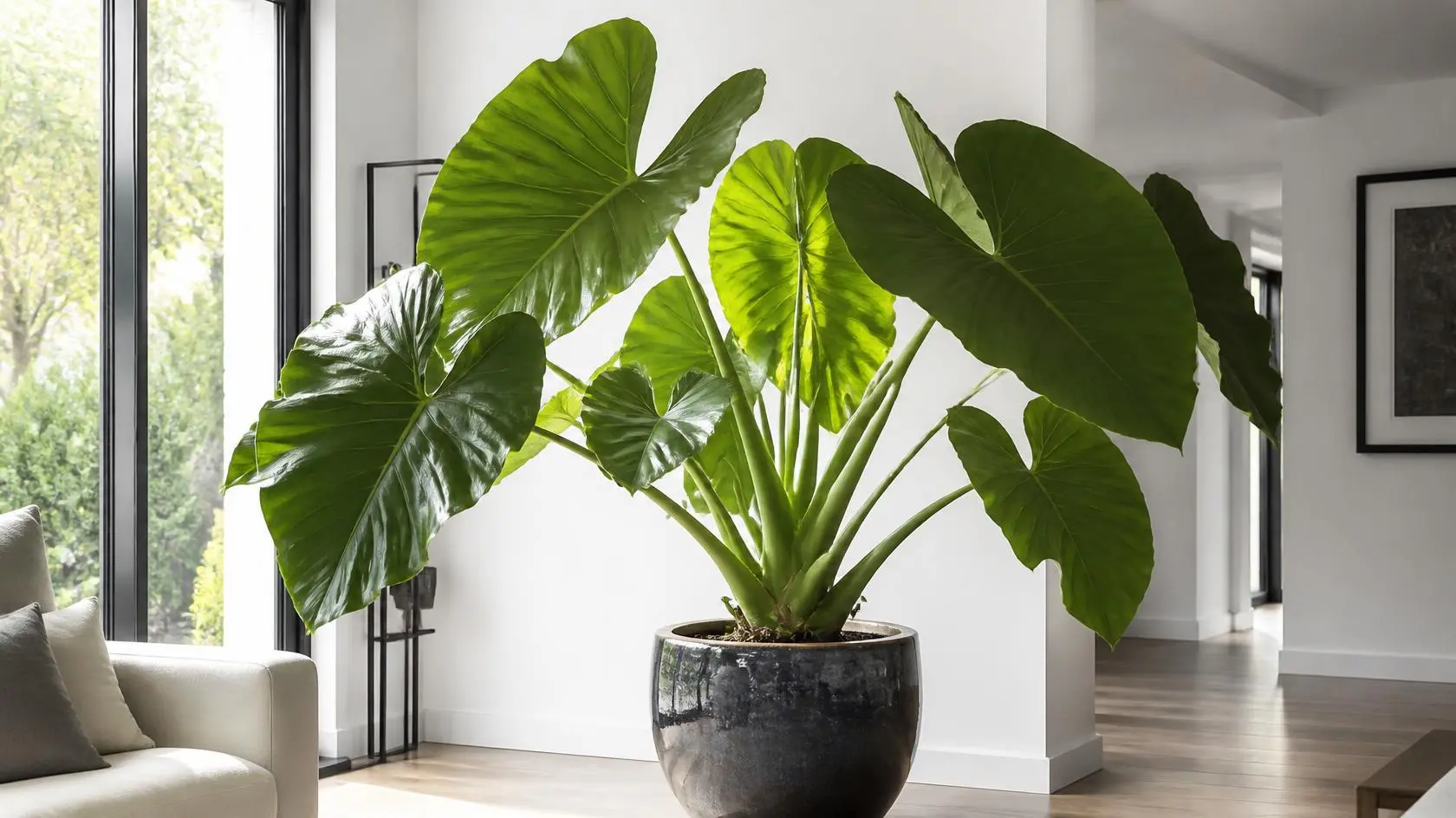
Alocasia macrorrhizos care indoors comes down to bright indirect light, warmth, generous watering in summer and a cool, dry winter rest. The Royal Horticultural Society says to grow it in peat-free houseplant compost with added grit, in bright, indirect light, to water freely and feed every 2 to 3 weeks from spring to autumn, to provide high humidity, and in winter to cut watering to a minimum and keep it above 15°C (59°F). Often sold as giant taro or upright elephant ear, it is one of the largest alocasias, and it is toxic to people and pets if eaten.
| Need | What the sources say |
|---|---|
| Light | Bright, indirect; strong sun can scorch the leaves (RHS). Outdoors, part shade or filtered sun; leaves often scorch in full sun (Missouri Botanical Garden) |
| Water | April to October, water when the top 5 cm (2 in) is dry; in winter reduce to a minimum (RHS) |
| Temperature | At least 16°C (60°F) in the growing season; never below 10°C (50°F) (RHS alocasia guide); species page: above 15°C in winter |
| Humidity | Medium to high: pebble tray, grouping, bathroom or humidifier (RHS) |
| Soil | Peat-free houseplant compost with horticultural grit, about 3 parts compost to 1 part grit (RHS) |
| Feeding | General liquid fertilizer every 2 to 3 weeks, spring to autumn (RHS species page) |
| Pets | Toxic to dogs, cats and horses: insoluble calcium oxalates (ASPCA) |
Sources: RHS Alocasia macrorrhizos and RHS alocasia growing guide; Missouri Botanical Garden; ASPCA.
What Is Alocasia macrorrhizos?
Alocasia macrorrhizos (sometimes spelled macrorrhiza) is a large rhizomatous perennial in the arum family. The Missouri Botanical Garden lists common names including giant elephant’s ear, giant taro and cunjevoi, and says it has naturalized over large tropical areas from India to Southeast Asia and Malaysia, so its exact original range is unclear. The RHS gives its range as central Malesia to northeast Australia.
It is grown for its huge, upright leaves and, in the tropics, as a food crop. The Missouri Botanical Garden explains that its rhizomes and stem pith have long been eaten as a starchy vegetable, but only after cooking, usually boiling, to remove the calcium oxalates that make raw parts inedible.
Giant taro vs taro. True taro is Colocasia esculenta. The easiest way to tell them apart, according to the Missouri Botanical Garden, is leaf position: Alocasia leaves point skyward on rigid stems, while Colocasia leaves droop and point toward the ground.
Variegated forms. Variegated plants sold as ‘Variegata’, ‘Camouflage’ or ‘Albo’ have white, cream or mottled sections with no chlorophyll. They grow more slowly than the green form, need the bright end of the light range, and, like other variegated plants, can throw all-green growth; the RHS advises removing reverted shoots so they don’t take over.
Light
The RHS alocasia guide says alocasias grow best in bright but indirect light, that strong sunlight can scorch the foliage, and that they survive in lower light but grow much more slowly. The Missouri Botanical Garden adds two useful signs: leaves often scorch in full sun, and in too much shade the petioles weaken and can’t hold the leaves up.
Indoors, a spot near an east window, or a little back from a south or west window behind a sheer curtain, works well. Turn the plant slightly each time you water, as the RHS suggests, so it doesn’t lean toward the light and become lopsided and unstable. In dim rooms a grow light helps; see our grow light guide.
Soil and Pots
The RHS recommends peat-free houseplant compost or peat-free multipurpose compost with horticultural grit for drainage, about three parts compost to one part grit. Outdoors, the Missouri Botanical Garden says it grows in moist to wet, organically rich soils. In a pot, the goal is a mix that holds moisture for a thirsty plant but still drains; our aroid soil mix guide explains how bark, perlite and grit change that balance.
Repot in spring every couple of years, when roots are crowded, going up only about 5 cm (2 in) in pot diameter each time to avoid overpotting (RHS). If the mix starts drying out very fast after watering, the plant is probably pot-bound. The RHS suggests a heavy terracotta pot for larger alocasias, for stability; tall leaves make a light plastic pot easy to tip over.
Watering
From April to October, the RHS says to water as needed once the top 5 cm (2 in) of compost has dried, and the species page says to water freely while in growth. Water thoroughly until it drains, then empty the saucer. A large plant in a warm, bright room can need water often in summer; check the soil rather than following a calendar.
In winter, when the plant slows down or goes dormant, the RHS says to reduce watering to a minimum, and warns that overwatering, especially while dormant, can cause the roots to rot. Room-temperature water is gentler on roots than cold water. If you are not sure whether a plant is too wet or too dry, see our overwatered vs underwatered guide.
Temperature and Humidity
The RHS alocasia guide gives two limits: at least 16°C (60°F) during the growing season, and above 10°C (50°F) at all times, with cooler, drier conditions in winter to allow dormancy. The species page asks for a little more warmth in winter (above 15°C). Keep the plant out of cold drafts, which the RHS lists as damaging, and away from heating vents.
Alocasias like medium to high humidity in the growing season, and the RHS notes low humidity can brown leaf edges and attract red spider mites. Its suggestions: stand the pot on a tray of gravel or clay granules with water just below the surface, group plants together, grow it in a bathroom, or use a humidifier. Our VPD guide explains why warm, dry rooms pull water from big leaves so quickly.
Feeding
The RHS species page recommends a general liquid fertilizer every 2 to 3 weeks from spring to autumn, and the RHS alocasia guide says to feed during the growing season, April to October, at the dose rate on the package, to fuel the production of large leaves. Stop feeding in winter. In lower indoor light, growth is slower, so err on the light side; if a white crust appears on the soil or leaf edges brown, flush the pot with plain water (see our fertilizer salt guide).
Propagation
The RHS lists two methods for this species: division of rhizomes in spring, or sowing ripe seed at 23°C. For most growers, division or offsets are the practical route. The RHS alocasia guide says the easiest way is to separate and pot up offsets (small plants at the base of mature plants) in spring, or to divide the fleshy rhizome in late spring or early summer.
- Put on gloves: the sap can irritate skin (RHS).
- Unpot the plant in spring and find offsets or natural divisions of the rhizome.
- Cut them away with a clean knife, keeping as much root as possible with each piece.
- Pot each piece in gritty, peat-free compost.
- Keep them warm and in good light; they soon produce new shoots (RHS). Water lightly until growth starts.
Alocasias do not grow from leaf cuttings. For a smaller alocasia that is propagated the same way, see our Alocasia Polly care guide.
How Big Does It Get?
Outdoors in the right climate it is huge. The Missouri Botanical Garden gives 12 to 15 feet tall and 6 to 10 feet wide in optimum conditions, with leaves 3 to 6 feet long, and lists it as winter hardy in USDA Zones 9 to 11. In a pot it stays much smaller: the RHS lists a maximum height and spread of 1.5 to 2.5 metres (about 5 to 8 feet), and its alocasia guide says it can reach 1.5 m (5 ft) indoors.
In cold climates, the Missouri Botanical Garden suggests growing it in a container that goes outside after the last frost and comes back in before the first fall frost, overwintering it in a sunny, humid but cool spot (around 60 to 65°F) with less water.
Why Is It Dropping Leaves?
| What you see | Likely cause | What to do |
|---|---|---|
| One or two oldest leaves yellow as new ones appear | Normal turnover | Cut the old leaf off at the base, with gloves (RHS) |
| Several leaves lost in autumn or winter | Dormancy; the RHS says losing some foliage then is nothing to worry about | Keep it cooler and drier; it regrows in spring |
| Yellowing with wet soil, soft stem base | Overwatering, root rot (RHS) | Let it dry more; check the rhizome and roots |
| Brown, crispy edges | Low humidity (RHS) or salt buildup | Raise humidity; flush the soil |
| Dark, damaged leaves after a cold night | Cold or drafts (RHS) | Move it away from cold windows and doors |
| Floppy leaf stalks | Too much shade (Missouri Botanical Garden) | Move it somewhere brighter |
For yellowing in general, see our yellow leaves guide; for rot rescue, our root rot treatment guide.
Pests
The RHS says this species may be susceptible to mealybugs and glasshouse red spider mite, and that red spider mites thrive in dry air. Check leaf undersides for fine webbing and pale speckling (spider mites) and leaf bases for white cottony clusters (mealybugs). Isolate an affected plant, wipe or rinse the leaves, raise humidity, and treat early. Our rubbing alcohol for mealybugs guide covers spot treatment, and our neem oil guide explains what neem can and can’t do.
Is It Toxic to Pets and People?
Toxic if eaten; irritant sap
The ASPCA lists Alocasia (elephant’s ear) as toxic to dogs, cats and horses because of insoluble calcium oxalates, with signs including oral irritation, pain and swelling of the mouth, tongue and lips, excessive drooling, vomiting and difficulty swallowing. The RHS rates Alocasia macrorrhizos as toxic if eaten, a skin and eye irritant and toxic to pets, and recommends gloves when handling. If a pet chews it, call your vet or the ASPCA Animal Poison Control Center at (888) 426-4435.
The plant is eaten in the tropics, but only after cooking to remove the calcium oxalates (Missouri Botanical Garden). Do not eat a houseplant: ornamental plants are not grown as food and may have been treated with pesticides. Keep it out of reach of pets and children, wear gloves when cutting leaves or dividing, and wash hands and tools afterwards. For pet-friendly alternatives, see our cat-safe plants guide.
Frequently Asked Questions
How much light does Alocasia macrorrhizos need?
Bright, indirect light. The RHS warns strong sun can scorch the leaves, and the Missouri Botanical Garden notes leaves often scorch in full sun outdoors and the stalks weaken in too much shade.
How often should I water Alocasia macrorrhizos?
From April to October, whenever the top 5 cm (2 in) of compost is dry (RHS). In winter, water only minimally; overwatering a dormant plant can rot the roots.
Why are my Alocasia macrorrhizos leaf edges turning brown?
Usually low humidity, which the RHS says causes browning on leaf edges and attracts red spider mites. Salt buildup from feeding can also brown edges. Raise humidity and flush the soil with plain water.
Is Alocasia macrorrhizos the same as taro?
No. It is called giant taro, but true taro is Colocasia esculenta. Alocasia leaves point upward on rigid stems; Colocasia leaves droop toward the ground (Missouri Botanical Garden).
How big does Alocasia macrorrhizos get indoors?
The RHS gives a maximum of 1.5 to 2.5 metres (about 5 to 8 feet) in height and spread. Outdoors in the tropics it can reach 12 to 15 feet (Missouri Botanical Garden).
Does Alocasia macrorrhizos go dormant?
It slows down in winter. The RHS recommends cooler, drier conditions above 10°C (50°F) so alocasias can go dormant, and says some leaf loss then is nothing to worry about.
Is Alocasia macrorrhizos toxic to cats and dogs?
Yes. The ASPCA lists Alocasia as toxic to dogs, cats and horses because of insoluble calcium oxalates, which cause mouth pain, drooling, vomiting and difficulty swallowing.