
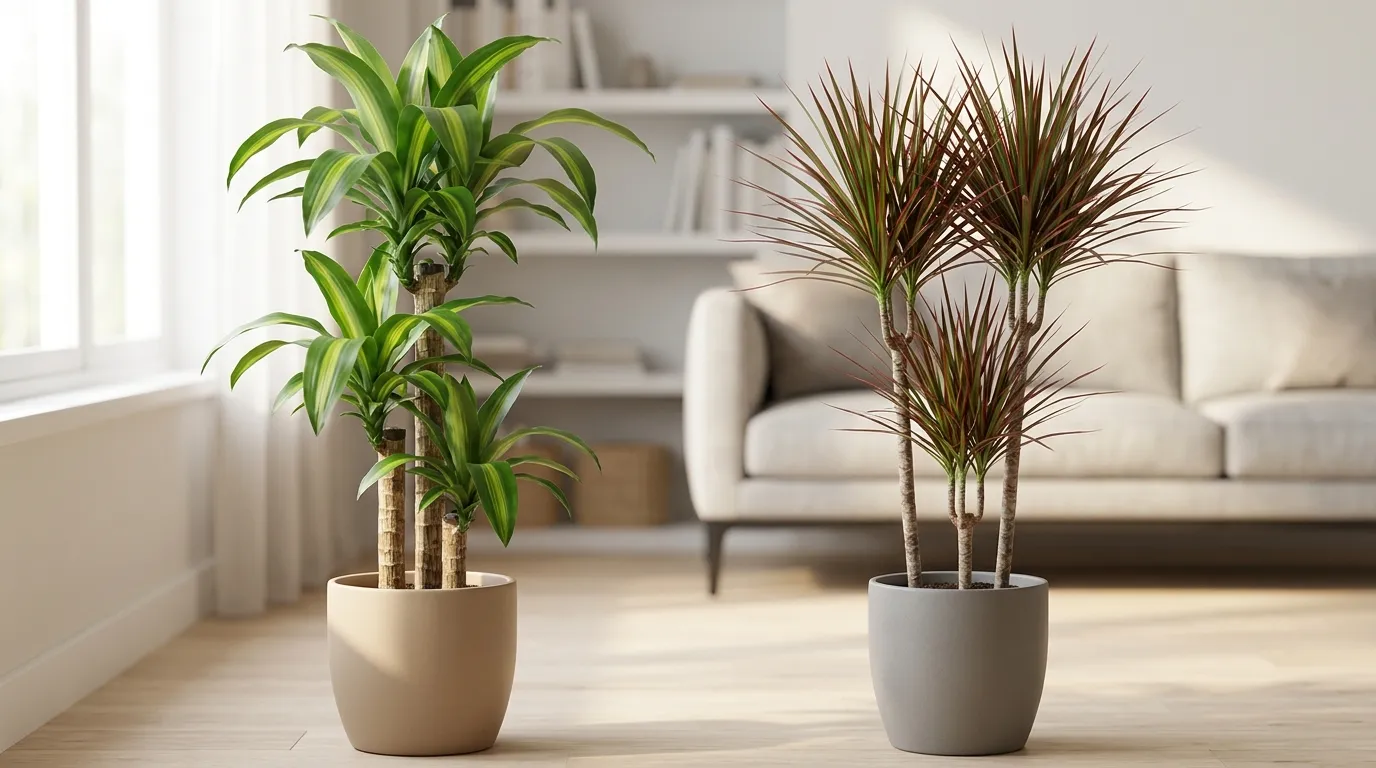
Dracaenas are some of the most common indoor plants: the corn plant (Dracaena fragrans), the dragon tree (D. marginata), ‘Janet Craig’, ‘Warneckii’ and pleomele (D. reflexa). They are easy-going, tolerate lower light, and can grow from desk size to 10 feet tall. Dracaena care indoors comes down to bright, indirect light, letting the mix dry slightly between waterings, steady warmth, and avoiding the fluoride and fertilizer salts that brown their leaf tips. This guide follows Clemson HGIC, the RHS and the ASPCA.
Common Types of Dracaena
| Type | Description (Clemson HGIC) |
|---|---|
| Corn plant (D. fragrans) | Named for leaves that resemble sweet corn |
| Dragon tree (D. marginata) | Thin stems topped with slender arching leaves with narrow purple margins |
| ‘Janet Craig’ | Dark green leaves; can grow up to 10 feet tall |
| ‘Warneckii’ | One of the best variegated plants for low light |
| Pleomele (D. reflexa) | Flexible stems |
Source: Clemson HGIC 1504, Dracaena. Clemson says dracaenas grow 2 to 10 feet tall depending on cultivar.
Two other well-known plants are now classed as dracaenas: lucky bamboo (D. sanderiana; see our lucky bamboo guide) and the snake plant (D. trifasciata; see our snake plant guide). Their care is different, so this guide covers the cane and tree-type dracaenas above.
Dracaena Care at a Glance
| Need | What the sources say |
|---|---|
| Light | Bright, indirect; tolerates lower light (Clemson); no direct summer sun (RHS) |
| Water | When the top 5 cm (2 in) is dry (RHS); dry slightly, then water thoroughly, not with cold water (Clemson) |
| Water quality | Rainwater or filtered water; fluoride browns tips (RHS, Clemson) |
| Temperature | 18 to 30°C (65 to 86°F) (RHS); 60 to 70°F days, nights about 10°F cooler (Clemson) |
| Humidity | Humid air preferred; gravel tray, grouping, misting (RHS, Clemson) |
| Feeding | April to October (RHS); monthly in spring and summer (Clemson); avoid superphosphate (Clemson) |
| Repotting | Every 2 to 3 years in spring, one size up (RHS) |
| Pets | Toxic to dogs and cats: saponins (ASPCA) |
Sources: Clemson HGIC 1504; RHS How to grow dracaena; ASPCA.
Light
Clemson HGIC says most dracaenas grow best in bright, indirect light but many tolerate lower light, and that moving a plant from dim light to a brighter spot produces thicker, stronger new leaves. ‘Warneckii’ is one of the best variegated plants for low light. The RHS recommends bright but indirect light and warns that direct summer sun can scorch the leaves. A spot near an east window, or set back from a south or west window, suits most types. See our north-facing window plants guide for low-light rooms.
Watering and Water Quality
The RHS says to water only once the top 5 cm (2 in) feels dry, and warns that overwatering or leaving the plant sitting in water can cause root rot. Clemson says to let the plant dry slightly between waterings, then water thoroughly, and to avoid cold water; it notes root rot usually comes from a poorly draining mix or watering too often. Water less in winter, when growth slows.
Fluoride: Clemson says dracaena is very sensitive to fluoride, which yellows or scorches leaf tips and margins. The RHS recommends rainwater or filtered water because tap water is often alkaline and can contain fluoride. If your plant keeps getting brown tips, switching water is the first thing to try.
Temperature and Humidity
The RHS suggests a consistently warm spot at 18 to 30°C (65 to 86°F), away from cold draughts and radiators. Clemson gives normal house temperatures of 60 to 70°F by day, with nights about 10°F cooler. Clemson notes that sudden temperature changes and drafts can cause leaf loss.
The RHS says these tropical plants enjoy humid air and suggests a tray of moist gravel, grouping plants and occasional misting. Clemson says dry tips and edges usually point to low humidity and suggests misting when indoor humidity drops below 30 to 40 percent. See our guide to dry indoor air.
Soil, Repotting and Feeding
Soil: the RHS suggests a loose, fast-draining but moisture-retentive, loam-free ericaceous mix, for example three parts peat-free ericaceous compost, one part perlite and one part medium orchid bark. Clemson says a standard houseplant potting mix works, but to avoid mixes with a high percentage of perlite (because perlite can supply fluoride) and to keep the soil pH at 6.0 to 6.5.
Repotting: the RHS says to repot in spring into a slightly larger pot once the roots are overcrowded, about every two to three years, one pot size up, and not to overpot.
Feeding: the RHS suggests a general liquid houseplant fertilizer from April to October; Clemson suggests a liquid foliage plant fertilizer monthly in spring and summer, or time-release pellets. Both warn against overfeeding, which can burn leaf tips and damage roots. Clemson says to avoid superphosphate fertilizers, which often contain high levels of fluorine.
Pruning a Leggy Dracaena
Tall, bare canes are common on older plants. Clemson says to cut stems back to the height you want, and new leaves will soon appear; the RHS notes that dracaenas readily produce new shoots on the stem just below the cut. Use clean, sharp pruners, and keep the top you cut off for propagation.
Dracaena Propagation
- Tip or stem cuttings: Clemson lists tip and stem cuttings; the RHS suggests semi-ripe or hardwood cuttings in summer with bottom heat from a propagator.
- Air layering: Clemson lists air layering, useful for rooting the top of a tall cane while it is still attached.
- Basal shoots: Clemson suggests rooting shoots from the base in spring or late summer.
See our sphagnum moss propagation guide for a reliable rooting method.
Brown Tips, Yellow Leaves and Pests
| Symptom | Likely cause | Source |
|---|---|---|
| Brown, dying leaf tips | Fluoride, over- or underwatering, dry air, cold drafts, heat, sun scorch, heavy feeding | RHS, Clemson |
| Sudden leaf loss | Temperature changes, drafts, poor drainage, heavy pest infestations | Clemson |
| Root rot, wilting | Poorly draining mix or watering too often | Clemson, RHS |
| Weak, thin new leaves | Too little light | Clemson |
| Mottled leaves, poor growth | Spider mites, mealybugs, scale | RHS, Clemson |
Sources: RHS; Clemson HGIC 1504.
Older lower leaves on cane dracaenas yellow and drop slowly as the plant grows; that is normal as long as new leaves at the top look healthy. For pests, see our spider mite guide and mealybug guide.
Is Dracaena Toxic to Cats and Dogs?
Yes. The ASPCA lists dracaena (corn plant, cornstalk plant, dragon tree, ribbon plant) as toxic to dogs and cats because of saponins, with vomiting (occasionally with blood), depression, loss of appetite, drooling and, in cats, dilated pupils. The RHS also says all parts are toxic. Keep it out of reach and call your veterinarian or the ASPCA Animal Poison Control Center at (888) 426-4435 if a pet chews it. See our cat-safe plants list.
For other indoor trees and shrubs, see our guides to bird of paradise. For more easy houseplants, see our list of the 10 best low-maintenance indoor plants. Have a dog? See our list of plants safe for dogs. For other indoor trees and shrubs, see our guides to croton care. It can also be grown as a kokedama; see our guide to kokedama moss balls.
Frequently Asked Questions
How much light does a dracaena need?
Bright, indirect light is best, but many dracaenas tolerate lower light (Clemson). Keep them out of direct summer sun (RHS).
How often should I water a dracaena?
When the top 5 cm (2 in) of the mix is dry (RHS), watering thoroughly and draining well. Water less in winter.
Why are my dracaena leaf tips turning brown?
Often fluoride in tap water, which dracaenas are very sensitive to (Clemson), or dry air, irregular watering or overfeeding (RHS). Try rainwater or filtered water and raise the humidity.
Can I cut the top off a tall dracaena?
Yes. Cut the cane to the height you want; new shoots grow just below the cut (Clemson, RHS), and the top can be rooted as a cutting.
How do you propagate a dracaena?
By tip or stem cuttings, air layering, or rooting basal shoots (Clemson).
Is dracaena toxic to cats?
Yes. The ASPCA lists dracaena as toxic to cats and dogs because of saponins.