
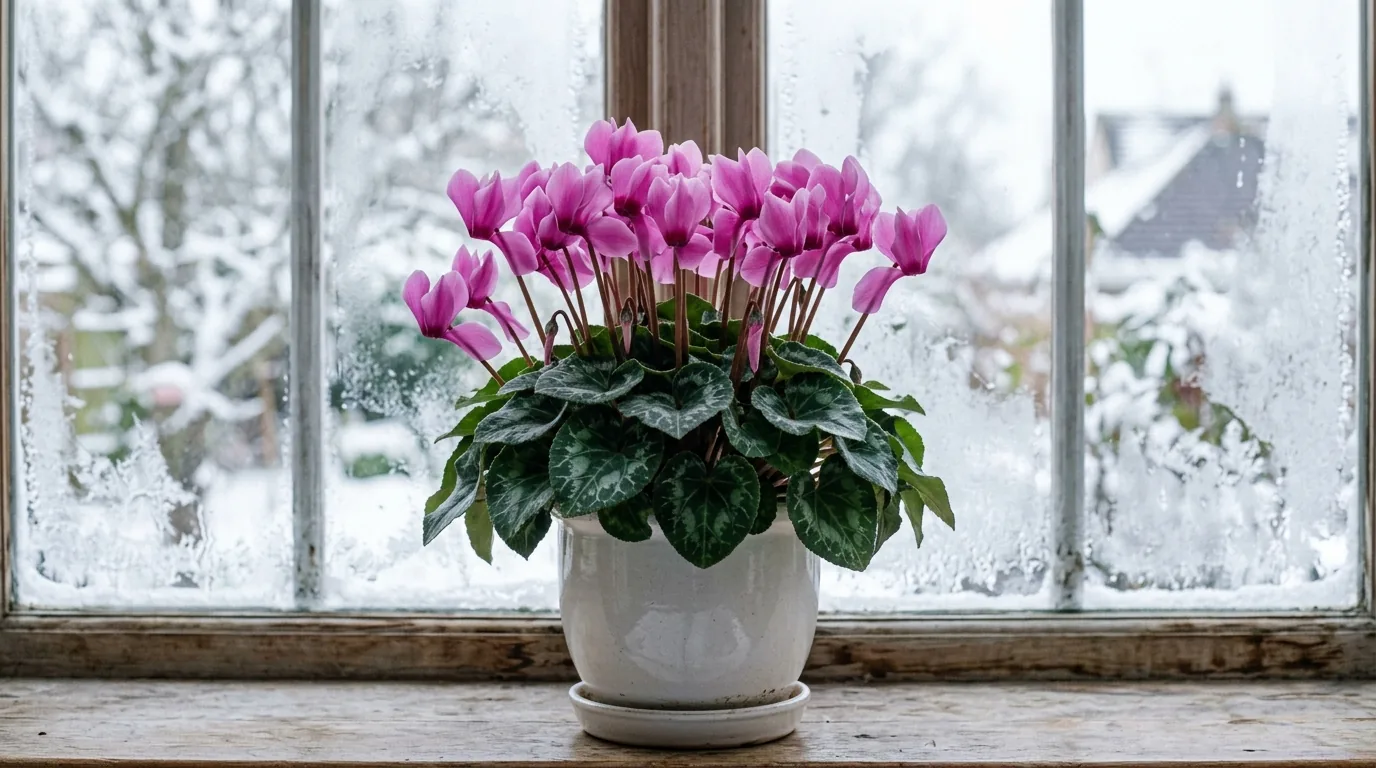
Florist cyclamen (Cyclamen persicum) is the winter-blooming pot plant with swept-back flowers over marbled, heart-shaped leaves. It is easy to keep in bloom for months and just as easy to lose in a week, because it hates the two things most homes have in winter: warm rooms and a tendency to overwater. Cyclamen care indoors comes down to a cool, bright spot, careful watering that keeps the tuber dry, and knowing that yellowing leaves in spring usually mean dormancy, not death. This guide follows Iowa State, UW-Madison, University of Maryland Extension, the New York Botanical Garden and the ASPCA.
Cyclamen Care at a Glance
| Need | What the sources say |
|---|---|
| Temperature | 60 to 65°F days, about 50°F nights (UW-Madison); 50 to 60°F (Iowa State); 55 to 65°F days, 50 to 55°F nights (NYBG) |
| Light | Bright, indirect; an east window often works (UW-Madison, UMD) |
| Water | When the surface is dry; from below or at the rim, never on the crown (all sources) |
| Humidity | High while flowering; pebble tray, away from warm drafts (UW-Madison); above 50% (NYBG) |
| Feeding | Every two weeks while growing and blooming; low-nitrogen bloom fertilizer (UW-Madison) or half strength (UMD) |
| Bloom length | Up to three months in winter or early spring (UW-Madison) |
| Dormancy | Late spring to summer; dry rest of about 6 to 8 weeks (Iowa State, UMD, NYBG) |
| Pets | Toxic to dogs, cats and horses (ASPCA) |
Sources: UW-Madison Extension (2025); Iowa State Extension (2022); University of Maryland Extension (2022); NYBG (2026); ASPCA.
Temperature: Why Cool Matters
The sources agree that temperature makes or breaks a florist cyclamen. UW-Madison Extension gives an ideal of 60 to 65°F during the day and around 50°F at night, and says keeping the plant cool extends both the life of each flower and the whole blooming season. University of Maryland Extension adds that warmer temperatures shorten flowering and signal the plant to go dormant, and the NYBG notes that buds may fail to open in a room that is too warm.
In practice that means the coolest bright room in the house, away from radiators, heat vents and warm drafts. A cool windowsill, a bright unheated porch that stays above freezing, or a spare bedroom with the heat turned down all work. Modern hybrids tolerate a wider range than older types (UW-Madison), but none of them like a warm living room.
Light
All the sources recommend bright, indirect light. UMD and UW-Madison suggest an east-facing window; in northern winters a south window may be better (UW-Madison). The NYBG warns that strong sun scorches the leaves, so if the only bright spot is a south window, set the plant back from the glass. UW-Madison lists low light among the causes of yellow leaves and buds that fail to open.
How to Water Cyclamen
Cyclamen grows from a flattened tuber that sits at the soil surface, and the center of that tuber, the crown, rots easily if it stays wet. Every source says the same thing: keep water off it.
- Check the soil. Water when the surface feels dry (Iowa State, UW-Madison); Iowa State suggests checking daily, since a plant in bloom in a small pot dries quickly.
- Water from below or at the edge. UW-Madison and the NYBG suggest standing the pot in a bowl of water for about 15 minutes, then letting it drain. If you water from above, pour around the rim, away from the center (UMD, NYBG).
- Drain completely. Never leave the pot in a saucer of standing water (NYBG).
- Don’t let it wilt. UMD says to let the top dry, but not so far that the plant wilts. UW-Madison notes that soft foliage means it needs water; firm, upright leaves are the goal.
Iowa State suggests room-temperature water. If bottom watering is new to you, our bottom watering guide walks through it.
Feeding, Humidity and Deadheading
- Feeding: every two weeks while the plant is growing and in bloom. UW-Madison suggests a low-nitrogen fertilizer or a houseplant food for flowering plants and warns that too much fertilizer makes soft, lush growth that is more prone to disease; UMD suggests half strength once the leaves are fully developed.
- Humidity: UW-Madison says cyclamen needs high humidity while flowering and suggests a tray of wet gravel; the NYBG suggests keeping it above 50% with pebble trays or a humidifier. See our guide to dry indoor air.
- Deadheading: remove each spent flower with its whole stem. UW-Madison suggests twisting the stem and pulling sharply so it comes away cleanly from the base, rather than leaving a stub that can rot. The NYBG says to remove yellowed leaves the same way.
Why Are My Cyclamen Leaves Turning Yellow?
| What you see | Likely cause | What to do |
|---|---|---|
| Leaves yellow gradually in late spring after flowering | Normal dormancy (Iowa State, UW-Madison) | Start drying it off; see after flowering |
| Yellow leaves and buds that fail to open in winter | Too warm, hot dry air or low light (UW-Madison, NYBG) | Move it somewhere cooler and brighter, away from heat |
| Yellow leaves with wet, heavy soil; limp stems | Overwatering (UW-Madison, NYBG) | Let it dry more between waterings; water from below |
| Yellow leaves with soft, wilting foliage in dry soil | Underwatering (UW-Madison) | Water thoroughly from below |
| Rotting crown, collapsing center | Water on the crown, soggy mix (Iowa State, UW-Madison) | Usually fatal once advanced; prevent by watering at the rim or from below |
| Yellowing with insects or mites on the plant | Pests such as spider mites, aphids or cyclamen mites (UW-Madison) | See pests; discard plants with cyclamen mites |
Sources: UW-Madison Extension; Iowa State Extension; NYBG.
Cyclamen Care After Flowering
Many people treat florist cyclamen as a long-lasting bouquet and compost it once it finishes: Iowa State Extension calls it “best discarded after flowering,” and UMD says it is not easy to get it to flower a second time. But it can rebloom, and the method is simple:
- Dry it off. When the leaves start yellowing after flowering, usually in late spring, gradually reduce watering over several weeks and stop feeding. Stop watering once all the leaves have yellowed (NYBG, Iowa State).
- Rest it. Remove the dead leaves and keep the pot dry in a cool, shaded place, about 45 to 50°F (Iowa State) or about 50°F (NYBG), for 6 to 8 weeks. UMD suggests about two months without water, indoors somewhere cool or in a cool, shaded spot outdoors. UW-Madison describes an alternative: lift the tuber and store it in dry vermiculite at about 50°F for 6 to 12 weeks.
- Restart it in mid to late summer. Repot the tuber in fresh potting mix with the top half above the surface (UW-Madison, NYBG), then give it warmer conditions, about 50 to 65°F (Iowa State), and start watering again, lightly at first until it has enough leaves (NYBG).
- Grow it on. Keep it moist but not soggy, in bright light with high humidity, and feed regularly. Buds should form in fall or winter (Iowa State).
If you summer it outdoors, UW-Madison warns not to let the mix stay wet while the tuber is leafless, and to bring it inside before the first frost.
Pests and Diseases
- Cyclamen mites: tiny mites that the NYBG says can attack in warm, dry indoor conditions. UW-Madison says they are extremely difficult to control, so infested plants are best discarded. Cool nights and higher humidity help prevent them (NYBG).
- Aphids, mealybugs, spider mites and thrips: occasional pests (UW-Madison), controlled with insecticidal soap or a houseplant-labeled product. See our guides to aphids, spider mites and mealybugs.
- Crown rot: from excess moisture, especially water left on the crown (UW-Madison, Iowa State).
Florist Cyclamen vs Hardy Cyclamen
The cyclamen sold as a gift plant in winter is C. persicum, a tender species grown indoors. UW-Madison notes it is one of 23 species in the genus, native to parts of southern Europe, western Asia and North Africa. Some of the small species are hardy garden plants: the RHS recommends C. hederifolium (pink flowers in early autumn) and C. coum (flowers January to March) for partial shade outdoors, planted 3 to 5 cm deep. A florist cyclamen planted in the garden won’t survive a frost.
Is Cyclamen Toxic to Cats and Dogs?
Yes. The ASPCA lists cyclamen as toxic to dogs, cats and horses because of terpenoid saponins. Signs include drooling, vomiting and diarrhea, and after large amounts of the tuber, heart rhythm problems, seizures and death. Keep it, and any stored tubers, well away from pets, and call your veterinarian or the ASPCA Animal Poison Control Center at (888) 426-4435 if a pet eats some. For pet-safe winter flowers, the ASPCA lists the Christmas cactus as non-toxic; see our Christmas cactus guide and cat-safe plants list.
For more holiday plants, see our guides to amaryllis, paperwhites, Norfolk Island pine, kalanchoe and Christmas cactus care.
Frequently Asked Questions
How do you care for a cyclamen indoors?
Give it a cool room, about 60 to 65°F by day and 50°F at night, and bright, indirect light. Water from below when the surface dries, feed every two weeks, and keep it away from heat vents (UW-Madison).
How often should I water a cyclamen?
Whenever the surface of the mix feels dry, which can be every day or two in bloom; Iowa State suggests checking daily. Water from below or around the rim, never onto the crown, and never leave it standing in water.
Why is my cyclamen drooping?
Soft, drooping foliage in dry soil usually means it needs water (UW-Madison). Limp stems in wet soil point to overwatering (NYBG), and a warm room also shortens its life.
What do I do with my cyclamen after it flowers?
Either compost it or let it go dormant: reduce watering as the leaves yellow, rest the dry tuber somewhere cool for about 6 to 8 weeks, then repot and restart watering in mid to late summer (Iowa State, UMD, NYBG).
Do cyclamen come back every year?
Florist cyclamen can rebloom indoors after a summer rest, though UMD says it is not easy. Hardy garden species such as C. hederifolium and C. coum come back outdoors every year (RHS).
Is cyclamen poisonous to cats?
Yes. The ASPCA lists cyclamen as toxic to cats, dogs and horses; the tuber is the most dangerous part.
Sources
- Mahr, S. Cyclamen. UW-Madison Extension, Wisconsin Horticulture (updated 2025)
- Haynes, C. and Steil, A. All About Cyclamen. Iowa State University Extension (reviewed 2022)
- Carignan, C. How do I care for a cyclamen plant I received as a gift? University of Maryland Extension (updated 2022)
- New York Botanical Garden: Cyclamen (updated 2026)
- RHS: How to grow cyclamen
- ASPCA: Cyclamen