
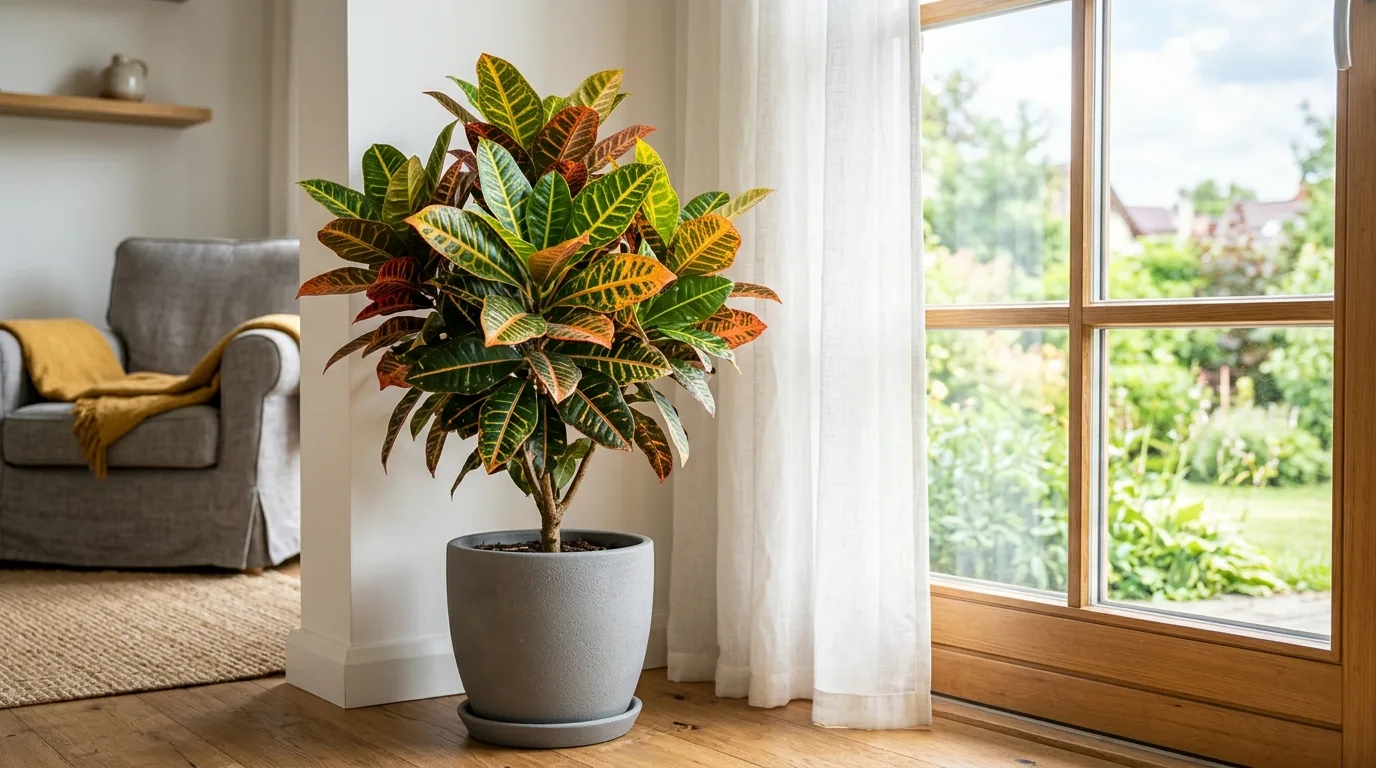
Croton (Codiaeum variegatum) is grown for its leathery leaves splashed with yellow, orange, red, pink, purple and green. It is a woody shrub in the spurge family; NC State Extension lists it as native to Malaysia, the Pacific islands and northern Australia, reaching about 3 feet indoors. Crotons have a reputation for being fussy, and most of that comes down to three things: light, steady warmth and even watering. This guide covers croton plant care indoor basics, croton care in pots, croton care in winter, pruning, propagation, pests and safety, following NC State, UW-Madison Extension, the RHS and Iowa State.
Croton Care at a Glance
| Need | What the sources say |
|---|---|
| Light | Bright, indirect light indoors (UW-Madison, RHS); bright light with some direct sun for best color (NC State) |
| Water | When the top 1/2 to 1 inch of soil is dry (UW-Madison); less in winter |
| Temperature | 60 to 85°F (UW-Madison); 65 to 95°F, not below 55°F (RHS) |
| Humidity | Moderate to high (UW-Madison); low to medium, a pebble tray helps (NC State) |
| Soil | Fertile, well-drained (UW-Madison); 3 parts peat-free ericaceous compost to 1 part grit (RHS) |
| Feeding | Once or twice in the growing season, or more for faster growth (UW-Madison) |
| Size | About 3 feet indoors (NC State); 30 to 90 cm (RHS) |
| Safety | All parts poisonous; milky sap irritates skin and eyes (RHS, NC State) |
Sources: UW-Madison Extension (2025); NC State Extension Plant Toolbox; RHS.
Light and Leaf Color
Light drives croton color. UW-Madison Extension says indoor plants need bright, indirect light, that low light makes the leaves revert to green, and that too much direct sun makes them gray and dull. The RHS agrees on bright, indirect light in summer and warns that full summer sun through glass can scorch the leaves. NC State leans sunnier: bright light with some direct sun for the best color, and it notes that a croton in too much shade may lose its lower leaves.
The practical middle: a bright east or west window, or near a south window with the harshest midday summer sun filtered. If the new leaves come out mostly green, it needs more light; if they look bleached or scorched, it needs less. In a dim room, a grow light can fill the gap.
Watering and Humidity
UW-Madison says to water only when the top half inch to an inch of soil has dried, and to water less in winter. NC State says to water liberally from spring to autumn and sparingly in winter, and the RHS suggests rainwater at room temperature, tipping away any excess. The key is consistency: UW-Madison notes that leaves drop if the plant stays too wet or too dry for extended periods, and the RHS lists waterlogged compost as the cause of root rot.
On humidity, UW-Madison says moderate to high, while NC State lists low to medium. Both NC State and the RHS suggest standing the pot on a tray of damp pebbles, and the RHS suggests wiping the leaves with a damp cloth now and then. Dry air also favors spider mites, croton’s worst pest (see below).
Not sure which way your watering is off? Our guide to overwatered vs underwatered plants covers the signs.
Croton Care in Pots: Soil and Repotting
Use a fertile, well-drained mix (UW-Madison). The RHS recipe is three parts peat-free ericaceous compost to one part grit, and NC State describes a well-drained, humus-rich soil that is occasionally dry. Always use a pot with drainage holes.
- When to repot: in spring, once roots are crowded. The RHS says every year or two while young, then every few years.
- Pot size: UW-Madison says move up only 1 to 2 inches larger; an oversized pot holds water around the roots.
- Summer outdoors: potted crotons can go outside once temperatures stay above 50°F and must come back in before they drop below it (UW-Madison).
Our step-by-step guide on how to repot a plant covers the method.
Temperature
Croton is a tropical shrub, hardy outdoors only in USDA zones 11 to 12 (UW-Madison, NC State). UW-Madison gives a best range of 60 to 85°F and says leaf drop occurs when temperatures stay below 50°F. The RHS gives 18 to 35°C (65 to 95°F) and says not to let it fall below 15°C (55°F). Both warn against cold drafts and sudden temperature swings.
Croton Care in Winter
Winter is when most crotons drop leaves. NC State says croton needs no true dormancy but appreciates a rest with reduced watering from fall to late winter, and the RHS notes that growth slows in winter’s lower light. A winter checklist:
- Bring outdoor plants in before nights fall below 50°F (UW-Madison); see our guide to bringing plants indoors for winter.
- Give it the brightest window you have, since light levels drop.
- Keep it away from cold glass, doors and heating vents.
- Water less often, but don’t let the soil stay dry for long.
- Skip fertilizer until spring growth starts.
For general cold-season advice, see our winter houseplant care guide.
Feeding
UW-Madison suggests fertilizing once or twice during the growing season, or more often if you want faster growth. Feed only in spring and summer, never a stressed plant, and follow the label rate.
Pruning and Propagation
If a croton gets leggy, UW-Madison suggests pruning hard in early spring, before new growth begins, to encourage branching. The RHS says to prune in spring, cutting just above a leaf joint with sharp secateurs. Wear gloves: the RHS warns that the white sap irritates skin and eyes, and NC State notes it permanently stains fabric.
Seed-grown crotons don’t resemble the parent, so named cultivars are propagated vegetatively (UW-Madison):
- Stem cuttings: softwood cuttings in summer (UW-Madison) or early summer (RHS). Iowa State Extension lists croton among plants for stem tip cuttings: 3 to 6 inches with at least two nodes, high humidity under a loose plastic cover, 65 to 75°F, and roots in 3 to 6 weeks.
- Air layering: in spring (UW-Madison). Iowa State lists croton for air layering: remove a 1-inch ring of bark 12 to 18 inches below a shoot tip, wrap it in moist sphagnum moss under plastic, and cut below the new roots once they are several inches long. Our guide to propagating in sphagnum moss has more on the moss.
Problems and Pests
| Symptom | Likely cause | What to do |
|---|---|---|
| Leaves dropping | Cold below 50°F, drafts, sudden temperature changes, soil too wet or too dry for long (UW-Madison); dry compost or air, below 55°F for long (RHS) | Steady warmth, even watering; see croton dropping leaves |
| New leaves mostly green, dull color | Too little light (UW-Madison) | Move to a brighter spot |
| Gray, dull or scorched leaves | Too much harsh direct sun (UW-Madison, RHS) | Filter midday summer sun |
| Lower leaves falling, plant leggy | Too much shade (NC State) | More light; prune in spring |
| Wilting with wet soil, dark roots | Root rot from waterlogged compost (RHS) | Let it dry; repot in a draining mix |
| Speckled, dull leaves, fine webbing | Spider mites (NC State, UW-Madison) | See how to get rid of spider mites |
| Silvery streaks, black specks | Banded greenhouse thrips (NC State) | See our thrips guide |
| White cottony clusters | Mealybugs (UW-Madison) | See how to get rid of mealybugs |
| Hard or waxy bumps on stems | Scale insects (UW-Madison) | See our scale guide |
Sources: UW-Madison Extension; NC State Extension; RHS.
NC State notes that spider mites are serious enough on croton to limit its long-term use in offices and other interiorscapes, so check the undersides of the leaves regularly.
Is Croton Toxic?
Yes, to a degree. The RHS says all parts are poisonous and that the white sap irritates skin and eyes. NC State rates its poison severity as low, names diterpene esters as the toxic principle, and says it is toxic only if large quantities are eaten, with nausea, vomiting and diarrhea; the sap can cause contact dermatitis, and repeated contact can lead to an allergic rash. UW-Madison also notes contact dermatitis in sensitive people.
The ASPCA’s plant database has no croton entry, so there is no ASPCA rating for cats and dogs. Given the other sources, keep it away from pets that chew plants, and call your veterinarian or the ASPCA Animal Poison Control Center at (888) 426-4435 if one eats it. For safer choices, see our lists of cat-safe plants and plants safe for dogs.
Frequently Asked Questions
How do you take care of a croton?
Give it bright, indirect light, keep it between about 60 and 85°F away from drafts, and water when the top half inch to inch of soil is dry (UW-Madison). Use a draining mix in a pot with holes, water less in winter and feed once or twice during the growing season.
Can a croton get direct sun?
Some. NC State says croton needs bright light with some direct sun for the best color, but UW-Madison says too much direct sun makes leaves gray and dull, and the RHS warns full summer sun through glass can scorch them. Morning or filtered sun is the safe middle.
Why is my croton losing its color?
Usually too little light: UW-Madison says low light makes croton leaves revert to green. Move it to a brighter spot; new leaves will show the change first.
How often should I water a croton?
When the top half inch to an inch of soil has dried (UW-Madison). There is no fixed interval; it will need water more often in warm, bright summer months and less in winter.
How do I care for a croton in winter?
Bring it indoors before nights fall below 50°F (UW-Madison), give it your brightest window, keep it away from cold glass and heating vents, water less often and stop feeding until spring.
Is croton toxic to cats and dogs?
The ASPCA has no croton entry. NC State lists all parts as poisonous with low severity (diterpene esters) causing nausea, vomiting and diarrhea if large amounts are eaten, and the RHS says all parts are poisonous, so keep it away from pets.
Can you grow croton outside in summer?
Yes. UW-Madison says potted crotons can go outside once temperatures stay above 50°F, in partial shade, and must come back in before they drop below 50°F.
Sources
- Mahr, S. UW-Madison Extension: Croton, Codiaeum variegatum (revised 2025)
- NC State Extension Gardener Plant Toolbox: Codiaeum variegatum
- RHS: How to grow codiaeum
- Steil, A. Iowa State University Extension: How to Propagate Houseplants by Stem Tip Cuttings (2025)
- Steil, A. Iowa State University Extension: How to Propagate by Air Layering and Simple Layering (2025)