
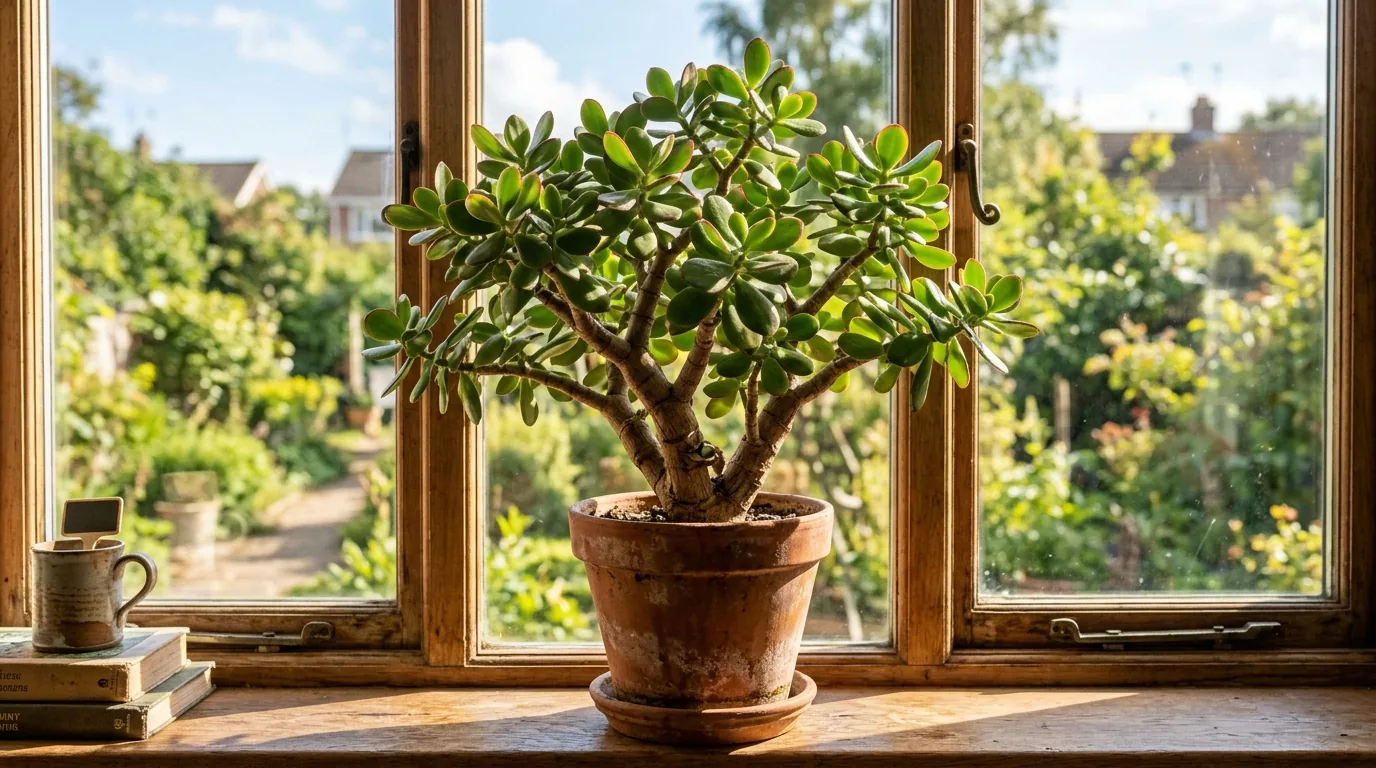
Jade plant (Crassula ovata, formerly Crassula argentea) is a slow-growing succulent shrub from South Africa with thick, glossy leaves on woody, branching stems. NC State Extension lists other names including jade tree, lucky plant and money plant, and the RHS says it can reach 1.5 to 2.5 metres in 5 to 10 years. UW-Madison notes that jades can be grown for many years, even root-bound. This guide covers jade plant care indoor basics: light, how often to water a jade plant, soil, feeding, pruning, jade plant propagation, getting it to flower, common problems and whether a jade plant is toxic to cats, following Clemson HGIC, UW-Madison, NC State, the RHS and the ASPCA.
Jade Plant Care at a Glance
| Need | What the sources say |
|---|---|
| Light | Four or more hours of direct sun a day (Clemson, UW-Madison); full light (RHS) |
| Water | Spring and summer: moist but not wet (Clemson), or water liberally and let it dry slightly (UW-Madison); winter: let it dry between waterings |
| Soil | Cactus or succulent mix (RHS, UW-Madison); Clemson’s mix is 1 part soil, 1 part peat moss, 3 parts coarse sand |
| Temperature | Days 65 to 75°F, nights 50 to 55°F (Clemson) |
| Feeding | From monthly in spring and summer (RHS) to every 3 to 4 months (Clemson) |
| Repotting | Every 2 to 3 years, as new growth starts (UW-Madison); can stay root-bound for years (Clemson) |
| Size | Up to 5 feet indoors (Clemson); 1.5 to 2.5 m in 5 to 10 years (RHS) |
| Pets | Toxic to dogs, cats and horses (ASPCA) |
Sources: Clemson HGIC 1507; UW-Madison Extension (2025); NC State Extension Plant Toolbox; RHS; ASPCA.
Light
Jade is a sun lover. Clemson HGIC recommends full sun or bright filtered light, such as a south-facing window, with at least four hours of direct sunlight a day, and UW-Madison Extension gives the same four hours while noting it tolerates bright indirect light. NC State suggests a sunny spot with some afternoon shade indoors. NC State also notes that leaf edges take on a red tint in direct sun.
UW-Madison says too little light gives deep green leaves and drooping stems. If you move a jade outdoors for summer, do it gradually to avoid sunburn and bring it back in before the first frost (UW-Madison); see our guide to bringing plants indoors for winter. A plant stretching toward a dim window can also be helped with grow lights.
How Often to Water a Jade Plant
No source gives a fixed number of days, because the right interval depends on light, temperature, pot size and season. What they agree on is the pattern:
| Season | Clemson HGIC | UW-Madison | RHS |
|---|---|---|---|
| Spring and summer (growing) | Keep soil moist but not wet | Water liberally, letting the soil dry slightly between waterings | Water lightly |
| Winter (resting) | Let the soil dry between waterings | Restrict watering; keep the soil on the dry side | Water very sparingly |
Sources: Clemson HGIC 1507; UW-Madison Extension; RHS.
So check the soil rather than the calendar: water thoroughly when the mix has dried, let the excess drain away, and never leave the pot standing in water. Clemson also advises avoiding splashing water on the leaves. Overwatering causes leaf drop and stem rot (UW-Madison), and root rot comes from slow-draining soil or watering too often (Clemson).
Underwatering shows up too. Clemson says leaf drop can occur if the plant becomes extremely dry, and long drought causes dwarfing, spotted leaves and eventually death. Wrinkled or shriveled leaves can mean either thirst or a damaged root system; our guide to jade plant wrinkled leaves shows how to tell which.
Soil, Pots and Repotting
Use a fast-draining mix. The RHS recommends cactus compost, and UW-Madison a well-drained, high-porosity succulent or cactus mix, or a standard mix with extra perlite or sharp sand. Clemson gives two options: cactus mix with added organic matter, or 1 part sterilized soil, 1 part sphagnum peat moss and 3 parts coarse sand by volume.
- Pot: always with drainage holes. Clemson suggests moving older, top-heavy plants into a large, heavy pot so they don’t tip over.
- When to repot: UW-Madison says every two to three years, or when the plant is top-heavy, ideally as new growth starts. Clemson notes jades can stay root-bound for years.
- Same pot: if you repot into the same size, UW-Madison suggests pruning the roots.
- After repotting: Clemson says let the soil dry, and UW-Madison says water sparingly until the plant is established. Clemson also waits 4 months before feeding a repotted plant.
Our step-by-step guide on how to repot a plant covers the method.
Temperature
Clemson gives 65 to 75°F during the day and 50 to 55°F at night, and suggests keeping the plant away from drafts and keeping the leaves off cold windowpanes in winter. UW-Madison says jade tolerates a wide range of temperatures and may survive a light frost, but freezing kills it. The RHS rates it H2, tolerant of low temperatures but not of being frozen. Cool winter nights are fine and, as shown below, they help with flowering. For general winter advice, see our winter houseplant care guide.
Feeding
Jade plants grow slowly and need little fertilizer, but the recommended frequency varies:
| Source | How often to fertilize |
|---|---|
| Clemson HGIC | Every 3 to 4 months with a liquid houseplant fertilizer |
| UW-Madison Extension | Every two months during active growth, or a dilute fertilizer more often |
| RHS | Monthly from spring to summer with a general liquid fertilizer |
Sources: Clemson HGIC 1507; UW-Madison Extension; RHS.
Whichever you follow, feed only while the plant is actively growing and skip winter.
Pruning
UW-Madison says spring is the best time to prune, cutting stems back to a lateral branch. The cuts heal in a few days and new growth appears within a few weeks. Pruning keeps an old plant from becoming top-heavy, and every piece you remove can become a new plant.
Jade Plant Propagation
Jade is one of the easiest succulents to propagate. NC State says it is easily done by leaf cuttings, and stem cuttings also work. UW-Madison says cuttings can be taken any time of year but root most easily in summer; the RHS suggests spring.
- Take a stem cutting, or twist off a healthy, plump leaf whole.
- Let the cut pieces dry for a few days so the cut end heals before planting (UW-Madison).
- Set them in a fast-draining succulent or cactus mix in a pot with drainage holes.
- Keep them in bright light and water sparingly; UW-Madison says roots form in a few weeks under mild conditions.
For more on rooting succulents, see our guide on how to grow succulents, and for another easy succulent to multiply, our guide to snake plant propagation.
How to Get a Jade Plant to Flower
NC State says jade rarely blooms as a houseplant, but mature plants can produce clusters of small, star-shaped white or pink flowers in winter (Clemson). UW-Madison explains that flowering is triggered by long nights and shortening days. Its method:
- In fall, withhold water.
- Keep the plant cool, around 55°F, especially at night.
- Give it no supplemental light in the evening.
- After several weeks of this cold, dry, dark treatment, resume regular watering.
It works on the same short-day principle as holiday plants; see our guides to Christmas cactus not blooming and kalanchoe care, a relative in the same family.
Problems and Pests
| Symptom | Likely cause | What to do |
|---|---|---|
| Leaves dropping, soil wet, soft or dark stems | Overwatering: leaf drop, stem rot, root rot (UW-Madison, Clemson, NC State) | Let the mix dry; check roots; repot in a draining cactus mix |
| Leaves dropping, soil bone dry | Extreme dryness (Clemson) | Water thoroughly, then follow the seasonal pattern above |
| Wrinkled or shriveled leaves | Thirst or damaged roots | See our wrinkled leaves guide |
| Deep green leaves, drooping or stretched stems | Too little light (UW-Madison) | Move to a sunnier window, gradually |
| Dead patches on leaves | Leaf burn from sun, insecticide or frost (UW-Madison) | Damaged leaves fall and new ones sprout; acclimate to sun slowly |
| White, cottony clusters in leaf joints | Mealybugs, the most common pest (Clemson) | Wipe off with rubbing alcohol on a cotton swab (Clemson, UW-Madison) |
| Speckled, dull, dusty-looking leaves | Spider mites (Clemson) | See our guide on how to get rid of spider mites |
Sources: Clemson HGIC 1507; UW-Madison Extension; NC State Extension.
NC State also lists aphids and scale as occasional pests, and the RHS adds vine weevils.
Is Jade Plant Toxic to Cats and Dogs?
Yes. The ASPCA lists jade plant as toxic to dogs, cats and horses. The toxic principle is unknown, and the clinical signs are vomiting, depression and incoordination. So if you were wondering whether a jade plant is toxic to cats, the answer is yes: keep it where pets can’t chew it, and call your veterinarian or the ASPCA Animal Poison Control Center at (888) 426-4435 if they do. For alternatives, see our lists of cat-safe plants and plants safe for dogs.
Note that “money plant” is a shared nickname: NC State lists it for jade, but it is also used for other plants, including the money tree (Pachira), which needs very different care.
For other succulents, see our guides to ponytail palm care. Jade can also be grown from a single leaf; see our guide to leaf propagation.
Frequently Asked Questions
How often should you water a jade plant?
There is no fixed schedule. In spring and summer, water when the soil has dried slightly (UW-Madison) and keep it moist but not wet (Clemson); in winter, let the soil dry between waterings and water very sparingly (RHS).
Does a jade plant need direct sunlight?
It does best with it. Clemson and UW-Madison recommend at least four hours of direct sun a day; UW-Madison says it tolerates bright indirect light but too little light gives drooping stems.
Why are my jade plant leaves falling off?
Usually from watering problems. Overwatering causes leaf drop and stem rot (UW-Madison), and Clemson says leaves also drop if the plant gets extremely dry. Check the soil and roots to see which.
How do you propagate a jade plant?
Take a stem cutting or a whole leaf, let it dry for a few days so the cut heals, then set it in a fast-draining succulent mix. UW-Madison says roots form in a few weeks and cuttings root most easily in summer.
Is jade plant toxic to cats?
Yes. The ASPCA lists jade plant as toxic to cats, dogs and horses; the toxic principle is unknown and signs include vomiting, depression and incoordination.
How do I get my jade plant to bloom?
Mature plants bloom in winter after a cool, dry, dark period. UW-Madison suggests withholding water in fall, keeping the plant around 55°F at night with no evening light for several weeks, then resuming regular watering.
What is the best soil for a jade plant?
A fast-draining cactus or succulent mix (RHS, UW-Madison). Clemson also gives a recipe of 1 part soil, 1 part peat moss and 3 parts coarse sand by volume.