
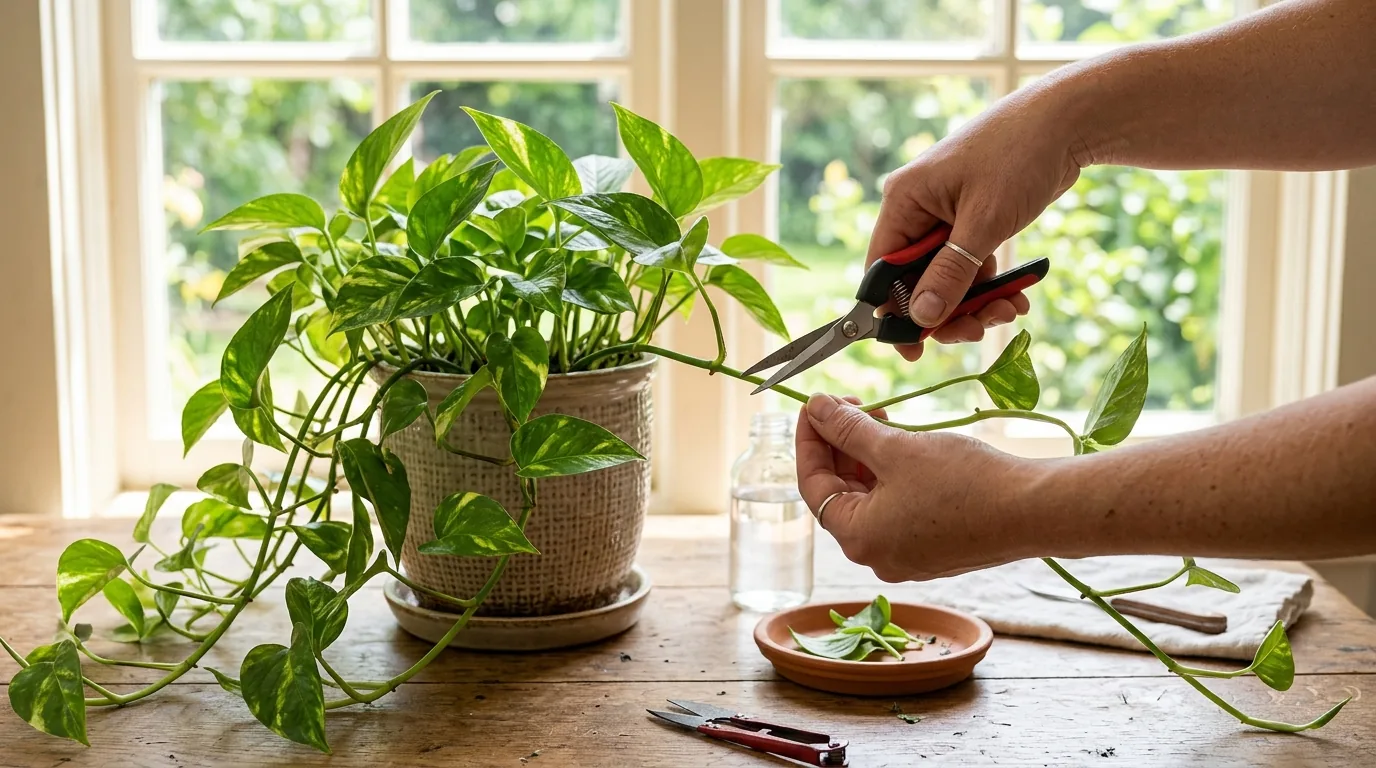
Most houseplants get leggy over winter: stems stretch toward the window, gaps open between the leaves, and the plant leans or flops. A few well-placed cuts fix that and push the plant to branch. This guide covers how to prune houseplants step by step: when to do it, where to cut, how much to remove, how often to prune houseplants, and how to prune trailing houseplants like pothos without losing length for good. It follows the University of Minnesota, Clemson HGIC, the University of Georgia and Penn State Extension.
Pruning Houseplants at a Glance
| Question | Short answer | Source |
|---|---|---|
| Best time | Late winter to early spring, light pruning | UMN, Clemson HGIC |
| Where to cut | Just above a leaf node | UMN |
| Distance above the bud | About 1/4 to 1/2 inch | Penn State |
| How much | Lightly; Penn State’s guideline for perennials is no more than about 25% of top growth in a season | UMN, Clemson, Penn State |
| Fast growers | Prune lightly and frequently, pinching small shoot tips | UGA |
| Tools | Sharp snips, sanitized between plants | Clemson HGIC |
| What to remove first | Dead, yellow, damaged and leggy growth | Clemson HGIC, UMN |
Sources: University of Minnesota Extension (Trott, reviewed 2026); Clemson HGIC (Nichols 2026); UGA Extension B1318 (Pennisi 2022); Penn State Extension, Pruning Herbaceous Plants (Lamont and Sellmer, updated 2026).
When to Prune Houseplants
The University of Minnesota calls early spring ideal for light pruning, because many plants respond quickly and send out new leaves within a few weeks. Clemson HGIC puts a light prune into its end-of-winter checkup, before the growing season starts.
The University of Georgia sums up timing with the old saying “when the knife is sharp”, meaning: use the plant’s natural cycle as your guide. In practice, prune when the plant is about to grow or is growing, so it can replace what you cut. Dead or yellow leaves can come off any time of year.
How to Prune Houseplants, Step by Step
Whether you call it pruning or trimming, the method is the same. Here is how to trim houseplants without setting them back:
- Look first. UMN suggests a quick check before you prune or repot: yellow or brown leaves, leggy stems reaching for the light, roots poking out of the drainage holes. Decide what each plant needs; not every plant needs a trim.
- Clean your tools. Use sharp snips or scissors and sanitize them between plants to limit the spread of disease (Clemson HGIC).
- Remove the dead and damaged. Take off dead, yellow and damaged leaves first. Clemson notes this reduces the chance of pests getting established. UGA says leaves with brown tips or edges can be trimmed back to the healthy part.
- Shorten leggy stems. Cut each stretched stem just above a leaf node (UMN). Penn State’s guideline is about 1/4 to 1/2 inch above the bud, so the stub doesn’t die back and the cut looks natural.
- Step back and stop early. UMN says you don’t need a major cut: a few thoughtful cuts redirect the plant’s energy into fresh shoots. Turn the pot and check the shape from all sides.
- Clean up and give it light. Pick up the clippings, then move the plant somewhere bright so the new shoots grow compact instead of stretching again. Leggy growth is often a sign of low light, so see our guide to grow lights for indoor plants if your window is dim.
Pinching, Heading Back and Deadheading
| Cut | What it is | Use it for | Source |
|---|---|---|---|
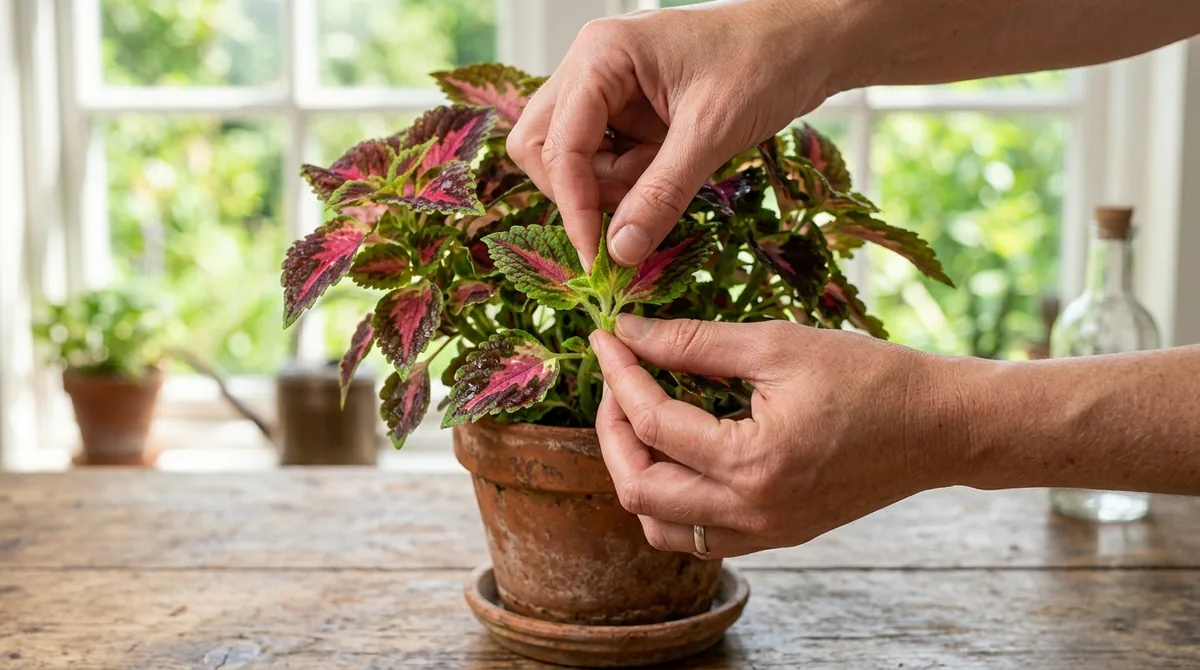
| Pinching | Removing the soft growing tip with the first set of leaves, with fingers or a fingernail | Making a young or fast-growing plant branch and fill out | Penn State, UGA |
| Heading back | Cutting a stem back to just above a bud or node | Shortening leggy stems, shaping | Penn State, UMN |
| Deadheading | Removing spent flowers | Keeping flowering plants tidy and blooming | UGA, Penn State |
| Trimming leaf tips | Cutting brown tips or edges back to healthy tissue | Cosmetic cleanup | UGA |
| Root pruning | Shortening roots to keep a plant in the same pot | Controlling size | UGA |
Sources: Penn State Extension, Pruning Herbaceous Plants (2026); UGA Extension B1318 (2022); University of Minnesota Extension (2026).
Pinching is the gentlest and most useful cut. UGA explains that pinching and light pruning increase branching and give a stockier, fuller plant. The reason: the growing tip holds back the buds below it, and once it is gone, side shoots grow. Penn State notes that pinched stems produce new side stems, which on flowering plants means more flower buds.
How to Prune Trailing Houseplants
Pothos, heartleaf philodendron, tradescantia and other vines get long and bare near the pot. The fix is the same node rule: cut a long vine just above a leaf node, and new growth usually comes from the node below the cut. To fill the top of the pot, cut a few vines back hard and leave others long, so the plant isn’t bare all at once.
Don’t throw the trimmings away. Pieces with at least one node can be rooted and planted back into the same pot to fill it out. See our guides to pruning a pothos plant and pothos propagation, and for plants that root from a single leaf, our guide to leaf propagation.
How Often to Prune Houseplants
There are two rhythms, and most plants need both:
- Once a year, a light shaping prune in late winter or early spring (UMN, Clemson HGIC).
- Little and often during the growing season for fast growers. UGA says that when a plant grows quickly and you want to keep it a certain size, prune lightly and frequently, removing shoots or tips while they are still small.
Slow growers, like many succulents and cacti, may need nothing more than the removal of dead leaves. Penn State’s guideline for herbaceous perennials is to remove no more than about 25% of top growth in a season; it was written for outdoor perennials, but it is a sensible ceiling for houseplants too.
Root Pruning
If a plant has outgrown its pot but you want to keep it at the same size, you can prune the roots instead of moving up a pot size. UGA describes two ways: pull roots away from the root mass and cut them back to within 1 inch of the soil ball, or make three or four vertical cuts about 1 inch deep into the root ball. Then repot it into the same container with fresh mix. Our guide on how to repot a plant covers the rest.
Mistakes to Avoid
- Cutting between nodes: a bare stub with no bud can’t make a new shoot. Cut just above a node.
- Doing it all at once: UMN says a major cut isn’t needed; a few cuts are enough.
- Dirty tools: sanitize between plants (Clemson HGIC).
- Pruning, then leaving the plant in the dark: new shoots will stretch the same way the old ones did.
- Feeding a stressed plant hard right after: UMN recommends starting spring feeding gently, at half strength.
Frequently Asked Questions
How do you prune houseplants?
Remove dead, yellow and damaged leaves first, then cut leggy stems just above a leaf node, about 1/4 to 1/2 inch above the bud (UMN, Penn State). Use clean, sharp snips and keep the session light.
How do you trim houseplants without hurting them?
Trim lightly, cut just above a node rather than in the middle of a stem, sanitize your tools between plants (Clemson HGIC), and prune when the plant is about to grow, in late winter or early spring (UMN).
How often should you prune houseplants?
Most need one light shaping prune a year in late winter or early spring. Fast growers can also be pinched lightly and frequently during the growing season (UGA).
Where do you cut a leggy houseplant?
Just above a leaf node, where a leaf joins the stem. A new shoot grows from the bud at that node, which makes the plant fuller (UMN).
How do you prune trailing houseplants?
Cut long vines just above a node, staggering the lengths so the plant isn’t bare all at once, and root the cuttings to plant back into the pot to fill it out.
Should you cut off brown leaf tips?
You can. UGA says leaves with brown tips or edges can be trimmed back to the healthy part. Also fix the cause, which is often dry air, salt buildup or uneven watering.
Can you prune houseplants in winter?
Removing dead leaves is fine any time. Save shaping cuts for late winter or early spring, when the plant is about to grow and can replace what you remove (UMN, Clemson HGIC).
Sources
- Trott, R. University of Minnesota Extension: Spring Houseplant Care (reviewed 2026)
- Nichols, J. Clemson HGIC: End-of-Winter Houseplant Care (2026)
- Pennisi, B. UGA Extension B1318: Growing Indoor Plants with Success (2022)
- Lamont, P. and Sellmer, J. Penn State Extension: Pruning Herbaceous Plants (updated 2026)