
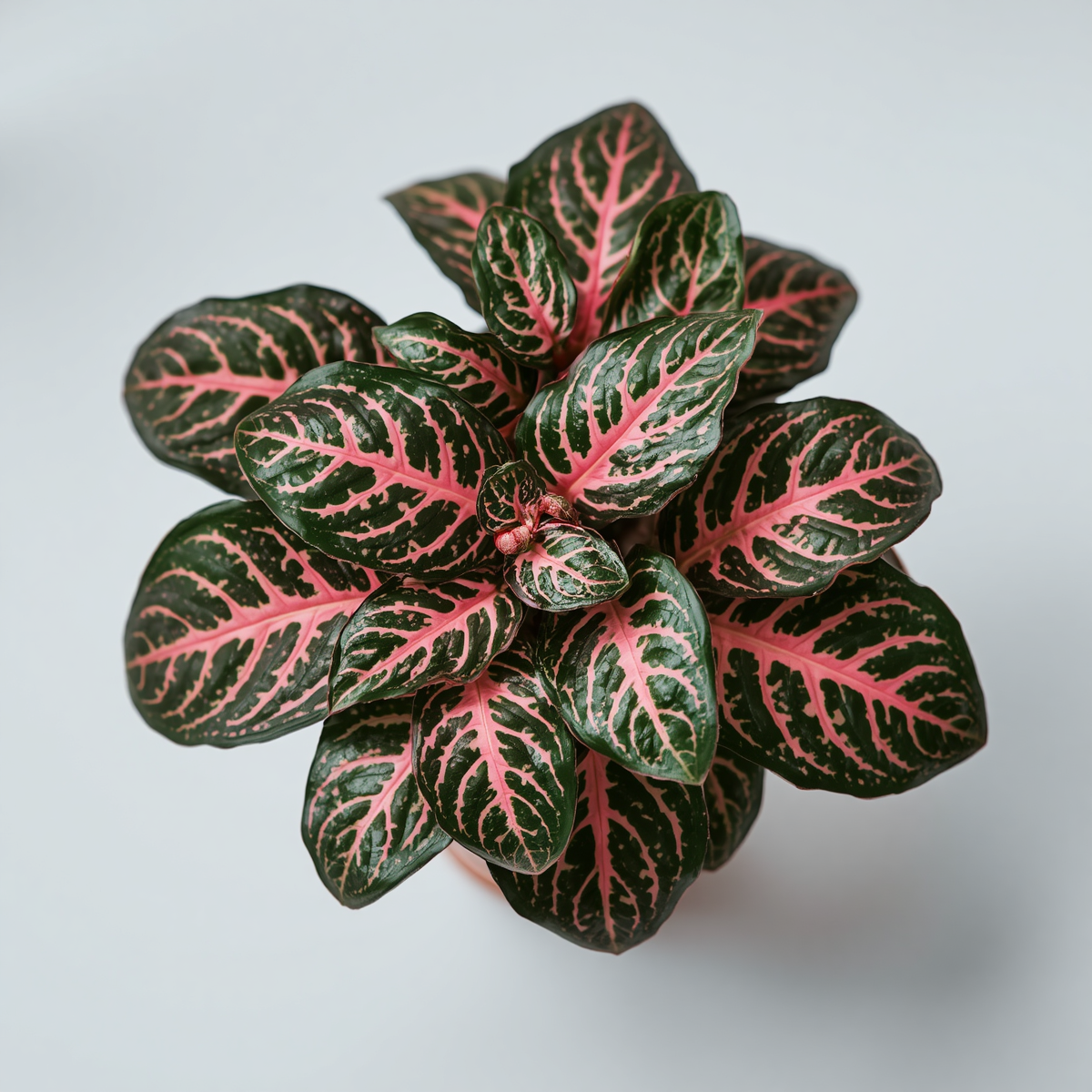
The nerve plant (Fittonia albivenis) is a small, creeping houseplant with leaves netted in white, pink or red veins. It is famous for “fainting”: when its soil dries out, the whole plant flops, then perks up after a drink. Nerve plant care comes down to bright light without direct sun, compost that stays moist but never soggy, warmth and humid air, which is why it thrives in terrariums. This guide follows the RHS, NC State and the ASPCA.
What Is a Nerve Plant?
NC State describes Fittonia albivenis as a creeping, low-growing plant from the tropical rainforests of South America (Bolivia, northern Brazil, Colombia, Peru and Venezuela), about 3 to 8 inches tall and up to 18 inches wide. It belongs to the acanthus family. Older names include Fittonia verschaffeltii and F. argyroneura, which are now treated as the same species; you may still see them on labels, along with common names such as mosaic plant and silver net plant.
| Need | What the sources say |
|---|---|
| Light | Bright spot out of direct sun; north or east window (RHS); bright to medium light, tolerates fluorescent (NC State) |
| Water | Keep moist with frequent watering (RHS); wilts when dry, recovers after watering; overwatering causes root rot (NC State) |
| Temperature | 15 to 17°C (60 to 63°F) or above; no drafts or radiators (RHS) |
| Humidity | Moist air; terrarium, bathroom or pebble tray (RHS) |
| Compost | Moisture-retentive, peat-free houseplant compost (RHS) |
| Feeding | Every 2 to 3 months, half-strength (RHS) |
| Size | 3 to 8 in tall, up to 18 in wide (NC State) |
| Pets | Non-toxic to dogs, cats and horses (ASPCA) |
Sources: RHS fittonia growing guide; NC State Extension; ASPCA.
Light
The RHS says fittonias need a bright spot away from direct sunlight, ideally near a north- or east-facing window, because direct sun scorches the leaves. NC State says bright to medium light, and notes that it tolerates fluorescent lighting, which makes it a good desk or terrarium plant. The RHS adds that yellowing leaves usually mean too little light, and a nerve plant in a dim spot tends to stretch and lose its vein color. If your room is dark, see our grow light guide.
Nerve Plant Care: Watering and Fainting
The RHS says to keep the compost moist by watering frequently, with less needed in a terrarium. NC State suggests watering about twice a week and notes that overwatering can cause root rot. Water when the surface is just starting to dry, water thoroughly, and empty the saucer.
The “fainting” is the nerve plant’s built-in alarm. The RHS says a lack of water makes fittonias droop or wilt, and that they usually recover after a thorough watering if they haven’t been left dry too long. NC State likewise notes that it wilts dramatically when dry but recovers after watering. Repeated collapses stress the plant, so treat a faint as a reminder, not a watering schedule.
Humidity and Temperature
The RHS says fittonias need moist air or their leaves turn brown, and suggests a steamy bathroom or kitchen, an enclosed terrarium, or a tray of damp gravel or clay granules under the pot. NC State lists medium humidity and notes that the leaves shrivel in dry air or drafts. For temperature, the RHS gives a minimum of 15°C (60°F) in one place and a warm room above 17°C (63°F) in another; either way, keep it warm and away from cold drafts and radiators.
Nerve Plant Care in a Terrarium
The RHS says enclosed terrariums suit fittonias well because they keep the air humid, and that terrarium plants need less watering because the compost dries slowly. NC State also notes that the shallow roots allow a small pot. In a terrarium:
- Water sparingly and check the compost before adding more; condensation tells you the air is already humid.
- Give it bright, indirect light, never direct sun, which overheats a closed glass container.
- Open the lid now and then for air: the RHS warns that grey mould (Botrytis) can develop in very humid conditions.
- Pinch the tips if it outgrows the space.
Compost, Pots and Feeding
The RHS recommends a moisture-retentive, peat-free houseplant compost or peat-free multipurpose compost. NC State lists a well-drained potting soil and notes the shallow roots suit a small pot. Always use a pot with drainage holes. For feeding, the RHS suggests a half-strength general-purpose or houseplant fertilizer about every two or three months.
Propagation
The RHS describes two easy methods:
- Stem-tip cuttings in spring or summer, rooted in moist peat-free compost in a humid spot such as a propagator or a sealed bag. NC State notes that the creeping stems root readily.
- Division of large clumps, keeping three or more stems per piece; this also helps if the center of an old plant dies out.
See our sphagnum moss propagation guide for another option.
Problems
| Symptom | Likely cause | What to do |
|---|---|---|
| Whole plant flops | Compost dried out (RHS, NC State) | Water thoroughly; it should recover within hours |
| Brown, crispy leaves | Dry air (RHS); drafts (NC State); direct sun or heat (RHS) | Raise humidity; move away from drafts, radiators and sun |
| Yellowing leaves | Too little light (RHS); overwatering (NC State) | Move to brighter, indirect light; check the compost isn’t soggy |
| Grey fuzzy mould | Botrytis in very humid, still air (RHS) | Remove affected parts; ventilate |
| Leggy stems, fading veins | Too little light | Brighter spot; pinch back |
| Webbing, cottony spots, bumps | Spider mites, mealybugs, scale (RHS, NC State) | Isolate and treat |
Sources: RHS fittonia growing guide; NC State Extension.
See our overwatered vs underwatered guide and spider mite guide. Calatheas share many of the nerve plant’s needs; see our calathea care guide.
Is Fittonia Toxic to Cats?
No. The ASPCA lists the nerve plant (under its older name Fittonia verschaffeltii) as non-toxic to dogs, cats and horses, and NC State tags it non-toxic. As with any plant, a pet that eats a lot of it may get a mild stomach upset. See our cat-safe plants list.
For more houseplants grown for their colorful leaves, see our guides to Tradescantia Nanouk and polka dot plant. It is also on our list of plants safe for dogs. It is one of the plants Iowa State suggests for a closed terrarium; see our guide on how to make a terrarium.
Frequently Asked Questions
Why does my nerve plant keep fainting?
It is drying out. The RHS and NC State both say fittonias wilt when dry and recover after a thorough watering. Water a little sooner next time so it doesn’t collapse repeatedly.
How often should I water a nerve plant?
Keep the compost moist with frequent watering (RHS); NC State suggests about twice a week. Water less in a terrarium, and never leave the pot standing in water.
Is nerve plant care in a terrarium easier?
Often, yes. The RHS says enclosed terrariums suit fittonias because they keep the air humid, and the compost dries more slowly so it needs less watering. Ventilate now and then to prevent grey mould.
Is Fittonia toxic to cats?
No. The ASPCA lists the nerve plant as non-toxic to dogs, cats and horses.
Why are my nerve plant leaves turning brown?
Usually dry air, which the RHS says makes the leaves turn brown, or scorching from direct sun or heat. Drafts can also shrivel the leaves (NC State).
How do you propagate a nerve plant?
Take stem-tip cuttings in spring or summer and root them in moist compost in a humid spot, or divide a large clump into pieces with three or more stems (RHS).