
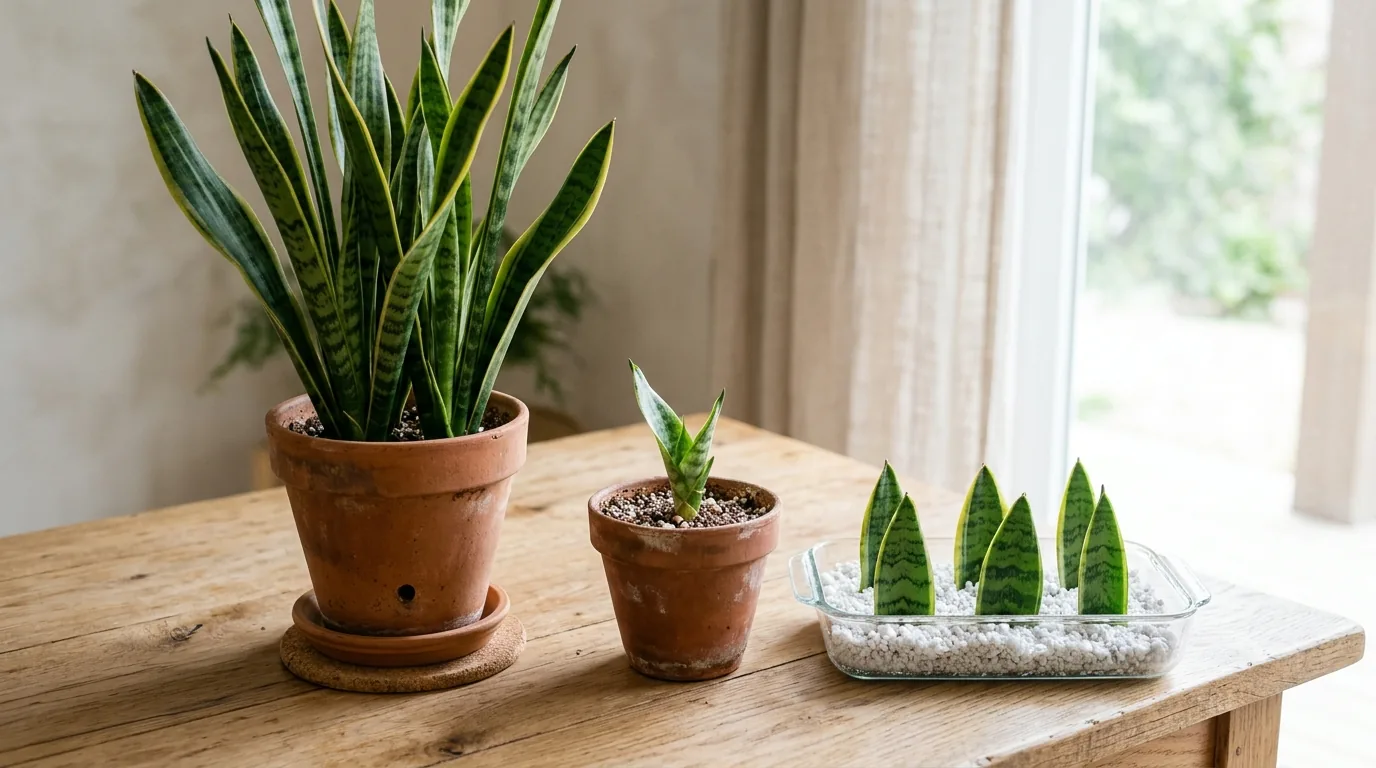
Snake plants are classic pass-along plants: Penn State Extension calls them easy to propagate, and one healthy pot can become several. There are three ways to do it: divide the clump, pot up the offsets (pups) that grow from the rhizomes, or root sections of a leaf in soil, perlite or water. Division is the fastest and the only one that keeps a variegated plant’s pattern. Leaf cuttings give you many plants from one leaf but take a couple of months. This guide covers snake plant propagation step by step, using the RHS, Iowa State, Penn State, Colorado State and NC State Extension and the ASPCA.
Snake Plant Propagation Methods Compared
| Method | Best for | Keeps variegation? | Time to a new plant |
|---|---|---|---|
| Division | Crowded, overgrown pots; quickest results | Yes | Immediate: each piece already has leaves and roots |
| Pups (offsets) | Plants that have been in the same pot for 2 to 3 years (RHS) | Yes | Immediate, once the pup has its own roots |
| Leaf cuttings in soil or perlite | Many plants from one leaf; green types | Usually not (Iowa State, RHS) | New shoots in about two months (Iowa State) |
| Leaf cuttings in water | Watching roots form | Usually not | Similar to soil; pot up when roots are about 1 inch long (Iowa State) |
Sources: RHS Sansevieria growing guide; Iowa State University Extension (reviewed 2025); Penn State Extension (2023).
The best time is spring. The RHS recommends March to May, when plants start growing again after winter.
Method 1: Division
Penn State Extension says that although snake plants can be grown from leaf cuttings, division is the easiest method. Colorado State’s PlantTalk explains why it works so well: new shoots grow from underground rhizomes, so an older pot is really a cluster of plants that can be separated. The RHS method:
- Slide the plant out of its pot. If it is stuck, run a knife around the inside of the pot.
- Split the clump so that each piece has one or more leaves attached to fibrous roots. Pull it apart by hand where you can, and use a sharp knife or pruners on tough sections of rhizome.
- Throw away damaged or dead pieces and pot up only the healthy ones.
- Pot each piece in fresh, free-draining mix in a pot just big enough for its roots. Colorado State notes that clay or ceramic pots are steadier than plastic, because snake plants get top-heavy.
- Stake tall, wobbly divisions with a cane and string until they root in and stand on their own (RHS).
Water lightly after potting and let the mix dry before watering again; the divisions already have roots, so they establish quickly.
Method 2: Potting Up Pups
Snake plant pups are the small rosettes that come up beside the main plant from its rhizomes. Penn State notes that snake plants produce offspring after a few years, and the RHS suggests this method for established plants that have been in the same pot for 2 to 3 years.
- Take the plant out of its pot and find pups that have their own roots.
- Pull or cut them away from the rootball, keeping as much root as possible.
- Pot them individually, or several together for a fuller pot (RHS).
- Return the parent to its pot and fill the gaps with fresh mix.
A pup with no roots of its own can be treated like a leaf cutting: let the cut end dry, then insert it in damp, gritty mix.
Method 3: Leaf Cuttings in Soil or Perlite
Snake plant propagation in soil works with sections of a single leaf. The RHS and Iowa State Extension describe almost the same method:
- Cut a mature, healthy leaf at its base (RHS). Iowa State suggests watering the parent the day before so the leaf is full of water.
- Slice it across into sections. The RHS uses 5 cm (2 inch) sections; Iowa State uses sections about 3 to 4 inches tall.
- Mark the bottom. Each section only roots from the end that was nearer the base of the plant. Iowa State suggests cutting a small notch in the top end so you can tell which way is up.
- Let the cut ends callus in a dry place for a day or two (RHS).
- Insert the bottom end into a damp, free-draining medium: the RHS uses peat-free cuttings compost or a 50:50 mix of compost and horticultural grit, inserting half of each section; Iowa State uses perlite, sand or a sand and peat mix, inserting sections 1 to 2 inches deep, and suggests dipping the base in rooting hormone first.
- Keep them warm and humid. Iowa State recommends bright, indirect light and air at 65 to 75°F, under a clear dome or bag propped up so it does not touch the leaves. The RHS suggests bottom heat of 18°C (65°F) or a clear bag in a warm room. Colorado State suggests a bag with a few holes, in medium light.
- Keep the medium just moist, re-moistening it when it starts to dry (Iowa State). Wet, airless mix is how sections rot.
For choosing between the two additives, see our guide to vermiculite vs perlite.
Snake Plant Propagation in Water
Rooting leaf sections in water is popular because you can watch the roots form. None of the extension sources gives a water method written for snake plants specifically, but Iowa State’s general rules for rooting houseplant cuttings in water apply:
- Stand each section bottom end down in a clean jar, with only the lower part in the water.
- Change the water one to two times a week, and never let the level drop so far that developing roots are left in the air (Iowa State).
- Pot up when the roots are about 1 inch long (Iowa State). Waiting much longer does not help: Iowa State notes that roots formed in water are coarser than roots formed in a solid medium, so they have to adjust once potted.
- Keep the jar in bright, indirect light and at normal room temperature.
The main risk is rot: a soft, translucent or mushy base means bacteria have taken hold. Cut above the soft tissue, let the cut callus, and start again in fresh water or in damp perlite. Our guide to cuttings rotting in water explains the causes in detail.
How Long Does It Take?
| Stage | What the sources say |
|---|---|
| Callusing before planting | A day or two (RHS) |
| Roots on leaf sections | “A few weeks” (Colorado State) |
| New shoots at the base of a section | About two months (Iowa State) |
| Water cuttings ready to pot | When roots are about 1 inch long (Iowa State) |
| Potted plant established | Within a few weeks of potting (Iowa State) |
| Divisions and rooted pups | No rooting wait: they already have roots |
Sources: RHS Sansevieria growing guide; Colorado State University Extension PlantTalk 1337; Iowa State University Extension (reviewed 2025).
Snake plants are slow growers, so expect leaf cuttings to look unchanged for weeks. Warmth helps: cool rooms slow rooting a lot.
Why Variegated Cuttings Turn Green
Iowa State explains that the variegation of the yellow-edged ‘Laurentii’ and similar snake plants comes from a chimera (a plant made of genetically different tissue layers), so these types usually do not come true from leaf sections. The RHS also says cuttings from variegated cultivars tend to revert to green. So leaf cuttings of ‘Laurentii’ usually give plain green plants. To keep the pattern, propagate variegated snake plants by division or by potting up pups.
Troubleshooting
| Problem | Likely cause | What to do |
|---|---|---|
| Cutting is soft and mushy at the base | Rot from too much water or a fresh, uncallused cut | Trim above the rot, callus for a day or two, replant in barely damp mix |
| No roots after many weeks | Section planted upside down (Iowa State, RHS) or a cold room | Check the orientation; keep at 65 to 75°F (Iowa State) |
| Cutting is wrinkling or shriveling | Medium too dry or air too dry | Re-moisten the mix; use a propped-up clear cover (Iowa State) |
| New plant is all green | Leaf cutting from a variegated cultivar (Iowa State, RHS) | Normal; use division to keep variegation |
| Division wilts or flops after potting | Tall piece not yet anchored (RHS) or overwatering | Stake it; let the mix dry between waterings |
Sources: Iowa State University Extension (reviewed 2025); RHS Sansevieria growing guide.
Caring for the New Plants
Once rooted, treat the young plants like any snake plant. NC State Extension says to let the soil dry between waterings from spring to autumn and to water only every one to two months in winter, because overwatering rots the roots. Colorado State says not to pour water into the center of the rosette. Penn State suggests feeding monthly in the growing season with an all-purpose fertilizer at half strength. For light, soil and repotting, see our full snake plant care guide.
The same methods work for the round-leaved cylindrical snake plant; see our Sansevieria cylindrica care guide. For other plants, see our guides to pothos propagation and hoya propagation.
For more on propagation, see our guides to jade plant care, rubber plant propagation, plants that grow in water and leaf propagation. For other succulents, see our guides to ponytail palm care.
Frequently Asked Questions
What is the best way to propagate a snake plant?
Division. Penn State Extension says division is the easiest method, and it gives full-size plants with roots straight away. It is also the only way, along with potting up pups, to keep a variegated cultivar’s pattern.
How long does snake plant propagation take?
Divisions and rooted pups need no rooting time. Leaf sections root in a few weeks (Colorado State) and send up new shoots in about two months (Iowa State).
Can you propagate a snake plant in water?
Yes. Stand leaf sections bottom end down in water, change it one to two times a week, and pot them up when the roots are about 1 inch long (Iowa State’s guidance for water-rooted cuttings). Watch for soft, mushy bases, which mean rot.
How do you propagate a snake plant in soil?
Cut a leaf into 2 to 4 inch sections, let them callus for a day or two, and insert the bottom halves into damp cuttings compost, a compost and grit mix, or perlite. Keep them warm, in bright, indirect light, under a loose clear cover (RHS, Iowa State).
Why did my snake plant cutting lose its yellow edges?
The variegation of types such as ‘Laurentii’ comes from a chimera, so leaf sections usually come up plain green (Iowa State, RHS). Propagate them by division instead.
When should you separate snake plant pups?
When the pup has roots of its own, ideally in spring. The RHS suggests potting up offsets from established plants that have been in the same pot for 2 to 3 years, keeping as much root as possible on each one.
When is the best time to propagate a snake plant?
Spring. The RHS recommends March to May, when the plant starts growing again after winter.
Sources
- RHS: How to grow Sansevieria
- Steil, A. How to Propagate Houseplants by Leaf Section Cuttings. Iowa State University Extension (reviewed 2025)
- Marquesen, S. (2023). Snake Plant: A Forgiving, Low-maintenance Houseplant. Penn State Extension
- Colorado State University Extension PlantTalk: 1337 Snake Plant
- NC State Extension Gardener Plant Toolbox: Dracaena trifasciata
- ASPCA: Snake Plant