
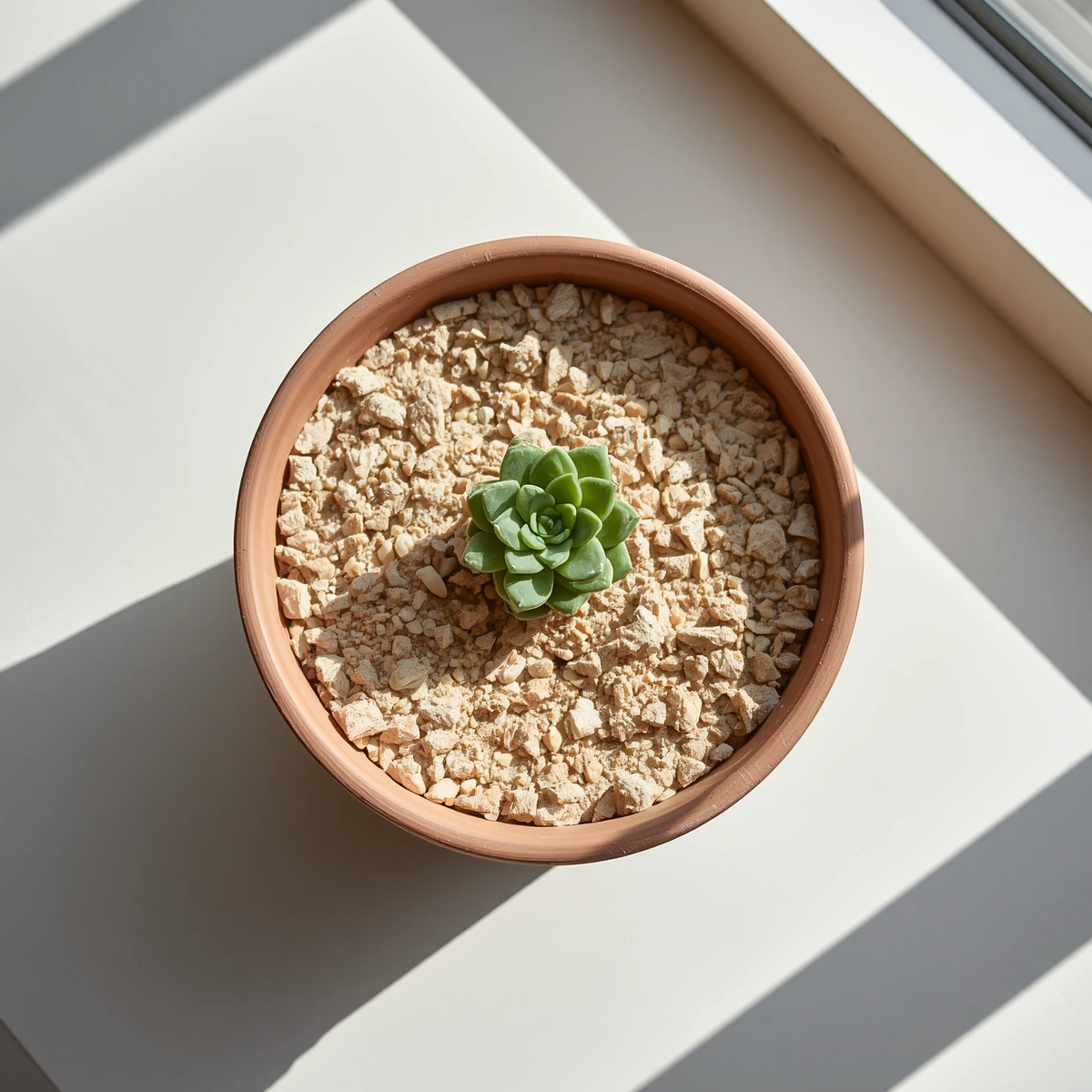
How to grow succulents: give them lots of bright light, a fast-draining mix in a pot with a drainage hole, and water only when the soil has dried. Iowa State University Extension recommends a mix of about one part organic material to two parts mineral material, a wet-dry watering cycle (water thoroughly, then let the soil dry), and ten or more hours of bright, indirect light indoors, noting that most succulents need at least six to eight. Most succulent failures come from too much water and too little light.
| Factor | What succulents need indoors |
|---|---|
| Light | Ten or more hours of bright, indirect light; most need at least 6 to 8 |
| Potting mix | 1 part organic (potting soil, pine bark, compost or coir) to 2 parts mineral (perlite, coarse sand, pumice or fine gravel), or a cactus and succulent mix |
| Pot | Must have drainage holes; clay or terracotta dries fastest |
| Water | Water thoroughly, let the soil dry; start at every 2 to 3 weeks |
| Feeding | All-purpose fertilizer at half to a quarter of the label rate in spring and summer; none in winter |
| Temperature | Prefer 55 to 75 °F; tolerate roughly 45 to 85 °F |
Source: Iowa State University Extension and Outreach, Growing Succulents Indoors (Steil, reviewed 2024).
What Conditions Do Succulents Need?
Iowa State describes succulents as plants with thick, juicy stems or leaves, found in several plant families; all cacti are succulents, but not all succulents are cacti. Their needs are consistent: strong light, a gritty mix that dries quickly, and a dry spell between waterings. Iowa State notes most succulents prefer temperatures of 55 to 75 °F, tolerating roughly 45 to 85 °F, with cooler nights and warmer days suiting them well, and that they usually handle the low humidity of most homes.
Planting Succulents in Pots
- Succulent soil mix: one part organic material (potting soil, pine bark, compost or coir) to two parts mineral material (perlite, coarse sand, pumice or fine gravel), or a commercial cactus and succulent mix (Iowa State). For a comparison of the minerals, see our vermiculite vs perlite guide.
- Drainage: containers must have drainage holes. A layer of gravel in the bottom does not replace a hole; if a decorative pot has none, use it as a sleeve around a smaller pot that drains (Iowa State).
- Material: clay or terracotta is ideal because it is porous and lets the soil dry faster (Iowa State).
- Planting: set the plant at the same depth it was growing, firm the mix gently, and wait a few days before watering if you trimmed or damaged roots.
How to Water Succulents
Iowa State recommends a wet-dry cycle: water thoroughly, wetting the entire root ball until it drains, then let the soil dry before watering again. Never let water sit in trays, sleeves or double pots for more than a few hours. As a starting point indoors, it suggests watering every 2 to 3 weeks, checking that the soil is dry several inches down. A wooden skewer pushed to the bottom of the pot is a simple way to check deep pots. Water less in winter, when growth slows.
Water the soil rather than pouring into tight rosettes such as Echeveria, where water can sit between the leaves. If your tap water is hard and leaves a white crust, see our guide to white crust on soil.
How to Grow Succulents Indoors
Light is the limiting factor indoors. Iowa State says succulents need ten or more hours of bright, indirect light (bright enough to cast a shadow), and most need at least six to eight. Put them in your brightest window, and rotate the pots so they don’t grow lopsided. If no window is bright enough, Iowa State recommends high-output, full-spectrum fluorescent or LED grow lights; follow the fixture’s distance guidance, and see our grow light guide.
Plants moved into stronger light, including outdoors for summer, should be transitioned gradually to avoid sunburn (Iowa State). Skip fertilizer in winter, when indoor succulents are not growing.
Growing Succulents Outside
Hardiness depends on the plant. Hardy types such as many sedums and hens and chicks (Sempervivum) are grown outdoors in cold-winter regions, while tender succulents such as Echeveria, aloe and jade need frost-free conditions and are brought indoors for winter in cold climates. Check the hardiness zone on the plant label. Outdoors, the same rules apply as in pots: excellent drainage (raised beds or slopes with gritty soil help in clay), and a gravel or stone mulch rather than wood mulch around the crowns. Move potted succulents outdoors gradually in spring and back inside before frost.
Propagating Succulents from Leaves, Cuttings and Offsets
Iowa State’s propagation guide covers four methods:
- Offsets (pups): separate an offset with roots and leaves or stems attached, pot it in a well-drained mix, water lightly, and it establishes after a few weeks.
- Stem cuttings: cut a section of stem with clean, sharp tools, remove the lower leaves, let the cut end dry and callus for several days, then plant in a well-drained mix.
- Leaf cuttings: remove the entire leaf, including the tissue that attached it to the stem (partial leaves won’t root), lay it on damp mix with the stem end at the surface, and keep the mix damp but not wet. Roots and new rosettes form in several weeks.
- Beheading: for rosette types that make few offsets, cut off the rosette with an inch or two of stem, let it callus and root it like a stem cutting; side rosettes may form on the remaining stalk over several months. The same approach fixes a stretched, leggy plant.
Not every succulent roots from leaves; aloes and Haworthias, for example, are usually propagated from offsets.
Growing Succulents from Seed
Many succulents can be grown from seed, but it is slow: seedlings take months to reach a size worth potting. Sow the tiny seeds on the surface of a sterile, gritty seed mix, keep it evenly moist under a clear cover in bright, indirect light or under a grow light, and ventilate once seedlings appear to avoid mold. For quicker results, cuttings and offsets are far easier.
Why Is My Succulent Dying?
| What you see | Likely cause | What to do |
|---|---|---|
| Yellowing, soft, mushy leaves and stems; mold or fungus gnats | Overwatering | Stop watering, let the soil dry, check drainage, repot in fast-draining mix if needed |
| Tall, spindly, pale new growth | Too little light | Move to more light or add a grow light; prune or behead lanky growth |
| Brown or tan patches on leaves or stems | Sun damage | Move to less intense light; transition plants gradually; damaged leaves won’t recover |
| Cottony masses where leaves join stems | Mealybugs | Isolate, rinse and remove, dab with rubbing alcohol, use neem or insecticidal soap as labeled |
| Wrinkled, deflated leaves | Thirst, or roots lost to rot | Check the roots: water thoroughly if they are firm; propagate healthy tissue if they have rotted |
Source: Iowa State University Extension, Common problems and issues with succulents.
Iowa State lists overwatering, insufficient light, sun damage and mealybugs as the common problems. For more, see our guides to root rot, mealybugs and wrinkled jade leaves.
Are Succulents Safe for Pets?
Some are and some aren’t, so check each plant by name against the ASPCA plant list. On its list for cats:
- Non-toxic: Haworthia, Echeveria (hens and chickens), burro’s tail (Sedum morganianum), Christmas cactus.
- Toxic: aloe (Aloe vera), jade plant (Crassula), kalanchoe (mother of millions, devil’s backbone), pencil cactus (Euphorbia tirucalli).
Non-toxic doesn’t mean edible: eating a lot of any plant can upset a pet’s stomach. See our cat-safe plants guide and aloe vera care guide.
For other succulents, see our guides to Aloe microstigma, jade plant care and ponytail palm care.
Frequently Asked Questions
How often should I water succulents?
When the soil has dried. Iowa State suggests starting at every 2 to 3 weeks indoors, checking that the soil is dry several inches down, then watering thoroughly until it drains.
Can succulents grow in regular potting soil?
Not on its own; it holds too much water. Mix one part potting soil (or bark, compost or coir) with two parts perlite, coarse sand, pumice or fine gravel, or use a cactus and succulent mix (Iowa State).
How much light do succulents need indoors?
Ten or more hours of bright, indirect light, with most needing at least six to eight (Iowa State). Use a grow light if your windows are dim.
Why is my succulent stretching?
Tall, spindly, pale growth means light levels are too low (Iowa State). Move it somewhere brighter and behead or prune the stretched growth.
How do you propagate succulents from leaves?
Remove the whole leaf including the base where it joined the stem, lay it on damp mix and keep it damp but not wet; roots and a new rosette form in several weeks (Iowa State).
Are succulents safe for cats?
Some are. The ASPCA lists Haworthia, Echeveria and burro’s tail as non-toxic to cats, but aloe, jade, kalanchoe and pencil cactus as toxic.