
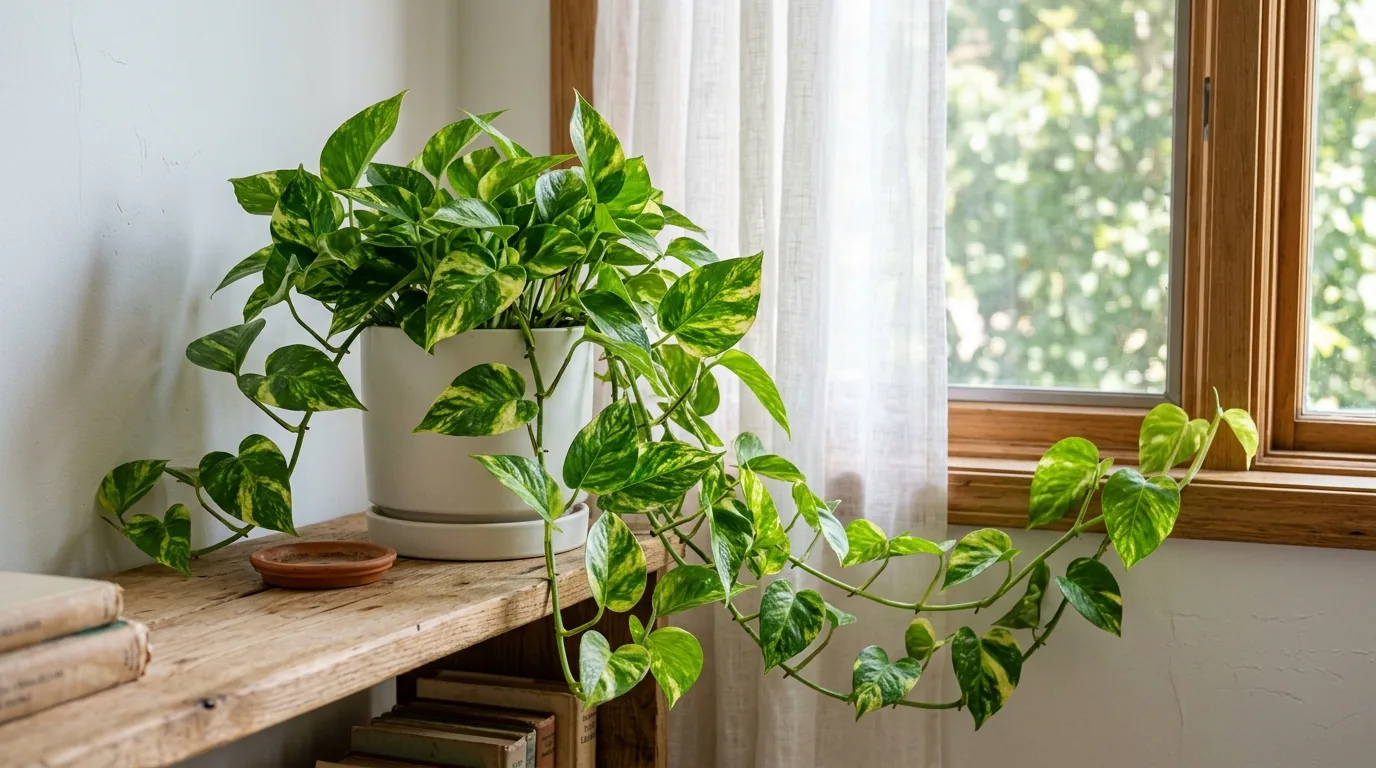
Pothos (Epipremnum aureum), also called golden pothos or devil’s ivy, is the trailing vine extension services keep putting at the top of their easy houseplant lists. NC State Extension lists it as native to the Society Islands and formerly named Scindapsus aureus. It forgives a lot, but it does have preferences, and most problems come from too much water or too little light. This guide covers pothos care indoors: light, watering, soil, feeding, pruning, repotting, pothos care in water, pothos yellow leaves and pet safety, following Clemson HGIC, NC State, UW-Madison, Penn State Extension, the RHS and the ASPCA.
Pothos Care at a Glance
| Need | What the sources say |
|---|---|
| Light | Bright, indirect light; tolerates lower light, but variegated types may lose color (Clemson, NC State) |
| Water | Let the soil dry between waterings, then water thoroughly (Clemson, NC State) |
| Soil | Airy, well-draining mix (Clemson); soilless potting mix that drains well (Penn State) |
| Temperature | Nights 60 to 70°F, days 70 to 85°F (Clemson); 65 to 86°F (RHS) |
| Humidity | Prefers 50 to 70%, tolerates typical home levels of 30 to 60% (Clemson) |
| Feeding | From every other month (NC State, UW-Madison) to every two weeks (Penn State) in the growing season |
| Repotting | Every year or two, when roots fill the pot (Clemson); every 2 to 3 years (RHS) |
| Size | Leaves 3 to 6 inches; stems 8 to 10 feet or longer indoors (Penn State) |
| Pets | Toxic to dogs and cats: insoluble calcium oxalates (ASPCA) |
Sources: Clemson HGIC 1568 (2026); NC State Extension Plant Toolbox; UW-Madison Extension (2025); Penn State Extension (2025); RHS; ASPCA.
Light
Clemson HGIC says pothos prefers bright, indirect light but tolerates lower light, which is why it shows up in offices and dim corners. The trade-off is color: Clemson, NC State and UW-Madison all note that low light can make variegated plants lose their variegation. Clemson adds that the most variegated cultivars, such as Marble Queen, Pearls and Jade and Snow Queen, need more light than green or golden types.
Avoid strong direct sun. Penn State Extension says direct sun yellows the leaves and suggests rotating the pot weekly so the vine grows evenly. The RHS suggests an east or west facing window, or a south facing window behind a sheer curtain or blinds. If you are short on window light, see our guide to grow lights for indoor plants.
Watering
All the sources agree on the principle: let the soil dry between waterings, then water thoroughly so moisture reaches all the roots (Clemson). The RHS says to water only when the compost is nearly dry, checked with a finger, and Penn State notes that overwatering causes root rot while underwatering only causes temporary drooping. In other words, a slightly thirsty pothos recovers; a waterlogged one may not.
- How to check: push a finger into the mix. If the top layer is dry, water until it drains from the bottom, then empty the saucer.
- Drooping: a limp pothos in dry soil is usually just thirsty; Penn State describes underwatering drooping as temporary.
- Winter: growth slows, so the mix takes longer to dry; check before watering rather than following a calendar. See our winter houseplant care guide.
- Water quality: the RHS suggests rainwater or filtered water at room temperature, especially in hard water areas.
Not sure whether your plant has too much or too little water? Our guide to overwatered vs underwatered plants walks through the signs.
Soil, Pots and Repotting
Clemson recommends an airy, well-draining mix and Penn State a soilless potting mix that drains well. The RHS gives a specific recipe: three parts peat-free ericaceous compost, one part grit and one part medium orchid bark, or a peat-free houseplant compost. Whatever you use, the pot needs drainage holes.
The sources differ on how often to repot:
| Source | Repotting advice |
|---|---|
| Clemson HGIC | When roots show through the drainage holes or the plant is root-bound; most need it every year or two |
| Penn State | Annually in spring, into a slightly larger container |
| RHS | In spring every two or three years, moving up one pot size |
Sources: Clemson HGIC 1568; Penn State Extension; RHS.
The common ground: repot in spring, only when the plant has filled its pot, and go up just one size. Our step-by-step guide on how to repot a plant covers the method.
Temperature and Humidity
Clemson gives 60 to 70°F at night and 70 to 85°F during the day. Penn State says average room temperatures of 60 to 80°F, and the RHS 18 to 30°C (65 to 86°F). UW-Madison Extension warns that cold, or a sudden drop from very high to moderate temperatures, causes brown patches on the leaves. Clemson suggests keeping plants away from air conditioning vents in summer and from cold windowsills and heating vents in winter.
On humidity the sources disagree. Clemson says pothos prefers 50 to 70% humidity but tolerates typical home levels of 30 to 60%, and a humidifier can help. The RHS says it does not need high humidity. In practice, normal indoor air is fine; if you see brown tips in a dry, heated room, Clemson lists low humidity as one cause.
Feeding
Pothos is not a heavy feeder by most accounts, but the recommended schedules vary a lot:
| Source | How often to fertilize |
|---|---|
| NC State Extension | Every other month, except during winter dormancy |
| UW-Madison Extension | Every other month, skipping winter when growth slows |
| RHS | Once a month from April to October with a general houseplant fertilizer |
| Penn State Extension | Balanced houseplant fertilizer every two weeks, and monthly in winter |
Sources: NC State Extension; UW-Madison Extension; RHS; Penn State Extension.
A reasonable middle ground is a balanced houseplant fertilizer at label strength every month or two in spring and summer, and little or none in winter. UW-Madison warns that excess fertilizer builds up salts that can blacken leaf tips and margins, so more is not better. If a white crust appears on the soil, see our guide to white crust on houseplant soil.
Pruning and Support
NC State notes that older leaves naturally yellow and drop, so untrimmed vines end up bare along most of their length with leaves only at the tips. Pruning fixes that. The RHS says to cut stems back to just above a leaf to encourage bushier growth, and Penn State suggests snipping just above a node with sharp scissors, or removing a whole vine and leaving a 2-inch stub. UW-Madison says vines can be cut back to 2 inches from the soil line if necessary. Our guide on how to prune a pothos plant covers where to cut for a fuller pot.
The cuttings are not waste: each piece with at least one node can root (Clemson). See our pothos propagation guide, and pot several rooted cuttings back into the parent pot for a fuller plant, as UW-Madison suggests.
Pothos is a climber that clings with aerial roots. NC State says that with support and adequate light it produces larger, more mature leaves, and the RHS suggests a moss or coir pole kept damp so the stems attach. In a hanging basket it stays in its smaller juvenile form.
Pothos Care in Water
Pothos is one of the easiest plants to root in a glass of water. Clemson and NC State both say vines root easily in water, and UW-Madison says cuttings root in water or vermiculite within 3 to 4 weeks. South Dakota State Extension suggests moving rooted cuttings to potting soil once the roots are well established.
Many people keep pothos in water for months as a decorative vine. The extension sources we used describe water as a rooting method, not a permanent home, and none gives a feeding schedule for long-term water culture, so we will not invent one. If you keep it in water, change the water when it clouds, keep the leaves above the waterline, and watch for soft, brown, smelly stems, which mean rot; our guide to cuttings rotting in water explains what to do. For a planned soil-free setup with nutrients, see our hydroponic systems guide.
Pothos Yellow Leaves and Other Problems
Pothos yellow leaves are the most common complaint, and there are several causes. One or two old leaves at the base of a vine yellowing and dropping is normal aging (NC State, UW-Madison). Many yellow leaves at once usually point to a care problem.
| Symptom | Likely cause | What to do |
|---|---|---|
| Several leaves yellowing, soil wet | Overwatering or poorly draining soil, leading to root rot (Clemson) | Let the mix dry; check roots; repot in a draining mix if roots are brown and soft |
| Older leaves pale or yellowing, plant not growing | Low fertility (Clemson) | Feed in spring and summer (Clemson suggests every other month) |
| Yellow or pale leaves on the sunny side | Direct sun (Penn State); too much light (South Dakota State) | Move back from the window or behind a sheer curtain |
| Leaves losing their variegation | Low light (Clemson, NC State, UW-Madison) | Move to brighter, indirect light |
| Brown, crispy tips or scorched patches | Low humidity or intense light (Clemson) | Move out of hot sun; keep away from heating vents |
| Blackened leaf edges or tips | Over or underwatering, or salt buildup from excess fertilizer (UW-Madison); overwatering (NC State) | Correct watering; flush the pot with plain water; feed less |
| Brown patches after a cold spell | Cold or a sudden temperature drop (UW-Madison) | Keep away from cold windows and drafts |
| Bare vines with leaves only at the ends | Natural loss of older leaves (NC State) | Prune and replant cuttings in the pot |
| Cottony white clusters in leaf joints | Mealybugs (Clemson, NC State, UW-Madison) | See our guide on how to get rid of mealybugs |
| Fine webbing, speckled leaves | Spider mites (Clemson, UW-Madison) | See our guide on how to get rid of spider mites |
Sources: Clemson HGIC 1568; NC State Extension; UW-Madison Extension; Penn State Extension; South Dakota State Extension.
Clemson says pothos is generally pest-free indoors, but spider mites and mealybugs can occur; NC State also lists scales and banded greenhouse thrips. For yellowing on other plants too, see our general guide to plant leaves turning yellow.
Pothos Varieties
The care above applies to all Epipremnum aureum cultivars. The main differences are light needs and growth speed (Clemson):
| Cultivar | Look | Care note |
|---|---|---|
| Golden Pothos | Green with yellow variegation | The classic, forgiving type |
| Marble Queen | White or cream variegation | Needs more light than other varieties |
| Snow Queen | Mostly white with green speckling | Needs lots of bright, indirect light |
| Pearls and Jade | Green, gray-green and white, smaller leaves | Needs lots of light |
| Neon | Lime green, slender leaves | Fast growing; tolerates lower light |
| Jade | Solid dark green | Good in low light (NC State, UW-Madison) |
Sources: Clemson HGIC 1568; NC State Extension; UW-Madison Extension.
To tell similar cultivars apart, see golden pothos vs Marble Queen and N-Joy vs Pearls and Jade. Satin pothos is a different genus; see our Scindapsus pictus care guide. NC State also notes that pothos is often confused with heartleaf philodendron; pothos has grooved leaf stalks. Our heartleaf philodendron care guide covers that plant.
Is Pothos Toxic to Cats and Dogs?
Yes. The ASPCA lists golden pothos as toxic to dogs and cats because of insoluble calcium oxalates. Signs include oral irritation, intense burning of the mouth, tongue and lips, heavy drooling, vomiting and difficulty swallowing. NC State rates its poison severity as medium and notes it can cause contact dermatitis, and the RHS recommends wearing gloves when pruning or taking cuttings. Penn State describes it as poisonous but non-lethal to people and pets.
So, is pothos toxic to cats? Yes: hang it well out of reach or choose a pet-safe plant instead. If a pet chews it, call your veterinarian or the ASPCA Animal Poison Control Center at (888) 426-4435. For alternatives, see our lists of cat-safe plants and plants safe for dogs.
It can also be grown as a kokedama; see our guide to kokedama moss balls.
To help it climb, see our guide to using a moss pole.
For more trailing and hanging plants, see our guides to string of hearts care. Pothos is one of our picks for dim counters in our guide to kitchen plants.
Frequently Asked Questions
How often should I water a pothos?
There is no fixed schedule. Water thoroughly when the soil has dried (Clemson, NC State); the RHS says when the compost is nearly dry to the touch. The mix dries faster in a warm, bright room in summer and much more slowly in winter, so check rather than follow a calendar.
Does pothos need sunlight?
It needs light but not direct sun. Clemson recommends bright, indirect light and says pothos tolerates lower light, though variegated types may lose color. Penn State says direct sun yellows the leaves.
Why are my pothos leaves turning yellow?
The most common causes are overwatering and low fertility (Clemson), direct sun (Penn State) and normal aging of the oldest leaves (NC State). Check whether the soil is staying wet first.
Can pothos live in water forever?
Pothos roots easily in water, and many people keep cuttings in water for a long time. The extension sources we used treat water as a rooting step and suggest moving rooted cuttings to soil once roots are established (South Dakota State). None gives a long-term feeding plan for water culture.
Is pothos toxic to cats?
Yes. The ASPCA lists pothos as toxic to cats and dogs because of insoluble calcium oxalates, which cause mouth irritation, drooling, vomiting and difficulty swallowing.
How do I make my pothos fuller?
Prune long vines just above a node or leaf to encourage branching (Penn State, RHS), then root the cuttings and plant them back into the same pot (UW-Madison). Good light also keeps growth compact.
What temperature does pothos like?
Clemson gives 60 to 70°F at night and 70 to 85°F during the day; the RHS says 65 to 86°F. Keep it away from cold drafts, which UW-Madison says can cause brown patches.
Sources
- Taylor, A. and Tanner, C. Clemson HGIC 1568: How to Grow Pothos Indoors (2026)
- NC State Extension Gardener Plant Toolbox: Epipremnum aureum
- Mahr, S. UW-Madison Extension: Pothos, Epipremnum aureum (revised 2025)
- Marquesen, S. Penn State Extension: Pothos as a Houseplant (2025)
- RHS: How to grow epipremnum
- South Dakota State University Extension: Pothos House Plant How-To (2024)
- ASPCA: Golden Pothos