
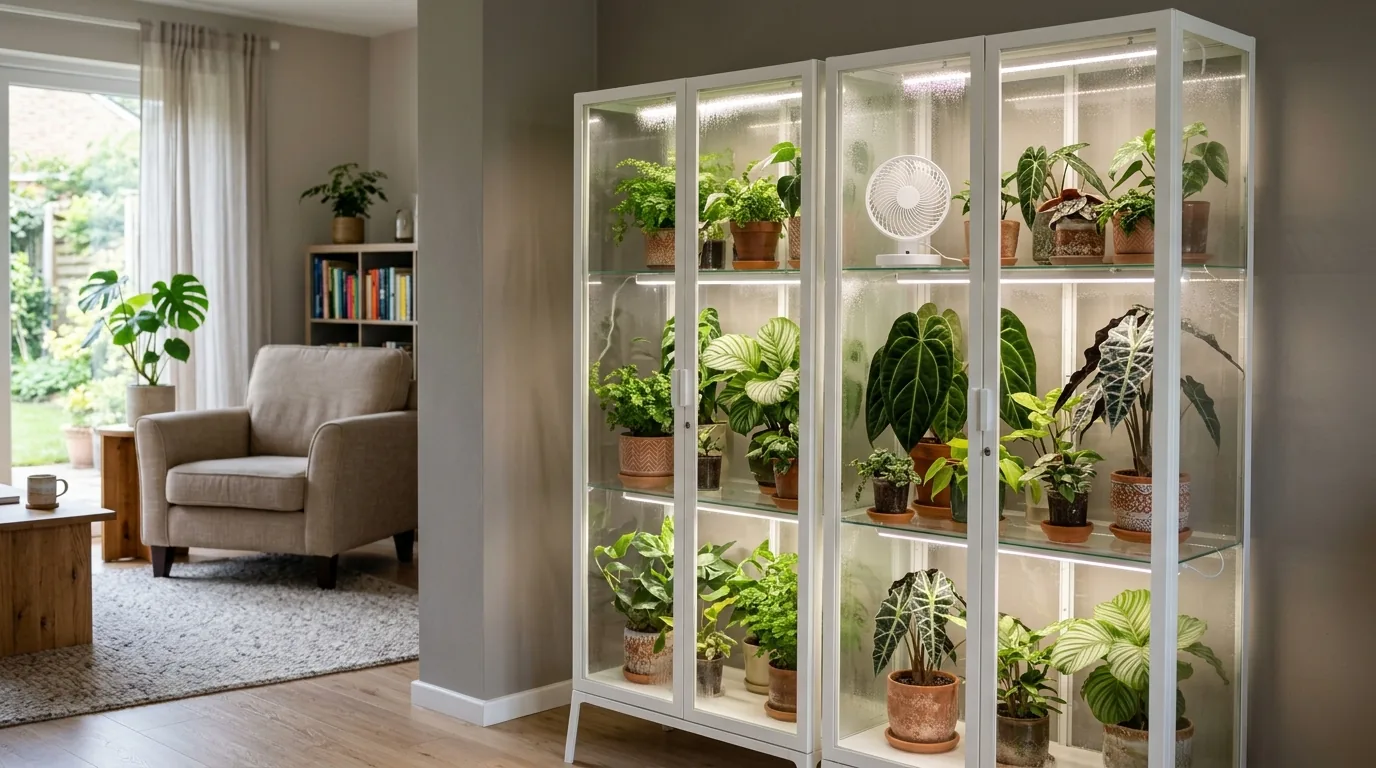
A greenhouse cabinet is a glass-fronted cabinet turned into a small indoor greenhouse: grow lights on a timer, a small fan, and enough enclosed air to hold the humidity that tropical plants miss in a heated home. It sits between a closed terrarium and an open shelf. This guide explains how to set up an indoor greenhouse cabinet with grow lights, why a greenhouse cabinet fan matters, what greenhouse cabinet humidity to aim for, and which greenhouse cabinet plants benefit, using University of Minnesota Extension lighting guidance and greenhouse humidity research from UMass and Michigan State. It is a planning guide, not a build log of a specific product.
What a Greenhouse Cabinet Does (and Doesn’t)
| Open shelf | Greenhouse cabinet | Closed terrarium | |
|---|---|---|---|
| Humidity | Room level | Raised, adjustable with doors and vents | Very high, sealed |
| Light | Window or lamp | Built-in grow lights on a timer | Bright indirect window light; no direct sun (Iowa State) |
| Air movement | Room air | Small fan | Almost none |
| Plant size | Any | Small to medium plants in pots | Small, slow plants |
| Main risk | Dry winter air | Stagnant, saturated air if not ventilated | Disease or algae from trapped humidity (Oregon State) |
Sources: Iowa State Extension; Oregon State Extension; Plant Blueprint comparison.
The point of a cabinet is control. A typical heated home in winter sits at about 70°F and 30 to 40% RH, which works out to a VPD of roughly 1.5 to 1.75 kPa, very drying for humidity-loving plants (see our VPD guide). A cabinet lets you raise humidity in one small space without making the whole room damp. What it doesn’t do is fix poor care: plants still need the right potting mix, watering and light. And because the air is enclosed, mistakes such as overwatering show up faster.
Choosing the Cabinet
Many people convert a glass display cabinet, the kind sold flat-packed for collections. Whatever you use, the features that matter are practical:
- Glass on at least the front so you can see the plants and light reaches the shelves.
- Doors that close but are not airtight. A cabinet needs some air exchange: UMass explains that venting moist air and replacing it with drier air is one of the main ways greenhouses reduce humidity-related disease.
- Shelves you can remove or space out, so lights can hang at the right distance above the plants (see the next section).
- A waterproof base: trays or a liner on each shelf to catch drips, since water standing on surfaces adds humidity and wood can swell.
- A way to run cords for the lights and fan without leaving doors propped wide open.
- A stable spot away from heating vents and out of direct sun. Iowa State warns that heat builds up quickly inside glass in direct sun.
Indoor Greenhouse Cabinet With Grow Lights
Inside a cabinet, grow lights usually do most of the work. The University of Minnesota Extension compares the options:
| Light type | Pros (UMN) | Cons (UMN) | For a cabinet |
|---|---|---|---|
| LED | Very energy efficient, long-lasting, wide spectrum, do not produce too much heat, many sizes | Higher up-front cost; bright light can be distracting | Best fit: low heat in a closed space |
| Fluorescent | Cheaper up front, moderately efficient | Shorter life, more energy than LED | Workable |
| Incandescent | Cheapest up front | Inefficient, create heat, far-red light causes stretching | Avoid |
| High-pressure sodium, metal halide | Lots of light over a wide area | Large, release a lot of heat | Avoid |
Source: University of Minnesota Extension, Lighting for indoor plants and starting seeds (reviewed 2026).
- Distance: UMN suggests 12 to 24 inches above foliage houseplants and 6 to 12 inches above flowering houseplants.
- Hours: use a timer. UMN gives 12 to 14 hours a day for foliage houseplants and 14 to 16 hours for flowering ones.
- Color: UMN says white or balanced light suits most plants at any stage of growth.
- Intensity: compare bulbs by PPF or PPFD rather than lumens, which UMN says are less relevant for plants. UMN puts medium light at 150 to 250 umol m-2 s-1, and notes that PPFD falls as plants get further from the source.
For choosing specific fixtures, see our guide to the best grow lights for indoor plants.
Greenhouse Cabinet Humidity: What to Aim For
Relative humidity alone can mislead, because warm air holds much more water than cool air. UMass notes that air at 70°F holds twice as much moisture as air at 50°F. That is why Michigan State University researchers recommend thinking in terms of vapor pressure deficit (VPD), the air’s actual drying power.
| Goal | Target | Source |
|---|---|---|
| Growing plants | VPD above about 0.5 kPa, so plants can transpire and foliar diseases are less likely | MSU (Wollaeger and Runkle 2015) |
| Rooting cuttings | VPD around 0.3 kPa to reduce drying | MSU |
| Disease warning | Above about 85% RH, water lingers on leaves and favors fungal pathogens | MSU |
| In practice for a growing cabinet | Roughly 60 to 75% RH at 70 to 75°F | Our VPD chart, based on MSU’s method |
Sources: Michigan State University Extension; Plant Blueprint VPD chart.
Use a digital hygrometer inside the cabinet to see where you are; UMass notes that humidity meters and pens are widely available. To raise humidity, close the doors more, add a tray of water and pebbles, or group plants. To lower it, open the doors or vents for a while and run the fan.
Why a Greenhouse Cabinet Fan Matters
The fan is what separates a healthy cabinet from a moldy one. UMass Extension explains that condensation forms on the coldest surfaces when they fall below the dew point, and that this moisture promotes fungal spores such as Botrytis and powdery mildew. Its key point for growers:
- Adequate air movement occurs when the leaves move slightly. The mixing prevents the air at the leaf surface from cooling below the dew point, so moisture does not condense on the leaves, which means less Botrytis.
- The highest humidity is usually inside the plant canopy, where moisture is trapped by insufficient air movement; spacing plants improves circulation.
- In very humid air the margin is tiny: UMass gives the example that at 95% RH and 60°F, condensation forms when a leaf is only one degree cooler than the air.
For a cabinet, that translates into a small, quiet fan running continuously (UMass recommends continuous running for greenhouse air-circulation fans), aimed to stir the air rather than blast the plants. If leaves flutter gently, the airflow is about right. Our VPD guide makes the same point: humid but not saturated, with air moving.
Setup Checklist
- Place the cabinet away from heating vents and direct sun.
- Line the shelves with trays to catch water.
- Mount LED lights under each shelf or at the top, 12 to 24 inches above foliage plants (UMN), and put them on a timer for 12 to 14 hours (UMN).
- Add a small fan that runs continuously and makes leaves move slightly (UMass).
- Add a hygrometer and watch it for a few days before adding plants.
- Adjust humidity with the doors and vents first; add trays of water only if it stays too dry.
- Add plants with similar needs, spaced so air can move between them (UMass).
- Water in the morning, so surfaces dry before the lights go off; UMass recommends watering early enough in the day for plant surfaces to dry before evening.
Greenhouse Cabinet Plants
The best candidates are plants that like warmth and humidity and do well in medium light, the level UMN describes for east windows or fluorescent-lit offices. Plants that need full sun, such as cacti, succulents and most flowering plants in UMN’s high-light list, are a poor match for a humid cabinet. Good fits from our guides include:
| Plant group | Why it suits a cabinet | Care guide |
|---|---|---|
| Velvet-leaved anthuriums | Humidity-loving foliage; see the guides for specifics | Anthurium crystallinum, Anthurium clarinervium |
| Calatheas and marantas | Humidity-loving foliage; see the guides for specifics | Calathea care, Maranta care |
| Alocasias | UMN lists alocasia (elephant ear) as a medium-light plant | Alocasia Black Velvet, Alocasia zebrina |
| Philodendrons | Velvet-leaved types often kept in humid setups; see the guides | Philodendron gloriosum, Philodendron micans |
| Small terrarium plants | On Iowa State’s closed-terrarium list but can outgrow jars | Nerve plant, begonias |
| Cuttings and acclimating plants | Low VPD (about 0.3 kPa) helps rooting (MSU) | Tissue culture acclimation, sphagnum propagation |
Sources: UMN Extension light categories; MSU Extension; individual Plant Blueprint care guides.
Group plants by need: a shelf of humidity lovers under the lights, and keep sun lovers and succulents outside the cabinet.
Problems and Fixes
| Problem | Likely cause | Fix |
|---|---|---|
| Glass streaming with condensation | Humidity too high, surfaces below the dew point (UMass) | Open doors or vents for a while; run the fan; water less |
| Gray fuzzy mold, spotted leaves | Botrytis or other fungi favored by wet leaves and still air (UMass, MSU) | Remove affected leaves, improve airflow, space plants, water in the morning |
| White powdery coating | Powdery mildew, which UMass lists with Botrytis among humidity-related diseases | More air movement, steadier humidity; remove badly affected leaves |
| Mushrooms or gnats in the pots | Constantly wet potting mix | See mushrooms in houseplant soil and getting rid of fungus gnats |
| Stretched, pale growth | Too little light (UMN) | Lower the lights toward 12 inches or extend the timer within UMN’s range |
| Bleached or scorched leaves | Too much light (UMN) or heat buildup | Raise the lights; check the temperature near the top shelf |
| Plants drying fast despite the cabinet | Doors open, VPD still high | Close the doors more and check the hygrometer |
| Spider mites | Pests moved in on a new plant | Isolate new plants first; see how to get rid of spider mites |
Sources: UMass Extension; MSU Extension; UMN Extension.
For other small indoor garden projects, see our guides to air plant care. For a bog plant that needs full sun and high humidity, see our guide to Venus fly trap care.
Frequently Asked Questions
What humidity should a greenhouse cabinet be?
For growing plants, MSU suggests a VPD above about 0.5 kPa and warns that air above about 85% RH favors fungal pathogens. In practice that is roughly 60 to 75% RH at 70 to 75°F. Rooting cuttings can go more humid, around 0.3 kPa.
Does a greenhouse cabinet need a fan?
Yes. UMass explains that air movement strong enough to make leaves move slightly keeps moisture from condensing on them, which reduces Botrytis. Run a small fan continuously.
How far should grow lights be from plants in a cabinet?
UMN suggests 12 to 24 inches above foliage houseplants and 6 to 12 inches above flowering houseplants, and recommends LEDs because they are efficient and do not produce much heat.
How many hours should grow lights be on in a greenhouse cabinet?
UMN gives 12 to 14 hours a day for foliage houseplants and 14 to 16 hours for flowering houseplants. Use a timer so the schedule stays consistent.
What plants are best for a greenhouse cabinet?
Plants that want warmth, high humidity and medium light, such as velvet-leaved anthuriums, calatheas and marantas, alocasias, velvet philodendrons, nerve plants and begonias, plus cuttings that are rooting. Keep cacti and succulents outside.
Why is my greenhouse cabinet growing mold?
Usually too much moisture and too little air movement. UMass says condensation on leaves promotes fungi such as Botrytis; open the doors for a while, run a fan, space the plants and water in the morning.
Do I need a humidifier in a greenhouse cabinet?
Often not. Closing the doors, grouping plants and adding a tray of water may raise humidity enough. Check with a hygrometer first, and only add a humidifier if it stays too dry.
Sources
- Weisenhorn, J. and Hoidal, N. University of Minnesota Extension: Lighting for indoor plants and starting seeds (reviewed 2026)
- UMass Amherst Extension Greenhouse and Floriculture: Reducing Humidity in the Greenhouse
- Wollaeger, H. and Runkle, E. (2015). Why should greenhouse growers pay attention to vapor-pressure deficit and not relative humidity? Michigan State University Extension
- Steil, A. Iowa State University Extension: How to Create and Care for a Terrarium
- Oregon State University Extension: Tiny gardens, big impact: how to make (and care for) a terrarium (2024)